My twin brother disappeared without a trace when we were fifteen.
For thirteen years, I lived with the belief that he had died somewhere in the woods surrounding a remote summer camp, carried away by the river we had been swimming in that night.
There was never a body.
Never a goodbye.
Never even a single piece of evidence that could tell us what had happened to him.
Then, one ordinary night, I walked into a roadside diner and saw him sitting alone in a back booth.
Older.
Thinner.
Exhausted.
But unmistakably Liam.
I barely managed to say his name before he grabbed my arm and whispered the words that turned thirteen years of grief into something far more frightening.
âYou shouldn’t have found me.â
I stared at him through tears.
âLiam?â
His eyes darted toward the entrance.
Then he leaned closer.
âI left to keep you alive.â
For most of our childhood, it had been Liam and me against the world.
We were twins, and people often joked that we seemed to share one mind.
We wore each other’s clothes.
Finished each other’s sentences.
Had the same friends.
And when one of us got into trouble, the other usually wasn’t far behind.
Then, thirteen years ago, everything changed.
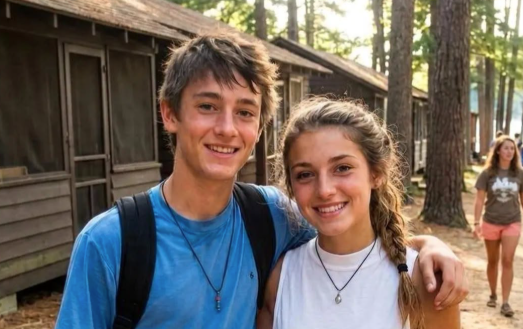
We were fifteen and spending July at a remote summer camp.
One evening, we slipped away from the other campers and walked down to the river.
It was something we had done before.
We laughed.
We pushed each other into the water.
We splashed around until the summer darkness began settling over the trees.
Then I turned away for only a few seconds to wipe water from my eyes.
When I looked back, Liam was gone.
There had been no scream.
No struggle.
No splash.
Nothing.
Just an empty stretch of dark water.
I shouted his name until my voice disappeared.
Camp counselors came running.
Then the police arrived.
For an entire month, search teams combed through the river and surrounding woods.
Divers searched underwater.
Dogs were brought in.
The riverbanks were examined.
Every trail was checked.
But they found nothing.
Eventually, authorities concluded that Liam had probably been caught in a powerful underwater current and pulled beneath the surface.
Without a body, we never got the kind of closure people imagine comes with losing someone.
My mother refused to stop searching.
She spent more than $40,000 over the years on investigators, travel, private searches and anything else that offered even the smallest possibility of an answer.
I kept Liam’s missing-person flyer.
I carried it through moves, jobs and relationships.
I became twenty-eight, but part of me remained fifteen years old, standing beside that river and waiting for my brother to come back.
Then, last night, everything changed.
I was driving late and decided to stop at a small diner just off the interstate.
The place was nearly empty.
A waitress stood behind the counter.
An old television played quietly above the bar.
And in the back corner sat a thin man drinking coffee alone.
I walked past his booth.
Then stopped.
Something about him made my entire body freeze.
His face was older.
His cheeks were hollow.
There were deep lines around his eyes, and he looked as though he had spent years living without enough sleep.
But his eyes were the same.
Gray.
Familiar.
Impossible.
I knew those eyes.
I knew the small scar above his eyebrow.
I knew the way his fingers tightened around his coffee cup when he was nervous.
My heart began pounding so hard that I could barely breathe.
I slowly turned around.
âLiam?â
The man’s hand froze.
He looked up.
For a moment, neither of us moved.
Then his face changed.
Recognition.
Fear.
Panic.
All at once.
âIs that really you?â I whispered.
He didn’t answer.
Instead, he reached across the table, grabbed my wrist and pulled me closer.
âYou shouldn’t have found me.â
I could barely speak.
âWhere have you been?â
His eyes moved toward the diner entrance.
âI left to keep you alive.â
Those words made no sense.
I sat across from him and demanded an explanation.
Liam told me he hadn’t drowned.
He had never even been in the river when I lost sight of him.
Someone had taken him away from the camp.
According to Liam, a relative he trusted had approached him that night and told him that our father had made enemies over money.
The man warned Liam that those people could hurt our family.
But, he said, there was one way to keep me safe.
Liam had to disappear.
He was fifteen.
He was scared.
And he believed the adult who was telling him that his sister’s life depended on his silence.
So he left.
He was given false names.
He moved from place to place.
He was told never to contact Mom or me.
Every so often, letters arrived through rented mailboxes.
They contained the same warning:
If Liam contacted his family, I could be put in danger.
For years, he believed those warnings.
But eventually, he began questioning them.
He started searching for information about us.
He found photographs online.
He discovered that Mom was still alive.
He learned that I had grown up, built a life and continued searching for him.
And still, he stayed away.
Not because he didn’t love us.
Because he had been convinced that coming home could get me killed.
Before we left the diner, Liam gave me an address.
Then he said something that stayed with me all night.
âWatch the people who kept telling you to move on.â
There was only one person who immediately came to mind.
Our Uncle Ray.
After our father’s death, Ray had handled many of the family’s legal and financial affairs.
He had always been the one telling Mom that she needed to accept reality.
He was the one who repeatedly told me to stop looking backward.
He said Liam was gone.
He said we couldn’t spend the rest of our lives chasing a ghost.
I had trusted him.
Until I remembered something.
Ray had stored several boxes of old family documents in Mom’s attic.
The following day, I went through them.
What I found made my hands shake.
There were altered signatures.
Old insurance documents.
A $750,000 life-insurance policy.
And paperwork that appeared to have been prepared before Liam had officially been declared legally dead.
Then I found the letters.
The handwriting looked familiar.
Too familiar.
I compared them with old documents from Ray.
The handwriting matched.
I called Liam.
That night, he brought me every letter he had kept for thirteen years.
We took everything to a family attorney.
The attorney compared the letters with insurance records, mortgage documents, estate filings and an investment account that Ray had controlled.
The picture that emerged was devastating.
According to the documents, Ray had taken advantage of his position as a trusted family member.
He had arranged insurance policies involving the twins, forged our mother’s approval on certain documents and eventually participated in the process that resulted in Liam being legally declared dead.
After the disappearance, insurance money was collected.
Some of the funds appeared to have been moved through property payments and private investments.
The boy we had spent thirteen years mourning had been alive the entire time.
And someone in our own family had worked to make sure we never found him.
The attorney told us not to confront Ray alone.
So we didn’t.
We arranged a family dinner.
Ray arrived believing it was simply another gathering.
Mom sat at one end of the table.
I sat beside Liam.
Ray walked into the room.
Then he saw my brother.
He stopped.
For several seconds, nobody spoke.
The attorney placed the documents on the table.
Insurance records.
Financial statements.
Letters.
Property documents.
Everything we had uncovered.
Ray immediately denied knowing anything about Liam’s disappearance.
Then Liam reached into his jacket and placed one final document on the table.
It was one of the original letters.
The handwriting was Ray’s.
And his initials were clearly visible.
Ray’s expression changed.
Mom stared at him.
Then she looked at Liam.
For thirteen years, she had believed her son was dead.
Now he was sitting across from her.
Alive.
Older.
But still her son.
She stood up and crossed the room.
Then she wrapped her arms around him.
She held him so tightly that I could see her hands shaking.
Liam began crying.
âIâm sorry,â he whispered.
Mom shook her head.
âYou were a frightened boy,â she told him. âYou were lied to.â
The authorities were notified.
The disputed insurance funds and estate accounts were frozen while the case was investigated.
There were questions about forged documents, financial transfers and the legal steps surrounding Liam’s disappearance and declaration of death.
But for our family, the most important thing wasn’t the money.
It was the fact that Liam was finally home.
The years had changed him.
He still checked the windows before going to sleep.
He kept a packed bag beside his bed.
He sometimes woke suddenly during the night, convinced he needed to leave.
Thirteen years of fear don’t disappear simply because someone finally tells you that you’re safe.
But slowly, things began to change.
A week after returning home, Liam finally unpacked the bag he had kept ready for thirteen years.
He put his clothes in the closet.
Then he placed an old photograph of the two of us on the dresser.
I took the missing-person flyer I had carried for all those years and folded it carefully.
For the first time, I put it away.
Not because those thirteen years didn’t matter.
Not because the grief suddenly disappeared.
And certainly not because we could somehow reclaim everything we had lost.
We couldn’t get back the birthdays.
The holidays.
The summers.
The ordinary teenage years we were supposed to experience together.
But we had something we hadn’t had in thirteen years.
A chance.
A future.
My twin brother was finally home.
And this time, there was no river, no false name and no family secret powerful enough to make me let him disappear again.