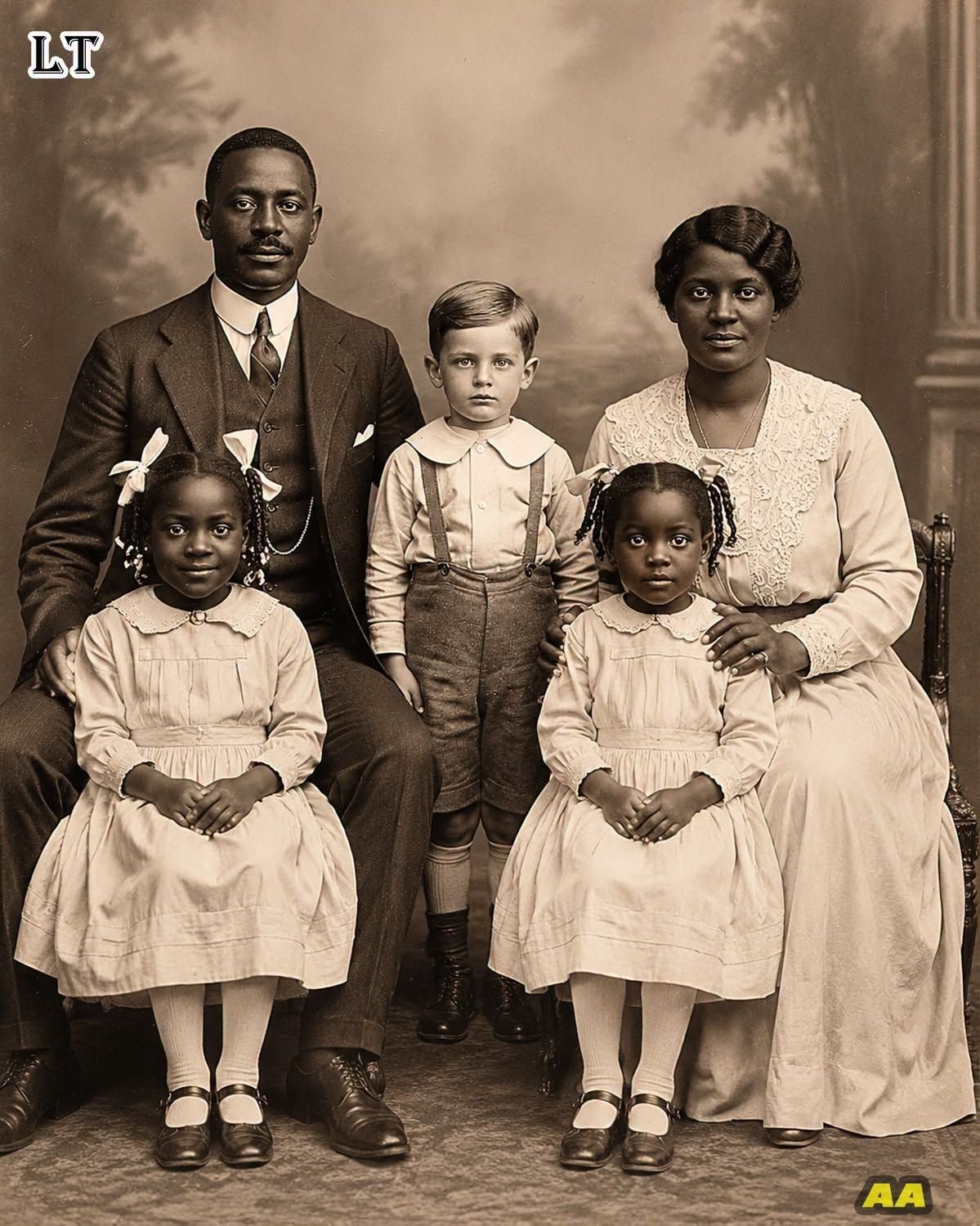
For nearly one hundred years, the photograph remained silent. It rested among forgotten documents, old family papers, and fragile records stored away in an archive where thousands of pieces of history waited for someone to notice them. The edges had faded with time. The paper had become thin and delicate. The faces captured inside the image belonged to another America, a country divided by laws, fear, and social boundaries that shaped almost every part of daily life. To most people who might have discovered it, the photograph would have seemed ordinary. Just another family portrait from the early twentieth century. But when genealogist James Mitchell opened the archive box in Greenwood, Mississippi, he immediately sensed something unusual. He had spent years studying forgotten family histories, tracing names through old census records, church documents, and handwritten letters. He knew that sometimes the smallest details revealed the biggest stories. A missing name. A changed address. A forgotten photograph. Those small pieces could completely rewrite what people believed about the past. But this image was different. The mystery was not hidden in the background. It was standing directly in front of the camera. The photograph was dated March 1920. In the center stood a Black family dressed in their finest clothing. The father wore a dark suit, his posture confident and proud. The mother sat beside him with a quiet strength, her hands carefully folded in her lap. Their daughters stood nearby in white dresses, their hair decorated with ribbons. And between them stood a young boy who seemed impossible to explain. He was white. His skin was pale. His hair was light and wavy. His eyes appeared bright even through the faded sepia image. Yet what fascinated James most was not the difference in appearance. It was the way the family stood together. The Black man’s hand rested gently on the boy’s shoulder. The child did not look afraid. He did not look uncomfortable. He looked like he belonged. Like he was home.
THE CHILD WHO DID NOT EXIST IN THE RECORDS
James carefully turned the photograph over, hoping the back might reveal the answer. Written in faded pencil were five names: Samuel, Clara, Ruth, Dorothy, and Thomas. Below them was the date: March 14th, 1920. The names immediately became the beginning of an investigation. James copied every detail into his notebook. He searched for Samuel Johnson and Clara Johnson first. The records showed that Samuel was a respected carpenter in the Greenwood community. He owned his own home, worked steadily, and was known as a reliable man. Clara earned income through sewing and was remembered as someone who helped neighbors whenever she could. Their daughters, Ruth and Dorothy, appeared in official documents as well. Everything matched. Everything except Thomas. There was no record of a white child living with the Johnson family. No birth certificate. No adoption document. No newspaper article. No mention anywhere. The boy seemed to exist only inside the photograph. James knew immediately that the mystery went beyond genealogy. Mississippi in 1920 was a dangerous place for a Black family to cross racial boundaries. The Jim Crow era shaped everyday life through segregation and discrimination. A photograph showing a Black family openly embracing a white child was not simply unusual. It could attract suspicion, hostility, and violence. James brought the image to an elderly archivist named Mrs. Patterson, hoping she might recognize the faces. The moment she saw it, her expression changed. She quietly identified the couple as Samuel and Clara Johnson. Then she paused when she saw the boy. “There are stories,” she said. Stories that people had stopped repeating. Stories that survived only through whispers. Before James left, she gave him one name: Evelyn Price. She was ninety-three years old, and her mother had known the Johnson family personally. James realized that the answer might not be hidden in official documents. It might be hidden in the memories of people who carried the past with them.
THE FIRE THAT CHANGED ONE CHILD’S LIFE
That night, James continued searching through historical records. He started with the 1920 census. Samuel Johnson was listed. Clara Johnson was listed. Their daughters were listed. But again, there was no Thomas. Then he searched newspapers from early 1920. That was when he found a story that changed the direction of his investigation. On February 3rd, 1920, a local newspaper reported a devastating house fire. Robert Hayes and his wife Margaret had died. The article mentioned that they left behind a young son. A six-year-old boy. James looked back at the photograph. The age was almost identical. The timeline was almost impossible to ignore. Six weeks after the Hayes family tragedy, Thomas appeared in the Johnson family portrait. James continued digging. He discovered that orphaned children in the region were often sent to institutions that were supposed to provide care and protection. But historical reports from similar facilities during that period revealed overcrowding, poor conditions, and children who were sometimes forgotten by the system. Some disappeared from public records. Some were moved without documentation. James began wondering if Thomas had been one of those children. A boy left without parents. A child whose future depended entirely on whether someone was willing to step forward. Then he returned to the photograph. Suddenly, the meaning of Samuel’s hand on Thomas’s shoulder changed completely. It was no longer just a fatherly gesture. It was an act of protection. It was a statement. In a society that often told people where they belonged and who they could care for, Samuel and Clara had made a choice that carried enormous risk. They had chosen a child.
THE FAMILY WHO CHOSE LOVE OVER FEAR
When James finally met Evelyn Price at Magnolia Gardens, he brought the photograph with him. The elderly woman held it carefully in her hands. For a long moment, she said nothing. Then she whispered the names of the people she remembered. Samuel and Clara Johnson. Her voice carried the weight of decades. She remembered them not as names in a record but as real people. She remembered their kindness. She remembered the way neighbors talked quietly about the unusual situation. She remembered the fear surrounding the family. Then she told James what official records never captured. Thomas Hayes had lost his parents in the fire. He had been found alone near the remains of his home, waiting for someone to decide where he would go. Authorities planned to send him away. But Samuel Johnson could not walk away from a child who had already lost everything. He went home and told Clara what had happened. They already had two daughters. They understood the danger. They knew what people might say. They knew that in Mississippi in 1920, a Black family taking responsibility for a white child could bring serious consequences. But Clara made her decision. She believed a child’s need was more important than society’s rules. Thomas came into their home. He became part of their family. He ate at their table. He grew up with their daughters. He was no longer just a boy abandoned by tragedy. He was a son. The Johnson family did not have power. They did not have wealth. They could not change the world around them. But they could change one child’s world.
THE PHOTOGRAPH THAT BECAME A MESSAGE TO THE FUTURE
James still wondered why Samuel and Clara had allowed the photograph to be taken. They understood the risks. They knew someone could misunderstand. They knew the image could create questions. Evelyn answered that question with a simple explanation. Samuel wanted proof. He wanted the world to know that Thomas had been loved. He wanted a record that could survive even if the family could not explain themselves. The photograph was not just a portrait. It was a message. It said that this child belonged somewhere. It said that someone had chosen him. It said that family was not always defined by appearance, blood, or the expectations of society. The image represented courage in a quiet form. There was no speech. No public protest. No newspaper announcement. Just a family standing together and refusing to hide their love. James continued searching through archives, hoping to understand how long the secret had survived. Then he discovered something unexpected. A church archive contained references to Thomas. Not directly at first. Just small mentions. A child attending community events. A young man helping neighbors. A name appearing beside the Johnson family. Slowly, another truth emerged. Samuel and Clara were not the only people protecting Thomas. Their community knew. They understood. And for decades, they kept the story safe.
THE BOY WHO CONNECTED TWO FAMILIES
As James continued piecing together Thomas’s life, the photograph became more than an unexplained historical mystery. It became the beginning of a much larger story about compassion, courage, and the meaning of family. Thomas grew up carrying two histories. He carried the memory of his birth parents, Robert and Margaret Hayes, whose lives ended tragically. But he also carried the love of Samuel and Clara Johnson, the people who opened their home when he had nowhere else to go. The world around him was complicated. The era he lived in was filled with division and injustice. Yet inside one household, a different story existed. A story where a child was judged not by race or circumstance, but by whether he needed someone. The Johnson family could not erase the challenges of the world. They could not prevent every hardship Thomas would face. But they gave him something powerful. Stability. Belonging. A place where he was seen as a person. The photograph preserved that truth. It captured a moment when a family chose humanity over fear. And decades later, when James discovered it, the image finally spoke again.
THE SECRET THAT SURVIVED BECAUSE SOMEONE CHOSE LOVE
Nearly a century after the photograph was taken, James Mitchell held an image that had waited decades to reveal its meaning. At first glance, it appeared to be a simple family portrait. But hidden inside were questions about race, family, courage, and the choices ordinary people make during extraordinary times. The little boy who stood between Samuel and Clara Johnson was not a mystery anymore. He was Thomas Hayes. A child who lost everything and found a family when he needed one most. The photograph survived because someone believed the truth was worth preserving. Samuel and Clara could not know who would eventually discover it. They could not know that decades later, a historian would study the image and uncover the story behind it. But perhaps they understood something more important. They understood that love leaves evidence. Sometimes it survives in letters. Sometimes in memories. Sometimes in a faded photograph hidden inside an old archive box. And sometimes, after seventy years of silence, one image is enough to remind the world of a simple truth: family is not only created by who we are born to. Sometimes it is created by the people who choose to stand beside us when we need them most.