July 1936 was not an ordinary summer.
Across large parts of the United States, temperatures climbed to extraordinary levels, turning streets, farms, factories, and homes into places of unbearable heat.
The country was already experiencing one of the most difficult periods in its history.
The Great Depression had left millions unemployed or struggling to survive. Families stretched every dollar, farmers faced mounting debts, and many communities were still recovering from years of economic hardship.
In the Great Plains, the Dust Bowl had damaged farmland and livelihoods.
Drought and extreme temperatures made conditions even worse.
Then the heat intensified.
In some parts of the country, temperatures exceeded 110°F. Several states recorded temperatures above 120°F during the summer.
The National Weather Service recognizes July 1936 as one of the most extraordinary periods of widespread extreme heat in American weather history.
But numbers alone cannot capture what those days felt like.
Imagine waking before sunrise and discovering that the air was already hot.
Imagine opening every window in your home, only to find that the breeze offered no relief.
Imagine working all day under the blazing sun and returning to a bedroom that still held the heat of the afternoon.
For many Americans, that was daily life during the summer of 1936.
There were no smartphones delivering hourly heat warnings.
Modern cooling centers did not exist on today’s scale.
And residential air conditioning was still a luxury beyond the reach of most families.
People had to find their own ways to endure.
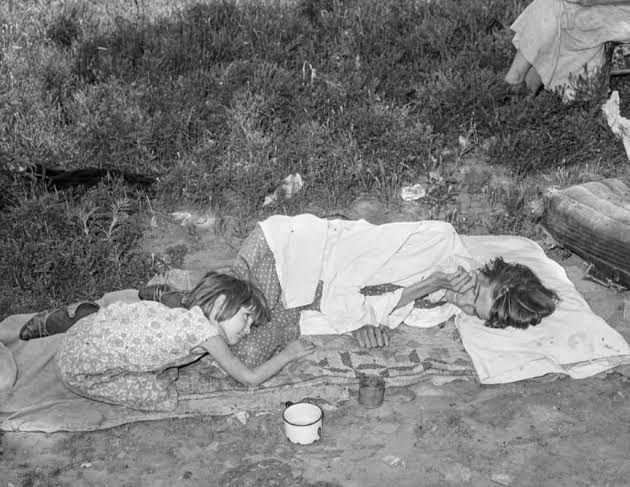
For thousands, the answer was to abandon their bedrooms and sleep outdoors.
2. When Bedrooms Became Too Hot to Sleep In
During the 1930s, many American homes had little protection against prolonged extreme heat.
Air conditioning technology already existed, but it was uncommon in ordinary residences.
Electric fans were available, although not every household owned one or could afford the electricity.
Many people relied on open windows, shaded porches, hand fans, and whatever breeze the evening might provide.
During an ordinary summer, those methods could offer some comfort.
But the heat wave of 1936 was different.
The temperatures remained dangerously high for days, and in some places nighttime brought little relief.
Buildings absorbed heat throughout the afternoon and released it slowly after sunset.
Upper-floor apartments could become especially uncomfortable.
In crowded urban neighborhoods, families struggled to find a cool place to rest.
Sleep became difficult.
Children cried through the night.
Older adults and people with existing medical conditions faced particularly serious risks.
For those who worked long hours in factories or on farms, the lack of rest added to their exhaustion.
Eventually, many families decided that remaining indoors was worse than sleeping outside.
They carried mattresses, pillows, blankets, and folding cots into yards, parks, and other open spaces.
Some slept on porches or fire escapes.
Others gathered on lawns, hoping that the open air might be slightly cooler than their bedrooms.
The sight was extraordinary.
Entire groups of neighbors lay side by side beneath the night sky.
There were no hotel reservations or summer vacations involved.
These were ordinary families searching for relief from dangerous heat.
The photographs that survive from this period are powerful because they reveal how quickly everyday life could change when the weather became unbearable.
3. The Heartbreaking Photographs of Families Sleeping Under the Stars
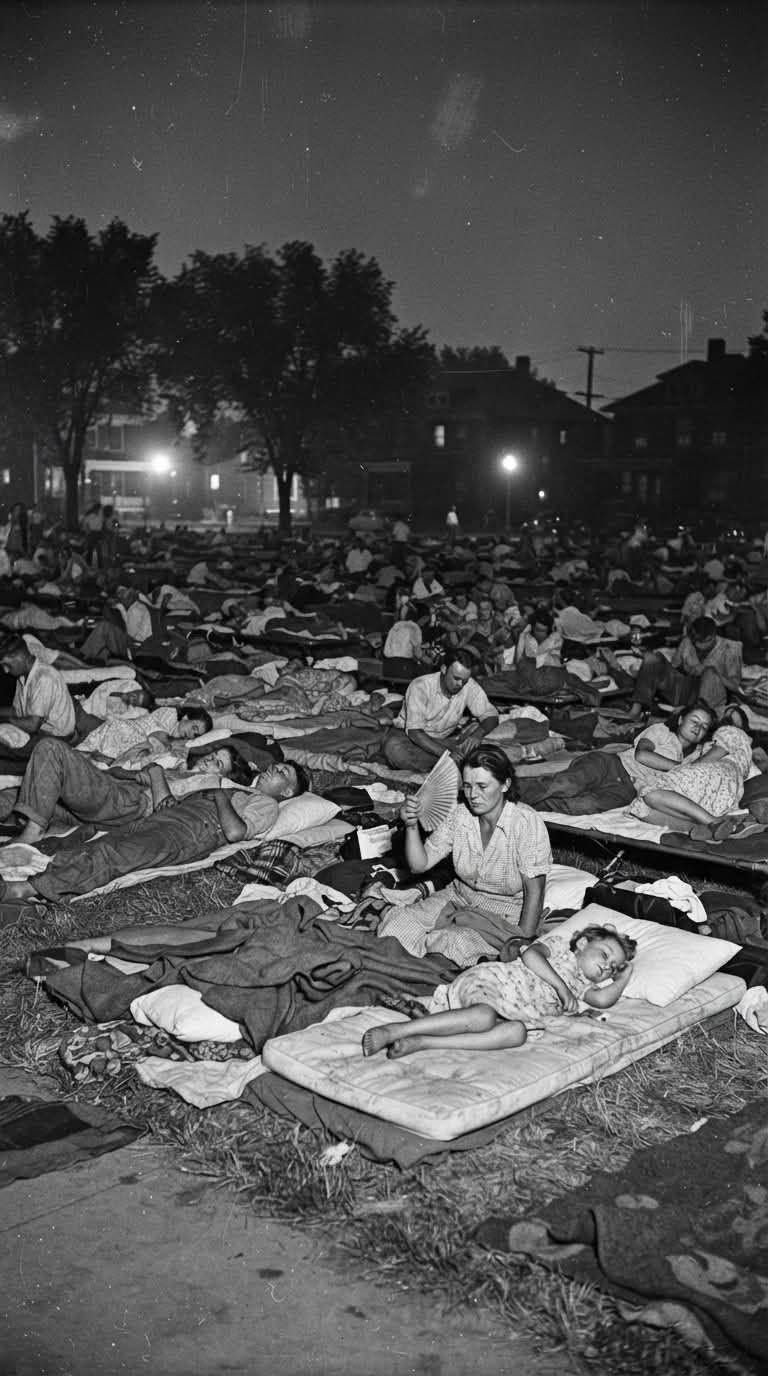
One of the most memorable visual records associated with the 1936 heat wave shows a crowded outdoor sleeping area.
Mattresses cover the ground.
Men lie beside their belongings.
Women sit near sleeping children.
Some people appear exhausted, while others remain awake, apparently hoping the night will finally become more comfortable.
In the foreground of the photograph provided here, a woman sits with a fan beside a young child resting on a mattress.
Behind them, dozens of other people occupy nearly every available space.
The image captures a remarkable scene of communal endurance.
It also invites us to consider what might have happened before the photograph was taken.
Families may have spent hours trying to cool their homes.
Parents may have opened windows, carried water, or moved bedding from room to room.
Eventually, they brought their sleeping arrangements outdoors.
The people in the picture are not participating in a celebration.
They are attempting to rest under difficult circumstances.
There is something especially moving about the presence of children.
Young children depend on adults to recognize danger and provide protection.
During a prolonged heat wave, parents could do everything available to them and still struggle to keep their homes comfortable.
A mother using a handheld fan might offer only temporary relief.
But sometimes that small gesture represented the best option available.
The photograph reminds us that history is not only found in presidential speeches, wars, and major political events.
It is also preserved in ordinary moments of human survival.
A blanket spread on the ground.
A child sleeping beside a parent.
A family choosing an unfamiliar place to spend the night because home had become too hot.
These details reveal the human experience behind the weather records.
Although the supplied caption identifies the scene with St. Louis or Lincoln, Nebraska, the exact location, photographer, and date of this particular image have not been independently established here.
What the image illustrates, however, is consistent with documented accounts of Americans sleeping outdoors during the extreme heat of the 1930s.
4. St. Louis, Nebraska, and the Nights That Offered No Escape
The summer of 1936 brought extraordinary temperatures to both cities and rural communities.
St. Louis, Missouri, experienced a particularly severe heat emergency.
During July, the city endured prolonged high temperatures, with heat-related deaths mounting as the crisis continued.
The extreme conditions affected people in crowded neighborhoods, especially those living in poorly ventilated housing.
For many residents, relief was difficult to find.
Public parks, shaded areas, and outdoor spaces became places where people could gather after sunset.
But the heat did not always disappear when the sun went down.
That was one of the most dangerous aspects of the event.
When nighttime temperatures remain unusually high, the human body has less opportunity to recover from daytime heat exposure.
For vulnerable individuals, prolonged heat stress can become life-threatening.
Nebraska also experienced remarkable temperatures.
On July 24, 1936, Minden, Nebraska, recorded 118°F, one of the state’s highest officially recognized temperatures.
Other communities across the Great Plains experienced similarly extreme conditions.
The original account accompanying this photograph describes a Nebraska night when the temperature supposedly never fell below 91°F.
Such warm nights are meteorologically possible, but that specific observation would need to be checked against local weather records before being presented as a verified historical measurement.
Regardless of the exact nighttime minimum, the broader reality was severe.
People faced repeated days of extreme heat with limited cooling options.
Livestock suffered.
Water supplies came under pressure in drought-stricken areas.
Farmers watched crops struggle in the dry soil.
Families who were already financially vulnerable faced another crisis they could neither predict nor easily escape.
The heat wave did not affect everyone equally.
People with money had more options for finding relief.
Poorer families often had to endure dangerous conditions in their existing homes or seek whatever public space was available.
That inequality remains an important part of understanding the disaster.
5. The Deadliest Heat Wave in American History
The 1936 North American heat wave is widely remembered as one of the deadliest weather disasters in United States history.
Historical estimates commonly attribute approximately 5,000 deaths nationwide to the extreme heat, although totals vary depending on the sources and methods used.
The true number is difficult to determine with precision.
In the 1930s, heat-related deaths were not always identified or recorded in the same way they are today.
A person who died from heart failure or another medical complication during extreme heat might not have been officially counted as a heat victim.
As a result, historical death totals can underestimate the full impact of such disasters.
The heat wave also extended beyond the United States into Canada, where numerous communities experienced extraordinary temperatures and fatalities.
Its consequences were widespread.
In cities, residents struggled with overheated buildings and limited ventilation.
On farms, crops and livestock were exposed to prolonged drought and heat.
For workers performing physical labor outdoors, the conditions were particularly hazardous.
And for children, older adults, and people with certain health conditions, the lack of reliable cooling increased the danger.
The crisis exposed how vulnerable communities could become when extreme weather continued for weeks.
Unlike a tornado or earthquake, a heat wave does not necessarily leave behind dramatic scenes of destruction.
Buildings may remain standing.
Roads may appear unchanged.
But the consequences can be devastating.
The danger is often invisible until people begin collapsing, falling ill, or dying.
That is why extreme heat has sometimes been underestimated as a natural disaster.
The summer of 1936 demonstrated that prolonged high temperatures could claim thousands of lives without destroying a single city skyline.