Kicked Out With Two Kids, She Found a Sealed Cellar No One Had Opened in Years — It Held Everything
The wind screamed across the mountain pass like a living thing.
Emma Carter pulled her coat tighter around her shoulders and kept walking.
Snow crunched beneath her worn boots as she dragged the old wooden sled behind her. Two children stumbled through the deep snow at her heels, holding onto the frayed rope tied to the back.
“Mom,” eight-year-old Caleb whispered through chattering teeth, “are we gonna die out here?”
Emma stopped.
The question cut deeper than the cold.
She turned and knelt in the snow, brushing frozen strands of hair from his face. Beside him, little Rosie—only five—was so exhausted she could barely keep her eyes open.
“No,” Emma said firmly, though her own body trembled from fear and exhaustion. “We’re not dying. We keep moving, understand? God didn’t bring us this far to leave us here.”
But secretly, she wasn’t sure.
Three days earlier, she’d had a home.
Not a good one. Not a happy one. But it had walls, heat, and food.
Then Richard had thrown her out.
Her husband of eleven years had stood in the doorway of their farmhouse in Montana, arms crossed while snow fell behind her.
“You’re useless,” he’d spat. “You and those kids eat everything and contribute nothing.”
Emma had stared at him in disbelief.
She’d cleaned his house. Raised his children. Cooked every meal. Worked his father’s land beside him when the hired men quit. But ever since the mine shut down the year before, Richard had changed. The drinking got worse. The rage got worse.
And then came the woman from town.
Emma had known long before he admitted it.
“Please,” she’d whispered that night. “At least let the kids stay until morning.”
Richard tossed her a canvas bag.
Inside were two blankets, stale bread, and a flashlight.
“That’s more than you deserve.”
Then he slammed the door.
Emma would remember the sound for the rest of her life.
Now, three days later, the mountains stretched endlessly around them beneath a darkening sky.
The old mining trail they’d followed had nearly disappeared beneath fresh snow. Emma had hoped to reach the next town before the storm worsened, but the mountains had swallowed every landmark.
The cold was becoming dangerous.
Rosie stumbled suddenly.
Emma caught her before she fell face-first into the snow.
“I can’t walk anymore,” the little girl whimpered.
Emma’s heart twisted.
She lifted Rosie onto the sled beside the small bundle of blankets. Caleb lowered his head and kept pulling the rope.
The boy never complained.
That hurt worst of all.
The wind howled harder as daylight began fading into blue-gray dusk.
Then Caleb froze.
“Mom.”
Emma looked up.
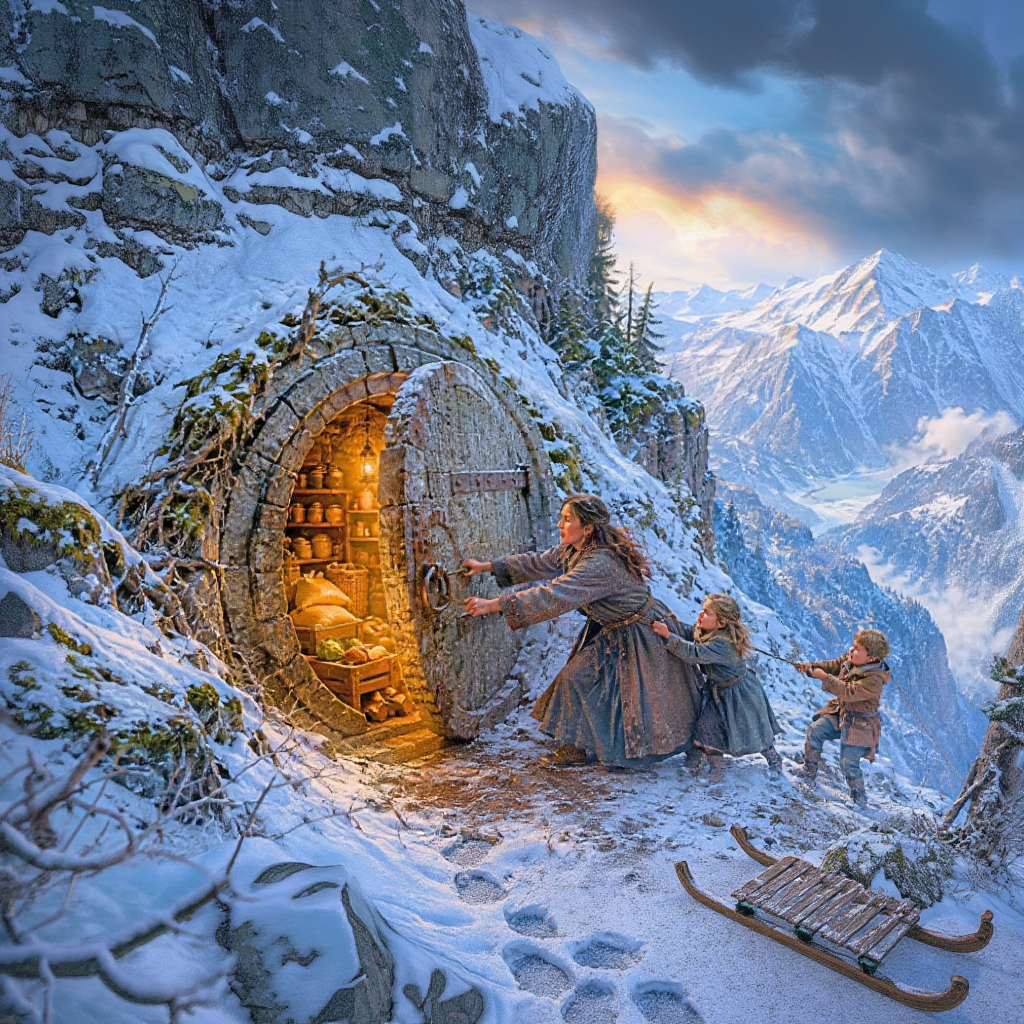
At first, she thought the mountain face ahead was just another wall of rock buried in snow.
Then she saw it.
A circle.
Perfectly round.
Half-hidden beneath ice and drifting snow.
A stone doorway.
Emma blinked hard, wondering if exhaustion was making her hallucinate.
The door looked ancient—built directly into the mountainside like something from a fairy tale. Thick stones surrounded a heavy wooden center reinforced with iron bands blackened by time.
Snow-covered footprints led nowhere near it.
No smoke.
No signs of life.
Yet somehow… it didn’t look abandoned.
Golden light barely glowed around the edges of the doorframe.
Emma’s pulse quickened.
“Stay behind me,” she whispered.
They approached carefully.
The mountain towered above them, jagged peaks glowing silver beneath the last rays of sunlight. Wind swept snow across the rocky slopes while long shadows crawled over the valley below.
The closer Emma got, the stranger the place felt.
The iron handle was free of ice.
As if someone had touched it recently.
She swallowed hard and grabbed it.
The door didn’t budge.
Emma braced both boots against the stone and pulled harder.
Still nothing.
Then Caleb stepped beside her silently.
Together they strained against the frozen wood.
With a deep groan, the massive round door suddenly cracked open.
Warm air exploded outward.
Emma gasped.
The smell hit first.
Wood smoke.
Bread.
Dried herbs.
Life.
Golden light poured into the snow, illuminating the children’s stunned faces.
Inside lay a cellar unlike anything Emma had ever seen.
Shelves lined the curved stone walls from floor to ceiling. Jars of preserved vegetables gleamed amber beneath lantern light. Bundles of dried meat hung from beams overhead. Firewood stood stacked neatly beside a cast-iron stove that still radiated warmth.
Blankets.
Candles.
Tools.
Flour sacks.
Water barrels.
Everything.
Rosie stared wide-eyed.
“Mommy…”

Emma stepped inside cautiously, her boots echoing softly against stone floors.
Someone had built this place carefully. Lovingly.
It wasn’t just storage.
It was survival.
A long wooden table stood in the center of the room beside three sturdy chairs. Dust covered some surfaces, but not enough for decades of abandonment.
On the table rested a single oil lamp and a folded note.
Emma’s fingers shook as she opened it.
If you found this place in winter, you probably need it more than I do.
Stay warm.
Take what you need.
Leave what kindness you can behind.
No signature.
Emma sat down abruptly.
For the first time in days, her body stopped fighting.
And suddenly she cried.
Not soft tears.
Violent, shaking sobs that seemed pulled from somewhere deep inside her chest.
The children rushed into her arms.
They held each other while snowstorm winds screamed harmlessly outside the thick stone walls.
That night, they slept beside the glowing stove beneath heavy wool blankets.
And for the first time in years, Emma slept without fear.
Morning came quietly.
Golden sunlight filtered through a narrow crack high in the stone ceiling, illuminating tiny floating dust particles.
Emma woke to the smell of warmth and pine.
For several blissful seconds, she forgot everything.
Then reality returned.
The mountain.
The storm.
Richard.
But this time, something felt different.
She wasn’t helpless anymore.
Caleb sat near the stove carefully feeding pieces of wood into the fire exactly as she’d taught him.
“You let Mommy sleep,” Emma said softly.
The boy shrugged.
“You looked tired.”
She kissed the top of his head.
Rosie still slept soundly beneath blankets, cheeks pink from warmth instead of frostbite.
Emma explored the cellar more carefully after breakfast.
The place extended farther into the mountain than she first realized.
Behind the main room were narrow stone corridors leading to storage chambers carved directly into the rock. One room held tools—axes, lanterns, ropes, pickaxes. Another contained preserved food carefully labeled by year.
Most surprising of all was a hidden sleeping chamber with two bunks built into the wall.
Whoever created this place had planned for long winters.
Very long winters.
Near the back chamber, Emma discovered something else.
Books.
Dozens of them.
Journals, maps, farming guides, survival manuals.
And one leather-bound diary.
The first page read:
Property of Elias Bennett, Winter of 1978.
Emma sat beside the lantern and began reading.
Elias Bennett had been a miner.
According to the diary, an avalanche destroyed the nearby mining settlement nearly fifty years earlier. After losing his wife and son in the disaster, Elias abandoned the town and disappeared into the mountains.
Everyone assumed he died.
But he hadn’t.
He built this hidden cellar instead.
Year after year, he stocked it with food and supplies, preparing for travelers who might one day face the same deadly storms that took his family.
One passage made Emma stop breathing.
The mountain doesn’t care if you’re rich or poor. Good or bad. It takes people all the same. So if I can save even one family from freezing out there, maybe their children get the future mine never did.
Emma closed the diary slowly.
The old miner had spent decades building hope inside a mountain.
And somehow, after all these years, it had found her.
Days passed.
The storm worsened outside, trapping them completely.
But inside the cellar, life slowly returned.
Emma cooked soup from preserved potatoes and dried venison. Caleb learned how to chop wood safely. Rosie explored every corner like it was a magical castle.
For the first time in years, the children laughed freely.
No shouting.
No fear.
No smashed bottles or slammed doors.
Only warmth.
One evening Caleb spoke quietly while staring into the fire.
“Do we have to go back to Dad?”
Emma’s chest tightened.
“No.”
The boy looked up quickly.
“Really?”
She nodded.
“We’re never going back.”
Silence filled the room.
Then Caleb began crying silently.
Emma wrapped her arms around him immediately.
“I tried so hard,” he whispered brokenly. “I tried not to make him mad.”
Emma felt something inside her break completely.
“Oh baby… none of that was your fault.”
Rosie crawled into Emma’s lap too.
The three of them stayed there beside the fire while snow buried the mountain outside.
That night, Emma made a promise.
She would never allow another man to make her children feel unwanted again.
Never.
By the second week, the weather finally cleared.
Emma climbed outside cautiously at sunrise.
The storm had transformed the mountains into glittering white giants beneath a brilliant golden sky. Endless snowfields sparkled in every direction.
And from the ridge above, she saw smoke.
A town.
Far in the valley below.
Hope surged through her.
They could leave.
Start over.
Yet strangely, Emma hesitated.
She turned back toward the round stone door built into the mountain.
The cellar had saved them.
More than that—it had changed them.
Inside those stone walls, Emma had remembered who she used to be before fear consumed her life.
Strong.
Capable.
Needed.
That evening, while organizing supplies, she discovered another surprise hidden beneath a loose floorboard.
Money.
Bundles of cash sealed carefully inside metal tins.
Not millions.
But enough.
More than enough to rent a small place in town and survive until she found work.
Beside the money sat one final note in Elias Bennett’s rough handwriting.
If you found this, it means the mountain spared you.
Use this place wisely.
And when you’re strong again, leave the door unsealed for the next soul who needs saving.
Emma stared at the words for a long time.
Then she smiled through tears.
Spring arrived slowly in the valley below.
The town of Alder Ridge was small but alive—full of lumber workers, shopkeepers, ranchers, and tired people trying to survive hard winters.
Emma rented two tiny rooms above a bakery using part of the money from the cellar.
She found work almost immediately.
People trusted her quickly because she worked harder than anyone else.
Caleb started school.
Rosie made friends.
And little by little, life stopped feeling like survival.
Then one afternoon, nearly six months later, someone knocked on the bakery door.
Emma opened it and froze.
Richard stood outside.
Thinner than before.
Unshaven.
Angry.
“You took my kids.”
Emma looked him dead in the eye.
“No. You threw us away.”
People nearby turned to watch.
Richard stepped closer.
“You think you can survive without me?”
Emma almost laughed.
Because for the first time, she realized the truth.
She already had.
“I know I can.”
Something in her voice made him pause.
He glanced around at the busy bakery, the warm lights, the children laughing upstairs.
Then he looked back at her—and finally understood he no longer controlled her.
Richard left without another word.
Emma closed the door calmly.
And that was the last time she ever saw him.
Years later, travelers passing through the mountains sometimes spoke about a strange round door hidden in the snow.
Some called it a myth.
Others swore it appeared only for desperate people.
But every winter, fresh firewood somehow appeared beside the stove.
Shelves remained stocked.
Blankets stayed folded neatly near the beds.
And if frightened strangers arrived half-frozen at the mountain door, they always found a warm lantern waiting inside.
Along with a handwritten note resting on the table.
If you found this place in winter, you probably need it more than I do.
Stay warm.
Take what you need.
Leave what kindness you can behind.
— Emma Carter