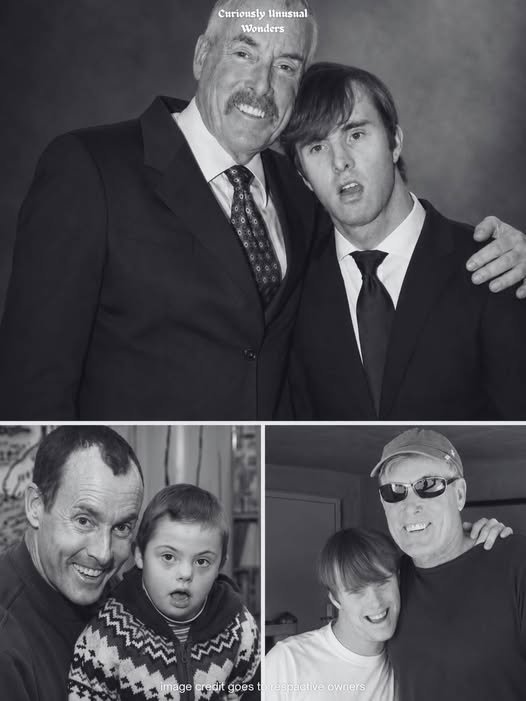
In 1997, when actor John C. McGinley and his wife welcomed their son Max into the world, they entered a moment that would quietly reshape the entire course of their lives. Max was born with Down syndrome, a genetic condition that, for decades, had been misunderstood, stigmatized, and too often hidden from public view. For many families in Hollywood—an industry built on image, perfection, and perception—the pressure to stay silent would have been immense.
Not long after Max’s birth, John’s talent agent pulled him aside. The message was framed as practical career advice, delivered in the calm tone of someone who believed they were protecting him.
Don’t talk about this publicly. Keep it private. People will stop hiring you.
In that moment, the industry’s unspoken rules were made explicit: vulnerability was a risk, difference was a liability, and silence was the safest strategy.
John C. McGinley did not hesitate.
He fired the agent.
That decision, simple on the surface, marked the beginning of a journey that would extend far beyond Hollywood. It would become a decades-long commitment to visibility, advocacy, and the radical act of refusing to hide what the world had historically been taught to ignore.
This is not just a story about an actor and his son. It is a story about what happens when a father decides that love is not something to be concealed—and when one family’s private truth becomes a public force for change.
A DIFFERENT KIND OF BEGINNING
John C. McGinley had already built a successful acting career by the late 1990s. Known for his sharp intensity, quick wit, and commanding presence on screen, he was carving out a reputation as a versatile performer in both comedy and drama. Hollywood, however, is an industry that often demands control—control over image, narrative, and perception.
Max’s birth disrupted that illusion of control in the most human way possible.
Down syndrome, a naturally occurring chromosomal condition, is often accompanied by developmental differences and unique learning patterns. But what society frequently fails to see is the individuality that exists within those differences. In 1997, public understanding was still catching up to medical knowledge. Misconceptions were widespread. Many families were advised—directly or indirectly—to stay quiet.
The agent’s warning was not unusual for the time. It reflected a deeper cultural discomfort: the belief that visibility of disability might somehow diminish success, attractiveness, or marketability.
But John saw something else entirely.
He saw his son.
Not a condition. Not a complication. Not a limitation.
A child.
And that distinction would define everything that followed.

THE MOMENT SILENCE WAS REJECTED
When John fired his agent, it wasn’t a symbolic gesture. It was a line being drawn with absolute clarity.
From that moment forward, Max would not be hidden.
Instead of retreating from public life, John began bringing his son into it. Red carpets, interviews, film sets, and industry events became spaces where Max was not excluded but included. At a time when many children with Down syndrome were still kept away from public visibility, John made a different choice: he normalized presence.
He did not present Max as a cause. He did not frame him as inspiration. He simply included him.
And in doing so, he challenged something far bigger than Hollywood expectations. He challenged the idea that difference should be managed behind closed doors.
There is a quiet but powerful shift that happens when visibility replaces concealment. People begin to adjust not because they are told to, but because they are shown a new reality repeatedly enough that it becomes normal.
That is what John began to do—without speeches, without campaigns at first, just through presence.
Max was not a secret. He was his son.
WHEN PRIVATE LIFE BECOMES PUBLIC PURPOSE
Over time, what began as a father’s instinct evolved into something larger.
John C. McGinley gradually became one of the most visible advocates for Down syndrome awareness in the United States. He began speaking at events focused on disability rights, inclusion, and education. He supported organizations that worked to improve medical care, early intervention programs, and educational access.
But perhaps more importantly, he began changing the conversation in subtle but lasting ways.
He testified, participated in discussions with policymakers, and contributed to broader conversations about employment rights for individuals with disabilities. The goal was not charity—it was structural inclusion. The idea that people like Max should not only be accepted, but given genuine opportunities to participate in society as workers, students, neighbors, and citizens.
One of the most persistent barriers for individuals with Down syndrome has historically been employment. Misconceptions about capability often lead to exclusion before opportunity is ever given. John’s advocacy challenged that assumption directly.
He was not asking for special treatment.
He was demanding equal access.
And in doing so, he aligned himself with a growing movement that reframed disability not as inability, but as difference requiring accommodation, understanding, and respect.

THE QUESTION THAT REVEALED EVERYTHING
At one public moment, a reporter asked John a question that revealed more about societal bias than it did about Max.
“Do you ever wish your son were normal?”
It was the kind of question that exposes the quiet assumptions still embedded in language—the idea that “normal” is a fixed standard and that anything outside it is less desirable.
John’s response was immediate and unambiguous.
Max is normal. The question isn’t.
That answer cut through decades of conditioning in a single sentence.
It reframed the entire conversation. It rejected the premise that worth is measured by conformity. It challenged the idea that love is conditional upon similarity to a majority standard.
In that moment, he did not just defend his son.
He defended an entire category of human beings who are too often spoken about instead of spoken with.
GROWING UP IN FULL VIEW
As Max grew older, the world that once might have pushed him into the margins instead saw him growing into his own life.
Today, Max is in his late twenties. He works, participates in his community, and navigates daily life with increasing independence. These milestones may seem ordinary in description, but they carry deeper meaning when viewed against the expectations once imposed by outsiders.
There was a time when children like Max were often underestimated from the start—when assumptions about limitation shaped the trajectory of their education, employment, and social integration.
Max’s life stands as a quiet counterargument to those assumptions.
He is not defined by what others once thought he could not do. He is defined by what he has done, and continues to do, within his own capacity and rhythm.
And perhaps more importantly, he is living proof that independence is not a single definition. It exists in degrees, in forms, in variations that reflect human diversity rather than uniform expectation.

WHAT FATHERHOOD BECOMES WHEN IT IS TESTED
When John reflects on his journey with Max, his words consistently return to transformation.
He has often described how his son changed his understanding of patience, presence, and unconditional love. These are concepts frequently spoken about in abstract terms, but rarely tested in the sustained, daily reality of caregiving, advocacy, and lifelong commitment.
What Max offered his father was not a challenge to overcome, but a relationship to grow into.
Fatherhood, in this context, was not about correcting or reshaping a child to fit the world. It was about reshaping one’s understanding of the world to accommodate the child.
That shift is subtle in language but profound in impact.
It requires letting go of expectations that were never truly the child’s responsibility to meet.
And it requires replacing them with something far more difficult: acceptance without conditions.
THE SOCIAL SHIFT BEYOND ONE FAMILY
While Max’s story is deeply personal, its ripple effects extend outward.
Over the past few decades, public understanding of Down syndrome has changed significantly. Inclusion in schools has increased. Employment opportunities, while still limited, have expanded. Representation in media has become more visible and more nuanced.
Families like John’s have played a role in that shift—not as sole drivers, but as part of a larger collective movement toward inclusion.
Visibility matters because it interrupts assumptions.
When people see individuals with Down syndrome participating in everyday life—working, learning, contributing—it becomes harder to maintain outdated narratives of limitation.
Change rarely happens through single moments. It happens through accumulation. Through repeated exposure. Through normalization.
John’s decision to bring Max into public spaces contributed to that normalization in ways that cannot be measured easily, but are nonetheless real.
WHAT TRUE INCLUSION MEANS
At its core, this story is not about fame or Hollywood or public advocacy.
It is about the meaning of inclusion.
True inclusion does not begin with awareness campaigns or slogans. It begins with presence. With refusal to erase or hide difference for the comfort of others.
It is easy to say that society values diversity. It is harder to build systems that reflect that value in practice.
Education systems must adapt. Workplaces must adapt. Communities must adapt. Language must adapt.
And perhaps most importantly, perception must adapt.
Because the most persistent barriers are not physical—they are conceptual.
They exist in assumptions about what people can or cannot become.
Max’s life challenges those assumptions not through argument, but through existence.
A LEGACY BUILT IN FULL VIEW
Today, when people speak about John C. McGinley, his acting career is often mentioned. His roles, his performances, his presence in film and television remain part of his public identity.
But alongside that, another legacy exists—one that is quieter, but arguably more enduring.
It is the legacy of a father who refused to hide his son.
A man who chose visibility over silence.
A family that turned what others saw as difference into a life lived openly, fully, and without apology.
Max did not need to be changed to belong in the world.
Instead, his presence helped change how the world understands belonging.
And that is perhaps the most important shift of all.
Because inclusion is not achieved when people are simply allowed in.
It is achieved when they are no longer seen as exceptions in the first place.
FINAL THOUGHT
There are stories that entertain, stories that inform, and stories that quietly reframe how we see each other.
This is one of those stories.
A father, a son, and a decision made in a hallway in 1997 that echoed far beyond anyone’s expectations.
Not every act of courage looks dramatic.
Sometimes it looks like a father holding his son’s hand in public—and refusing to let go.