In 2011, Michelle Obama quietly worried about something most people would never associate with a state visit, diplomacy, or global attention. It wasn’t policy. It wasn’t protocol. It wasn’t even fashion in the traditional sense of gowns, designers, or press coverage.
It was a small brooch.
A modest vintage piece she had carefully chosen as a personal gift for Queen Elizabeth II.
On paper, it should have been insignificant. The Queen had worn jewels worth millions of dollars, including heirlooms that traced back centuries, artifacts of empire, coronations, weddings, and history itself. Against that backdrop, a $50 antique brooch from a Washington shop felt almost fragile, almost invisible.
And yet, that small object would become one of the most quietly powerful symbols of mutual respect ever exchanged between two women on opposite sides of the Atlantic.
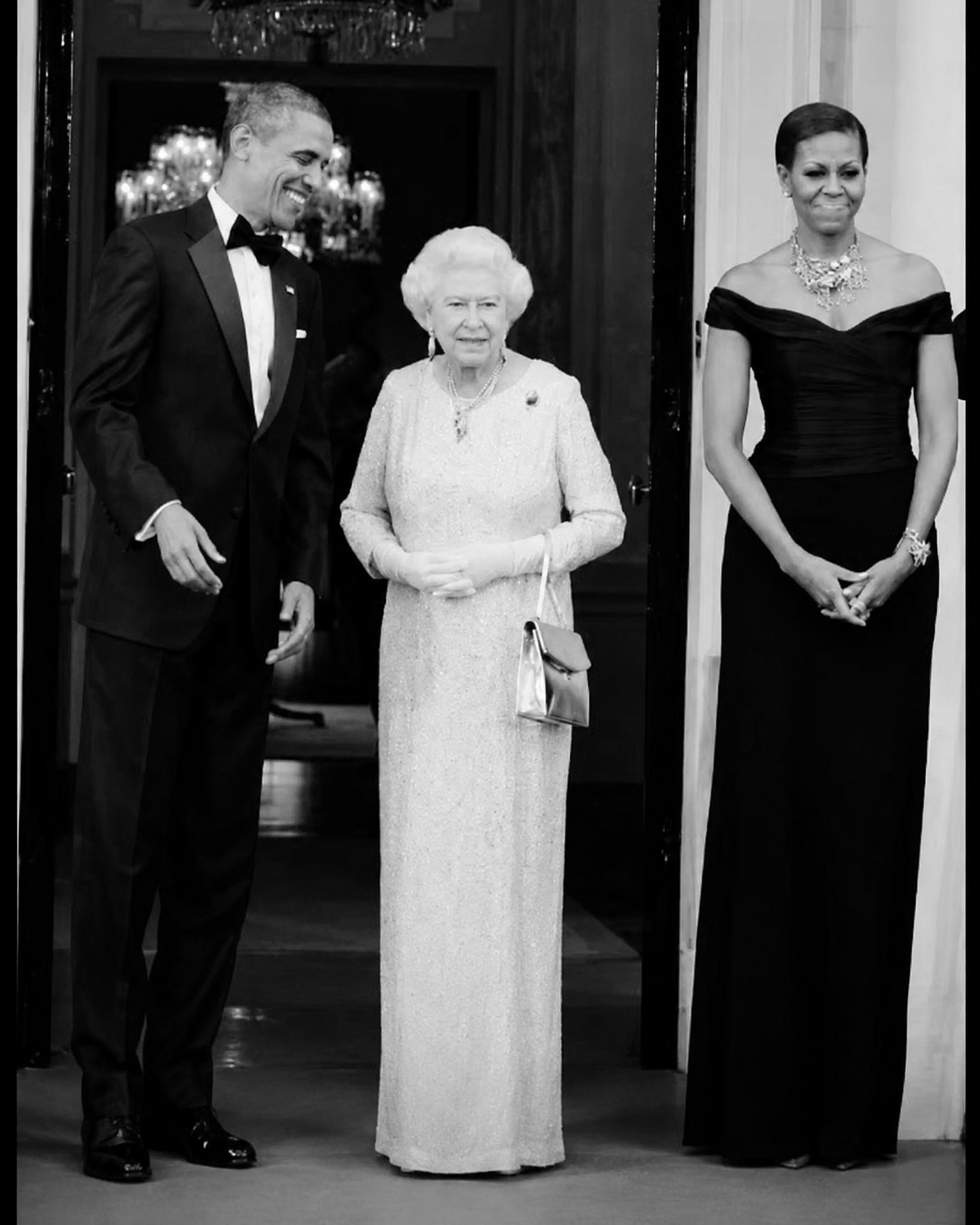
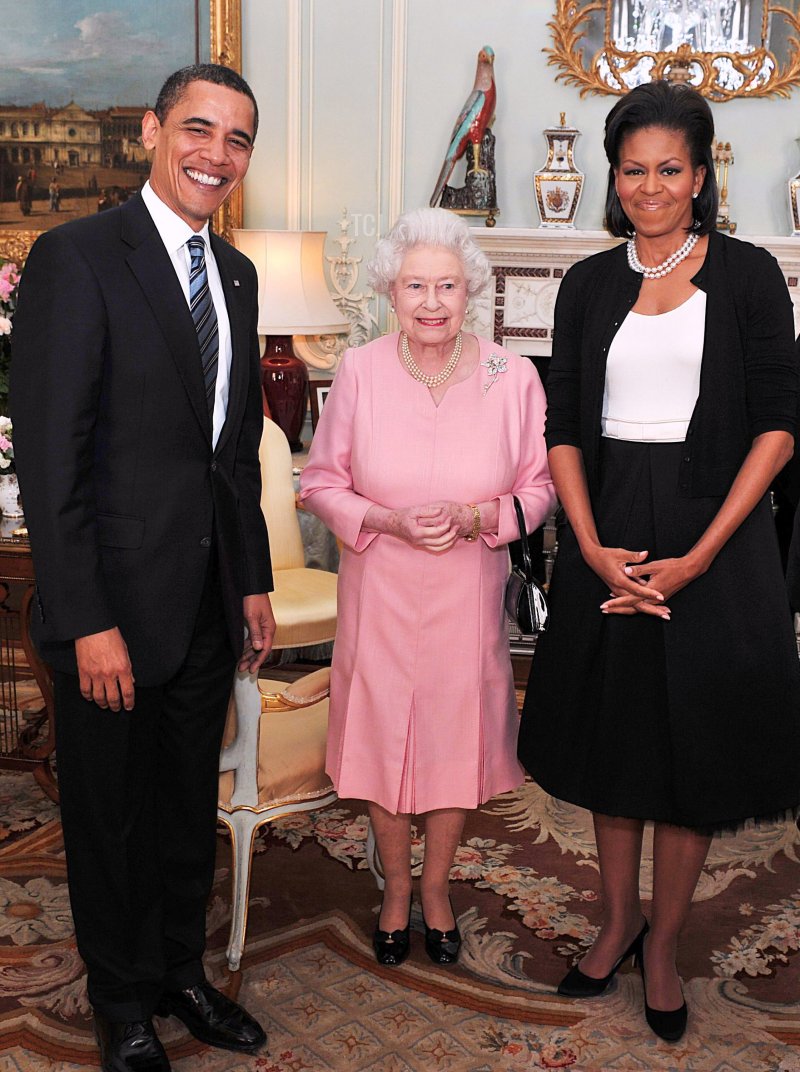
The story begins during a highly formal diplomatic moment: a full state visit to the United Kingdom by President Barack Obama and the First Lady. Only the second time in history that a sitting U.S. president had been granted such an honor, the visit carried enormous symbolic weight. It was staged with precision inside the grandeur of Buckingham Palace, where centuries of tradition seemed to press against every polished surface, every chandelier, every ceremonial pause.
Inside that world of rigid protocol, even the smallest gestures were magnified.
And Michelle Obama, despite her composure and public confidence, felt the pressure of it more than she admitted.
She had chosen the brooch carefully. It wasn’t extravagant. It wasn’t designed to impress. It was a vintage flower-shaped piece made of gold, diamonds, and moss agate—discovered not in a royal archive or luxury auction house, but in a modest antique store in Washington known as the Tiny Jewel Box.
To her, that detail mattered. It made the gift personal, grounded, human.
Still, as the moment approached, doubts crept in. Would it be enough? Would it feel appropriate? Would it feel small next to a monarch whose personal collection represented centuries of history, diplomacy, and inherited wealth?
The anxiety wasn’t about money. It was about meaning.
During the official exchange, the Obamas presented their formal state gift first: a leather-bound album filled with rare photographs and historical memorabilia from the 1939 visit of the Queen’s parents to the United States. It was a carefully curated piece of shared history, designed to honor lineage and connection between two nations.
Witnesses later recalled a subtle shift in the Queen’s demeanor as she turned its pages. There was recognition, emotion, and something close to nostalgia. She reportedly paused, absorbed the images, and offered a quiet expression of gratitude.
But that was diplomacy.
The second exchange was something different entirely.
This was Michelle’s personal gift.
No cameras focused on it in the same way. No formal speech elevated it. No press statement defined its meaning in advance. It was simply handed over, quietly, almost delicately, as if acknowledging its fragility.
A small American brooch. A flower in gold and stone. A piece chosen not for political symbolism, but for aesthetic intuition and personal thoughtfulness.
And then it disappeared into the formal rhythm of the evening.
For Michelle Obama, that might have been the end of it. A completed gesture, tucked into memory, folded into the larger weight of the visit.
But diplomacy has a way of revealing its most meaningful truths later, often when no one is looking.
The next evening, the Obamas hosted a return dinner at Winfield House, an elegant but less ceremonial setting compared to Buckingham Palace. It was meant to mirror the earlier hospitality, to complete the ritual balance of state visits, where every gesture is reciprocated in form if not in identical substance.
Guests arrived in formal attire. Conversations flowed in carefully managed tones. Cameras captured moments, but the atmosphere was noticeably more relaxed than the night before.
And then the Queen arrived.
What happened next was so subtle that many people in the room didn’t immediately recognize its significance. There was no announcement. No spotlight. No deliberate pause.
But Barack Obama noticed first.
Then Michelle did.
The Queen was wearing the brooch.
The same one Michelle had given her less than twenty-four hours earlier.
In a world where monarchs have access to vaults filled with heirlooms, where brooches are selected not casually but with historical intention, the choice carried a quiet but unmistakable message.
It wasn’t about value.
It was about preference.
And preference, in royal protocol, is one of the strongest forms of acknowledgment.
Michelle Obama reportedly felt an immediate emotional shift in that moment. What had been a private worry—Was it too small? Was it too simple? Was it appropriate?—was suddenly answered without a single word being spoken.
The Queen had chosen it.
Not because she had to.
But because she wanted to.
Barack Obama later reflected on this moment as a defining example of the Queen’s character. He often described her as someone who operated with a kind of understated clarity—never overly expressive, never performative, but deeply attentive to the emotional undercurrents of every interaction.
That brooch, in his telling, became more than a gift. It became a signal of respect returned.
A quiet affirmation that thoughtfulness, even in its smallest form, carries weight in the highest rooms of power.
Over time, the brooch took on a life of its own within royal context. It became informally known as the “American State Visit Brooch,” a name that reflected its origin rather than its material worth. It was not among the most famous jewels in the royal collection, nor the most valuable, but it held a distinct place because of its story.
The Queen wore it again on several occasions in the years that followed, each appearance reinforcing its quiet significance. One of the most discussed moments came in July 2018, when she wore it during an engagement with religious leaders on the same day President Donald Trump arrived in Britain. The timing was widely noted in the press, interpreted by commentators in different ways, but at its core, it simply underscored that the brooch had become part of her personal rotation, not just a ceremonial artifact.
It had entered her lived experience.
And that, in royal terms, is rare.
The relationship between the Obamas and the Queen did not hinge on a single visit. It unfolded across years, shaped by multiple encounters that gradually revealed mutual comfort rather than formal obligation.
There was the G20 summit in 2009, where early impressions were formed under global economic pressure. There was the 2011 state visit, the most formal expression of diplomatic respect. And later, there was a quieter, more intimate visit in 2016 at Windsor Castle for the Queen’s ninetieth birthday celebration.
Each encounter added another layer, another reference point, another shared memory.
During that final visit, Barack Obama reportedly told journalists that the Queen was one of his favorite people to meet in public life. The statement was striking not because it was dramatic, but because it was unguarded. Diplomacy rarely allows space for favorites. Yet here it was, offered without hesitation.
He later explained that what stood out about her was not grandeur, but consistency. She had a way of making formal environments feel less rigid without breaking their structure. She could shift tone without changing protocol. She could soften a room simply by being fully present in it.
And, as he often noted, she had a sense of humor that revealed itself unexpectedly, catching people off guard in ways that made the encounter feel personal rather than ceremonial.
He also remembered something more practical: her sense of timing.
At Buckingham Palace, even conversations had schedules. And at some point, the Queen would simply, calmly, without drama, signal that it was time for the visit to conclude. No awkwardness. No offense. Just clarity.
It was, in its own way, a form of respect for everyone’s time, including her own.
Michelle Obama’s reflections on the Queen carried a different tone but echoed the same underlying impression. She often spoke about how nervous she initially felt entering that world—how easy it would be to assume distance, formality, and hierarchy would define every interaction.
But that expectation dissolved quickly.
What replaced it was something more human.
She described how conversation flowed more easily than expected, how warmth appeared in unexpected places, and how quickly the sense of intimidation faded once actual dialogue began.
In her memory, the Queen was not distant. She was attentive. Direct. Curious in a way that felt grounded rather than ceremonial.
And perhaps most unexpectedly, generous in her small gestures.
That generosity extended beyond the formal exchanges of state visits. When Michelle Obama later visited the United Kingdom with her daughters, Malia and Sasha, the Queen extended an invitation for tea. It was not a publicized diplomatic event. It was something quieter, almost familial in tone.
During that visit, she offered the girls a ride around the palace grounds in her golden carriage, an experience that blended spectacle with personal hospitality in a way only royal tradition could.
For the Obama family, the memory lingered long after the event itself ended. Not because of the carriage, or the setting, or the photographs, but because of what it represented: a moment where formality softened into something resembling personal kindness.
Barack Obama later reflected that his daughters remembered it vividly, not as a political event, but as a human one.
That distinction mattered.
Because it echoed what the brooch itself had already revealed.
That the most enduring gestures in diplomacy are rarely the largest ones. They are the ones that feel personally chosen, not institutionally required.
The Queen also exchanged a gift in return during that same week—a separate brooch, antique in design, shaped like a rose made of gold and red coral. It was a reminder that this exchange was not one-sided. It was mutual, deliberate, and balanced in its own quiet way.
Two women, from entirely different backgrounds, separated by history, geography, and institution, meeting each other not only through protocol but through objects chosen with care.
Objects that carried no political agenda.
Only intention.
Years later, after the passing of Queen Elizabeth II, reflections on her life often returned to these small moments. Not just coronations, not just political milestones, but the quieter exchanges that revealed character more than ceremony ever could.
In his tribute, Barack Obama described her in personal terms, comparing her warmth and steadiness to that of his own grandmother. He emphasized not only her dignity, but her grounded humor, her practicality, and her ability to remain fully herself within the most formal environments imaginable.
Michelle Obama, in her own remembrance, returned again to that first moment of uncertainty—the nervousness she had felt stepping into Buckingham Palace, carrying a small brooch she feared might not be enough.
And how quickly that fear had been erased.
Not by protocol.
Not by praise.
But by the simple, unspoken decision of another woman choosing to wear it the very next evening.
In the end, the brooch did not remain significant because of its material value. It remained significant because it captured something rare in diplomatic history: a moment where scale did not determine meaning.
Where a $50 object could stand in the same emotional space as crowns and diamonds.
Where thoughtfulness outweighed grandeur.
And where a small flower-shaped brooch, worn quietly at a dinner in London, became a lasting reminder that respect is not measured in size, but in attention.
Sometimes, the most powerful messages are not spoken at all.
They are simply worn.