A Birth That Quietly Changed How People See Family
In 1997, in the historic city of Gloucester, England, two baby girls were born who would later challenge the way millions of people think about identity, family, and genetics. Their names were Lucy and Maria Aylmer. On paper, they were twins—born on the same day, to the same parents, sharing the same womb and the same beginning. But in appearance, they looked nothing alike.
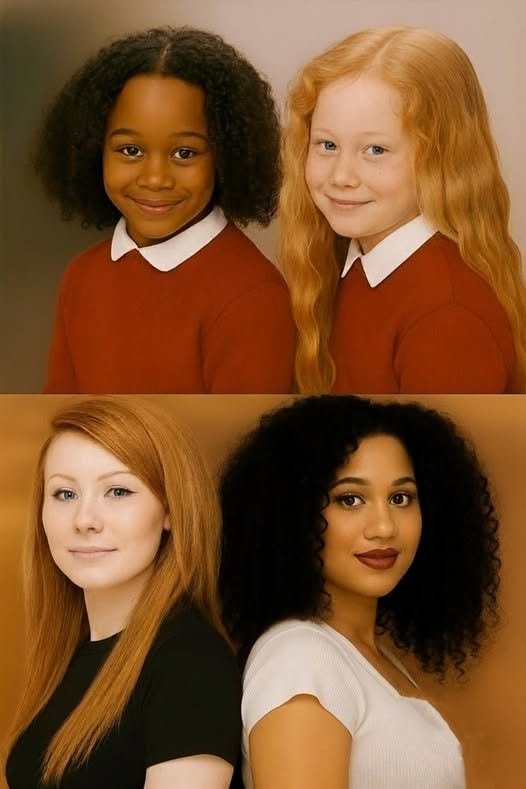
One had very fair skin, bright blue eyes, and straight red hair. The other had deep brown skin, dark curly hair, and warm brown eyes. When they were photographed together years later, many people refused to believe they were even sisters, let alone twins. Their image would eventually spread across the internet and turn them into one of the most discussed examples of genetic diversity in modern times.
A Family Rooted in Mixed Heritage
Lucy and Maria were born to Vince Aylmer, a white father, and Donna Aylmer, their mother, who is of mixed heritage—half Jamaican and half white. From the very beginning, their genetic background carried a wide range of possibilities, reflecting generations of ancestry.
Unlike identical twins, Lucy and Maria are dizygotic, meaning they developed from two separate eggs fertilized by two different sperm cells. This makes them genetically similar to regular siblings rather than carbon copies of one another. What makes their case so visually striking is how differently those genetic combinations expressed themselves in each child.
Genetics does not distribute traits evenly or predictably. Instead, it reshuffles inherited information in ways that can sometimes produce unexpected contrasts within the same family.
When Two Sisters Did Not Look Like Sisters
As the twins grew older, their differences became more noticeable to everyone around them. In public, people often stared. Some assumed they were simply friends. Others believed they could not possibly be related.
The reaction followed them into daily life. Strangers questioned their story. Classmates were confused. Even adults often asked for confirmation before believing what they were told. At times, the girls reportedly had to show official documents just to prove they were actually twins.
While most siblings may experience comparisons, Lucy and Maria experienced something far more unusual—the need to constantly validate their own family bond.
The Science Behind Their Difference
The explanation lies in how fraternal twins are formed. Unlike identical twins, who share the same genetic blueprint, fraternal twins are created from two separate fertilized eggs. This means each child inherits a completely unique combination of genes from both parents.
In families with diverse ancestry, this can result in children who express different physical traits more strongly. Skin tone, hair texture, and eye color are influenced by multiple genes working together, not a single switch. As a result, siblings can inherit different visible characteristics depending on which genetic combinations become dominant.
Lucy and Maria became one of the most well-known real-life examples of this genetic variation—sometimes described in media as a “genetic lottery.”
Growing Up Under Constant Attention
Life for Lucy and Maria was shaped not only by their family bond but also by how others perceived them. From childhood through adolescence, they became used to reactions of surprise.
Some people were fascinated. Others were skeptical. Many simply did not know how to respond when told that two girls who looked so different were twins.
This constant attention created an unusual kind of pressure. Instead of their identity being accepted immediately, it was often questioned first. For most children, identity is something that develops quietly over time. For Lucy and Maria, it was something they had to explain repeatedly.
Going Viral and Becoming a Global Story
The twins gained worldwide attention in 2015 when their photographs began circulating online. The contrast between them was so striking that many viewers assumed the images had been altered or staged.
But they were real.
News outlets quickly picked up the story, and Lucy and Maria became a global phenomenon. Millions of people shared their images, often reacting with shock, curiosity, and admiration.
For many, it was the first time they had seen such a clear visual example of how unpredictable genetics can be within a single family. For others, it sparked conversations about race, identity, and how society categorizes people based on appearance.
More Than a Viral Image
While the internet focused heavily on how different the twins looked, their real story goes deeper than appearance. At its core, their experience highlights how quickly humans make assumptions based on visual cues.
People often believe they can understand someone’s background, family, or identity just by looking at them. Lucy and Maria’s story disrupts that assumption completely. They demonstrate that appearance is only one layer of identity—and often not the most accurate one.
Their lives quietly challenge the idea that family must look uniform. Instead, they show that family is defined by connection, not similarity.
The Emotional Reality Behind the Fascination
:upscale()/2015/03/02/037/n/24155406/1b211785_edit_img_cover_file_16119370_1425337080.jpg)
Behind the global attention, there is a more personal reality. Imagine being a child and constantly needing to prove your own truth. Imagine introducing your twin sister and being met with disbelief every time.
For Lucy and Maria, this was not a one-time experience—it was a recurring part of life. Over time, they learned to respond with patience, humor, and sometimes documentation. But the underlying experience reveals something important about how society processes difference.
When people encounter something that challenges their expectations, the first reaction is often disbelief rather than curiosity or acceptance. Their story exposes that instinct in a very human way.
Identity, Perception, and Assumptions
One of the most powerful aspects of the Aylmer twins’ story is how it reveals the difference between identity and perception.
Identity is who a person truly is—shaped by family, history, relationships, and lived experience. Perception is how others interpret what they see, often influenced by cultural expectations and unconscious bias.
Lucy and Maria share the same identity as sisters and twins, but the world often perceives them differently based on appearance alone. That gap between truth and perception is what makes their story so compelling.
It also raises an important question: how many other families experience similar misunderstandings simply because they do not fit common expectations?
A Living Example of Human Diversity
The phrase “genetic lottery” is often used to describe rare or surprising combinations of inherited traits. In Lucy and Maria’s case, it refers to how two children from the same parents can inherit very different visible characteristics.
But beyond biology, their story reflects something much larger: the natural diversity of human beings. No two people are exactly the same, even within the same family. And sometimes, those differences become visible in dramatic ways.
Rather than being an anomaly to be explained away, their existence highlights the full range of what human inheritance can produce.
A Message That Goes Beyond Appearance
At the heart of their story is a simple but powerful truth: family is not defined by how people look, but by how they are connected.
Lucy and Maria grew up sharing the same home, the same parents, and the same childhood experiences. Their bond is not weakened by difference—it is strengthened by it.
Their story reminds us that love, trust, and belonging are not visible traits. They are lived experiences.
Why Their Story Still Matters Today
Even years after their images first went viral, Lucy and Maria’s story continues to resonate because it speaks to something universal. Everyone, in some way, has experienced being misunderstood or misjudged based on appearance, background, or assumption.
Their story encourages people to slow down their judgments and recognize the complexity behind every face. It also highlights the growing diversity of modern families around the world.
In a global society where cultures and identities increasingly overlap, their story feels more relevant than ever.
A Final Reflection on Difference and Belonging
Lucy and Maria Aylmer are not just twins who look different. They are a reminder that human identity cannot be simplified into categories. Their story shows that difference does not divide family—it can exist within it naturally and beautifully.
They challenge us to rethink what we think we know at first glance. They remind us that the most important truths about people are often not visible at all.
And most importantly, they show that belonging is not about resemblance. It is about connection.