The Day I Thought We Had Finally Survived
The morning of my son’s graduation, I stood in front of my bedroom mirror longer than necessary.
I adjusted my collar, wiped away a smudge of mascara, and quietly reminded myself that I was allowed to be happy.
This was Marcus’s day.
After everything our family had endured, my son had made it.
He had survived the confusion of adolescence, the loneliness that settled over our home, and the unbearable absence of his older sister. He had studied through sleepless nights, worked part-time jobs, and carried responsibilities no child should ever have been forced to carry.
Now he was graduating.
For once, I wanted to sit in an auditorium and cry tears of pride instead of grief.
I had no idea that before the ceremony ended, my son would walk onto the stage holding a newborn baby and the hand of my fifty-eight-year-old best friend.
And what he revealed into that microphone would tear open a wound I had carried for ten years.
The Empty Chair in Our Family
The auditorium was packed with families waving programs, adjusting cameras, and calling out to graduates they could barely see.
I sat near the center aisle with my purse balanced on my knees.
The room was warm, but my hands felt cold.
Graduations have a way of forcing you to measure time.
As I watched young people in caps and gowns gather near the stage, I could not stop thinking about how much had changed in ten years.
Ten years earlier, my teenage daughter had walked into the woods behind our neighborhood.
She never came back.
The night before she disappeared, we had argued more fiercely than we ever had before.
She had been dating a boy for only six months, but she insisted they were in love. She wanted my legal permission to marry him.
I thought she was throwing away her future.
“You’re too young to understand what marriage means,” I told her.
“You don’t know him the way I do,” she shouted.
“I know you,” I replied. “And I know you’re not ready.”
Her face hardened.
“You don’t want me to be happy.”
“That isn’t true.”
“It is! You want to control everything!”
She stormed away before dinner, slamming the door so hard that a framed photograph shook on the wall.
At first, I assumed she had gone to see the boy.
An hour later, I called his parents. I expected to find her sitting in their living room, angry but safe. I imagined the adults gathering around the kitchen table and calmly explaining why marriage at that age was a terrible idea.
But she was not there.
The boy said he had not seen her.
I accused him of lying.
The police checked his phone records, spoke with his family, and questioned neighbors. Nothing suggested he knew where she had gone.
Her friends knew nothing either.
By sunrise, search teams were entering the woods.
Marcus had been the last person in our family to see her.
He was still a child then. He had watched his sister disappear between the trees, furious with the entire world.
For years, he blamed himself for not following her.
And for years, I wondered whether my final words had driven my daughter away forever.

The Friend Who Held Us Together
My best friend, Dana, became the person who kept Marcus and me alive.
We had known each other for three decades. She had been beside me through birthdays, holidays, breakups, illnesses, and every ordinary moment that turns friendship into family.
After my daughter disappeared, Dana became the solid ground beneath my feet.
She drove with me along back roads until we knew every abandoned building, gas station, and bus stop within a hundred miles.
Whenever a stranger called claiming to have seen a girl who resembled my daughter, Dana came with me.
Most of the calls led nowhere.
Some were cruel pranks.
Others came from well-meaning people who had simply mistaken someone else for her.
Each false lead broke me a little more.
Dana was always there afterward.
“Please eat something,” she would say, placing soup in front of me. “Marcus is watching you. He needs to know you’re still here.”
When I forgot to pack his lunch, she packed it.
When I could not get out of bed, she drove him to school.
When the phone rang after midnight, she answered it because I had begun trembling whenever I heard the sound.
She attended parent meetings, birthdays, and school performances.
Marcus adored her.
So did I.
There were moments when I genuinely believed Dana had saved our lives.
That belief made what happened later almost impossible to accept.
The Distance I Refused to Question
About a year before graduation, something began to change.
Marcus started leaving the house more often.
“I’m going to the coffee shop,” he would say, sliding his laptop into his backpack. “I have a big exam coming up.”
“Again?” I once asked. “You’ve gone there almost every night this week.”
“It’s easier to focus there.”
His answer sounded reasonable.
He was an adult now. I knew I could not question every decision he made.
Still, there was something in his expression—a tension around his eyes, a hesitation before he left—that unsettled me.
Around the same time, Dana began withdrawing too.
She stopped arriving without warning.
For years, she had walked into my kitchen as if it were her own, calling my name and helping herself to coffee. Suddenly, days passed without a visit.
Sometimes she ignored my calls.
When she eventually responded, she blamed exhaustion, headaches, or appointments.
I tried not to take it personally.
I told myself Marcus was building a life of his own and Dana was simply growing older. Perhaps both of them were finally dealing with the grief they had postponed while taking care of me.
But deep down, I sensed a connection.
The two people closest to me were becoming secretive at exactly the same time.
I did not have the courage to confront them.
I had already spent years chasing answers that never came. I could not bear the possibility of losing anyone else.
So I accepted their excuses.
I convinced myself that silence was safer than truth.
Marcus’s Name Was Called
The lights dimmed, pulling me back into the graduation ceremony.
The principal approached the microphone and welcomed the families. Speeches were given about perseverance, courage, and the future.
Then the graduates began crossing the stage.
One name after another echoed through the auditorium.
Families cheered.
Cameras flashed.
I sat straighter as Marcus’s turn approached.
My heart swelled with pride.
I thought about the frightened little boy he had once been—the child who used to sit by the window, convinced his sister would return if he watched long enough.
Now he was about to walk into adulthood.
When the announcer called his name, I lifted my hands to applaud.
Then Marcus stepped into the light.
But he was not alone.
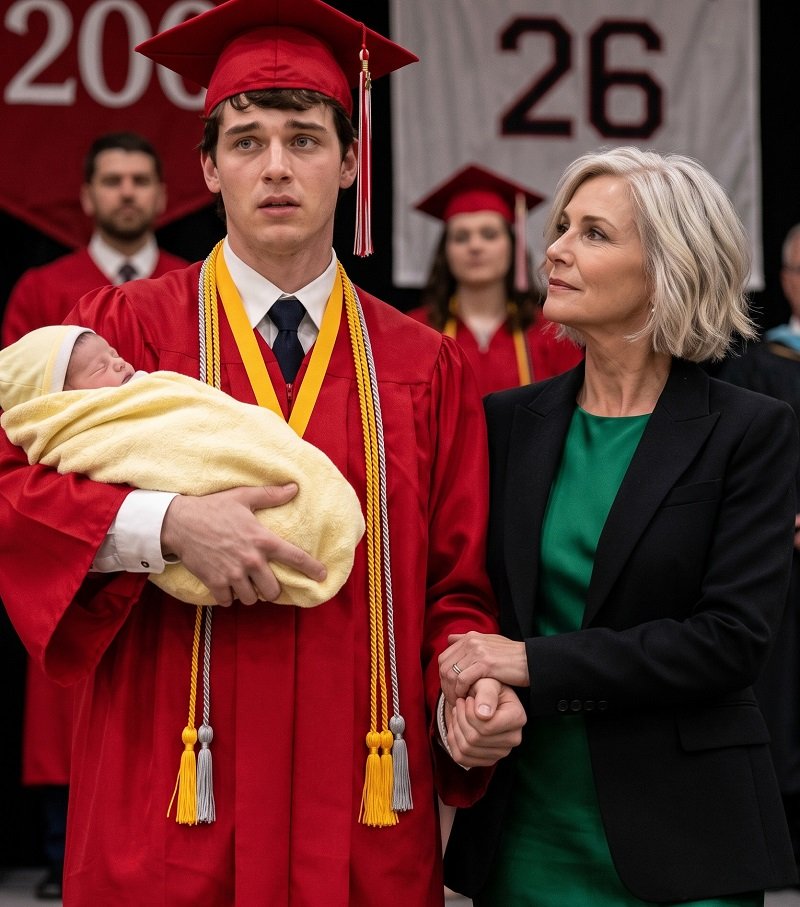
He was holding a newborn baby against his chest.
The infant was wrapped in a pale yellow blanket, with only a tiny face visible beneath the folds.
Walking beside Marcus was Dana.
She was holding his free hand.
The applause around me weakened into confused murmurs.
My body went rigid.
Dana’s silver-streaked hair reflected the stage lights. Tears ran openly down her face as she stood beside my son.
Marcus held her hand tightly while cradling the baby with surprising confidence.
My mind seized upon the most horrifying explanation.
Dana was thirty-five years older than Marcus.
She was my closest friend.
She had helped raise him.
Yet there she stood, hand in hand with my son while he carried a newborn.
My stomach twisted.
“No,” I whispered.
The woman beside me glanced over.
“Are you feeling all right?”
“No,” I answered, unable to look away from the stage. “I think my best friend has been taking advantage of my son.”
My shock quickly turned to fury.
How long had this been happening?
Was this why they had both been avoiding me?
Had the coffee shop been a lie?
Had Dana’s illnesses and appointments been excuses to hide a relationship?
Thirty years of friendship collapsed in my mind within seconds.
I gripped my purse so tightly that my fingers hurt.
Then Marcus walked toward the microphone.
“Mom, Please Listen”
The dean stepped aside.
Whatever was happening had clearly not been included in the ceremony schedule.
Marcus adjusted the baby against his shoulder.
The infant made a soft sound, and Marcus gently rocked him without taking his eyes off the audience.
“Before I talk about my degree,” he began, his voice trembling through the speakers, “there is something I need to tell my mother.”
The auditorium became silent.
Marcus scanned the crowd until he found me.
The moment our eyes met, his face nearly crumpled.
“Mom,” he said, “I know what you probably think you’re seeing.”
My purse slipped from my knees and landed on the floor.
Dana lowered her head.
“Please don’t make any decisions yet,” Marcus continued. “Just listen to me.”
I could hear my own pulse.
“This isn’t what it looks like,” he said. “Dana and I are not together. The baby isn’t ours.”
Relief should have come.
Instead, I felt something even darker gathering beneath his words.
“I’ve been keeping something from you for almost a year,” he continued. “I didn’t do it because I wanted to lie to you. I did it because I had to be absolutely certain.”
A year.
A year of late-night study sessions.
A year of Dana disappearing.
A year of unanswered questions.
“Marcus,” I called, half rising from my seat. “Come down here. We can talk privately.”
He shook his head.
“No, Mom. We can’t.”
Several people turned toward me, but I barely noticed.
“If I tell you privately,” Marcus said, “you might think grief has made me confused. You might believe someone pressured me. I need witnesses. And I need Dana to hear everything too.”
Dana lifted her face sharply.
For a moment, she did not look sad.
She looked afraid.

The Hope He Was Afraid to Give Me
Marcus looked down at the baby.
“About a year ago, I found someone,” he said.
His voice cracked.
“I found something online that didn’t make sense. A name, an old address, and a photograph. I thought it might be a coincidence, but I couldn’t let it go.”
I stopped breathing.
“I spent months checking records,” he continued. “I followed every address. I compared dates. I spoke to people who knew her. I needed proof before I came to you.”
“Proof of what?” I whispered.
Marcus looked directly at me.
“I couldn’t give you hope and then make you lose her again.”
A chill moved through me.
The room seemed to tilt.
He swallowed hard before continuing.
“When I finally reached her, she wouldn’t believe me. She thought I had contacted her because you were angry. She believed you still hated her.”
“Who?” I cried. “Marcus, who are you talking about?”
He tightened his arm around the newborn.
“Mom, this baby has your eyes.”
A sound escaped my throat, but it did not resemble a word.
“He is your grandson.”
The auditorium disappeared around me.
There was only Marcus, the baby, and the terrible hope spreading through my chest.
“My sister wanted you to meet him,” Marcus said.
His eyes filled with tears.
“She wanted to come home.”
I stood completely still.
“Wanted?” I managed to say.
Marcus closed his eyes.
“She didn’t get the chance.”
The Daughter I Had Searched for Was Alive
“My sister was alive, Mom,” Marcus said. “She was alive all these years.”
Gasps moved through the auditorium.
I grabbed the back of the chair in front of me.
“No,” I whispered.
Marcus nodded.
“I found her.”
The word alive entered my heart like both a miracle and a blade.
For ten years, I had imagined my daughter lost in those woods.
I had pictured every terrible possibility.
I had walked through storms with search teams.
I had placed missing-person posters on telephone poles until the paper dissolved in the rain.
I had checked hospitals, shelters, and bus stations.
And somewhere during all those years, my daughter had been growing older.
She had celebrated birthdays.
She had eaten breakfast, watched sunsets, and lived in rooms I had never seen.
“Where is she?” I cried.
Marcus looked down.
“She passed away three weeks ago.”
My knees nearly gave way.
“She died during childbirth,” he said softly. “But before it happened, she told me she wanted you to raise her baby if she couldn’t.”
The words struck harder than anything I had endured during those ten years.
My daughter had been alive.
Then she had died before I could see her.
I had lost her twice.
Once when she disappeared.
And again three weeks earlier, without even knowing she had returned to the edge of my life.
I began moving down the aisle.
Tears blurred every face around me.
I wanted the baby.
I wanted Marcus.
And, in that moment, I wanted Dana too.
I assumed she had helped my son find my daughter.
Her distance suddenly appeared noble. Her secrecy seemed understandable. Perhaps she had been protecting me while Marcus searched for proof.
When I reached the stage steps, Dana opened her arms.
Her face was wet with tears.
“Oh, Dana,” I sobbed. “Thank you.”
I started toward her.
Marcus stepped between us.
My Son Would Not Let Her Touch Me
“No,” he said.
The softness had vanished from his voice.
He lifted one hand toward Dana, stopping her from coming any closer.
I stared at him.
“Marcus, let her through. She helped you.”
“No, Mom.”
Dana’s expression changed so quickly that anyone else might have missed it.
But I had known her for thirty years.
I saw the fear beneath her tears.
“Sit on the step,” Marcus told me gently. “Please. I’m not finished.”
Dana touched his arm.
“This has been enough for one day,” she said. “Your mother is in shock. You can explain the rest later.”
Marcus pulled away.
“No. We explain it now.”
The auditorium remained completely silent.
Marcus turned toward Dana.
“I’m giving you one chance,” he said. “Tell her yourself.”
Dana blinked.
“Tell her what?”
“Tell my mother what you did to my sister.”
My grief froze inside me.
Dana’s face lost its color.
“Marcus, you’re upset. You don’t understand everything.”
“I understand more than you think.”
He shifted the baby carefully and reached inside his graduation robe.
Then he pulled out a folded stack of documents.
“I have the bank transfers,” he said. “I have the rental agreements. I have copies of every apartment lease you signed for her.”
Dana stopped breathing.
“Ten years,” Marcus continued. “You sent her money for ten years.”
I looked from the papers to Dana.
The woman who had driven beside me while I searched for my daughter had known where she was.
The woman who held me after every false lead had been helping keep the truth hidden.
“You didn’t help Marcus find her?” I asked.
Dana said nothing.
Marcus answered for her.
“No. Dana was the reason she never came home.”
The Truth Behind My Daughter’s Disappearance
My legs gave way, and I sat on the stage step.
“That isn’t possible,” I said.
Dana covered her mouth.
“Tell her,” Marcus demanded.
“Please,” Dana whispered. “Not here.”
“You chose to hide this for ten years. You don’t get to choose the place where the truth comes out.”
Dana looked at me.
For the first time in our friendship, I felt as though I were looking at a stranger.
“She came to me the day she left,” Dana admitted.
The words seemed to come from far away.
“She was crying. She believed you would never forgive her.”
“I would have forgiven her before sunset,” I said.
“I know that now.”
“You knew it then.”
Dana flinched.
“She was frightened. She said she needed somewhere to stay for a few days. I gave her money and helped her get away from town.”
“Why didn’t you call me?”
“I told myself she needed time.”
My hands began shaking.
“Time?”
“A few days became several weeks,” Dana said. “She was still angry. She didn’t want to come back.”
Marcus unfolded one of the documents.
“You told her Mom hated her,” he said. “You told her the police might punish her for causing trouble. You told her coming home would destroy the family.”
Dana looked at the floor.
“I was trying to keep her calm.”
“No,” Marcus replied. “You were trying to keep her dependent on you.”
Dana’s shoulders collapsed.
“I helped her find an apartment,” she whispered. “I sent money. I checked on her.”
“You watched me search for her,” I said.
Dana began crying harder.
“I didn’t know how to tell you.”
“You answered calls from people who claimed they had seen her.”
“I know.”
“You drove through the woods with me.”
“I know.”
“You watched Marcus blame himself.”
“I know!”
Her cry echoed through the auditorium.
Then she pressed both hands against her face.
“When she first disappeared, you needed me,” she said. “You couldn’t get through a day without calling me. Marcus needed me too.”
I stared at her.
“And somewhere along the way,” Dana continued, “I became afraid that if your daughter came home, you wouldn’t need me anymore.”
The truth was so selfish, so small, and so devastating that I could barely understand it.
“You kept my child away,” I said, “because you wanted to feel important?”
“I never meant for it to last ten years.”
“But it did.”
“She built a life. She moved several times. She stopped talking about returning.”
“Because you spent years telling her I hated her!”
Dana’s face twisted with shame.
“She wanted to come home eventually,” Marcus said. “When she found out she was expecting the baby, she started asking about Mom again.”
My heart shattered.
“She asked about me?”
“All the time.”
I covered my face.
Marcus’s voice softened.
“She kept the newspaper clippings from the searches. She had old family photographs. She knew about my school and my graduation because Dana told her.”
I looked at Dana.
“You gave her pieces of our lives while keeping her from us.”
Dana could not answer.

The Ten Years She Stole
I rose slowly.
My grief had transformed into something steadier than rage.
I walked up the steps until I stood directly in front of Dana.
“I blamed myself every day,” I told her. “I replayed our final argument until I could hear every word in my sleep.”
Dana cried silently.
“I thought my daughter had disappeared because I had failed her. Marcus believed he should have followed her into the woods. We lived with guilt while you knew she was safe.”
“I’m sorry.”
“No apology can return ten years.”
Dana reached toward me.
I stepped back.
“My daughter and I could have argued again,” I said. “We could have forgiven each other. We could have learned how to become a family again.”
“I know.”
“I could have watched her grow into a woman.”
Dana lowered her head.
“I could have been there when she needed her mother.”
My voice broke.
“And when she died, she might not have had to face it without me.”
Dana sank as though my words had taken the strength from her body.
“I thought I was protecting her at first,” she whispered.
“And after that?”
She looked at me with hollow eyes.
“After that, I was protecting myself.”
Meeting My Grandson
A tiny hand emerged from the yellow blanket.
The baby opened and closed his fingers as though reaching for something he could not see.
All the anger inside me paused.
Marcus stepped toward me.
“This is her son,” he said.
I reached out, afraid that the child might disappear if I moved too quickly.
Marcus placed the baby carefully into my arms.
The moment I felt his warmth against my chest, I began sobbing.
He had my daughter’s tiny nose.
He had Marcus’s dark hair.
And when his eyes opened for a moment, I saw something so familiar that my knees weakened again.
My daughter had once looked at me with those same eyes.
“She named him before she died,” Marcus whispered. “She left letters too. One for you and one for him.”
I pressed my cheek against the baby’s blanket.
“I’m sorry,” Marcus said. “I should have told you sooner, but every time I uncovered something new, the story changed. I needed to know what was true before I brought her back into your life.”
I looked at my son.
He had carried this secret for nearly a year.
He had found his sister, earned her trust, prepared for the baby, investigated Dana, and somehow completed his degree while protecting me from another false hope.
“You did nothing wrong,” I told him. “You brought her home.”
His face crumpled.
“Not the way I wanted to.”
“No,” I said. “But you brought back the truth. And you brought me her son.”
I shifted the baby into one arm and pulled Marcus close with the other.
For the first time in ten years, I held part of both my children at once.
The End of a Thirty-Year Friendship
Dana moved toward us.
“Please,” she whispered. “I know what I did was unforgivable, but we’re still family.”
I turned to face her.
“No,” I said. “Family does not watch someone search for a missing child while secretly paying for that child’s apartment.”
“I loved all of you.”
“That wasn’t love. Love does not need people to remain broken so it can feel necessary.”
Two officers appeared near the side entrance.
Dana noticed them and went still.
Marcus had already contacted the authorities. The financial records, false information, and years of concealed communication had been turned over before graduation day.
Dana glanced toward the nearest exit.
For one brief moment, I thought she might run.
Then her shoulders lowered.
There was nowhere left for her to hide.
As the officers approached, Dana looked at me one last time.
“I truly am sorry.”
I held my grandson closer.
“Spend the rest of your life understanding why sorry will never be enough.”
They led her away.
No one in the auditorium spoke.
The ceremony had become something none of us would ever forget.
What My Son Taught Me That Day
Marcus never gave the graduation speech he had originally prepared.
He never spoke about grades, opportunities, or professional dreams.
Instead, he stood on that stage and returned my daughter to me through the truth.
I did not get the reunion I had imagined during those ten years.
I never got to see my daughter walk through my front door.
I never got to tell her that one terrible argument could never erase a mother’s love.
But through the letters she left behind, I learned that she had wanted forgiveness.
She had planned to come home after the baby was born.
She had chosen to believe, at last, that Marcus was telling the truth—that I had never stopped loving her.
My grandson could never replace her.
No child should be given the burden of replacing someone who has been lost.
But he became a new beginning.
He became proof that even after years of deception, the truth could still find its way home.
That afternoon, as Marcus and I left the auditorium together, I remembered the first words he had spoken into the microphone.
“Mom, please listen.”
For ten years, I had been trapped inside the final argument I had shared with my daughter.
I had listened to guilt.
I had listened to fear.
I had listened to every cruel possibility my grief could invent.
But on my son’s graduation day, I finally listened to the truth.
And although it broke my heart, it also placed my daughter’s child into my arms.
Sometimes the truth arrives too late to repair everything.
But it can still end the lies.
It can still return dignity to the people who were wronged.
And sometimes, wrapped in a yellow blanket and carried by the son you are endlessly proud of, it can give a grieving mother one more reason to keep going.
Note: This story is a work of fiction inspired by real events. Names, characters, and details have been altered. Any resemblance is coincidental. The author and publisher disclaim accuracy, liability, and responsibility for interpretations or reliance. All images are for illustration purposes only.
Source: amomedia.com