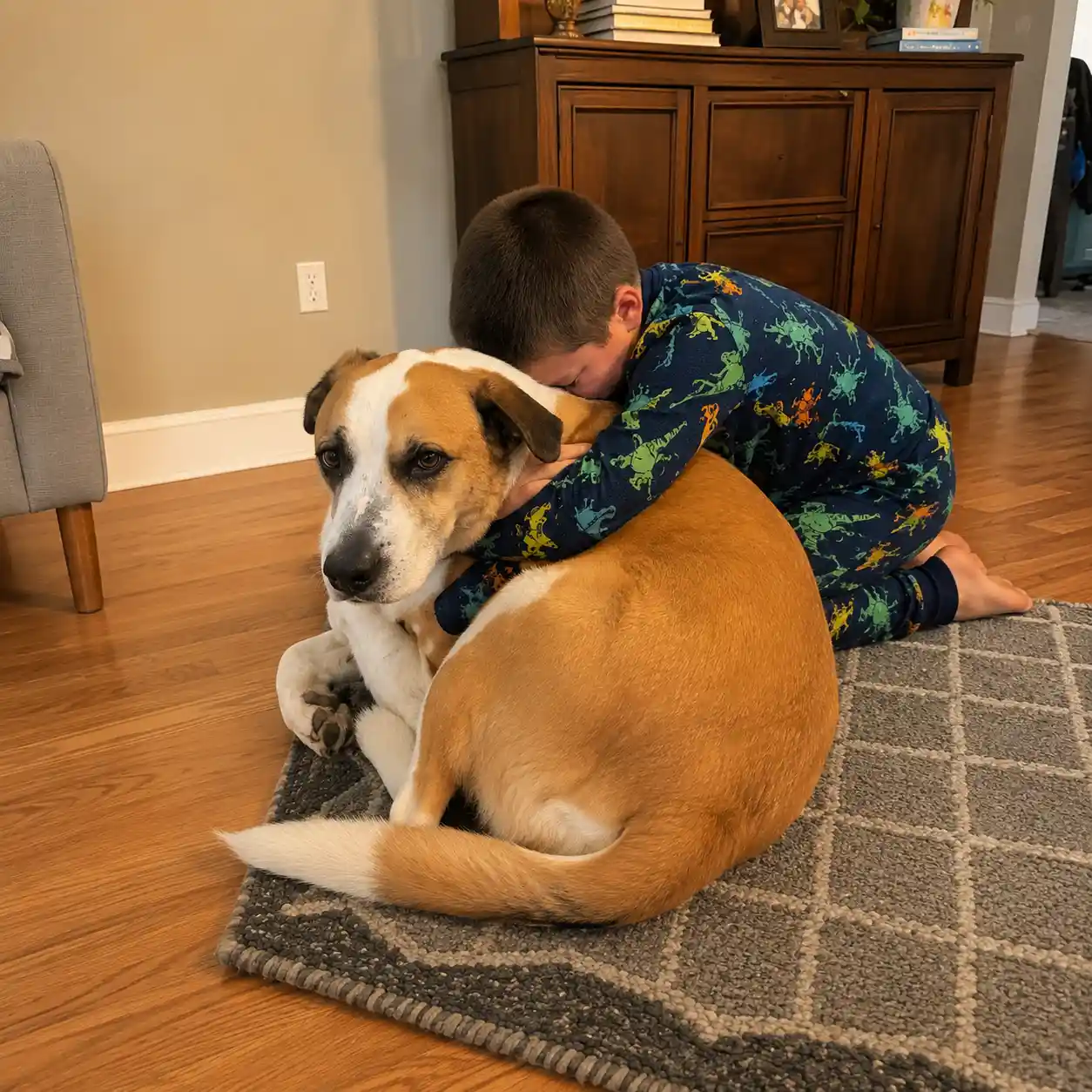
My new wife pointed at my son’s dog and said, “Either he goes, or I go.” She didn’t know my son was sitting on the stairs. Eight years old, in his dinosaur pajamas, hearing every word.
Let me back up. Buddy isn’t just a dog. My first wife Sarah brought him home as a puppy eight years ago, two months before our son Caleb was born. She used to joke that Buddy was her firstborn.
Sarah died three years ago. Cancer. Caleb was five.
The night of her funeral, I found Caleb asleep on Buddy’s bed on the floor, arms wrapped around his neck. They’ve slept like that almost every night since.
Then I met Rachel last year. She’s good to us in a hundred ways. But she and Buddy never clicked. He sheds. He smells. He’s too big. He stares at her.
Lately it got worse. The fur on her work clothes. The vet bills. The low growl he let out when she moved Sarah’s photo off the hallway shelf.
So Tuesday she gave me the ultimatum. And I’m ashamed to write this next part.
I said okay.
I told myself Caleb would adjust. Kids adjust. I found a coworker with a farm who agreed to take Buddy on Saturday morning.
Caleb didn’t cry when I told him. He didn’t scream or beg. He just looked at me for a long time, nodded once, and went to his room.
That scared me more than any tantrum would have.
Friday night I got up around midnight to check on him.
His bed was empty.
Buddy was gone too. The back door was unlocked, and Caleb’s little red backpack was missing from its hook.
There was a note on his pillow. Written in pencil, in that wobbly second-grade handwriting.
I stood in my son’s empty bedroom at midnight and read that note until my hands stopped working.
“Dad. Don’t be mad at Buddy. I took him somewhere safe. He can’t leave our house forever because he’s the only one who still remembers Mom. If you give him away there will be nobody left who knew her except me. Don’t worry about me. I have sandwiches. Love, Caleb.
P.S. Tell Rachel I’m sorry.”
He’s the only one who still remembers Mom.
Eight years old. Midnight. Gone. And that’s the sentence he left me with.
I don’t remember running down the stairs. I remember the backyard gate hanging open and the street lamps and me yelling his name up and down the block in my bare feet. Every window on our street stayed dark.
Rachel was awake by then, standing on the porch in her robe with her phone in her hand, already dialing the police.
“Wait,” I said. “Wait. He went somewhere specific. He said somewhere safe.”
Safe. Where does an eight-year-old feel safe at midnight? Grandma Jean’s house was twenty minutes away by car. He didn’t know the way. The school? The park?
Rachel suddenly went still. She was staring at the box in our hallway. The donation box she’d packed on Wednesday, the one with the things from the hallway shelf.
“The picture’s gone,” she whispered. “Sarah’s picture. He took it out of the box.”
And then it hit me like a truck.
Three weeks ago, driving home from Sunday dinner at Jean’s, Caleb had asked me a question from the back seat. So quiet I almost missed it.
“Dad, does Buddy know where Mom lives now?”
I’d laughed it off. Told him dogs don’t understand cemeteries. Changed the radio station.
Willow Creek Cemetery. A mile and a half away. The route he knew by heart because Jean took him there every single Sunday after church.
I grabbed my keys. Rachel was already putting on her shoes.
I’ve never driven like that in my life. Rachel kept her hand braced on the dash and didn’t say a word about it.
The main gate was chained for the night. But there’s a side entrance by the caretaker’s shed that never fully closes, and the grass beyond it was silver with dew, and there, pressed into the wet lawn, was a line of small sneaker prints with paw prints running beside them.
We followed them with my phone flashlight, past rows of dark headstones, up the little hill where the maple tree stands.
The light caught two eyes first. Green and glowing, low to the ground.
Buddy.
He was lying across my son’s legs like a ninety-pound blanket. His head came up and he let out one low woof, not a threat, an announcement. They’re here. I’ve got him.
Caleb was asleep against his mother’s headstone. He was wearing his backpack on his front, the way kindergartners do, and he’d taken Sarah’s old gray cardigan from the closet and put it on over his pajamas. The sleeves hung past his hands.
Inside the open backpack: two squashed peanut butter sandwiches. A juice box. A sandwich bag of dog biscuits. And Sarah’s photo in its frame, facing out, like he’d wanted her to see the view.
I got down on my knees in the wet grass and pulled him into my arms, and his eyes opened, and the first thing my son said to me was this:
“It’s okay, Dad. Buddy can stay here. Mom will watch him.”
I should have carried him straight to the car. It was cold and it was late and every parenting instinct said get him home.
Instead I sat down in the grass next to my wife’s grave, held my boy in my lap, and finally had the conversation I’d been running from for three years.
“Why here, bud? Why didn’t you talk to me?”
He picked at the sleeve of Sarah’s cardigan. “Because you were going to give him away anyway. I heard you and Rachel. I was on the stairs.”
“I know you were. I’m so sorry.”
“You said okay really fast, Dad.” His voice cracked on that one. “You didn’t even think about it.”
There’s nothing quite like an eight-year-old putting your worst moment into one sentence.
Then it all came out of him. Quiet and steady, like he’d been rehearsing it in his room for three days.
He told me he’s starting to forget Mom’s voice. That he lies in bed at night and tries to hear her singing the dinosaur song, and it keeps coming out sounding like his teacher, or like the mom from his favorite show, and it scares him so bad he can’t breathe.
He told me Buddy still remembers. That Buddy still sniffs her side of the bed every morning. That Buddy still goes to the front window at 5:30 every day, because that’s when her car used to pull in, and he waits there for twenty minutes, and then he lies down.
“You stopped waiting, Dad,” Caleb said. “Everybody stopped. Buddy never stopped.”
I couldn’t talk. I just held onto him.
“And he doesn’t hate Rachel,” Caleb went on, wiping his nose on the sleeve. “He just gets scared when Mom’s things move. When Rachel took Mom’s picture off the shelf, Buddy laid under the shelf for two whole days. Nobody noticed except me.”
The shedding on Rachel’s work clothes, the thing she complained about most. Caleb explained that too. Buddy sleeps in the closet sometimes. The closet where Sarah’s coats still hung until last month. Her clothes went into boxes, and Buddy kept sleeping in the empty corner where they used to be, and his fur got on everything new that came in.
Every single “problem” with that dog was grief. His, and my son’s. Sitting in the dark in the corners of my house, where I’d decided not to look.
“If Buddy goes to the farm,” Caleb said, and this is when his voice finally broke all the way, “then it’s just me who remembers her. And I’m already forgetting, Dad. I’m forgetting and I’m only eight.”
Buddy shifted in the grass and put his big head on Caleb’s knee.
I looked at that dog. Really looked at him for the first time in probably a year. Gray creeping in around his muzzle now. The dog who lay under Sarah’s hospice bed for the last eleven days of her life and had to be carried out of the room at the end.
I had agreed to hand him to a coworker like an old couch.
“Nobody’s going to the farm,” I said. “I promise you. Nobody’s going anywhere.”
Caleb studied my face the way kids do when they’re deciding whether an adult is lying.
Then he nodded once, the same nod from Wednesday, except this time he grabbed me around the neck and sobbed like the world was ending and starting over at the same time.
Here’s the part where you’re expecting me to tell you I went home and threw my new wife’s suitcases on the lawn.
That’s not what happened. Something better did.
When we came through the front door, Rachel was sitting on the bottom stair, exactly where Caleb had sat on Tuesday. She’d found the note. It was shaking in her hands.
“P.S. Tell Rachel I’m sorry,” she said. Her mascara was all over her face. “He ran away in the middle of the night, and he apologized. To me.”
Caleb stood there in his mom’s cardigan, holding Buddy’s collar, not sure what to do.
And Rachel slid off that stair, got down on her knees on our hallway floor, and asked my son to forgive her.
We talked until almost 3 a.m., the three of us at the kitchen table with cocoa, and Buddy lying across Caleb’s feet like he was never letting go again.
Rachel said things that night I don’t think she’d admitted to herself. That every room in our house felt like it already belonged to someone else. That she cooks in Sarah’s kitchen and hangs her coat where Sarah’s coats hung and some days it feels like being a guest in another woman’s life.
“I couldn’t compete with a ghost,” she said quietly. “So I picked a fight with her dog instead. Because the dog was the one who kept looking at me like he knew I wasn’t her.”
You want to hate her when you hear the ultimatum. I get it. I almost did too. But grief isn’t only for the people who knew the person. Sometimes it lands hardest on the one who came after, trying to love the people left behind.
At 3 a.m., Rachel took Sarah’s photo out of Caleb’s backpack, walked to the hallway shelf, and put it back. Then she moved it to the center.
“Your mom stays in this house,” she told Caleb. “I should never have touched it. That was wrong, and I knew it was wrong when I did it.”
Buddy walked over and sat down under the shelf.
Rachel looked at him for a long moment. Then she sat down on the floor next to him. She didn’t pet him. She just sat there, in the middle of the night, next to Sarah’s dog under Sarah’s picture.
After a minute, Buddy leaned over and rested his chin on her knee.
My son says that’s the moment Buddy decided to keep her. I think he’s right.
I called my coworker Dave at eight and told him the farm was off. He laughed and said, “Took you long enough. I was hoping you’d come to your senses.”
Rachel made pancakes. She put three on a plate and set the plate on the floor.
“Don’t tell the vet,” she said.
It wasn’t a magic fix. I want to be honest about that, because the internet loves a story where everything heals overnight, and that’s not how houses full of grief work.
Buddy still waited at the window at 5:30 that day. And the day after. Rachel started sitting with him while he waited, having her coffee on the floor by the window. It took about a month before he started bringing her the leash. It took two more before he slept outside our door instead of only Caleb’s.
Caleb started seeing a counselor who’s good with kids, somebody to help him hold onto his mom without being scared all the time. First session, she asked him to bring something that reminded him of her.
He brought Buddy. She allowed it. She’s been allowing it every week since.
It’s been a while now, and here’s how the story I almost wrote ends instead.
Every Sunday at ten, all four of us walk into Willow Creek through the main gate, legally this time. Caleb carries the flowers. Buddy pulls at the leash on the little hill, because he learned the way after exactly one visit, and he walks straight to Sarah’s headstone and lies down on the grass beside it like he’s reporting for duty.
Rachel usually stands back a little. Not because she’s unwelcome. Because she’s respectful. But last Sunday, Caleb grabbed her hand and pulled her forward and said, “Mom, this is Rachel. She makes pancakes for Buddy.”
I had to walk away and pretend I had something in my eye.
My new wife told me the dog goes or she goes. My eight-year-old heard everything, and thank God he did. Because he was the only person in that house brave enough to say what the rest of us were dancing around.
That dog isn’t a dog. He’s the last heartbeat of a woman we all loved, one of us without ever meeting her.
The note is still in my nightstand. I read it sometimes when I need to remember what almost happened.
“He’s the only one who still remembers Mom.”
Not anymore, buddy. Now we all do. Out loud, at the dinner table, with her picture in the middle of the shelf where it belongs.
Nobody went anywhere.