The music did not fade when I stepped into the ballroom—it died.
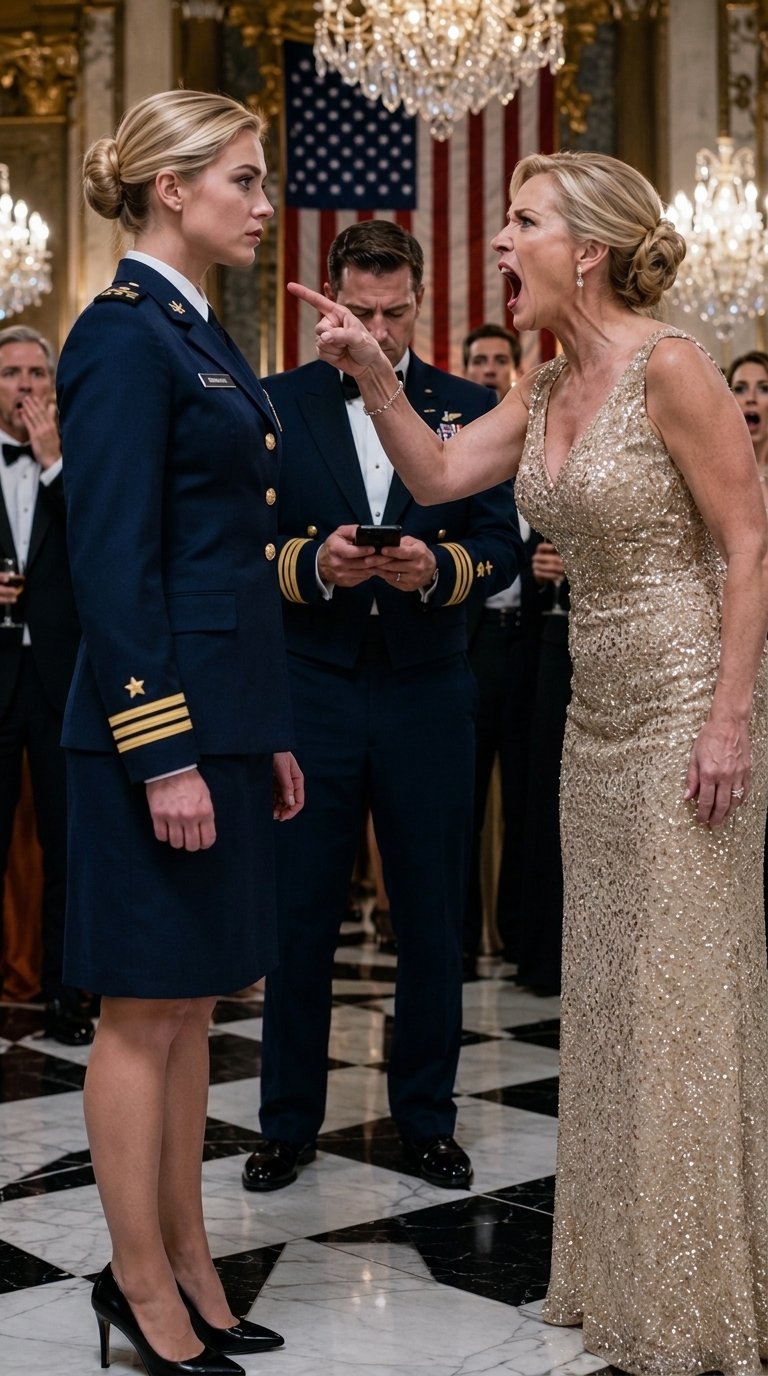
One second, a string quartet was playing a delicate Vivaldi piece beneath cascading crystal chandeliers in the heart of The Ritz. The air smelled of expensive gardenias, roasted truffles, and thousand-dollar champagne. The next second, my scuffed combat boots struck the polished marble floor, and three hundred heads turned in unison.
My name is Mara Harrington. Ten hours earlier, I had been strapped into the belly of a military transport plane, roaring across the Atlantic on my way home from a grueling overseas deployment. I had not slept properly in three days. My blood felt thick with exhaustion, the familiar grit of sand still lingering in the seams of my duffel bag. Yet, here I was, standing in my perfectly pressed dress blues, the ribbons mathematically aligned, my boots polished until they reflected the harsh chandelier light above me.
I had worn this uniform to funerals for friends who would never age. I had worn it in briefing rooms that decided the fate of entire grids. But standing here, trapped beneath the collective stare of New York’s elite, my uniform suddenly felt like a target painted on my back.
The night had been systematically sabotaged from the moment my boots hit American soil. My husband, Caleb Harrington, had picked me up from the base with black coffee and a garment bag holding a stunning emerald-green gown I had purchased specifically for this event—his younger brother Felix’s engagement party. But when we checked into our hotel suite to change, the garment bag was waiting on the bed, unzipped.
The dress inside had been shredded. Not torn by accident. Systematically cut into strips with a pair of shears, the ruined green silk spread across the white duvet like an open wound. Pinned to the center was a note on heavy cardstock: Try not to embarrass him tonight.
My mother-in-law, Celeste Harrington, knew exactly what she was doing. She knew I had precisely one formal dress to my name. She had cornered me into two choices: hide upstairs in the hotel room in defeat, or walk into the glittering ballroom exactly as I was.
When we descended to the lobby, the sabotage continued. The ballroom manager, a nervous man sweating through his tuxedo, physically blocked the mahogany doors. “I apologize, Mr. Harrington, but your… guest does not meet the strict dress code mandated by the host. I cannot let her in.”
I had expected Caleb to argue. I expected him to yell. Instead, a terrifying stillness washed over his features. He didn’t look at the manager. He pulled a heavy, encrypted black phone from his inner jacket pocket and dialed a sequence of numbers.
“Protocol Zero. Authorization Harrington-Alpha,” Caleb said quietly into the receiver. “Connect me to the global chief executive.”
A pause. The manager scoffed, crossing his arms. Ten seconds later, the manager’s earpiece crackled. All the color drained from the man’s face, leaving him looking like a freshly poured wax figure. He swallowed hard, his eyes darting to Caleb in sheer terror.
“R-right away, sir,” the manager stammered into his lapel microphone. He stepped aside, bowing his head so low I thought he might snap his spine. “Please, allow me to escort you both to the center table.”
That was how I ended up in the middle of the ballroom, a sea of bespoke silver gowns and tailored tuxedos parting for the woman in combat boots.
Celeste Harrington stood on the main stage, a microphone in her flawlessly manicured hand. She wore diamonds that glittered at her throat like ice. Every inch of her was meticulously arranged for the charity magazines. Her eyes, cold and sharp as obsidian, slid from my heavy boots to my service medals.
She tapped the microphone. The screech of feedback echoed through the cavernous room.
“Ladies and gentlemen,” Celeste’s voice purred over the speakers, magnified and inescapable. “Let us pause our celebration for a moment to raise a glass. It seems we have a member of the hired security detail who has wandered away from the service elevator and lost her way into our family gathering.”
A cruel, sycophantic laugh rippled through the room.
“Let us applaud her,” Celeste continued, her voice dripping with venom. “It takes a special kind of bravery to wear a Halloween costume to a black-tie gala.”
My jaw clenched so hard my teeth ached. My husband pressed a warm, steadying hand to the small of my back. To this room, to this family, Caleb was the ultimate disappointment—the golden heir who had inexplicably chosen to join the Army instead of taking his rightful seat at the family hedge fund.
“We should leave,” I whispered.
“No,” Caleb murmured, his voice a low, dangerous rumble. He stared at his mother on the stage, his eyes darker than I had ever seen them. “We are exactly where we need to be to watch the empire fall.”
Our apartment felt unbearably small after the cavernous opulence of The Ritz. At two in the morning, under the harsh glare of a single overhead bulb, our living room felt like a flimsy bunker waiting for an artillery strike.
Caleb locked the deadbolt and slowly loosened his tie. I stood in the center of the room, still encased in my uniform, adrenaline masking my crushing exhaustion.
Before I could demand answers about the phone call he made at the door, a thunderous pounding shook our front door.
Caleb approached the door and peered through the peephole. He unbolted it without hesitation.
Celeste stood in our narrow, dimly lit hallway. She had changed into a stark white power suit. She was flanked not by her usual private security, but by a man in a crisp military uniform—a Colonel I recognized from the Judge Advocate General’s Corps.
“What is this, Mother?” Caleb demanded, blocking the threshold.
Celeste stepped inside, forcing Caleb to step back. The Colonel followed, his expression grim.
“This is an intervention, darling,” Celeste said, her gaze sweeping over our thrift-store table and the scuffed boots by the door. She snapped her fingers. The Colonel pulled a thick manila envelope from his briefcase and dropped it on our sinking sofa.
“Captain Mara Harrington,” the Colonel said, his voice clipped. “You are under preliminary investigation for the theft of a four-carat diamond heirloom necklace, reported missing from the VIP suite at The Ritz this evening.”
A cold dread coiled in my gut. “That is a lie. I was never in the VIP suite.”
“We have two witnesses who claim otherwise,” the Colonel replied smoothly. “Given your… financial background compared to the Harrington family, the motive is clear. Pending the investigation, you will be suspended from active duty. If convicted, you face a dishonorable discharge and up to ten years in federal prison.”
My lungs forgot how to pull in air. A dishonorable discharge. My career, my reputation, the very core of my identity—she was going to burn it all to the ground.
Celeste walked over to the envelope and tapped it with a manicured nail. “It doesn’t have to end in a messy court-martial, Mara. These are annulment papers. Not a divorce. An annulment. If Caleb signs these tonight, returning to his rightful place in the family trust, the Colonel here will realize the witnesses were… mistaken. The charges will disappear.”
She turned to Caleb, offering a maternal smile that didn’t reach her dead eyes. “Come home, Caleb. Stop playing soldier. Sign the papers, and I will save her from a prison cell.”
I looked at Caleb. His face was a mask of carved stone. “You bribed a military investigator to frame my wife.”
“I am protecting the Harrington legacy from a parasite,” Celeste hissed, the mask slipping. “Sign the damn papers, Caleb, or I will ensure she never wears that precious uniform again.”
Caleb didn’t reach for the pen. He didn’t look at the annulment papers. Instead, he walked slowly toward the wall where a heavy, antique wooden frame hung. It was the Harrington family crest—a gift from his late grandfather.
Without a word, Caleb ripped the crest off the wall and slammed it over his knee.
The heavy wood splintered with a violent crack. Celeste gasped, taking a step back. “Have you lost your mind? That is a priceless antique!”
“No,” Caleb said quietly, pulling apart the broken wood. “It was a vault.”
From deep within the hollowed-out center of the frame, Caleb extracted a small, matte-black USB drive. It looked like a piece of military-grade encryption hardware. He held it up in the dim light.
“You think you control the board, Mother,” Caleb said, his voice dropping to a terrifying whisper. “But you just triggered Protocol Zero. You have seventy-two hours to enjoy your life. Because after that, you won’t have one.”
He grabbed his tactical duffel bag from the corner.
“Where are you going?” I asked, panic finally bleeding into my voice.
Caleb paused at the door, his eyes locking onto mine with an intensity that burned. “To end this. Trust what we built, Mara. Trust the training.”
Before I could say another word, he walked out into the night, leaving me alone with his mother, a corrupt Colonel, and a shattered family crest on the floor. I didn’t know it then, but that was the last time I would see my husband for twenty-one agonized days.
The next morning, two federal officers arrived at my door to deliver a notice. Caleb wasn’t just gone. The military had officially classified his status as MIA—Missing in Action.
The silence was the heaviest thing I had ever been forced to carry.
For three agonizing weeks, the world outside our rattling apartment window kept turning, while my reality remained suspended in a suffocating vacuum. I had been officially placed on administrative leave pending the military’s theft investigation. My dress blues, once my proudest possession, hung in the closet like a dead man’s shroud. I spent my days pacing the worn floorboards, staring at the splintered remnants of the Harrington family crest on the floor, and replaying Caleb’s final, cryptic words in my head until they lost all meaning.
Trust what we built. Trust the training.
But it is incredibly difficult to trust your training when the military you serve flags your husband as MIA—Missing in Action—in a classified sector they refuse to name.
On the twenty-second day, the agonizing vacuum finally broke.
A sharp, authoritative knock rattled the front door. It wasn’t the military brass bringing me the worst news imaginable; it was a private courier in a cheap gray suit. He handed me a sleek, cream-colored leather folder, requested my signature on his digital pad, and vanished down the hallway without a word.
The air in the apartment felt suddenly frigid. I carried the folder to the tiny kitchen table and flipped it open.
Inside was a stack of heavily watermarked legal documents. Divorce papers. At the bottom of the final page, stark against the white paper, was Caleb’s signature. It was unmistakable. A sharp, aggressive C with a long, impatient slash through the B—the exact, specific loop he used when signing restaurant receipts or hasty field reports.
Attached to the front page was a small sticky note, written in Celeste Harrington’s elegant, sprawling cursive:
He woke up. He couldn’t face the public shame of your impending arrest. He’s gone, Mara. Sign the papers, take the ten-thousand-dollar buyout enclosed, and disappear before the federal marshals come for you.
It felt as if a tectonic fault line had violently cracked open right beneath my ribs.
I collapsed into the kitchen chair, my fingers trembling so badly I could barely hold the paper. I stared at the signature. I traced the dried ink with my thumb. Grief, thick and suffocating, threatened to pull me under. My brain screamed that he had abandoned me. That the pressure of his mother, the threat of my ruin, had been too much.
But then, a different part of my mind woke up. The part that had survived ambushes in the desert. The intelligence officer.
I forced myself to breathe. Think, Mara. Think.
Caleb was currently classified as MIA on a highly secure grid. He was entirely off the radar. A man fighting for his life in a hostile territory does not casually retain a Manhattan divorce attorney. Furthermore, if he wanted to leave me, he would have looked me in the eye and said it.
Trust the training.
The signature was a flawless forgery. Celeste had somehow acquired his exact signature and digitally grafted it onto the document, using the chaos of his deployment to force my hand.
I stood up, the grief instantly burning away into a white-hot, razor-sharp focus. I needed to find what Caleb had left for me.
I tore the apartment apart. I checked the loose floorboards under the rug, unscrewed the metal air vents, and ripped the linings out of his winter coats. I pulled every book off the crooked wooden shelf he had built, shaking them until their spines cracked. Nothing.
Exhausted, coughing on the dust I had kicked up, I collapsed onto the floor of our cramped bedroom. My shoulder bumped against his heavy oak nightstand. I lay there for a moment, staring at the underside of the bottom drawer.
Wait.
I scrambled closer. Tucked securely underneath the wooden panel, held flat by a piece of heavy-duty, military-grade adhesive tape, was a small, cold metal chain.
I ripped it free. It was Caleb’s spare set of dog tags.
My heart hammered against my ribs. I held the stamped metal up to the solitary lightbulb swaying overhead. At first glance, they looked standard. But as I ran my thumb over the indented text, the anomaly jumped out at me. The fields meant for his blood type and religious preference had been replaced by a long, seemingly random string of alphanumeric characters.
To a civilian, or even his mother’s highly-paid investigators, it looked like a manufacturing error. To an intelligence officer trained in cryptology, it was a geographic coordinate layered with a substitution cipher.
I grabbed a legal pad and a pen. It took me four hours, three cups of bitter black coffee, and a splitting headache, but slowly, the cipher began to unravel.
The decoded coordinates didn’t lead to a military base or a hidden bunker. They led to a towering, hyper-modern glass skyscraper nestled deep in the financial district—the North American headquarters of the Helvetia Private Trust, a bank so exclusive it didn’t even have a sign on the door.
At 9:00 AM the next morning, I walked into the sterile, echoing marble lobby of the bank. I bypassed the tellers and approached the vault manager, a man in a bespoke suit who looked at my civilian clothes with polite disdain.
Without a word, I slid the legal pad with the decoded string of numbers across his pristine desk.
He glanced at it. Then, he froze. All the color rapidly drained from his face. He typed the sequence into his encrypted terminal, his eyebrows shooting up so high they nearly disappeared into his hairline.
“Right this way, Mrs. Harrington,” he said, his tone shifting instantly from polite indifference to profound, terrified reverence.
He led me past the security gates and down into a subterranean, climate-controlled vault. He used a retinal scan and two physical keys to unlock a massive steel safety deposit box, stepping back and bowing his head slightly to give me privacy.
Inside the cavernous metal box was a single, thick leather binder. Stamped onto the front cover in gold foil was a logo I had never seen before: Shadowbox LLC.
I pulled the binder out, resting it on the viewing table, my hands shaking. I flipped it open.
The first page was a corporate registry document. The sole owner, Chief Executive Officer, and primary shareholder of Shadowbox LLC was Caleb Harrington.
I turned the pages, the paper rustling loudly in the dead silence of the vault. The records detailed Caleb’s post-deployment life. He hadn’t just been doing basic security consulting. His highly specialized work extracting corporate assets from hostile war zones had paid him in massive defense contracts and untraceable equity. He had built a financial empire completely invisible to his mother’s invasive, controlling audits.
But it was the financial ledgers tucked in the back of the binder that made the breath catch in my throat.
For the past seven years, the legendary Harrington family trust had been bleeding out. Bad investments, catastrophic vanity projects, and Celeste’s insatiable, frantic need to maintain an illusion of boundless wealth had secretly bankrupted them. To keep the lights on and the charity galas funded, Celeste had been quietly taking out massive, high-interest shadow loans and mortgaging family properties through offshore shell companies.
I traced the meticulous paper trail with a trembling finger. Every single loan, every toxic mortgage, every piece of debt that Celeste Harrington had incurred over the last decade had been quietly, systematically bought up by one singular entity.
Shadowbox LLC.
I had to read the deeds three times to fully comprehend the gravity of the weapon Caleb had built. Celeste didn’t own the sprawling Harrington Manor. She didn’t own the Aspen ski lodge. She didn’t own the penthouse overlooking Central Park. She didn’t even own the luxury vehicles she was being chauffeured in.
She was a tenant. A squatter, living entirely on the silent, secret mercy of the son she had mercilessly mocked as a poor, wayward soldier.
And by forging those divorce papers, bribing a Colonel, and attempting to frame me for a felony, Celeste Harrington hadn’t just crossed a line. She had forced Caleb to withdraw that mercy.
Suddenly, the encrypted burner phone Caleb had left in my coat pocket buzzed violently, shattering the silence of the vault.
I pulled it out. A single text message flashed on the illuminated screen.
Package secured. See you in court, Captain. – C.
I looked down at the ledger, a fierce, predatory smile spreading across my face. A cold thrill washed over my exhausted body. Celeste Harrington genuinely believed she was the undisputed queen of the chessboard. She had absolutely no idea that my husband owned the board, the pieces, and the very table it sat on.
The courtroom inside the New York County Courthouse was an absolute circus.
Celeste had made sure of it. She had tipped off the tabloid reporters and society columnists, ensuring the heavy wooden gallery benches were packed shoulder-to-shoulder with journalists eager to document the dramatic downfall of a disgraced military officer and the tragic “madness” of the Harrington heir.
She sat at the plaintiff’s table dressed in sharp, mourning-black silk, occasionally dabbing her perfectly dry eyes with a monogrammed handkerchief. She was playing the role of the heartbroken matriarch to perfection—a mother painfully forced to institutionalize her missing, unstable son and divorce his criminal, opportunistic wife.
Sitting directly behind her, looking polished and arrogantly secure, was Colonel Vance—the man she had bought to orchestrate my ruin.
The judge, a stern, sharp-featured woman with absolutely no patience for media theatrics, banged her gavel loudly, demanding silence.
“We are here for the emergency petition regarding the temporary guardianship of Caleb Harrington, and the annulment of his marriage to Mara Harrington due to alleged fraud and impending criminal conduct,” the judge stated, her voice echoing off the mahogany walls.
“Your Honor,” Celeste’s high-priced lead attorney began, standing up and buttoning his expensive suit. “My client’s son has suffered a complete and devastating mental break. He is currently missing, presumed AWOL by his own commanders. His wife, facing severe felony theft charges for stealing a priceless family heirloom, is desperately attempting to drain what is left of his assets before she is court-martialed. We ask this court to grant immediate control of his estate to his mother to protect his legacy.”
The judge peered over the rim of her reading glasses at me. I sat entirely alone at the vast defense table, wearing my pristine dress blues, my medals gleaming under the fluorescent lights.
“Captain Harrington,” the judge said, a hint of pity in her voice. “Do you have legal counsel present? I strongly advise against proceeding unrepresented in a matter of this magnitude.”
I stood up slowly, squaring my shoulders, feeling the weight of every camera lens in the room aimed squarely at my back.
“I don’t need counsel, Your Honor,” I said, my voice ringing out clear, steady, and loud enough to reach the back row. “I just need you to look at the back doors.”
Before the judge could reprimand me, the heavy oak doors of the courtroom slammed open with a concussive force that rattled the brass hinges.
The journalists gasped collectively. Celeste dropped her silk handkerchief, her spine snapping completely rigid.
Caleb Harrington strode down the center aisle. He wasn’t wearing a tailored Italian suit. He was in full, dust-caked combat gear—reinforced Kevlar vest, tactical boots, a heavy drop-leg holster strapped to his thigh, and a tactical pack slung over one broad shoulder. His jaw was rough with days of dark stubble, his eyes burning with a lethal, terrifying focus.
But the true shock was who was walking beside him.
Flanking Caleb on his left was General Miller, a highly decorated two-star general and my supreme commanding officer. Flanking him on his right were three large men wearing dark windbreakers with the letters F.B.I. printed in stark, bold yellow across their backs.
“Sergeant First Class Caleb Harrington, reporting as ordered,” Caleb said, his voice cutting through the stunned, breathless silence of the courtroom like a serrated blade.
He didn’t spare a single glance for his mother. He walked straight past the plaintiff’s table, approached me, and stood firmly by my side. His ungloved hand found mine, his fingers interlacing with mine. His grip was an absolute anchor.
“Mr. Harrington,” the judge said, recovering her composure though her eyes were wide. “Your mother has filed sworn affidavits claiming you are missing in action and mentally incapacitated.”
“My mother is a liar, Your Honor,” Caleb said smoothly, the calmness in his voice far more dangerous than if he had shouted. He reached into his tactical vest and pulled out a thick stack of sealed military documents, handing them to the wide-eyed bailiff. “I was on a highly classified, Tier-One extraction mission, fully sanctioned by the Department of Defense. General Miller is here to personally confirm my whereabouts and my operational capacity.”
General Miller stepped forward, nodding sharply at the bench. “Confirmed, Your Honor. Sergeant Harrington’s service is exemplary. Any claims of desertion, mental instability, or AWOL status are entirely fabricated and borderline treasonous.”
“Furthermore,” Caleb continued, turning his icy, unblinking gaze toward the corrupt Colonel sitting frozen behind his mother. “The federal agents present in this room are here to execute an arrest warrant for Colonel Vance. We have audio recordings and offshore bank traces proving he accepted a two-hundred-thousand-dollar bribe from Celeste Harrington to fabricate military charges, forge witness statements, and falsify evidence against my wife.”
The courtroom violently erupted into chaos. Camera shutters clicked frantically, a blinding strobe of flashes lighting up the room. Reporters shouted questions over each other.
Colonel Vance scrambled backward, knocking his chair over, but the FBI agents were already on him, slamming him against the wooden railing and locking heavy steel cuffs around his wrists.
Celeste’s face turned the color of wet ash. She clutched the edge of her mahogany table, her knuckles stark white, her breathing shallow and panicked.
“This is absurd!” Celeste shrieked, entirely dropping the grieving mother act, her voice shrill with raw panic. “He’s lying! The family trust—I have the wealth! I have the power!”
“The Harrington trust is a rotting corpse,” Caleb interrupted, his voice booming over the noise, forcing the room into silence once again. He reached into his pack and handed a second, massive leather folder to the bailiff. “Those are the certified financial records and property deeds belonging to Shadowbox LLC. My mother has spent the last seven years taking out illegal, high-interest shadow mortgages against family properties she did not have the authority to leverage. She is completely, irreversibly insolvent.”
The judge quickly scanned the documents, her eyes widening with every page she turned. “Mr. Harrington… according to these ledgers, you are the sole owner of the shell company that holds literally all of her debt.”
“I am,” Caleb confirmed.
He finally turned to look his mother dead in the eye. The air in the room seemed to drop ten degrees.
“I bought your debt to keep you out of federal prison, Mother,” Caleb said, his tone devoid of any familial warmth. “I protected you because you were blood. But you couldn’t stand that I chose a life outside your control. You targeted my wife. You humiliated her, you tried to destroy her honorable career, and you forged my signature to erase our marriage.”
Celeste was physically trembling now, her eyes darting frantically around the room, realizing the sheer, crushing magnitude of the trap she had blindly walked into.
“Caleb, please,” she whispered, her voice cracking. “You wouldn’t… I am your mother.”
“Protocol Zero is the complete liquidation of a compromised asset,” Caleb stated coldly, turning back to the judge. “Your Honor, as the sole owner of the debt, I am officially calling in the loans. All of them. Effective immediately. I am foreclosing on the Harrington Manor, the penthouse, the vehicles, and seizing all remaining liquid assets to cover the defaults.”
“You can’t do this!” Celeste screamed, tears of genuine terror finally spilling down her perfectly contoured cheeks. “You are leaving me with absolutely nothing! I’ll be in the street!”
“No,” Caleb said softly. He turned back to me, the coldness in his eyes instantly melting away into something fiercely, unconditionally protective. “I am leaving you exactly what you earned.”
The judge slammed her gavel down with finality. “Petition for temporary guardianship is denied with prejudice. Petition for annulment is denied. Federal agents, you may proceed with your arrest and remove the prisoner from my courtroom.”
As the FBI agents hauled the disgraced, cursing Colonel out the side doors, and Celeste collapsed completely into her chair, sobbing uncontrollably as the reality of her total destitution set in, Caleb turned to me.
With agonizing gentleness, right there in front of the flashing cameras and the stunned gallery, he reached out and brushed a tiny, invisible speck of dust from the flag patch on the shoulder of my uniform.
“Ready to go home, Captain?” he asked.
I laced my fingers through his. “Lead the way, Sergeant.”
We walked out of the courtroom together, leaving the ruined, hollow empire of the Harrington name behind us, and stepped out through the heavy doors into the bright, undeniable sunlight of the city.
If you want more stories like this, or if you’d like to share your thoughts about what you would have done in my situation, I’d love to hear from you. Your perspective helps these stories reach more people, so don’t be shy about commenting or sharing.