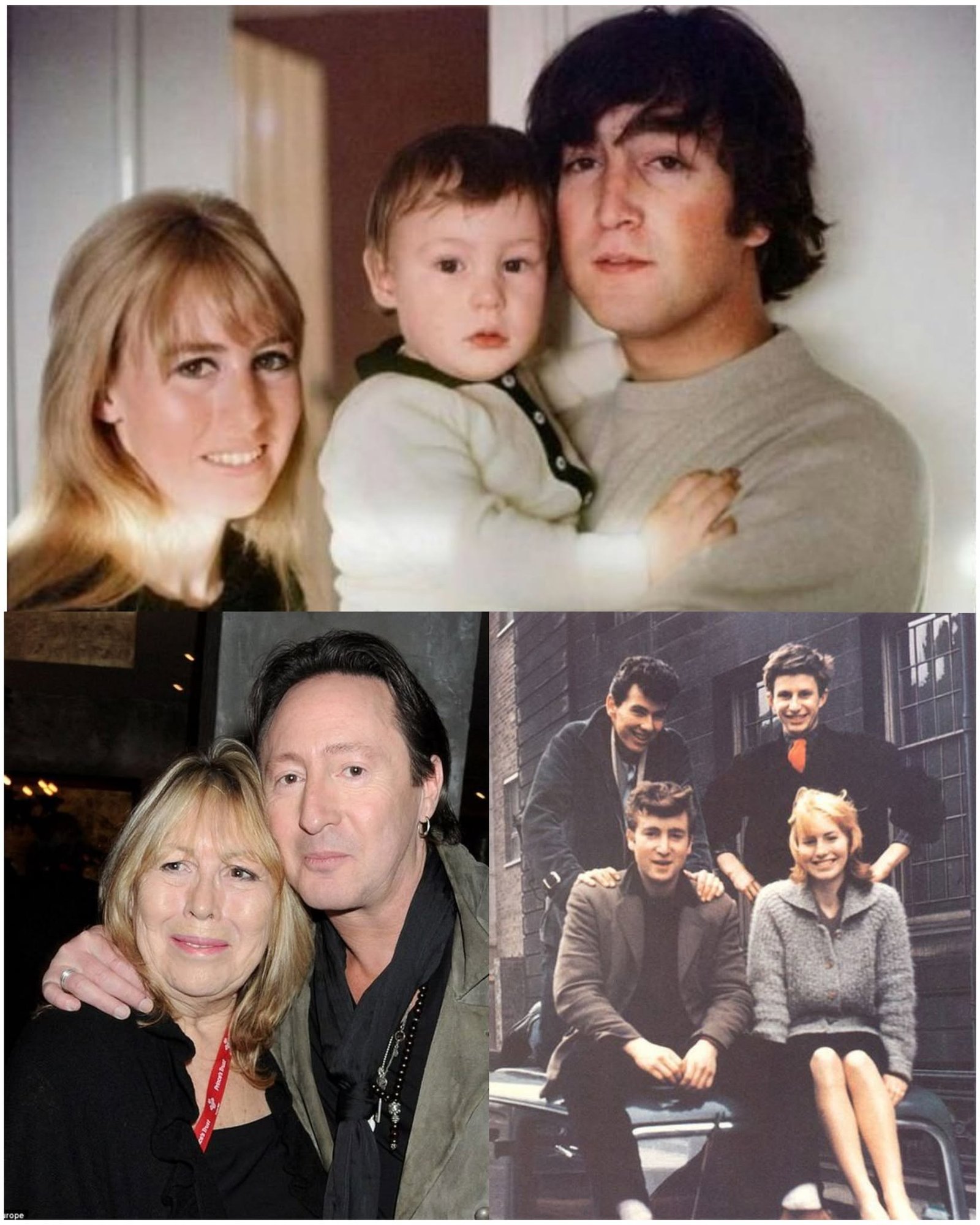
The Day Cynthia Lennon Walked Into Kenwood and Found Her Life Changed Forever
On a quiet day in 1968, Cynthia Lennon returned to Kenwood, the beautiful estate in Weybridge, Surrey, that she shared with her husband, John Lennon. She had been away in Greece, carrying with her the memories of a brief escape from the pressures surrounding one of the most famous men on Earth.
She returned expecting home.
She returned expecting her husband.
Instead, she walked into a moment that would permanently change the course of her life.
Inside the house, she found John Lennon sitting on the floor with Yoko Ono. They were facing each other, completely absorbed in their own world. It was a scene that required no explanation. The silence itself told the story.
But what made the moment unforgettable was not only the betrayal.
It was Cynthia’s reaction.
According to her own recollections, she did not scream. She did not throw accusations. She did not collapse into anger or create the dramatic confrontation that the world might have expected from a woman discovering her husband’s affair.
Instead, she calmly asked:
“Do you want dinner?”
It was a sentence that has remained one of the most heartbreaking details of their entire story.
Because sometimes the deepest pain does not arrive with shouting.
Sometimes it arrives quietly.
Sometimes a person already understands that something precious has ended before anyone says the words.
Cynthia Lennon had spent years building a life with John. She had known him before worldwide fame transformed him into a cultural icon. She had loved him when he was still a young art student in Liverpool, long before millions of people knew his face.
She was not just “John Lennon’s first wife.”
She was the woman who knew him before the world did.
And that made losing him even more complicated.
Because Cynthia was not losing a stranger.
She was losing the man she had helped become.
Before The Beatles Changed The World, There Was Cynthia
Long before the screaming crowds, the record-breaking albums, and the global phenomenon known as The Beatles, John Lennon was simply a young man searching for identity.
In 1957, at the Liverpool College of Art, John met Cynthia Powell.
Cynthia was not immediately drawn into the mythology surrounding him because, at that time, there was no mythology yet.
There was just John.
A talented, rebellious, sometimes difficult young artist with a sharp sense of humor and an intense personality.
Cynthia was different from many people around him. She was gentle, thoughtful, and steady. Where John could be unpredictable, Cynthia often provided balance.
Their relationship began during a period when John was still discovering who he wanted to become.
She knew the struggling musician.
She knew the insecure young man.
She knew the person behind the public image.
In 1962, they married privately after Cynthia became pregnant with their son, Julian.
The timing was complicated.
The Beatles were beginning to rise.
John Lennon’s life was changing faster than anyone could have imagined.
Suddenly, the quiet world Cynthia knew disappeared.
The man she married became one of the most famous musicians in history.
The Beatles were no longer just a band from Liverpool.
They became a global cultural revolution.
Every movement was watched.
Every word was analyzed.
Every relationship became public property.
And Cynthia found herself living in the shadow of a fame that belonged to someone else.
Life Behind The Fame Was Not The Fairy Tale People Imagined
From the outside, it appeared magical.
John Lennon was becoming a legend.
The Beatles were conquering the world.
Fans screamed his name everywhere he went.
But inside their private life, things were much more complicated.
Fame brought opportunities, but it also created distance.
John spent increasing amounts of time away from home. Recording sessions became longer. Tours became exhausting. The pressure of being a Beatle was unlike anything most people could understand.
Cynthia often found herself alone.
She was raising Julian while John’s world expanded beyond imagination.
The public saw the genius.
Cynthia saw the human being.
She saw his moods.
She saw his insecurities.
She saw the moments when the confidence disappeared.
Their marriage carried both love and pain.
John himself later admitted that he struggled emotionally during those years. He had unresolved issues from his childhood, including the trauma of losing his mother, Julia, and the complicated relationship he had with his family.
Cynthia became part of his emotional foundation.
But she was also affected by his struggles.
The world wanted to believe that John Lennon’s life was a beautiful story of music, creativity, and revolution.
The reality was more human.
And human stories are rarely perfect.
The Arrival of Yoko Ono and the End of an Era
When John Lennon met Yoko Ono in 1966, his life entered another chapter.
Their connection became intense very quickly.
For John, Yoko represented something new — an artistic partnership, a different way of seeing the world, and a relationship that felt connected to his changing identity.
For Cynthia, however, it represented the collapse of the life she had built.
The moment she returned home and discovered John and Yoko together became symbolic of something much larger.
It was not simply about an affair.
It was about realizing that the person she loved had already emotionally moved somewhere else.
The next day, John acted as though nothing had changed.
He kissed Cynthia.
He told her he loved her.
He suggested that Yoko meant nothing.
But Cynthia understood something important.
This was different.
This was not another difficult moment that could be repaired.
This was the end.
Sometimes relationships do not end when someone leaves.
Sometimes they end when one person realizes they are already alone.

A Divorce That Could Have Become A Public War
When John and Cynthia divorced in 1968, the entire world was watching.
John Lennon was not an ordinary husband.
He was a global superstar.
Every detail could become a headline.
Many people expected bitterness.
They expected accusations.
They expected revenge.
But Cynthia chose a different path.
During the divorce proceedings, John initially attempted to suggest that Cynthia had been involved with another man, Roberto Bassanini.
Cynthia denied the accusation.
Eventually, John acknowledged his own infidelity.
The divorce settlement gave Cynthia £100,000, custody of Julian, and financial arrangements for their son.
At the time, some viewed the settlement as generous.
Others believed Cynthia deserved far more considering the years she had spent supporting John before fame made him wealthy.
But Cynthia did not turn the divorce into a battle.
She accepted what was decided.
And she walked away.
That decision revealed something about her character.
She could have exposed private details.
She could have attacked John publicly.
She could have used her connection to one of the most famous men alive to become a permanent figure in celebrity drama.
She chose not to.
She chose peace.
Not because she was not hurt.
But because she refused to let her pain define her.
The Life After John Lennon: Finding Herself Again
After the divorce, Cynthia moved away from the center of celebrity attention.
She relocated to Wales and focused on creating a stable life for Julian.
She opened Oliver’s Bistro in Ruthin.
She became a mother first.
Not a celebrity.
Not the abandoned wife of a rock legend.
A mother.
While John continued making headlines around the world, Cynthia created something quieter.
A home.
A routine.
A childhood for Julian.
She understood something that many people around famous families learn:
Children do not need perfect parents.
They need stability.
They need love.
They need someone who stays.
Cynthia became that person for Julian.
She helped him navigate a childhood shaped by circumstances he never chose.
His father was one of the most famous musicians in history.
His family history was constantly discussed by strangers.
And yet Cynthia tried to give him something normal.
A chance to simply be a child.

The Song Paul McCartney Wrote For Julian Lennon
One of the most touching chapters of Cynthia Lennon’s story came not from John, but from Paul McCartney.
After John and Cynthia separated, Paul visited Cynthia and Julian.
He brought a red rose.
He offered kindness during one of the most painful moments of their lives.
Paul later explained that he felt deeply concerned for Julian, who was only five years old.
During a car ride, Paul began writing a song.
Originally titled “Hey Jules,” it was created as a message to a young boy facing a heartbreaking change.
The song eventually became:
“Hey Jude.”
One of The Beatles’ greatest songs.
Its message was simple:
“Take a sad song and make it better.”
Paul wanted Julian to understand that although life had changed, there was still hope.
There was still love.
There was still a future.
For years, millions of people sang “Hey Jude” without knowing the emotional story behind it.
Julian himself did not fully understand the song’s connection to him until decades later.
But the kindness behind it remained.
It was a rare example of compassion surviving even during one of the most painful moments in Beatles history.
Cynthia Lennon Refused To Destroy The Man Behind The Legend
In 1978, Cynthia published her memoir, A Twist of Lennon.
Many expected a revenge story.
They expected accusations.
They expected an attempt to damage John Lennon’s image.
Instead, the book was surprisingly human.
Cynthia wrote about memories.
About love.
About disappointment.
About a complicated relationship with a complicated man.
John attempted to prevent the book from being published, but Cynthia’s story reached the public.
Years later, in 2005, she published another memoir, John.
This time, she spoke more openly about the painful parts of their marriage.
She discussed emotional struggles, betrayal, and moments of hurt.
But even then, her writing was not filled with hatred.
She was not trying to destroy John Lennon.
She was trying to explain him.
That distinction mattered.
Cynthia understood that people are rarely only heroes or villains.
John Lennon was a genius.
He was also imperfect.
He was capable of great creativity.
He was also capable of causing pain.
Cynthia’s honesty did not come from revenge.
It came from experience.

The Day John Lennon Was Murdered
On December 8, 1980, the world stopped.
John Lennon was murdered outside his New York City apartment.
The news shocked millions.
For Cynthia, the loss was deeply personal.
She had every reason to feel anger.
Every reason to say “I told you so.”
Every reason to focus only on the painful parts of their relationship.
But she did not.
She grieved.
Because despite everything, John was still the man she had loved.
He was still Julian’s father.
He was still a person who had shared an important chapter of her life.
Cynthia supported Julian through the devastating loss.
Once again, she did what she had always done.
She held things together.
She protected her son.
She carried the emotional weight.
Cynthia Lennon’s Legacy Was Never About Being John Lennon’s Wife
Cynthia Lennon died on April 1, 2015, in Mallorca, Spain.
She was 75 years old.
Her son Julian was beside her.
After her passing, tributes came from many people, including former Beatles members and even Yoko Ono.
Many remembered her kindness.
Many remembered her strength.
But perhaps the most important part of Cynthia Lennon’s story is that she was never simply a chapter in John Lennon’s biography.
She was a person with her own journey.
She was a woman who experienced heartbreak in front of the entire world and still chose dignity.
She was someone who could have turned pain into anger but chose healing instead.
In a world where revenge often receives more attention than forgiveness, Cynthia Lennon’s quiet strength became something extraordinary.
She proved that surviving betrayal does not require becoming bitter.
She proved that losing someone does not mean losing yourself.
She proved that sometimes the strongest response is not a louder voice.
It is a calmer one.
The world remembers John Lennon for his music.
For his imagination.
For his influence.
But behind that story was Cynthia Lennon — the woman who knew him before the legend existed.
The woman who loved him before millions did.
The woman who carried the consequences of his choices and still protected the humanity of the man behind the name.
Her story is not a footnote.
It is a reminder that history is not only made by those standing on stage.
Sometimes history is also shaped by the people standing quietly beside them.
And sometimes the quietest person in the room is the one showing the greatest strength.