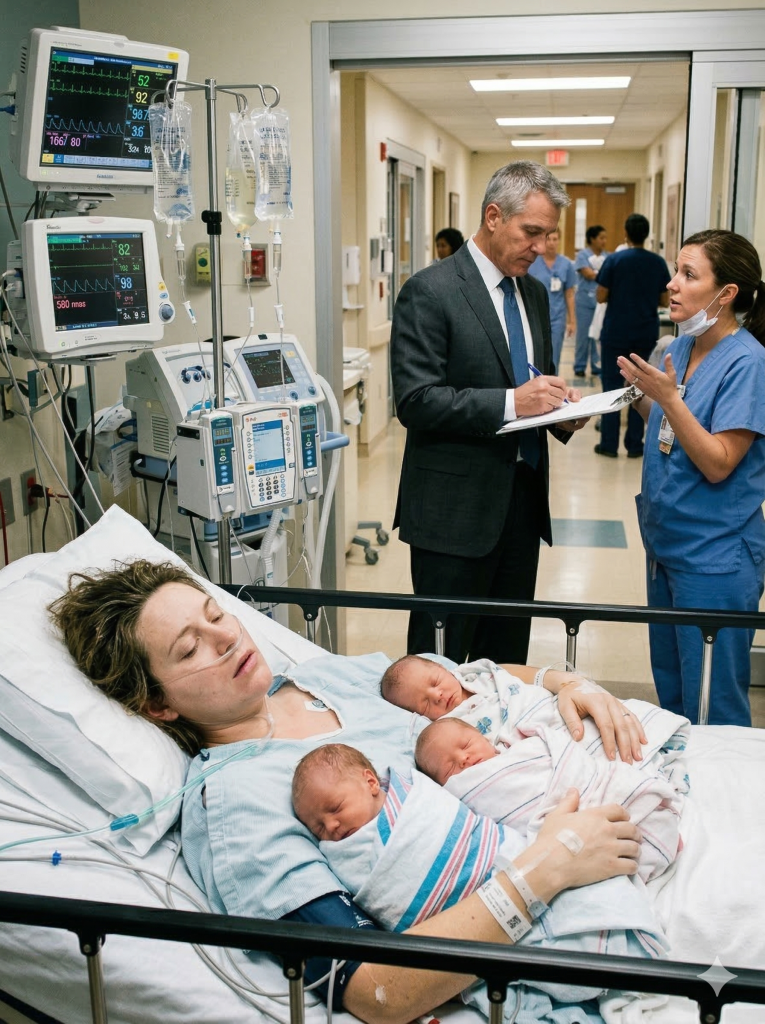
Consciousness did not return to me all at once. It came slowly, painfully, as if I were rising through something dense and resisting, every breath scraping against my throat, every movement reminding me that my body had been through something violent and irreversible.
The first thing I became aware of was the pain.
A deep, throbbing ache across my abdomen, the kind that made even the smallest shift feel like tearing. Then came the dryness in my throat, followed by the distant hum of machines that seemed to anchor me to the world I was struggling to re-enter.
A nurse leaned over me, her expression soft, her eyes carrying a quiet kind of compassion that told me everything before she even spoke.
“You’re awake,” she said gently.
The morning my divorce was finalized unfolded under harsh hospital lights that erased all sense of time. There was no sunrise, no warmth, no transition—just sterile brightness pressing down on a body that could barely keep up with its own survival.
Somewhere beyond the sealed doors of the neonatal intensive care unit, my three daughters were fighting for their lives.
They had arrived too early.
Too small.
Too fragile.
Machines breathed with them, supporting lungs that had not yet learned how to exist on their own, while doctors monitored every fluctuation as if it could determine everything.
And while they fought, everything else around them continued to move forward without hesitation.
Across the hallway stood Gabriel Hensley.

He did not look like a man whose family was in crisis.
His suit was immaculate, his posture controlled, his expression so composed that it bordered on detachment. While doctors moved quickly between emergencies and nurses carried urgency in every step, Gabriel remained still, as though he were attending a routine meeting rather than witnessing the collapse of his own family.
When his attorney handed him a pen, he accepted it without question.
He read the documents.
He signed them.
No pause.
No hesitation.
No emotion.
A physician approached him, exhaustion visible in the lines of her face.
“Mr. Hensley,” she said, her voice steady but urgent, “your wife is still in critical condition.”
Gabriel didn’t even turn.
“I am no longer legally connected to that patient,” he replied.
The words landed with a cold finality that silenced the space around them.
“That’s not how this works,” the doctor insisted, frustration breaking through professionalism. “She needs an emergency contact.”
“Update your records,” he said.
Then he walked away.
He didn’t look back.
Not at me.
Not at the ICU.
Not at the three lives he had just chosen to walk away from.
“My babies…” I whispered when I could finally speak, the words barely forming through the dryness in my throat.
“They’re alive,” the nurse said softly. “They’re very small, but they’re fighting.”
Relief came, but it wasn’t clean or complete. It was fragile, layered with fear, because survival had suddenly become something uncertain—not just medically, but structurally.
Minutes later, a hospital administrator entered my room, carrying the kind of neutrality that only exists in systems designed to function regardless of human cost.
“Mrs. Carter,” he began, then corrected himself seamlessly. “Miss Carter.”
The shift hit harder than any physical pain.
“I don’t understand,” I said.
“Your divorce was finalized this morning,” he explained. “All legal requirements were met.”
“I was unconscious.”
“That does not invalidate the process.”
Everything that followed happened with clinical precision.
My insurance coverage was terminated.
Financial responsibility was reassigned.
My status was updated across systems that did not hesitate, did not question, and did not care.
In a matter of hours, I had gone from patient to liability.
Recovery was no longer just about healing.
It became a negotiation.
Every treatment required approval.
Every day required justification.
Every decision was filtered through cost.
Several days later, Dr. Amelia Rhodes reviewed my file.
She didn’t hide her reaction.
“No treatment changes will be made without my direct approval,” she said firmly.
It was the first moment since I woke up that someone had chosen to stand between me and the machinery trying to reduce me to numbers.
That same evening, an attorney arrived.
Victor Langford.
He carried documents older than my marriage.
“Your family established a trust,” he explained, “designed to activate under specific conditions.”
My grandmother had created it.
And one of those conditions had just been met.
The birth of multiple heirs.
My daughters.
The realization shifted everything.
Gabriel had walked away believing he was severing responsibility.
In reality, he had disconnected himself from something far larger than he understood.
Something he could not control.
Leaving the hospital did not feel like freedom.
It felt like stepping into another battlefield—one built from contracts, leverage, and quiet strategy.
That’s when Elliot Mercer entered the picture.
He didn’t offer comfort.
He offered clarity.
“Silence protects leverage,” he told me. “Let him act on incomplete information.”
And Gabriel did exactly that.
He moved quickly, filing for custody, shaping narratives, presenting himself publicly as composed and stable.
Photos appeared.
Statements were made.
Everything was carefully constructed.
But beneath that surface, things were already shifting.
Audits deepened.
Questions multiplied.
And the foundation he relied on began to crack.
When we finally sat across from each other, the room between us felt colder than the ICU had.
“This doesn’t have to become a war,” he said smoothly.
“I’m asking for stability for our children,” I replied.
He slid the agreement toward me.
I read it.
Then I signed.
But not blindly.
Every clause had been placed with intention.
Every line carried weight he had chosen not to recognize.
Weeks later, the consequences surfaced.
In a boardroom filled with quiet authority, the decision was delivered without emotion.
“We are initiating leadership restructuring.”
For the first time, Gabriel’s composure broke.
Not dramatically.
But enough.
Outside of business, the unraveling was quieter.
Partnerships ended.
Legal proceedings closed.
Custody decisions aligned with what could be proven, not what could be performed.
And slowly, everything returned to balance.
Ninety days later, the trust activated exactly as it had been designed to.
Medical debts disappeared.
My daughters’ futures were secured.
And for the first time since I woke up in that hospital bed, I felt something unfamiliar.
Stability.
Months later, as the sun settled into a soft evening light, Elliot stood beside me.
“Will you build something lasting with me?” he asked.
I didn’t hesitate.
“Yes.”
Across the city, Gabriel Hensley sat alone.
Watching headlines.
Watching everything he once controlled move forward without him.
Justice didn’t arrive loudly.
It didn’t need to.
Because sometimes, the most powerful consequences are the ones that unfold quietly—until there is nothing left to hold onto.

When Silence Finally Turned Into Power
In the weeks that followed, life did not suddenly become easier.
It became clearer.
There was a difference.
Every morning began the same way—three small incubators replaced by three fragile cribs, three breathing rhythms I had learned to recognize even in my sleep, and three lives that depended on me with a quiet, undeniable certainty.
Motherhood did not arrive gently.
It arrived all at once, layered over exhaustion, stitched into healing wounds, and reinforced by a reality that left no space for hesitation.
I did not have the luxury of falling apart.
So I learned how to rebuild instead.
The World Gabriel Thought He Controlled
Gabriel, on the other hand, continued to move as if control were something he could restore through precision.
He scheduled interviews.
He attended events.
He appeared in photographs beside polished executives and carefully chosen allies, his expression composed, his narrative consistent.
A man who had made a difficult but necessary decision.
A leader who prioritized stability.
A father seeking structure.
But narratives built on omission rarely survive scrutiny.
And scrutiny, once it begins, has a way of expanding.
The Cracks That Couldn’t Be Managed
It started quietly.
A delayed audit.
A question raised during a board review.
A legal request that required documentation he could not easily provide.
At first, they were small inconveniences—things a man like Gabriel had resolved a hundred times before.
But this time was different.
Because this time, the questions were not coming from outside.
They were coming from within.
Investors wanted clarity.
Directors wanted accountability.
And once the divorce proceedings became part of the record—once the timing, the context, and the circumstances aligned—what had once been private began to shift into something far more visible.
Not scandal.
Not yet.
But doubt.
And in his world, doubt was far more dangerous.
The Part He Never Considered
What Gabriel failed to understand was not the law.
It was consequence.
He believed that by removing himself from responsibility, he had simplified his position.
What he actually did was create a record.
A sequence of decisions that, when placed side by side, told a story he could not rewrite.
A critically ill wife.
Three premature children.
A signed divorce executed in absence.
An immediate withdrawal of support.
Individually, each action could be explained.
Together, they formed something else entirely.
A pattern.
And patterns are difficult to defend.
The Day Everything Shifted
The boardroom where it happened was quiet.
Not tense.
Not chaotic.
Just quiet in the way that important decisions tend to be.
Gabriel sat at the head of the table, prepared to speak, prepared to guide, prepared to control the direction of the conversation as he always had.
But this time, the conversation did not follow him.
“We’ve completed our internal review,” the Chair said, her voice steady, measured.
There was no accusation in her tone.
No anger.
Just finality.
“We are moving forward with leadership restructuring, effective immediately.”
For a moment, nothing moved.
Then something subtle shifted in Gabriel’s expression—not panic, not anger, but recognition.
The kind that comes too late.
Because by the time consequences arrive in a room like that, the decision has already been made elsewhere.
What Remained
Outside of the corporate world, things settled differently.
There were no announcements.
No headlines that captured the full weight of what had happened.
Just quiet changes.
Calls that stopped coming.
Partnerships that didn’t renew.
Spaces that once welcomed him becoming… unavailable.
Loss, in his world, did not arrive loudly.
It arrived through absence.
What I Built Instead
My life did not return to what it had been.
It became something else.
Something smaller, at first.
More contained.
But also more honest.
There were nights when exhaustion still found me, when fear resurfaced in the quiet hours, when the memory of that hospital room pressed against my chest in a way that made it hard to breathe.
But those moments no longer defined everything.
Because each day, there was movement.
Three small hands learning to reach.
Three voices, fragile at first, growing stronger.
Three lives that had once been measured in percentages now unfolding in something far more certain.
Time.
The Kind of Stability That Can’t Be Taken
The trust had secured our future.
But what mattered more was something it couldn’t provide.
Agency.
For the first time, every decision I made belonged entirely to me.
Not filtered.
Not negotiated.
Not controlled.
Earned.
And that changed everything.
The Life That Continued
Months later, on an evening softened by quiet light, I stood by the window with Elliot beside me, the city stretching out in a way that no longer felt overwhelming.
“Do you ever think about him?” Elliot asked carefully.
I didn’t answer immediately.
Not because I didn’t have an answer.
But because I finally understood it.
“I think about what I survived,” I said.
“And what I chose after.”
That was the difference.
Not what was taken.
But what remained.
Across the city, in a place that once felt central to everything, Gabriel Hensley sat alone with the remnants of a life he had believed was permanent.
He still had the same city.
The same skyline.
The same name.
But none of it held the same weight.
Because control, once mistaken for strength, had revealed itself for what it was.
Temporary.
And somewhere between loss and rebuilding, between silence and truth, I realized something that no contract, no decision, and no person could take away.
I was still here.
And this time—I wasn’t surviving someone else’s choices.
I was living my own.