Last Updated on March 16, 2026 by Grayson Elwood
There are certain moments that a woman never forgets.
Not because they were beautiful or joyful, but because they revealed the truth of a situation she had been quietly avoiding for longer than she wanted to admit.
For Claire Dawson, that moment arrived on a gray Thursday morning while she was waddling down the hallway of her own home, one hand pressed to her lower back and the other steadying herself against the wall.
She was nine months pregnant.
The doorbell rang.
A young courier smiled and held out a clipboard.
“Signature required,” he said, in the cheerful voice of someone delivering a package.
Claire signed. She closed the door. She opened the envelope.
Inside were divorce papers. Her husband, Grant Ellis, had filed three days earlier without saying a word to her face. At the top of the first page was a handwritten note in his familiar slanted script.
It said: I’m not coming back. Don’t make this harder.
Before she had finished reading, her phone buzzed with a text from him.
Meet me at the courthouse at 2. We’ll finalize.
No apology. No explanation. Just instructions, as if she were another item on his afternoon to-do list.
The Courthouse Encounter She Would Never Forget
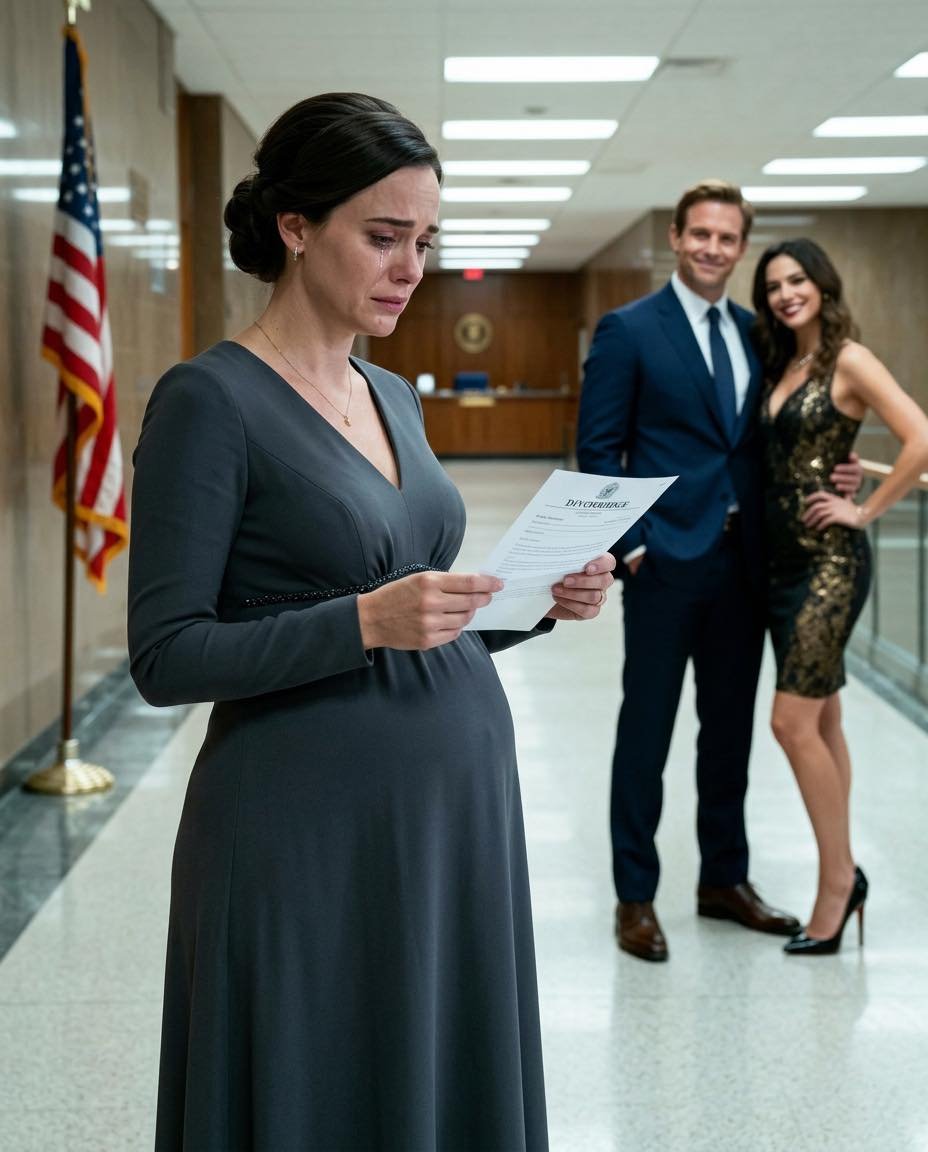
Claire arrived at the courthouse to find Grant already there.
He looked rested. He wore a crisp navy suit and carried himself with the easy confidence of someone who believes they have already won. Standing beside him, her manicured hand resting on his arm like it belonged there, was a woman Claire recognized immediately.
Tessa Monroe. A coworker from Grant’s office. The same woman Claire had once been told not to worry about. The same woman whose holiday party invitation Grant had urged Claire to skip because she was “too tired.”
Grant looked at Claire’s pregnant belly.
The expression on his face was not concern. It was not guilt. It was something closer to distaste.
“I couldn’t stay with a woman with a big belly like you,” he said flatly. His voice carried farther than he seemed to realize. Several people nearby turned to look.
“It’s depressing,” he added. “I need my life back.”
Tessa offered a small, sympathetic smile. “Grant really tried,” she said softly. “But men have needs.”
Claire’s throat tightened. She kept her voice quiet and steady.
“You’re divorcing me when I’m about to give birth,” she said.
Grant shrugged. “You’ll survive. My lawyer will arrange child support. I’m not your caretaker.”
Then he slid another document across the bench. A marriage application receipt. He and Tessa were planning to wed the following week.
Claire looked at the paper. Then she looked at him.
Grant leaned in close and lowered his voice so only she could hear.
“You were a mistake,” he said. “And honestly, you never brought anything to the table.”
He said it with quiet certainty. Not cruelty for its own sake. He genuinely believed it.
He believed she had nothing.
He believed she was nothing.
What Grant Ellis did not know was that Claire’s quiet, modest father, a man who lived in a simple house outside Dayton and avoided drawing attention to himself, owned a manufacturing company worth more than forty million dollars.
He also did not know that after Claire’s parents passed away two years earlier, she had inherited it.
She had never told Grant. Not once.
Standing in that courthouse hallway, watching him walk away with Tessa on his arm, she made herself a promise.
She would not beg. She would not chase him. She would rebuild her life quietly. And if Grant Ellis ever crossed her path again, he would finally understand what he had thrown away.
When Her Son Arrived and Her Purpose Hardened
Three days later, during a thunderstorm that rattled the hospital windows, Claire gave birth to her son, Noah.
Labor was long and difficult. At moments it felt like more than she could endure. But when the nurse placed Noah on her chest, warm and squirming and very much alive, something shifted inside her.
Purpose settled in where uncertainty had been.
Grant did not come. He did not call. The only message she received was from his attorney asking where to send the finalized divorce decree.
Her father arrived the next morning with a bouquet that looked far too cheerful for a sterile hospital room. He did not immediately ask questions. He kissed Claire’s forehead and spent a long time simply looking at Noah, as though memorizing every detail of his grandson’s face.
Then he said quietly, “Tell me what happened.”
Claire told him everything. The courthouse. The insult. The new wife standing there like a reward.
Her father’s expression barely shifted. He was a man who processed anger the way he processed business problems: silently and methodically. But his hand tightened around the plastic arm of the hospital chair until it let out a small creak.
“I’m sorry,” he said finally. “Not just for him. For me.”
Claire blinked. “For you?”
“I should have insisted on a prenuptial agreement,” he said. “I let you believe love was protection enough.”
She swallowed. “I didn’t want Grant to look at me differently.”
Her father nodded. “He looked at you differently anyway.”
A week after she came home from the hospital, someone from her old social circle posted photographs online. Grant in a tuxedo. Tessa in lace. Champagne. The caption read: When you know, you know.
Claire stared at the screen until her eyes hurt. Then she turned the phone face down and looked at Noah instead.
Rebuilding Quietly, On Her Own Terms
The months that followed were a blur of diapers, night feedings, and legal paperwork.
Grant’s attorney attempted to argue his income had recently changed, framing him as barely able to manage his expenses. This was happening at the same time Grant had acquired a new car, a new downtown condominium, and an expensive lifestyle with his new wife.
Claire’s father did not intervene directly. He paid for a skilled family law attorney who was not impressed by polished suits or clever financial presentations. Every deadline was enforced. Full financial disclosures were requested and obtained. Eventually a court-ordered support agreement was finalized that reflected what Grant actually earned rather than the fiction his lawyer had tried to present.
Still, Claire did not reveal who her father was.
It was not a strategy. It was pride.
She took a part-time remote position with a small nonprofit. She moved into a modest apartment. She allowed her life to appear smaller than it was because she wanted to know she could survive on her own before she leaned on anything her father had built.
When he eventually asked if she wanted to come back to the family neighborhood, she said yes. Not for the comfort, but for the stability it would give Noah.
She could not have anticipated how soon that decision would become relevant.
The Job Application That Changed Everything
Six months after Noah was born, her father called while she was rocking him to sleep.
“Claire,” he said, in the measured tone she recognized from childhood, “I need you to come by the office tomorrow.”
Her stomach tightened. “Is something wrong?”
“No,” he said. “Something is interesting.”
The next morning she took the elevator to the executive floor at her father’s headquarters. He was waiting with the HR director. A thick folder sat on the desk between them. Her father had the particular expression she remembered from her younger years, the look that appeared when a problem had just landed in his hands and he was deciding how to handle it.
He slid the top page of the folder across the desk toward her.
The name at the top of the job application stopped her breath.
Grant Ellis.
Her father kept his voice calm and even. “He applied for a management role in operations,” he said. “He listed your old shared address as his emergency contact.”
Claire looked at the paper.
“He doesn’t know,” she said quietly.
“No,” her father confirmed. “He doesn’t.”
Then he looked at her directly.
“Would you like to handle this,” he asked, “or should I?”
The Seat She Earned at the Table
Claire did not want dramatic revenge.
She wanted something quieter and more precise. She wanted Grant to understand that choices have consequences, and that the consequences of his choices had been accumulating the entire time he assumed she was powerless.
“Let me,” she told her father.
He nodded, as if he had already known that would be her answer. “Professionally,” he said.
Two days later, Grant arrived for his final-round interview five minutes early. He looked polished and self-assured. He had a new haircut and an expensive watch and the easy smile of a man who expected good news.
He walked into the conference room, took in the long glass table and the view of downtown, and saw the three people waiting for him.
His eyes landed on Claire.
For half a second, something behind his expression went blank. Then the smile returned, but it was forced now and working hard.
“Claire,” he said carefully. “What are you doing here?”
“I work here,” she replied.
He laughed softly, the way people laugh when they assume someone is joking.
The HR director spoke. “Mr. Ellis, this is Ms. Claire Dawson, Executive Project Lead.”
Grant looked between Claire and her father, searching for the punchline.
Her father spoke. “And I’m Richard Dawson. CEO.”
The silence that followed was the kind that fills a room entirely.
Grant’s eyes went back to Claire. There was no confusion in them now. There was anger, quick and sharp.
“You never told me,” he said tightly.
“You never asked,” she replied.
He shifted forward in his chair. “So this is about punishing me.”
“This is an interview,” Claire said, and she slid a document across the table.
It was not his resume. It was a printout of a court order, with a payment schedule and a note from the previous month showing he had paid late again.
The color left his face.
Her father spoke without raising his voice. “Your application lists reliability and integrity as core strengths,” he said. “But your record shows repeated failures to meet your obligations to your own child.”
Grant’s expression hardened. “That’s personal.”
“It’s relevant,” Claire said. “This role oversees vendor contracts and compliance. If you treat court-ordered commitments as optional, you are not suited for a position of trust.”
He leaned forward and lowered his voice into the tone he had always used when he wanted to regain control of a situation.
“Claire, come on. You know I’m a capable leader. We can be reasonable about this.”
She looked at him steadily.
She thought about the courthouse hallway. About the word depressing. About giving birth alone while he was at dinner with his new wife.
“No,” she said. “You’re not.”
The HR director ended the interview cleanly and professionally. Grant pushed his chair back as he stood, his eyes burning as he looked at Claire one last time.
“You think you won,” he said.
She did not flinch. “This is not a competition,” she replied. “It’s my son’s life.”
He left without shaking anyone’s hand.
What Freedom Actually Feels Like
In the weeks that followed, Grant’s child support payments became reliable and consistent. Not because he had changed as a person, but because he had finally understood that Claire was not the woman he thought he had dismissed on those courthouse steps.
She was not isolated. She was not struggling in silence. She was not someone he could pressure into accepting less than Noah was owed.
The quiet, ordinary-looking woman he had called depressing and a mistake had been standing on her own ground the entire time.
And the remarkable thing about the moment Grant walked into that conference room and finally understood what he had discarded was that Claire did not feel triumphant.
She felt free.
There is a difference between those two things, and it matters. Triumph is about the other person. Freedom is entirely your own.
She had spent the better part of a year proving something to herself: that she could function, provide, protect, and rebuild without leaning on anything except her own resolve. The inheritance existed. The company existed. Her father’s quiet, steadfast support existed.
But none of that had carried her through the nights when Noah would not sleep and the legal paperwork felt endless and the loneliness of single parenthood settled in like weather.
She had carried herself through those nights.
And now, on the other side of all of it, she sat at a conference table with her son’s future secured, her dignity completely intact, and a clarity about her own worth that no one had given her and no one could take away.
Grant Ellis had looked at a woman nine months pregnant and decided she had nothing to offer.
He had been wrong about nearly everything.
But he had never been more wrong than he was about that.
There are moments when we’re forced to confront the fragility of time, when every day…
I always thought Mr. Sloan — the grumpy old man next door — had made…
I once believed that love, once chosen carefully, would naturally protect me. I believed marriage…
Our five-year-old had reached that point in the day when every small task feels monumental,…
It’s been five years since I lost Karen, my wife, my best friend, and the…
They say money can’t buy love. But my ex-husband’s new wife clearly didn’t get the…
There are moments in life that arrive quietly, without warning, and end up teaching us…
At my own anniversary celebration, my mother-in-law suddenly pointed at me and announced, in front…
Mornings in Blue Springs always start the same way, and that sameness used to comfort…
A Quiet Evening Turns Uneasy It had been one of those long, draining days that…
An inspiring love story of resilience, forgiveness, and new beginnings There are moments in life…
But tied around it was a faded ribbon I recognized instantly. We used to save…
Linda sat on the edge of the old sofa, surrounded by dim light and silence…
The exam room was quiet except for the faint hum of fluorescent lights. Emma Harris,…
The landfill stretched before me like a wasteland of lost lives — a graveyard of…