On Saturday afternoons, Henderson’s Lanes glowed like its own small universe at the edge of town.
Cars rolled in and out of the cracked parking lot. Neon script buzzed in the front window, promising FAMILY FUN and LEAGUE NIGHTS beneath the faint outline of bowling pins that flickered when the weather was damp. Inside, the air was heavy with lane wax, stale popcorn, and the syrupy sweetness of cherry syrup spinning in the slushie machine.
To seven-year-old Sophia Ramirez, it might as well have been a palace.
She skipped two steps ahead of her mother as they walked in, sneakers squeaking on the linoleum, her bright pink jacket tied around her waist. The automatic doors parted, spilling noise over them: the thunder of balls slamming into pins, the triumphant shouts from lane twelve, the bleating arcade machines shouting for quarters.
“Stay close, Sofi,” Elena reminded her, as she always did. Not harsh, just steady. “You know the rules.”
“I know,” Sophia sang back, already craning her neck to spot which lane they’d get, which ball she’d claim as hers. “Don’t go outside, don’t talk to strangers, don’t run with the ball, don’t drink from other people’s cups, and no going near the bar. That’s the boring part.” She grinned over her shoulder. “Can I get my slushie now?”
Elena’s mouth twitched. “You win one game, you get your slushie.”
“I always win,” Sophia said, with the absolute confidence of someone whose world had never yet crumbled. She reached up and grabbed her mother’s hand anyway, fingers small and warm and sticky from the gummy bear she’d eaten in the car. “We’re gonna get the sparkly ball?”
“If no one else took it, yes.”
The ritual mattered. Elena had few things in her life she could control: her hours at the diner, the shifts she picked up at the café, the way money evaporated the moment it hit her checking account. But this—this she could orchestrate. Two games every other Saturday. Fries split exactly down the middle. One cherry slushie with two straws. Their universe, bought with tips and a stubborn refusal to let poverty steal her daughter’s childhood.
They found their lane. Sophia squealed when she saw the glittering six-pound ball still sitting in the rack like it had been waiting for her. She scooped it up with both hands and staggered under its weight, her pigtails bouncing.
“Watch this, Mommy!” she announced.
Elena stepped back, folding her arms, letting herself breathe. For a moment she wasn’t the tired single mother with circles under her eyes and a car that might or might not start when she turned the key. She was just Sophia’s mom, here in the loud, bright safety of a place everyone in town trusted.
Sophia waddled to the foul line, took a breath, and swung the ball with the solemnity of a professional. It rolled out of her hands, veering instantly toward the gutter.
“Come on, come on, come on,” she whispered, bouncing on her toes. By some miracle of warped boards or divine pity, the ball wobbled, straightened, and clipped three pins. They toppled in a clatter.
Sophia exploded into motion, throwing her arms in the air. “I’m a champion!” she shrieked.
“You are, mi amor,” Elena called, laughing. “Champion of the whole world.”
Sophia beamed, cheeks flushed, chest puffed out. Around them, Henderson’s Lanes hummed on. Kids darted between arcade machines. A cluster of men in team shirts argued about a spare. Someone from lane six whooped as all ten pins went down. Above it all, tucked behind the counter, the owner watched his kingdom with a careful, almost tender eye.
Arthur Henderson moved slowly these days. Time had thinned him, stooped his shoulders, left his hands mottled with age spots. But his eyes were sharp. People said he’d practically built the alley with his own two hands after inheriting it from his father. He knew each scratched lane, each sticky patch of floor, each regular who walked through the door.
He also knew Sophia.
He watched her now from a distance, the way her dark ponytails swung when she skipped, the way her nose scrunched when she concentrated on her throw. For just a heartbeat, the busy room flickered, and in her place he saw another little girl—barefoot in a summer dress, hair flying as she ran through a sprinkler in the yard behind the house he no longer owned.
Emily.
His throat tightened. The sounds of the alley receded like a tide pulling back. He saw an old car’s headlights, far too bright and far too close, reflected in a windshield. He heard the screech of brakes, the dull, sickening thump. For an instant, his chest seized and his hand went to the wall beside him until the wave passed.
When his vision cleared, he forced his face back into its familiar, benevolent smile. The mask slipped into place so easily now it was barely a conscious effort. He shuffled further down the counter toward the arcade, nodding at parents, slipping candies into small open palms, asking about school and church and league play.
But as Elena lined up her final frame, she caught him looking.
She’d always liked Mr. Henderson. Everybody did. He remembered her name, asked about her job, mentioned that “little champion” of hers whenever they came in. But now, as his gaze settled on Sophia, something shifted. The corners of his mouth sagged. The warmth faded from his eyes, leaving them dark and deep with something Elena couldn’t name.
It was gone in an instant. He smiled again, tipped his head, moved on.
She blinked, half-catching her breath, that small animal-brain alarm ringing once and then going silent. He’s an old man, she told herself. Old men get lost in their memories. She took her shot, knocked down seven pins, and let the moment go.
Later, she would replay it until it burned her nerves raw.
“Okay, little champion,” Elena said when the game tallies flashed on the screen. Sophia had actually won one of them by a single point, and she bounced as if she’d claimed Olympic gold. “Time to pay up and head home. You have homework.”
“Ugh, math,” Sophia groaned, but she slung her pink jacket over her shoulders and gripped an imaginary pencil between two fingers in mocking despair. “Can I at least do my spelling first? I like spelling better.”
“We’ll see.” Elena tapped her gently on the nose. “Come on. Slushie.”
The promise snapped Sophia back into focus. At the counter, the bored teenage worker with green hair didn’t even glance up from his magazine at first. Behind him, the red syrup in the slushie machine churned and glittered, the ice crystals catching the light.
“Cherry, please,” Sophia said, practically vibrating.
“One cherry slushie,” Elena echoed. “And can we get the shoe rental added to our tab?”
The teenager—Kevin, according to the name tag pinned crookedly to his chest—punched in buttons. “That’ll be twelve fifty,” he mumbled.
Sophia stood pressed against her mother’s hip, two hands cradling the cold plastic cup when Kevin slid it over. She took an enormous sip through the straw, the sugar hitting her tongue in a zing. For a second, the whole busy alley blurred as a cold ache shot up between her eyes.
“Brain freeze,” she whispered, giggling.
“Then sip slower,” Elena said.
She shifted her purse from one shoulder to the other, turning just enough to dig for her wallet. Her fingers brushed past a crumpled grocery list, a grocery-store receipt with negative dollars left, a packet of coupons she kept meaning to use. She stretched for the worn leather billfold at the bottom.
Ten seconds. Maybe fifteen. The length of a small breath, of a thought, of an entire life pivoting without warning.
She pulled out a ten and a five and laid them on the counter. Her mind was already jumping ahead: the drive home, the bath she’d ask Sophia to take, whether she had enough rice left for dinner.
“Out of fifteen?” Kevin asked. “Okay…”
He finally looked up, dragging himself out of whatever article had held him. His gaze slid past Elena toward something behind her shoulder. Someone had stepped up to the opposite end of the counter. Arthur Henderson, smiling his familiar, gentle smile, leaning in with a question about stock in the back kitchenette.
Kevin’s attention followed him.
Elena reached out to take the change.
“Ready to go, Sofi?” she asked, turning back.
Silence.
The spot beside her hip was empty. The weight that had leaned against her leg was gone. For a moment, the brain does what it always does with the impossible; it tries to paper over the hole. Her eyes moved automatically to the right, expecting to find her daughter swinging from the rope divider or peeking around her legs.
Nothing.
“Sophia?” she said lightly, annoyance flickering. “Come on, mija, no hiding.”
No giggle. No answering rustle.
Her gaze dropped, and something hot and sour surged into her throat. The slushie cup lay on its side on the checkered linoleum, slowly bleeding a spreading pool of violent red.
The world narrowed.
Cold, absolute dread speared through her. Her hand snapped out and grabbed the counter to steady herself.
“Did you—” Her voice came out cracked. She swallowed hard. “Did you see where she went? My daughter, she was just here.”
Kevin blinked, eyes still foggy with boredom that had nothing to do with him and everything to do with youth and a life not yet touched by real terror.
“No,” he said slowly, frowning. “I… I was looking at Mr. Henderson. I didn’t—she was just right there…”
Elena’s heart began to slam. The background noise that had been white and reassuring just moments before transformed into an oppressive roar. Every thud of a bowling ball sounded like a door slamming shut. Every shout twisted into a cry in her ears.
“Sophia!” she yelled, voice slicing through the clamor. Heads turned. A couple of moms in the arcade looked up from their seats. Someone pulled a ball from the return and paused mid-step. “SOPHIA!”
She sprinted toward the nearest lanes, scanning for pink. Pink jacket, pink shoes, the dark pigtails. She saw a dozen kids, none of them her daughter.
“She was just here,” she told a woman who stared at her with wide eyes. “Have you seen a little girl—she was just here—pink jacket, dark hair—Sophia!”
No one had.
The front doors of Henderson’s Lanes burst outward as she shoved them, breath hitching in short, desperate sobs. Outside, the early evening sky had gone the color of bruised peaches, the parking lot lights not yet fully awake, everything half-shadowed and hazy. Cars dotted the lot, a few empty spots like missing teeth. Beyond that, the road, the ditch, the thin clutch of trees.
“SOPHIA!” Her voice bounced uselessly off windshields, off the glass front of the building, off the indifferent sky.
No small figure darted between cars. No childish voice answered.
She staggered back inside, a wild animal trapped in her own panic. “Call 911,” she said to Kevin, but the words came out in a hoarse whisper that didn’t sound like her own voice. She grabbed his arm, her fingers digging in. “Call 911. Now. Someone took her.”
In the longest seven minutes of her life, Elena searched every aisle and corner she could reach. The shoe racks. The restroom. The entrance to the arcade, where blinking machines had never looked more sinister. She threw open the door of the janitor’s closet, sending a cascade of mops and plastic buckets clattering to the floor. Somewhere behind her, she heard the distant static squawk of Kevin’s voice trying to give an address over the phone.
By the time the shriek of sirens sliced through the autumn evening and blue and red lights pulsed against the front windows, Elena’s voice was gone.
The first officer through the door was a broad-shouldered man in his forties who moved with the stiff assurance of someone who believed his uniform meant control. He introduced himself later as Officer Jennings, but in that moment he was just a blur of navy and a notepad.
They isolated Elena in a small back office, away from the gathering onlookers. The room smelled of coffee, toner, and the faint tang of lane oil. There was a framed black-and-white photo of Henderson’s Lanes thirty years earlier hanging crookedly on the wall.
Detective Miller arrived fifteen minutes later, tie askew, hair flattened on one side like he’d just woken up from an uneasy nap. He’d been on the force for twenty years, and it showed in the sag of his face and the way his eyes flicked over Elena like he was already filing her into a category.
He took her statement with a kind of slow, methodical patience that felt like a slap.
“Your daughter’s full name?” he asked, pen hovering.
“S-Sophia Elena Ramirez,” she said. Her hands were shaking so badly she had to grip the edge of the chair.
“Age?”
“Seven.”
“What was she wearing?”
Elena described the pink jacket, the glittery sneakers, the jeans with the star patch on the knee. As she spoke, she saw each item in her mind’s eye, as if that specific combination of cloth and color might be the talisman that conjured her child back into the room.
Miller nodded, jotting it all down. “You say you only turned your back for a few seconds.”
“Yes.” Elena could hear how it sounded. Only. As if that word meant anything now. “I was paying. Ten seconds. Fifteen at most. I swear, she was right next to me. I could feel her against my leg.”
“And you didn’t see anyone suspicious near the counter. Anyone paying particular attention to you or your daughter?”
Elena thought about the blur of crowd, the families, the league bowlers, the laughter. About Mr. Henderson’s sad eyes, but she pushed it aside with a mental flinch. He was the owner. He was… safe. “No, it was crowded. I was looking at the cashier. I thought…” Her voice cracked. “I thought she was right there.”
Miller leaned back. “It’s a big place. Loud. There are side doors, back exits. Kids can be curious, wander off before you notice.”
“She wouldn’t,” Elena said fiercely. “She knows better. I’ve taught her. She would never go into the parking lot alone. She’s afraid of the dark, for God’s sake. She was right next to me. Someone took her. Inside the building.”
He gave her a look that tried to be gentle but came out condescending. “We have officers checking the parking lot, the street, the wooded area behind the alley. We’ll canvass the nearby businesses. If she wandered, we’ll find her.”
“I’m telling you—”
“We’re exploring all possibilities, Mrs. Ramirez,” he said, pen tapping against the pad. “We need to keep a calm head.”
Calm. Her daughter had evaporated from right beside her, and this man wanted calm? She lurched to her feet, knocking the chair back.
“You need to check every room,” she demanded. “Every storage closet, every maintenance hatch, every—everywhere. You haven’t found her outside, have you? She’s still here. She has to be.” Her voice rose. “Why are you wasting time talking to me? She’s here!”
Miller’s expression flattened. There it was—that subtle shift, the line between compassion and suspicion. In his mind, it was easier to imagine a mother too hysterical to see her own failings than a predator slipping into a family arcade. Mothers were supposed to keep their children safe. When they didn’t, it was neat, psychologically comforting, to imagine they must have done something wrong.
“We’re doing everything we can,” he said. “I need you to stay here and answer our questions. It’s important.”
Outside the office, the world moved on in bright, terrible fragments. Officers walked the lanes, their shoes squeaking on the polished floor. They opened doors, peered into storerooms, called Sophia’s name a few times. They checked the bathrooms. They sent one patrolman to the back to glance at the loading entrance, the dumpsters, the thin line of woods.
Nothing.
They asked Mr. Henderson if he had security cameras. He wrung his hands, nodding, his face a picture of devastated concern. He led them to a cramped closet where an ancient VCR sat stacked under a grainy monitor. When he hit play, the screen showed the counter—but the timestamp in the corner was frozen on 3:12 p.m., an hour before Sophia had vanished, and the same woman in a floral dress walked past the frame every thirty seconds.
“It’s been acting up for weeks,” he said, voice thick with regret. “I meant to get it serviced, but you know how it is.” He spread his hands in apology.
The detective sighed, rubbing his forehead. “We’ll send someone to look at it, but…” His tone suggested he wasn’t expecting miracles.
Nobody questioned why a man who’d run the cleanest alley in the county for forty years would let his cameras sit broken when they faced the front door.
To them, Arthur Henderson was the bowling alley. He sponsored the youth leagues, handed out trophies at the end-of-season banquets, kept a shoebox of financial hardship forms under the counter so kids whose parents couldn’t pay the full season fee never actually had to miss out. He was gentle. He was kind. He was as much a fixture of their childhoods as the smell of lane wax and the clatter of pins.
It was easier to believe in a stranger in the dark than a monster behind those crinkled eyes.
By midnight, the parking lot was lit like a crime scene in a movie. Police tape fluttered in the breeze across the front doors. Reporters began to arrive, hovering at the edge of the lights, rehearsing their introductions under their breath. Volunteers gathered with flashlights to search the tree line and the ditches.
When Elena finally staggered out of the office, her statement given and her fingers numb from clutching her own knees, the world looked like it had been scrubbed of color. Everything was sour and gray and unreal. An officer guided her to a bench against the back wall. People stared, some with naked curiosity, some with sympathy already curdling into pity. One woman murmured, “That must be the mother,” like Elena wasn’t three steps away.
She heard fragments of conversation.
“…Amber Alert’s going out…”
“…they think she walked out…”
“…stranger in a van, had to be…”
“No,” Elena whispered to herself. “No.”
Mr. Henderson sat on a chair near the shoe counter, head in his hands, shoulders shaking. When he raised his face, his eyes were wet.
“Mrs. Ramirez,” he said, his voice ragged. “I am so, so sorry. I should have—” His jaw trembled. “Nothing like this has ever happened here. Never.” His thin hand closed around hers for a second, a gesture of shared grief. “We will find her.”
She yanked her fingers back like she’d been burned, barely even registering the hurt in his eyes. The whole building felt toxic, like it had swallowed her daughter whole.
The next days bled into each other. Press conferences. Flyers. The photo of Sophia in her favorite purple shirt was suddenly on every lamppost, every bulletin board, every evening news broadcast. A little girl vanished from a family bowling alley. A mother who turned her back “for a moment.” A beloved local business standing shoulder to shoulder with police at the podium, offering a five-thousand-dollar reward.
Arthur Henderson stood beside the chief, his mouth a grim line, his eyes shining with tears when the cameras panned to his face. “We are a community,” he said into the microphone. “We look after our own. We will not rest until this little girl is home.”
The town clung to that narrative like a blanket. A stranger had come from outside and stolen one of their own. It was devastating and horrible, but it made sense in a way that didn’t force them to question people they knew.
In a small windowless room behind Henderson’s office, the lie solidified with each passing hour.
The first thing Sophia knew was darkness.
Not the cozy darkness of her bedroom at night, softened by the nightlight in the hall and the cartoon stickers on her walls, but a thick, absolute black that pressed against her eyes. Her slushie had been in her hand one moment, the straw between her lips, sweet cherry on her tongue, Mr. Henderson’s kind voice in her ear promising something about “a surprise.” The next, the world had slammed shut.
“Hello?” she whispered.
Her own voice sounded wrong. It had nothing to bounce off, nothing to dissolve into except more heaviness.
“Mommy?” she tried.
No answer. Her chest clamped. She ran her hands in front of her, palms scraping against something soft but firm—padding on the walls, though she didn’t know the word for it. She turned, heart jackhammering, arms outstretched. Wall. Wall. Wall. No handle.
Her legs thudded against a low cot. She tripped and fell, knees rattling against metal, then found the thin mattress. The smell of the room was old, like dust and paint and something else she couldn’t place.
“Mommy!” she shouted, this time louder. Her throat burned with the force of it.
After what felt like a long time measured in breathless sobs, there was a sound: a soft scrape, a mechanical sliding. A line of brightness appeared low in one wall, then a slot opened, a little door within the door. A tray slid through on a small shelf. A carton of milk, a plate with a sandwich cut into two perfect triangles.
“Sophia,” came Mr. Henderson’s voice. Muffled, distant, but unmistakable. “It’s okay, child. You’re safe. I need you to eat something.”
She ran to the slot, fingers jamming in. “Where’s my mom? I want my mom. I—I can’t see—”
“There was a bad man,” he said softly. “He was watching you. He wanted to take you. I brought you here so he couldn’t hurt you. This is a special room, a safe room. You’ll be okay. I’m going to take care of you.”
She didn’t understand. Her heart hammered so hard she felt sick. “I want to go home,” she cried. “Please. I’ll be good. I didn’t… I didn’t do anything.”
“You didn’t,” he said quickly, voice thickening with emotion. “You are perfect. That’s why I had to keep you safe. Eat a little, all right? I’ll come talk to you later.”
Then the slot slid shut.
Time dissolved. At some point, a light flicked on overhead, flooding the small room in dull yellow. Its suddenness made her yelp and cover her eyes. She sat there for a long time with her hands pressed to her face, the image of the bowling alley burning behind her eyelids: the lanes, the arcade, the slushie machine, her mother’s profile as she turned to get her wallet.
No matter how hard she tried, she couldn’t make that last memory stretch out longer. It was always too short.
Sophia screamed until her throat was raw. She kicked the door until her bare toes bruised. She sobbed and called for her mother and then, when her voice gave out, she curled around the stuffed bear that had been waiting on the cot, its button eye loose, its fur thin from long-ago hugs.
“Emily,” said Mr. Henderson quietly from the other side of the wall during one of those early days, his slip of a different name slicing through her cries like a knife.
“Sophia,” she whispered back, but he didn’t seem to hear.
When he finally opened the hidden door and stepped inside, he brought light with him—literal and otherwise. He loomed in the doorway at first, his frame blocking the hall, but he made his movements slow, deliberate, his voice soft. He held a book in one hand.
“I brought you something,” he said. “Stories. You like stories?”
She stared at him, trembling. “Why can’t I go home?”
His face crumpled. “Because the world doesn’t know how to keep you safe,” he said. “But I do. I can. I’m going to make sure nothing like what happened to…” He trailed off, swallowing. “Nothing bad is going to happen to you here. Not ever again. I promise.”
It made no sense to a seven-year-old brain, but promises and tone sometimes matter more than logic. He didn’t yell. He didn’t hit. He didn’t drag her by the arm. He sat on the edge of the cot, leaving space between them, opened the book with shaking hands, and began to read.
Outside, the world spun forward without her.
The official search for Sophia lasted a week in any meaningful way. The volunteers dwindled as people needed to go back to jobs and children and their own aching lives. The news cycle moved on to other tragedies, other missing faces. The reward poster remained in the window of Henderson’s Lanes, taped beside daily specials and league sign-up sheets.
At home, Elena slept in fits and starts, clothes unchanged, her heart permanently lodged somewhere between her lungs and her throat. She woke from dreams where Sophia was down the hall, where a small voice called “Mom?” only to stagger into an empty bedroom decorated with unicorn posters and a bed that still held the faint smell of her daughter’s hair.
She kept calling the police.
At first, they answered. They updated her in vague, bureaucratic phrases: “We’re following up on leads.” “We’re coordinating with other agencies.” “The Amber Alert is still active.” After a month, their tone cooled. After three, calls were routed to voicemail, returned days later, and then not at all.
On a gray morning nearly a week after Sophia disappeared, Detective Miller called.
“I’m sorry, Mrs. Ramirez,” he said. His voice was professional, worn, like someone delivering bad news for the hundredth time. “We’ve exhausted all immediate leads in the area. The case will remain open. If any new information comes in, you’ll be the first to know. But at this point…”
At this point, he meant, they were filing her daughter under Lost. A number in the column of unresolved.
Elena hung up the phone and stared at the wall she’d already begun covering in flyers and scribbled notes. Time had frozen on October fourteenth. The calendar pages flipped in the rest of the world, but that date stayed lodged in her chest like a shard of glass.
Nobody was coming.
So she went to war alone.
Elena learned the fluorescent buzz of the library’s basement microfiche machines, the way her own face looked reflected in the glass—eyes swollen from crying, jaw set in a line that hadn’t been there before. She rolled through years of local papers, looking for names and phrases that might matter. Henderson’s Lanes. Missing children. Accidents.
She found Emily in a pale column on page three of a twenty-five-year-old edition. “Local Girl, 7, Killed in Drunk Driving Accident.” There was a school photo: dark hair, crooked smile, missing front tooth. The resemblance hit her like a physical blow.
She went home and taped that obituary next to Sophia’s missing poster.
Next, she requested property records. Who owned Henderson’s Lanes? How long had it been in the family? She dug up old photos of ball teams and chamber of commerce events. Arthur Henderson appeared again and again, a background figure aging in snapshots, each year hollowing his eyes a little more.
If the idea that he might be involved had appeared in the initial investigation, it hadn’t lingered. A few officers had glanced at him, then at the clean family-friendly alley, at his donations to the PTA, and moved on.
Elena didn’t have their blind spots.
The anger that had been simmering beneath her grief began to harden into something sharp and narrow. She wrote Henderson’s name in the center of a notepad and circled it, connecting lines to everything she knew: Emily’s death. The faulty security system. His presence at the counter. The way the boy at the register had looked away at just the right moment.
Kevin.
Three years after Sophia vanished, Elena found him behind the counter at a gas station on the edge of town. His hair was a dull brown now, the green dye gone, but she recognized the droop of his shoulders, the way his fingers tapped on the laminate surface when he was bored. He scanned her lottery ticket without much interest, eyes flicking to the blinking screen behind her.
“I remember you,” Elena said.
He froze, the beep of the scanner cutting off abruptly. When he looked up, his gaze locked on her face, confusion flickering into recognition. Color drained from his cheeks.
“I…” He swallowed. “Ma’am, I don’t—”
“You worked at Henderson’s Lanes,” she went on, voice very calm, very flat. “The day my daughter disappeared. Kevin, right? That was your name on your little tag.”
“I already talked to the cops,” he said quickly. “I told them everything I knew.”
“I don’t think you did.” She leaned closer over the counter, lowering her voice. “Because I remember that day too. Every second. I remember turning to get my wallet—ten seconds, fifteen at most. And I remember seeing you in the reflection of the gumball machine. I saw Mr. Henderson walk up to you. I saw you look at him, away from me, just for a moment.” Her eyes bored into his. “What did he say to you, Kevin?”
He stared at her as if she’d pulled the memory out of his skull and held it between them.
In his mind, a fifty-dollar bill slid into his palm, crisp and unbelievable. “Go restock the cups in the back, would you?” Mr. Henderson had said with that same polite smile he always wore. “Take your time.” It had felt like a kindness, a small gift. A lucky break in a boring shift.
Kevin’s throat bobbed. “Ma’am, I—”
“What did he say?” Elena repeated softly. “What did he do to make you look away at the exact moment my daughter vanished?”
“You’re crazy,” he blurted, voice too loud, too shaky. He backed away, knocking over a display of gum. “I didn’t— I didn’t see anything.” He turned and fled into the back room, leaving her standing alone with the buzzing refrigerator cases and the smell of gasoline.
It wasn’t a confession. But it was confirmation.
Henderson had engineered the moment. He’d created the ten-second gap her whole life had fallen into.
Back inside the small room, Sophia’s world shrank to ten feet by ten feet, eight inches of padding, and one man’s voice.
He kept to a schedule so precise that years later, when she woke in the night sweating, she could still tell you what time it was by the feel of her own hunger. Breakfast slid through the slot at eight: a bowl of cereal, milk already poured, a banana sometimes, a slice of toast. Lunch at noon: peanut butter sandwich, carrot sticks, another carton of milk. Dinner at six: turkey sandwich, chips, and, always, a cherry slushie, icy crystals melting blue-red into the paper cup.
“Special treat,” he’d say from behind the door, his voice soft. “It was Emily’s favorite.”
She didn’t know who Emily was, not really. Sometimes, late at night, when he sat inside her room on the metal folding chair he’d brought in, he would forget himself and call her by that name. “Emily, read the next line for me.” “Emily, we don’t slam our cups.” “Emily, do you remember the park…”
Sophia would hesitate, fingers on the page or cup halfway to her lips, and quietly correct, “It’s Sophia,” but lightly, like she was afraid of bruising something inside him.
He taught her to read chapter books with dog-eared covers. He brought in math worksheets and explained them in a patient murmur, tapping his finger under each problem. He never raised his hand to her. He never yelled. The worst he did was go silent if she asked too many times about her mother, retreating behind the door, his voice distant and strained when he finally answered.
“She wasn’t careful enough,” he said once, when she’d cried for hours, demanding to know why her mother didn’t come. “The world took you from her. I’m not going to let it do that again.”
For a child whose only contact with the outside world was a man repeating that story, it began to burrow in. The memory of the bowling alley grew fuzzy. Her mother’s face slipped at the edges. Time in the room felt unending, looping: meals, stories, sleep, the overhead light snapping off at night, plunging her into darkness, then on again twelve hours later.
Outside the walls, the building aged. Pipes groaned. Seasons passed. League championships came and went. Babies were born. People died. Sophia turned eight. Nine. Ten. Eleven. The world didn’t know.
On the fifth anniversary of the day the world had ended for Elena, she parked her car across from Henderson’s Lanes and sat with the engine off, watching.
The neon sign flickered on in the dusk, buzzing faintly. Families walked in, jackets zipped against the fall chill. Kids pressed their faces to the glass case of bowling balls and giggled at their warped reflections. She could see the familiar silhouette of Mr. Henderson behind the counter, moving slowly, a little more bent now, hair thinner, but still there.
She sat with her hands numb on the steering wheel, heart hollowed out. This had become her ritual: once a year, she came here to remind herself that somewhere in the world there were still parents and children who got to leave their Saturday afternoon exactly as they’d entered it—together.
As she watched, a teenaged boy in a red polo walked out with a trash bag slung over his shoulder. He laughed with a co-worker and tossed the bag into the dumpster with an easy swing. Elena closed her eyes.
Inside the building, in the oldest parts of its bones, a copper pipe gave way.
It had been installed in 1952, before Henderson’s father even thought of turning the space into a bowling alley. Over decades, water had whispered through its narrow gut, leaving a greenish crust of corrosion along a weak seam. Day after day, year after year, the metal thinned.
On that ordinary evening, the struggle ended with a soft, surrendering pop.
Water began to leak—not in a dramatic burst, but a patient, seeping trickle—into the narrow cavity between the office wall and the hidden room Henderson had built. It traced its way down wooden studs, soaked into drywall, gathered at the baseboard like a secret being whispered where no one could hear.
At first, all Henderson noticed was the smell.
He was sitting at his desk a few days later, painstakingly balancing the week’s receipts, when it hit him—a damp, earthy scent, like wet cardboard forgotten in a basement. He wrinkled his nose, glancing around. The floor looked the same. The ceiling showed no stains.
Probably nothing, he told himself. Old building. Old buildings smell.
The next day, the faint must decreased, then returned stronger. By the third, a dark bloom had appeared on the wallpaper behind his desk, an ugly, spreading stain the size of a dinner plate.
The wrong wall.
Panic crawled up his spine, cold and electric. He stood on shaking legs and touched the discolored spot with his fingertips. They came away damp.
In his mind, the structure he’d created was perfect. He’d been meticulous when he built the hidden room—a space within the space, soundproofed, insulated, the door’s seam invisible behind a filing cabinet. It had been his sanctuary for years before Sophia. Now it was… everything. The only place he could breathe. The thought of it being breached, of someone prying at its edges, sent his heart skittering.
He tried to find the shutoff valve himself. The basement was a warren of rusted pipes, old electrical panels, forgotten storage crates. The diagram his father had drawn thirty years ago was useless now, lines of faded pencil on yellowing paper. He turned knobs at random, listening for changes in the faint hiss in the walls, but nothing stopped the seep.
By the end of the week, the stain had doubled in size. The wallpaper peeled in damp curls. Water squelched when he stepped on the carpet. The smell grew rank, sour with budding mold.
If he did nothing, the wall would eventually crumble. Water would find a way through into the hidden room. It could short the light, rot the beams, cause something to cave in. Someone might notice a drip somewhere they shouldn’t, follow it back, start asking questions.
Henderson sat at his desk, hands shaking so badly he had to lace them together, and stared at the wall that protected his secret.
He’d been so careful for so long.
He had no choice.
He opened the yellow pages with a kind of grim resignation, flipping past large ads from big companies—plumbing chains with smiling mascots and 24/7 EMERGENCY SERVICE banners. Too professional. Too big. They’d send a team, maybe. They’d talk. They’d look.
He needed someone small.
His finger stopped on a two-inch ad: MARCO’S PLUMBING – Fast, Fair, Reliable. A local number, no logo, just text.
“Marco’s Plumbing,” a young man’s voice answered when he dialed.
“Ah, yes, I’ve got a little leak in my office wall,” Henderson said, trying to keep his tone even. “Old pipes. It’s probably nothing major.”
“We’ll take a look,” the man said. “Tomorrow morning okay?”
Marco Hernandez—no relation to Henderson, though people sometimes misheard over the phone—pulled into the parking lot at nine the next day in a white van with his business name stenciled on one side in letters that weren’t quite straight. He’d started the company two years earlier after leaving a plumbing firm tired of someone else pocketing most of what he earned. He was good at what he did. He took pride in making things work again.
Henderson went to meet him at the front door, palms damp.
“Thanks for coming,” he said. “The office is back this way.”
Marco stepped inside and blinked at the dim interior. He’d bowled here a couple of times as a teenager, never very well, but he’d always liked the smell and the way the pins crashed. He followed the older man down a hallway to the cracked door labeled OFFICE.
The smell hit him as soon as he stepped in. Moist, pungent, the scent of water where water wasn’t supposed to be.
“Wow,” he said with an involuntary whistle. “You’ve got a serious leak going on.”
The wall behind the desk was a mess of sagging wallpaper and discoloration. When he pressed his fingers against it, the drywall flexed.
“I imagine it’s coming from the sink.” Henderson gestured toward the corner where a small sink with a rusted faucet clung to the wall. “It started just there, so…” He trailed off, watching Marco’s face with anxious intensity.
Marco shook his head, already reaching into his bag for a moisture meter. “Maybe. We’ll see.” He pressed the prongs into the wettest spot. The meter beeped angrily. He moved to the side, toward the sink. Still high. Then further away. Lower.
“The source isn’t the sink,” he said. “It’s behind the wall. Pipe probably burst in the cavity. I’m going to have to open it up to get to it.”
Henderson’s hands clenched. “Open… it up?”
Marco looked at him, misreading the old man’s fear as simple worry about damage. “I’ll make a clean cut. Just enough to get my tools in. We’ll patch it after, you’ll barely know I was here.” He pulled a marker from his pocket and drew a neat square on the wallpaper over the worst of the damage. “Right here.”
Henderson’s throat felt too tight to swallow. He wanted—desperately—to say no. To tell him to leave. To claim it had stopped on its own and he’d changed his mind. But he saw, in Marco’s clear, steady eyes, what any protest would look like.
Suspicious.
He’d built a life on being the opposite of suspicious.
“Do… do what you need to do,” he croaked, stepping back.
The drywall saw whirred to life with a high-pitched buzz. White dust puffed into the air as Marco guided the blade along the lines he’d drawn. It was quick work—less than a minute of cutting, then the square of damp drywall sagged inward.
Marco set the saw aside and carefully pulled the piece out, revealing the dark space behind.
Instead of pipes and insulation, there was another wall. Close behind the first, maybe six inches of air between them. This one was dark wood, smooth, with a small metal rectangle inset low to the floor.
“What the…” Marco leaned closer. “Is that… a mail slot?”
Sweat broke out along Henderson’s spine. “Must be from some old renovation,” he said, hoping his voice didn’t shake as much as his hands. “We’ve changed this building so many times over the years. Probably… probably nothing.”
Marco wasn’t really listening. Curiosity, that reflex that made him a good plumber and an abysmal conspirator, had already taken over. He took out his flashlight and shone it through the gap, angling the beam downward.
At first, the light hit wood. Then metal. Then the opening of the small slot. He bent, adjusting the angle, trying to get a better look at the void below.
The beam slid through the slot and painted a rectangle of brightness on the floor of the hidden room.
He saw a bare foot.
For a moment, his mind refused to process it. It cataloged facts instead. Pale skin. Small toes. Thin ankle. The hem of a gray dress.
The light travelled upward.
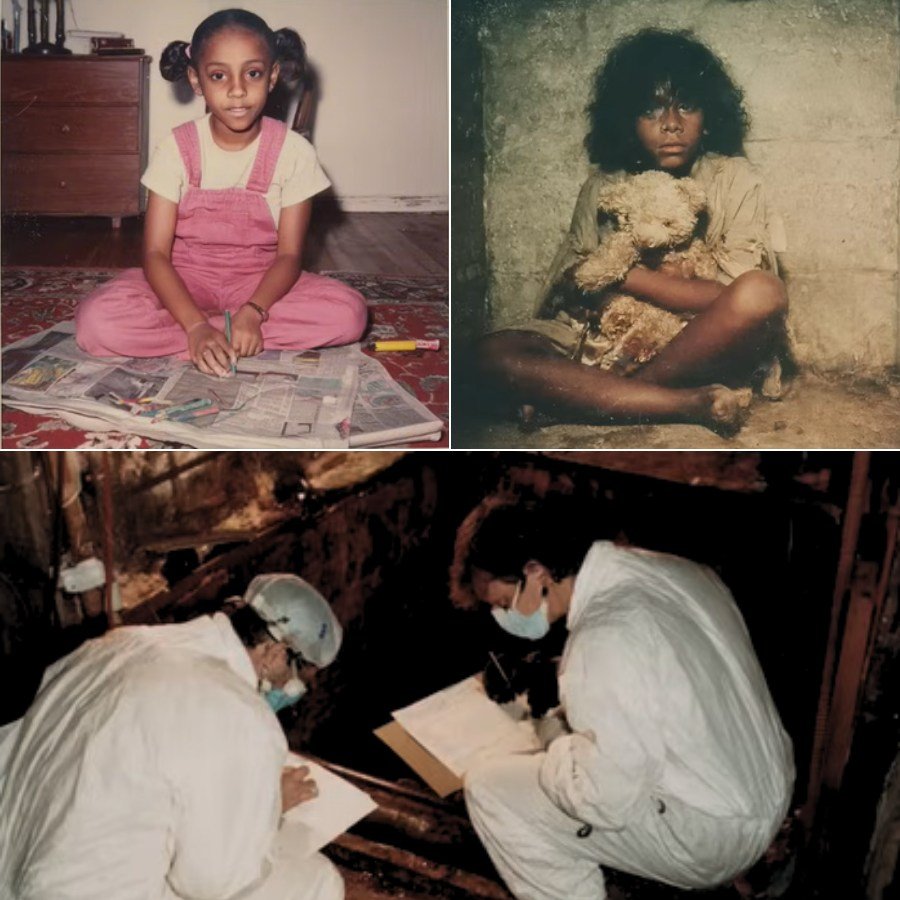
There was a frail body huddled in the corner of a tiny, windowless room. Long dark hair, matted and tangled, spilled over thin shoulders. The child’s hands were clamped over her ears against the noise of the saw.
As the beam moved across her face, she flinched and lifted her head.
Two enormous eyes, pupils blown wide by years of dim light, stared directly into Marco’s.
His breath caught. The flashlight slipped from his fingers and clattered onto the carpet, its beam spinning wildly, shadows jerking across the office like something alive.
He stumbled back, heart hammering against his ribs.
“What… who is that?” he whispered.
Henderson’s face had gone utterly, terrifyingly blank. When he moved, it was like watching a marionette pulled by invisible strings. He lunged forward and grabbed Marco’s arm.
“You saw nothing,” he hissed, voice thin with panic. “It’s nothing. Just storage.”
That touch broke the spell. Adrenaline crashed into Marco’s system.
He shoved the old man away, hard enough that Henderson collided with his desk. Then he dove for his phone.
His fingers fumbled, sliding on the cracked screen as he punched in three numbers he’d never dialed in his life with such urgency.
“Nine-one-one, what’s your emergency?” The dispatcher’s voice was cool, practiced.
“This is Marco Hernandez, I’m at Henderson’s Lanes—the bowling alley—on Route 9,” he babbled. “I was cutting into a wall to fix a leak, and there’s… there’s a room. There’s a room behind the wall and there’s a girl in there. There’s a little girl in the wall.”
The dispatcher’s questions anchored him enough to get through the address, his name, the bare details. Behind him, Henderson sank into his chair and put his face in his hands. His shoulders shuddered, a sound like a broken animal escaping him.
In the hidden room, the sudden racket had been overwhelming. The buzz of the saw. The tearing of the wall. A voice shouting words she didn’t recognize. Sophia cowered in the corner, her bear clutched to her chest, her palms over her ears. Light spilled in where there had never been light before, even if only in a thin beam.
She knew, somehow, without understanding logistics or plumbing, that the world outside had finally breached her cell.
When the sirens came this time, they stopped in front of the bowling alley.
Chief Davies was the one who stepped out of the first car, not Detective Miller. Miller had retired the year before, his name floating softly around the station with words like “old school” and “burnt out” attached to it. Davies had taken the job two years ago and inherited a filing cabinet full of other people’s failures.
The Ramirez case had stuck with him even then. A seven-year-old girl, vanished from a fluorescent-lit bowling alley crowded with witnesses, never to be seen again. He’d looked at the neat conclusion in the file—a probable stranger abduction—and felt, even as a junior officer in another town, that something didn’t line up.
“Show me,” he said when he reached the office.
Marco, still pale, still shaking, pointed at the hole in the wall.
Davies crouched, peered through, and saw the dark paneling and the metal slot. Something hot and ugly rose in his throat.
“Get a pry bar,” he snapped to the nearest officer. “And a sledgehammer. Now. We’re taking this whole section down controlled. And radio the station—pull the Ramirez case from cold storage and get it here five minutes ago.”
They didn’t hit the door with one wild smash. They worked around it, pulling away drywall and studs, exposing the inner wall of the hidden room like an archeologist painstakingly unearthing something foul. The sound was deafening in Sophia’s small space. Splintering wood. Boots thudding. Voices barking orders.
The wall cracked open in a burst of dust and noise, and for the first time in five years, sunlight—diluted through dirty office windows, refracted through floating particles—spilled across her skin.
She shrank back, hands flying over her eyes. The brightness stabbed.
“Easy,” someone said. It was a woman’s voice, low and gentle. “Hey there. Hey, sweetheart. My name’s Officer Lane. I’m not going to hurt you.”
The figures in the opening were ghosts at first, outlines against the light. They slowly resolved into people. Uniforms. Guns. Radios. Things that would have terrified her once and now just felt like an invasion of something she didn’t understand.
She didn’t cry. She didn’t scream. She had done so much of both in the early years that the well had gone dry. Instead, she sat with her back pressed against the far corner, white-knuckled around the stuffed bear, eyes huge.
“Can you tell me your name?” Officer Lane asked, keeping her voice steady, moving as though approaching a wild animal that might bolt. “Sweetheart?”
Sophia licked her lips. Her voice came out hoarse from disuse. “Where’s Mr. Eddie?” she whispered.
Lane’s heart twisted. She’d read enough about trauma bonding to understand the worst parts of the story without hearing them.
“Mr. Eddie’s not here right now,” she said. “You’re safe. We’re going to take you out of this room, okay? We’re going to get you to a doctor.”
She reached out a hand and waited, letting the silence stretch.
Sophia stared at the hand, then at the opening in the wall. The air beyond smelled different—like dust and coffee and something sharp she couldn’t place. Fear prickled along her skin, but something else did too. Curiosity. The faintest echo of a memory of big spaces and bright lights.
Her legs shook when she stood. The world outside the room seemed enormous, even though it was just a small office full of desks and file cabinets. She clutched the bear to her chest and took two steps forward. Officer Lane stepped into the room and slipped an arm gently around her shoulders.
She hesitated at the threshold, turning her head as if searching for someone behind the officers. Her gaze landed on the corner of the room where, for years, a folding chair had sat while a man read her stories.
“Where is he?” she asked again, a little louder. “Where’s Mr. Eddie?”
Henderson was in handcuffs by then, sitting on the floor just outside the door under the watch of two officers. His face was gray.
“He’s under arrest,” Davies said quietly from the doorway, mostly to himself. “That’s where he is.”
Across town, a patrol car pulled up in front of a small blue house with peeling paint.
Officer Reynolds adjusted his cap, took a deep breath, and walked up the steps. He’d delivered plenty of bad news in his ten years on the force, but never this particular kind. His chest felt tight.
The woman who opened the door was older than the photo in the case file, but not by as much as she should have been. Grief had stopped the clock in some ways and over-wound it in others. Thirty-four, but with lines carved deep around her mouth, hair pulled into a careless knot, eyes rimmed red from years of unshed tears.
“Mrs. Ramirez?” he asked.
She stiffened immediately. Her fingers curled on the edge of the door. “Yes,” she said. “Did something happen? Did you find…” She couldn’t quite say the name.
Reynolds swallowed. “We found her,” he said. “We found Sophia.” His voice broke on the second word. “She’s alive.”
The world tilted.
Sound rushed out of the room, out of her head, replaced by a roaring hush. Elena grabbed the doorframe to keep from falling backward. Her knees wobbled, giving way, and for a moment she thought she might be dreaming again—a cruel nightmare in reverse.
“You’re sure,” she whispered. “Don’t. Don’t lie to me. Don’t. Not this.”
“She’s alive,” Reynolds repeated, firmer now. “She’s at St. Matthews. They’re checking her out now. She…” He faltered, trying to find words for the image that had already burned into every officer’s mind at the scene—a child pale as paper, eyes too big, hair in a matted snarl. “She’s been through a lot. But she’s alive.”
A sound tore out of Elena’s chest, raw and ragged. The neighbors would later describe it as a scream, but it wasn’t anger. It was something old and deep, an animal finally released from a trap. Reynolds stepped forward, catching her as her legs buckled.
“Can you take me to her?” she gasped, grabbing his sleeve. “Now. Please. Now.”
“Yes, ma’am.”
At St. Matthews, doctors and nurses moved with grim efficiency. They weighed Sophia, measured her height, checked her pupils, drew blood. A nutritionist murmured something about “chronic undernourishment but not starvation.” A child psychologist talked quietly with Officer Lane in the hallway.
“She’s developmentally… fractured,” the psychologist said carefully. “She’s older, but her world has been so limited that in many ways she’s still seven. There are gaps everywhere. Language. Social cues. Sense of time. And her attachment…” She glanced through the observation window. “It’s complicated. He was her only person for five years. Bad as that is, her brain will cling to that.”
Officer Lane followed her gaze. Sophia sat cross-legged on the hospital bed, drowned in a flimsy gown, holding tightly to her bear. A disposable cup of water sat untouched on the tray. Every now and then, she glanced at the door, as if expecting someone specific to walk through.
When Elena finally did, Sophia did not react the way her mother had dreamed.
In Elena’s mind, the reunion had always been a running embrace. She’d pictured her daughter spotting her from across a room, squealing “Mom!” and launching herself into her arms like she had when she was five and scraped her knee. She’d imagined burying her face in Sophia’s hair and smelling the familiar pineapple shampoo, whispering I’ve got you, I’ve got you into her ear.
Instead, she stepped into a sterile room that smelled of antiseptic and plastic, and a wary stranger stared back at her from the bed.
Sophia’s eyes went over her once, quickly, like she was scanning an unfamiliar adult for danger. She clutched the bear closer.
“Hi,” Elena said, voice shaking. She took a step forward, stopping herself from rushing all the way to the bed. “Hi, baby. It’s… it’s Mommy.”
Sophia flinched at the word as if it were a loud sound.
Elena’s heart lurched. “Sophia,” she said softly. “Do you… do you remember me?”
There was a long silence. Sophia swallowed, that old habit of buying herself time before answering a hard question surfacing even now. “Mr. Eddie said my mom didn’t… didn’t want me anymore,” she said at last, her voice thin. “He said the world took me away and you didn’t… you didn’t come.”
Elena’s knees nearly gave out.
“He lied,” she whispered, for both of them. She stepped closer, hands out, palms up in a gesture she’d read somewhere was less threatening. “He lied to you. I have been looking for you every day. I never stopped. I will never stop. You are my whole world.”
Sophia’s eyes flicked to the door, to Officer Lane, to the other adults, then back to Elena’s face. She seemed to be measuring her against some invisible scale. Her fingers stroked the bear’s worn ear compulsively.
“When is Mr. Eddie coming?” she asked.
Elena closed her eyes for a moment, the pain dizzying. “He’s not,” she said, forcing the words out steadily. “He hurt you. He took you from me. He’s… he can’t come anymore.”
Sophia’s lower lip trembled. For a heartbeat, Elena thought she might cry. Instead, the girl’s expression shut down, flattening into something eerily blank. She looked away, focusing on the blank wall.
Elena sat in the chair beside the bed, her hands twisting in her lap, feeling as if she were being introduced to her child for the first time under the worst circumstances imaginable.
The legal system moved faster than hearts.
In a white-walled interrogation room at the station, Henderson sat with his hands folded on the table, looking small and old and almost harmless. Detective Marcus Cole, who’d been a rookie when Sophia disappeared and had spent the last hour rereading the original case file with a mounting fury, pressed record on the digital device between them.
“Mr. Henderson,” Cole said, “we need you to explain, in your own words, what happened five years ago.”
Henderson stared at the tabletop, eyes unfocused. When he spoke, his voice was soft and brittle. He didn’t talk about kidnapping. He talked about loss.
“My Emily was seven,” he began. “Same as that little girl. She was walking home from school. It was just across the street. I always told her to look both ways.” His jaw clenched. “Drunk driver. They said he didn’t even hit the brakes.”
He described the funeral, the way the house fell silent after, the way her room sat untouched for months. He described wandering the alleys at night, aimless, ending up in what would become his office, staring at the wall until sunrise.
“I built the room because I needed somewhere to put the ache,” he said. “Somewhere hidden. Somewhere that was mine and hers. I put some of her things in there. Her bear. Her favorite blanket. It made me feel like she was close.”
Years passed. The room sat empty, a mausoleum for a child.
“Then she walked in one day,” he whispered. “Emily. Or… or someone who looked so much like her that for a second I thought… I thought God had sent her back.” His eyes filled. “Same hair. Same smile. Even the way she held the slushie cup. My heart stopped.”
Cole’s jaw tightened. “You’re talking about Sophia.”
Henderson nodded as if the distinction were academic. “I watched her come in with her mother. I watched her laugh. And all I could see was… what could happen. A car that doesn’t stop. A stranger waiting outside. I thought, I can’t let the world take her too. Not again. Not another girl.”
“So you took her yourself,” Cole said, the words sharp as glass.
“I kept her safe,” Henderson insisted, a feverish brightness in his eyes now. “I never hurt her. I brought her food. I taught her. I read to her. I made sure… I made sure nothing could get in. Not cars, not men, nothing. She had everything. Books. Toys. She never had to go to school and be bullied. She never had to cross the street alone. She…” His voice cracked. “I gave her a sanctuary.”
“She had a mother,” Cole snapped, unable to keep the edge out of his tone. “A mother who has spent the last five years tearing herself apart looking for her. You didn’t give her anything. You stole everything from both of them.”
“I saved her,” Henderson whispered. He seemed genuinely incapable of seeing the difference.
In the end, the prosecutors didn’t need to dig for malice. The facts were enough: unlawful imprisonment, kidnapping, child endangerment, a litany of charges that stacked up to a life sentence without the possibility of parole. Henderson pled guilty, perhaps out of some warped sense of righteousness, perhaps because the vision of the hole in his wall had finally cracked his delusion.
He died of a stroke in the prison infirmary less than a year later, his last days spent in a concrete cell that wasn’t all that different in size from the room he’d once called a sanctuary.
For Elena and Sophia, the sentence was longer and far more complicated.
Healing is never a single moment. It’s a thousand tiny ones, many of them unremarkable to anyone who isn’t living inside them.
The first night at home, Sophia couldn’t sleep in her old bedroom. Elena had left it mostly the same for five years—posters on the walls, stuffed animals on the shelves, the faded rainbow comforter on the bed. To her, it had been a shrine. To Sophia, it was an assault of color and space and memories her brain didn’t know how to file.
She stood just inside the doorway, fingers digging into the fabric of Elena’s shirt, lashes trembling as she took it all in. “It’s too big,” she whispered.
Elena swallowed and nodded. “Okay. We don’t have to stay,” she said. “Where would you feel better?”
They ended up dragging a thin mattress into Elena’s small bedroom and placing it on the floor beside her bed. For weeks, Sophia slept there with her bear clutched under her chin, the glow of a nightlight painting the ceiling in a dim, reassuring amber. Elena lay awake into the small hours, listening to the rhythm of her daughter’s breathing and the way it sometimes hitched when she slipped into dreams.
Therapy became their new full-time job. A rotation of specialists helped Sophia decode the world she’d been removed from: occupational therapists who guided her through the feeling of grass under her feet, of wind on her face; speech therapists who coaxed out words she’d learned but rarely used; trauma counselors who sat with her on softly colored rugs and spoke in gentle tones about safety and fear.
Sometimes, Sophia responded. Sometimes she shut down, eyes glazing over, her voice reducing to monotone parallels of “I don’t know” and “Can I go back to my room now?”
Back at home, the smallest things became minefields.
The first time a car backfired on their street, Sophia dropped to the floor and scrambled under the table, hands over her ears, heart pounding so loudly in her chest that Elena could see it.
“It’s okay,” Elena murmured, crouching beside her. “It’s just a car. It’s not… nothing bad is happening. You’re safe.”
“How do you know?” Sophia whispered, eyes wide.
Because I refuse to accept any other reality, Elena thought. Out loud, she said, “Because I am here. And I will keep you safe.”
It was a promise she’d failed to keep once, in her own mind, even if the fault lay elsewhere. Making it again felt both terrifying and necessary.
Some days, Sophia seemed almost like the child she had been at seven. She laughed at a cartoon, head thrown back, forgetting to be wary for fifteen seconds. She tasted ice cream from the truck that rolled through their neighborhood and let out a surprised giggle when it melted faster than she expected, dripping down her fingers. She asked a question that had nothing to do with where Mr. Eddie was or why she couldn’t go back to the “safe room.”
“Do you think the moon follows us?” she asked one night as they walked down the block together, Sophia clutching Elena’s hand so tightly their fingers ached. The moon hung low and yellow over the rooftops, a familiar coin of light.
Elena looked up, then down at her. “Sometimes it looks like it’s trying to,” she said.
On other days, the weight of five stolen years pressed down so hard that Elena found herself in the kitchen gripping the counter until her knuckles turned white, breathing through the urge to scream. Sophia would sit in the living room, rocking back and forth on her haunches, humming a tuneless, repetitive melody under her breath the way she had in the room behind the bowling alley wall.
On those days, Elena reminded herself that they were still in the beginning. That this was the first chapter of another long story, one in which Sophia was alive and home, even if the lines of what “home” meant had blurred.
The town tried to make amends in clumsy ways. People brought casseroles and gift cards and clothes they thought a twelve-year-old might like. A local church organized a fundraiser to help pay for therapy sessions. A reporter asked for an interview, which Elena declined with a flat, exhausted stare.
She had no interest in being anyone’s inspirational story.
Once, when she had to run into a grocery store alone, leaving Sophia with a trusted therapist for an hour, she turned a corner and ran straight into Detective Cole. He looked older than she remembered from those early days after the disappearance, gray streaks cutting through his hair, but his eyes were sharp and ashamed.
“Mrs. Ramirez,” he said, almost startled. “I was… I’ve been meaning to…”
She stared at him, at the case file she imagined he’d read and reread the day Henderson’s wall came down, at the weight he’d been carrying since. “You believed him,” she said quietly. “When he said she walked out.”
“I was a rookie,” he said. “I believed… what the people above me believed. That it was a stranger. That Henderson was…” He broke off, jaw working. “I’m sorry.”
Elena nodded once, tightly. “I appreciate that,” she said. “But your sorry doesn’t give us back what he took.”
“No,” he agreed. “It doesn’t.” He hesitated. “If you ever feel like talking about… any of it, not for a report, not for a file, just… as a human, you can call the station and ask for me.”
She didn’t. But sometimes she thought about it—about telling him how it had felt to sit in his colleagues’ chairs while they subtly shifted blame toward her, how it had felt to walk into Henderson’s lanes year after year knowing in her bones that something in that building was wrong and having no one take her seriously.
One cool summer evening nearly a year after Sophia’s rescue, the air thick with the hum of crickets, they sat together on the back steps of their small house.
The fireflies were out, tiny lanterns blinking on and off in the tall grass. The sky was a deep indigo, the kind of color that feels like the world holding its breath. Elena had a mug of tea cooling between her palms. Sophia sat two steps down, knees tucked to her chest, chin on top of them, watching the flickers.
For nearly an hour, neither of them spoke. Elena had learned not to fill every silence; Sophia needed space to think, to feel. Pushing always backfired.
A car passed on the street out front, headlights washing briefly over the fence. Sophia stiffened, then relaxed when it rolled on. She exhaled slowly.
“You know,” she said after a long time, voice small, “Mr. Eddie used to tell me that outside was dangerous. That cars would hit me. That people would take me away. He said the room was the only place I was safe. That the world would forget about me if I went back.”
Elena’s chest tightened. “He was wrong,” she said firmly.
Sophia’s fingers curled around the edge of the step. “I was really scared when they took me out,” she admitted. “When the wall broke. I thought… I thought maybe it was a trick. Or that he’d be mad at me for going. I didn’t… I didn’t remember your face. Not really. Just a feeling. Like… like warm hands. And the smell of popcorn.” She laughed a little, a sound half bitter, half bewildered. “Is that weird?”
“No.” Elena swallowed, fighting past the lump in her throat. “No, baby. That’s not weird at all.”
They sat for another beat. Fireflies blinked, tiny constellations at ground level.
Tentatively, carefully, as if testing ice that might crack, Sophia reached out.
Her hand found Elena’s. Her grip was light at first, fingers resting on top, then slowly tightened. It was not the wild, impulsive hug of a seven-year-old. It was something more deliberate. A choice.
Elena looked down at their joined hands, at the pale, scarred knuckles of her daughter’s, at the faint callus on one finger from endless tracing of book pages in a room with no windows. She closed her other hand around them gently, cradling the contact as if it might break.
A year ago, she’d sat in a hospital room feeling as if she were trying to reach someone across an ocean. Now, on their cracked concrete steps, under a sky that had watched their whole story and would watch whatever came next, there was a bridge.
Sophia leaned her head sideways a little, letting it rest against Elena’s shoulder. It was the first time she’d initiated touch beyond a quick brush of fingers, the first time she had let herself sink into closeness without flinching immediately after.
“Do you think,” Sophia asked quietly, “it’s okay that I miss him sometimes? Even though he… even though he did bad things?”
Elena closed her eyes, breathing through the sharp twist in her chest. It would have been easy to say no. To tell her that monsters didn’t deserve to be missed. But the truth was more complicated, as it always is.
“I think,” she said slowly, choosing each word, “that you’re allowed to feel whatever you feel. He was… the only person you had for a long time. That does things to your heart. It’s not your fault. Missing him doesn’t mean what he did was right. And it doesn’t mean you love me less.”
Sophia was quiet for a moment. “He read to me every night,” she murmured. “But he never let me see the sky.”
Elena turned her head and pressed her lips to the top of Sophia’s hair, breathing in the scent of shampoo and summer air. “Then we’ll read together,” she said, her voice steady. “And you can see the sky as much as you want.”
A firefly drifted close, its abdomen glowing, then winking out. Sophia watched it, her fingers tightening once more around her mother’s hand.
He had stolen her childhood, buried her in a dark, padded room behind a wall in a place that sang with laughter she couldn’t hear. He had re-written her memories, twisted her understanding of safety.
But he had not destroyed her.
On that porch, in that ordinary summer dusk, with calloused hands linked and fireflies blinking in the weeds, a different kind of story was being written—one where the universe of a girl named Sophia was no longer limited to ten feet by ten feet, where it could stretch outward again, painfully and beautifully, toward a future she’d once been denied.
It would not be simple. The past would not vanish. Nightmares would come. Triggers would appear where neither of them expected. There would be arguments and setbacks and days when leaving the house felt impossible.
Yet now, for the first time in five long years, the story no longer stopped at a checkered linoleum floor and a spilled cherry slushie.
It continued—with the fragile, stubborn weight of a small hand, warm in her mother’s, refusing to let go.