In mountain towns, storms do not arrive politely. They do not announce themselves, do not wait for people to prepare, and they certainly do not care who is still outside when the wind turns sharp and the snow begins to fall sideways. By the time most residents realize how bad it is, doors are already shut, curtains drawn, and an unspoken agreement settles in: whatever is happening beyond the walls is no longer theirs to deal with.
Lena Whitaker did not know that rule.
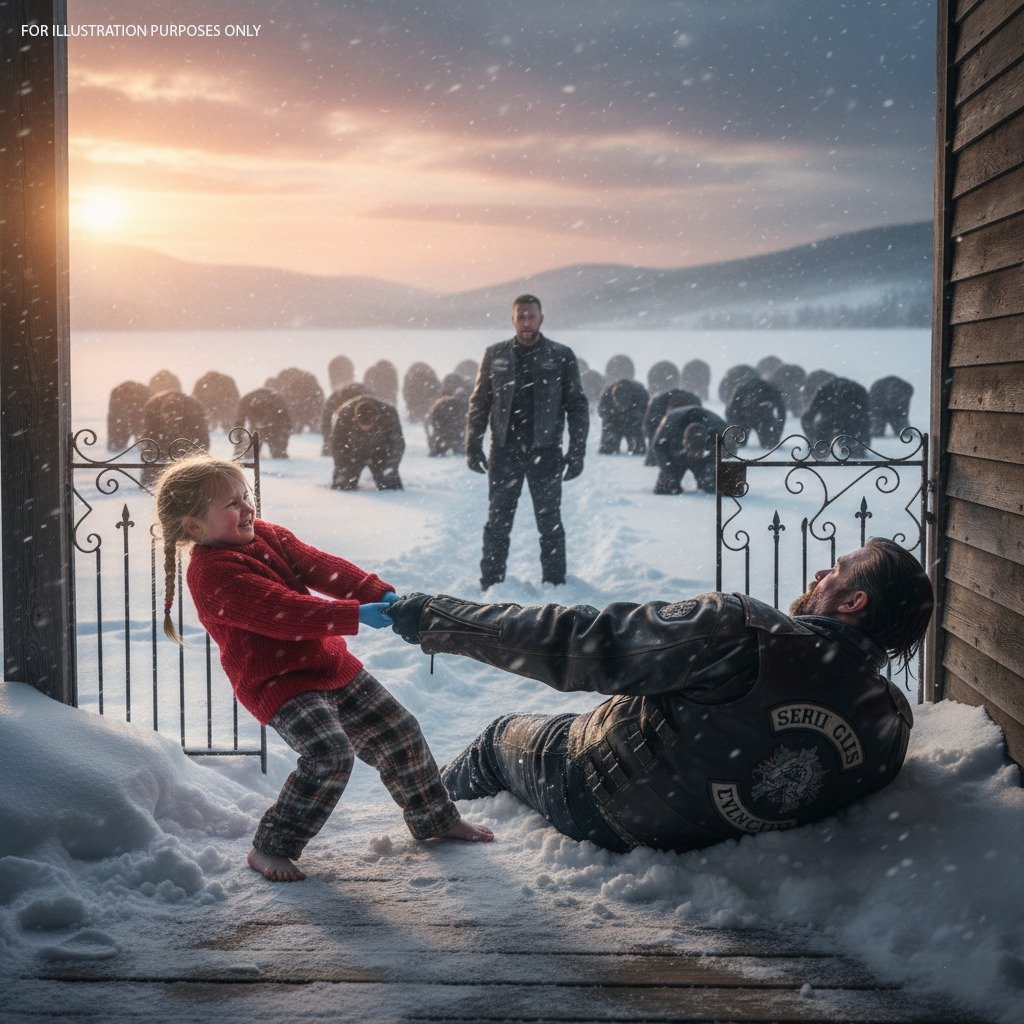
She was six years old, standing in snow that reached nearly to her knees, wearing thin pajamas under socks that had long since lost their warmth, her small body trembling not from fear but from effort as she leaned backward and pulled with everything she had against a man far larger than she was. He was heavy, unmoving, half-buried near the old iron gate at the edge of her grandfather’s land, his body twisted wrong, his jacket stiff with ice and marked by a symbol that most people in town would have recognized and avoided without hesitation.
Lena had noticed him because she noticed everything. She had been inside only minutes earlier, safe and warm, spooning cereal into her mouth while her grandfather slept in his chair, when she saw the gate swinging violently in the wind and something dark lying beyond it, something that did not belong. She did not think in terms of danger or reputation or consequences. She only knew that something was wrong and that no one else was looking.
Her fingers burned, then went numb, then lost all sensation as she wrapped them tighter around the man’s sleeve, counting quietly to herself as she dragged him inch by inch across the frozen ground. She slipped once and fell hard, the cold knocking the breath from her lungs, and for a moment she lay there staring up at the white blur of sky, wondering vaguely if this was how people disappeared without anyone noticing. Then she rolled over, pushed herself upright, and grabbed him again.
“You can’t stay here,” she whispered, more to herself than to him. “You’ll disappear.”
The wind roared back as if angry at her refusal to stop.
Inside the house, Noah Whitaker woke with a jolt, the kind that comes not from sound but from instinct. He was on his feet before his mind caught up, calling Lena’s name into an answering silence. The back door was open. Snow had begun to creep inside. Panic surged as he followed the uneven tracks toward the gate, his heart pounding harder with every step.
He saw her before she saw him, a small figure braced against the storm, pulling something impossibly large.
“Lena!” he shouted.
She turned, relief flooding her face. “Grandpa,” she cried, her voice raw, “help me. He’s so cold. He won’t wake up.”
Noah froze when he saw the man clearly—the jacket, the emblem, the blood frozen along his jaw. Every warning he had ever heard flared in his mind. Then he looked at Lena’s hands. Blue. Shaking. Still holding on.
They dragged the man inside together. Noah slammed the door against the storm as warmth rushed in, and only then did Lena finally let go, her strength spent, her body sagging with exhaustion. Outside, the blizzard screamed on, unaware that something permanent had already shifted.
When the man woke, warmth confused him before pain did. His leg screamed. His hands throbbed. And then he felt it—small fingers wrapped around his own, rubbing life back into them with fierce concentration. He opened his eyes to find a little girl watching him closely, her hair unevenly braided, her face serious.
“You’re awake,” she said, visibly relieved. “Grandpa said you didn’t want to be.”
Marcus Hale turned his head slowly, taking in the room, the fire, the older man standing watch nearby. “You shouldn’t have saved me,” he rasped.
Marcus had ridden into the storm because he did not care if he came back. Grief had hollowed him out months earlier, and the cold had felt like rest. He had once been someone people feared, someone whose name carried weight and consequence, someone who had buried a son and stepped away from everything that followed. He had expected to fade quietly into the snow.
Instead, a child had refused to let him.
By morning, the sound came. Engines. Not a few, but many, rolling in waves across the frozen land. Noah stood rigid by the window as black-clad riders filled the road, their presence overwhelming, their silence heavier than noise.
“They’re here for you,” Noah said.
Marcus closed his eyes. “I was hoping they wouldn’t be.”
Lena climbed up beside him. “Why are they all outside?”
“Because they’re afraid,” Marcus said quietly.
The engines stopped. One by one, the riders knelt in the snow—not before him, but before the child who had dragged a broken man out of a storm. Lena clutched her grandfather’s hand, confused.
“Did I do something bad?” she whispered.
Noah knelt beside her. “No,” he said, his voice unsteady. “You did something brave.”
They left after one night. They repaired what they could, spoke softly to neighbors, and carried away more than they arrived with. Marcus stayed. He healed. He learned how to be still.
Years later, people would argue about what really happened that night, about numbers and legends and kneeling men in the snow. But the truth was smaller and stranger.
A child saw a person where others would have seen a warning.
And she refused to let go.