The bell never sounded like a bell.
It sounded like a verdict.
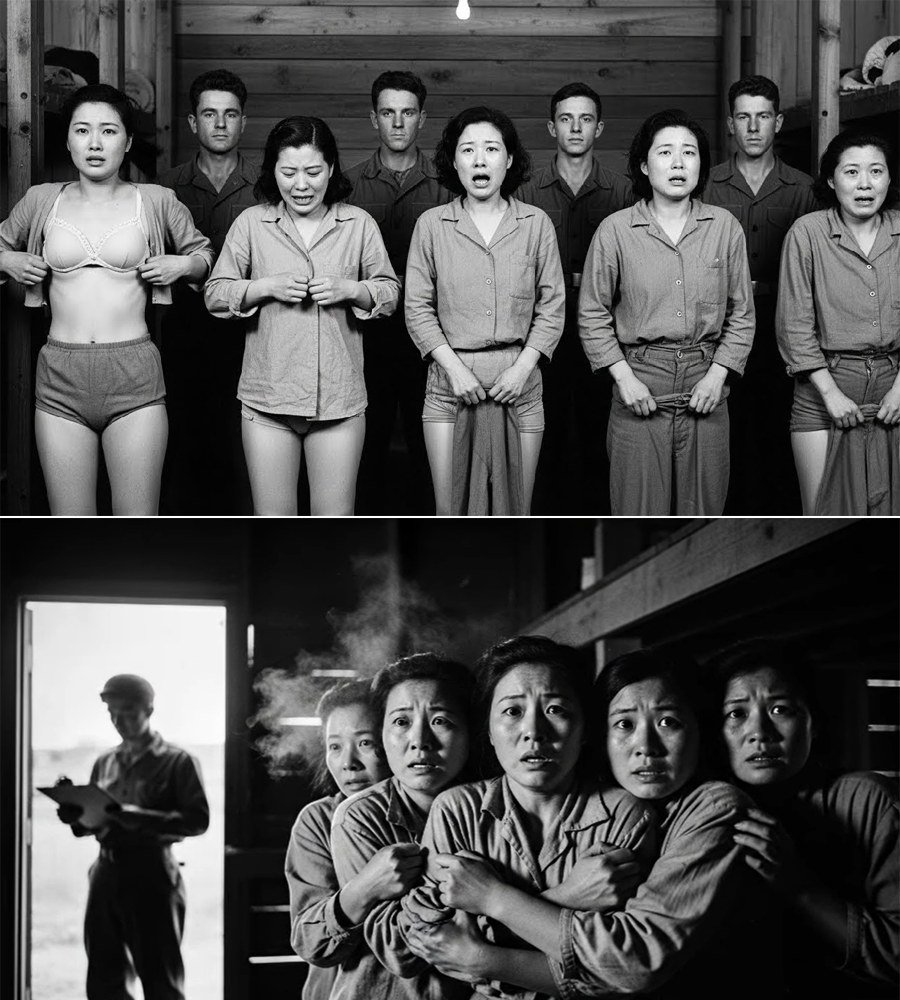
Every morning, long before the sun decided the world deserved light, the metal clanged through the compound and woke the women the same way a slap wakes a face—hard, immediate, personal. The barracks shivered as bodies sat up at once, as if movement itself was a rule they could be punished for breaking.
Aiko Nakamura learned early not to blink too slowly.
Blinking slowly made you look tired.
Looking tired made you look weak.
And weakness invited attention.
She swung her feet to the floorboards—cold, splintered wood that bit through thin socks—and stood with the rest. Around her, women reached for coats and scarves with the same careful rhythm, like dancers following a routine they despised but could not refuse.
It was always the same: the bell, the line, the yard, the ritual.
They called it inspection. The guards called it discipline.
The women called it something else in their heads.
The Unmaking.
Aiko tightened her scarf around her neck—not because it kept her warm, but because it reminded her she still had something to tighten. Something to choose. Even if it was only a knot.
“Don’t fidget,” whispered Kiyo, the older woman beside her. Kiyo’s voice was thin as paper but sharp as a pin. “They’ll notice.”
Aiko kept her hands still. She could feel her pulse in her fingertips anyway.
The door opened, and the wind rushed in like it had been waiting. The women filed out in twos, then ones, boots and shoes and worn slippers scuffing the ground. The yard was a rectangle of packed dirt bordered by wire and watchtowers that made the sky look caged.
Aiko lifted her eyes only as much as necessary.
The guards were already there, lined up with clipboards and expressions that suggested they’d rehearsed indifference until it became pleasure. At the center stood Sergeant Watanabe—small, neat, immaculate—his gloves always clean, his voice always calm. He never shouted. He didn’t need to.
When he spoke softly, the yard listened harder.
“Line,” he said.
They formed rows.
“Arms at your sides.”
They obeyed.
“Today we do it properly.”
Today.
As if yesterday hadn’t counted. As if tomorrow wasn’t already predetermined.
Watanabe paced in front of them. He stopped at random faces and stared, not like a man checking for disease but like a man checking for defiance. The women did not stare back. They had learned that eyes could be interpreted as a weapon.
Behind Watanabe, two guards carried a long wooden table and set it down like an altar. On it lay a stack of tags—small, numbered, with holes punched through them—and a shallow metal tray for anything deemed “not allowed.”
Anything could be deemed not allowed.
Aiko swallowed. Her throat was dry despite the morning damp.
Watanabe raised a hand. The yard fell into deeper silence.
“Layer by layer,” he said, as if reciting a lesson. “No shortcuts. No hiding.”
He made a gesture toward the first row.
The ritual began.
Coats off first.
Not tossed, not folded casually—removed and held out for inspection. Guards walked down the line, tugging at seams, pressing pockets, shaking collars. When they found something—a torn lining, a hidden thread, a scrap of paper—they held it up as if it were proof of corruption.
Sometimes it was.
Sometimes it was nothing.
Either way, it became a reason.
Aiko watched a younger woman—Emi, barely twenty—hand over her coat with trembling fingers. A guard snapped the collar, found a tiny knot of fabric stuffed into the hem.
“Contraband,” he said.
Emi’s eyes widened. “It’s… it’s just cloth,” she whispered.
The guard smiled without warmth. “You don’t decide.”
He dropped the cloth into the tray.
Then he pushed Emi hard enough that she stumbled.
Not enough to break bones. Enough to break pride.
Watanabe didn’t look surprised. He looked satisfied, the way a man looks when his system continues functioning.
Aiko’s turn came.
She removed her coat slowly, careful not to shake. The wind punched her immediately, sliding under her sweater. She held the coat out.
A guard took it and shook it once, twice. His fingers pressed her pockets. He found nothing.
He seemed disappointed.
“Next layer,” Watanabe said.
Sweaters. Vests. Scarves. Anything that could conceal.
The yard became a field of women standing in thinner and thinner protection, not because the weather demanded it, but because the ritual did. It wasn’t about warmth. It was about control. About teaching them that privacy was a privilege, and privileges could be revoked daily.
Aiko’s hands moved to the buttons of her cardigan.
She remembered her mother teaching her to button properly: Top to bottom, so you don’t miss a hole.
Aiko had once thought that lesson was about neatness.
Now she understood it was about endurance. About doing a hard thing the same way every time so the hard thing didn’t win.
She unbuttoned. Held it out. A guard patted it down, checked sleeves.
Still nothing.
He handed it back with a small shove.
Aiko did not react.
Kiyo, beside her, kept her eyes forward. Kiyo’s jaw was tight. She’d been a schoolteacher before the war. She carried the memory of classrooms in her posture—straight spine, chin level. It infuriated the guards in a quiet way, because straight spines implied something unbroken.
Watanabe noticed.
He stopped in front of Kiyo and tilted his head.
“Teacher,” he said softly. He always used that word like a joke that never got old. “You still stand like you have authority.”
Kiyo did not speak.
Watanabe’s smile sharpened. “Show your hands.”
Kiyo lifted her hands.
Watanabe inspected them—palms, fingers, nails—like he was searching for ink stains or blood. Then he leaned closer.
“Anything you want to confess today?” he asked.
Kiyo’s voice was calm, almost bored. “Nothing that belongs to you.”
The air in the yard tightened like a drawn string.
Watanabe’s smile vanished.
He turned, lifted his hand, and one of the guards stepped forward and struck Kiyo across the face with the back of his glove.
It was not a theatrical blow. It was quick, efficient, humiliating.
Kiyo staggered but did not fall.
Aiko’s body surged forward instinctively—one step, a half-step—then stopped. Her brain screamed at her to freeze. Her heart screamed to move.
Kiyo steadied herself and looked forward again, as if the impact were nothing but a gust of wind.
Watanabe stared at her a long moment. Then he nodded, satisfied again.
“That,” he said to the yard, voice gentle, “is what happens when you add words to the ritual.”
Aiko felt rage swell hot and thick in her chest.
Rage was dangerous.
Rage was also the only thing that still felt like hers.
After the last layer check, the guards moved down the line again with chalk, marking numbers on a board as if counting livestock. The women stood in thin clothes in a cold yard while their bodies were reduced to inventory.
Watanabe lifted a clipboard. “Return to barracks.”
They moved as one, a silent procession back to wooden bunks and damp blankets and the smell of boiled rice that never quite filled a stomach.
Inside, the women dressed again with stiff hands.
Kiyo touched her cheek, where the skin was already swelling. She didn’t cry. She didn’t even curse. She only sat on her bunk, breathing slowly, eyes fixed on a nail in the wall.
Aiko sat beside her. “You shouldn’t have said it,” Aiko whispered, though she hated herself for saying it.
Kiyo’s eyes shifted to her. “Shouldn’t?” she echoed. “Or couldn’t afford?”
Aiko’s throat tightened. “We can’t afford anything.”
Kiyo nodded once. “That’s the point of the ritual. To make you believe the cost of being human is too high.”
Aiko’s hands clenched. “Then what do we do?”
Kiyo leaned closer, voice barely audible. “We learn the ritual better than they do,” she whispered. “And then we change one thing.”
Aiko stared. “Change?”
Kiyo’s gaze was steady. “They want predictability,” she said. “Predictability is a chain. But it can also become a trap—for them.”
Aiko’s pulse jumped. “How?”
Kiyo glanced toward the door. Two guards stood outside, silhouettes behind frosted glass.
“Not here,” Kiyo murmured.
That night, the wind rattled the barracks like it wanted inside.
Aiko lay awake, staring at the ceiling’s cracks. Somewhere in the darkness, a woman coughed. Another whispered a prayer. A third muttered in her sleep, trapped in memories she couldn’t outrun.
Aiko thought about the ritual. The table. The tray. The tags.
Layer by layer.
No hiding.
No shortcuts.
She thought about how the guards checked seams and pockets, how they shook collars and sleeves.
They were looking for things.
For messages. For small blades. For proof of planning.
They were not looking for patterns.
Patterns were invisible when you believed you controlled the world.
Aiko turned her head slightly and saw Emi—young Emi—hunched over her blanket, shivering. Emi’s eyes were open, staring into nothing.
Aiko whispered, “Emi.”
Emi flinched. “Don’t,” she hissed. “If they hear—”
“They won’t,” Aiko said. She didn’t know if that was true. She decided to speak anyway. “What did they take from your coat?”
Emi swallowed. “A cloth knot,” she whispered. “It was… from my mother’s sleeve. I kept it. It’s stupid.”
“It’s not stupid,” Aiko said.
Emi’s eyes glistened. “It’s all I had.”
Aiko stared at the wall. “Tomorrow,” she whispered, “don’t hide it in your coat.”
Emi blinked. “Then where?”
Aiko’s mouth went dry. “In plain sight.”
Emi stared like Aiko had gone mad. “They’ll take it.”
Aiko nodded. “Yes. But we’ll choose how. And when.”
Emi’s breathing quickened. “Why would that help?”
Aiko’s voice was quiet. “Because the ritual isn’t about finding contraband,” she said. “It’s about making us feel like we always lose something by surprise.”
Emi’s eyes flicked. “And if we choose…?”
Aiko’s gaze hardened. “Then it’s not surprise anymore,” she whispered. “It’s a statement.”
Emi trembled. “A statement gets you punished.”
Aiko didn’t deny it. “So does breathing wrong,” she murmured. “At least let the punishment mean something.”
By morning, Aiko’s plan was not a plan. It was a thread.
And threads became rope when enough hands held them.
In the gray pre-dawn, Aiko moved among the bunks with careful steps, whispering to the women she trusted. Not many. Trust was a rare currency here.
Kiyo listened without blinking.
When Aiko finished, Kiyo’s eyes narrowed. “This is dangerous,” she said.
“Yes,” Aiko replied.
Kiyo studied her, then nodded once. “Good,” she said softly. “Danger wakes people up.”
The bell rang.
The yard awaited.
The ritual began again.
Watanabe stood by the table, gloves spotless, as if yesterday’s violence had never happened. The guards lined up with their practiced boredom. The tray sat empty, ready.
Watanabe’s eyes swept the women like a scan. “Layer by layer,” he said.
Aiko removed her coat.
Then her cardigan.
Then her scarf.
She held each item out with perfect obedience.
Her hands did not tremble.
When it came time for the final check—when the guard’s eyes flicked toward her waistband and the hem of her shirt—Aiko stepped forward half a pace, before she was instructed.
The guard paused.
Watanabe’s head tilted.
Aiko reached into her pocket—slow, deliberate—and pulled out something small. A cloth knot, like Emi’s, tied tight.
It was not hidden.
It was offered.
Aiko held it out over the tray.
Watanabe’s gaze sharpened. “What is that?”
Aiko’s voice was calm. “A memory,” she said.
A ripple moved through the line behind her—tiny shifts of breath.
Watanabe’s eyes narrowed. “That’s not an answer.”
Aiko held his gaze. “You asked what it is,” she said softly. “That’s what it is.”
For a moment, it felt like the yard had stopped moving.
Then Watanabe stepped closer.
He looked at the cloth knot like it offended him more than weapons ever could, because weapons were honest. Memories were not. Memories survived rules.
He reached out and plucked it from her fingers and dropped it into the tray.
The metal made a small clink.
Watanabe’s smile returned, thin. “And what did you gain by that?” he asked.
Aiko’s heart hammered. She forced her voice steady. “I chose the moment,” she said.
Watanabe’s eyes flashed.
He did not like being reminded that choice still existed in his kingdom.
He turned his head slightly.
A guard stepped forward and shoved Aiko hard enough that she stumbled, catching herself before she fell.
Pain shot through her shoulder.
Aiko kept her feet.
Watanabe watched her recover her balance, expression unreadable.
“Next,” he said, voice calm.
Aiko stepped back into line.
Behind her, Emi moved forward.
Emi’s hands shook, but she followed Aiko’s example with fierce precision. She reached into her pocket and pulled out her own cloth knot—different fabric, same intent—and held it out over the tray.
Watanabe’s eyebrows rose slightly.
He took it, dropped it.
Clink.
The guard shoved Emi too.
Emi staggered, but she didn’t fall.
Then another woman stepped forward. And another.
Not everyone. Not a mass rebellion. That would’ve been crushed immediately.
But enough.
A small procession of women, one by one, offering tiny “forbidden” tokens into the tray—not because the guards demanded it, but because the women chose it.
The yard turned electric with quiet defiance.
Watanabe’s calm began to crack—not in shouting, but in the tightening of his jaw, the slight redness creeping into his cheeks.
He understood now what was happening.
They weren’t smuggling.
They weren’t hiding.
They were refusing the most important lesson the ritual tried to teach:
That the guards controlled surprise.
That the guards controlled loss.
Watanabe slammed a gloved palm on the table. “Enough,” he snapped.
The line froze.
“You think this is clever,” he said, voice sharp now. “You think you are making a point.”
No one answered.
Silence was their armor.
Watanabe pointed at Aiko. “You,” he said. “Step out.”
Aiko’s stomach dropped.
Kiyo’s hand twitched, as if she wanted to grab Aiko’s sleeve and stop her. But Kiyo didn’t move. If she moved, she’d make it worse.
Aiko stepped out.
Watanabe walked up close, so close she could smell the soap on his gloves. “You want control,” he murmured, voice low enough that only she could hear. “I will show you what control is.”
Aiko met his eyes. “You already have,” she said quietly.
Watanabe’s face tightened.
He lifted a hand.
Aiko braced for the blow.
But he didn’t strike her.
Instead, he leaned closer and whispered, “Tomorrow, you will stand alone at the front. And you will do the ritual first.”
Aiko’s pulse hammered. He wasn’t punishing her body.
He was punishing her position.
He wanted her isolated. Singled out. Turned into a lesson for the others.
Watanabe straightened, then addressed the yard. “Return to barracks,” he said, cold now. “And remember: small acts still have consequences.”
Back inside, the women dressed in silence.
Aiko’s shoulder ached. Her skin burned where she’d been shoved. But the bigger pain was the knowledge of what tomorrow would bring: spotlight, isolation, a trap.
Emi crawled onto Aiko’s bunk, eyes wide. “I’m sorry,” she whispered. “We shouldn’t have—”
Aiko shook her head. “No,” she said. “We should have.”
Kiyo sat on the edge of her own bunk, face pale. “They’ll try to break you in front of everyone,” she said.
Aiko’s mouth went dry. “I know.”
Kiyo looked at her—really looked—and Aiko saw something in Kiyo’s eyes that was almost pride.
“That means you’re winning,” Kiyo murmured. “Because they don’t waste effort on people they’ve already broken.”
That night, Aiko didn’t sleep.
She listened to the compound’s silence—the kind of silence that wasn’t peace, but anticipation.
She thought about the ritual again. The layers. The table. The tray.
She thought about how the guards needed routine.
Routine made them feel powerful.
But routine also made them lazy.
And laziness created blind spots.
Aiko slid off her bunk and moved to the corner where the floorboard was loose. She lifted it gently.
Inside the gap was a tiny stash: a pencil stub, two scraps of paper, and a piece of string.
Not a weapon.
A message kit.
She took the pencil and wrote slowly, carefully, printing the letters so they couldn’t be mistaken:
WE WILL NOT GIVE YOU OUR SHAME.
She folded the paper into a tight square.
Then she tied it with the string and tucked it into the seam of her scarf—stitched into a place the guards rarely checked because it was too visible to be suspicious.
In the morning, the bell struck again.
The yard awaited.
Watanabe stood by the table with a new stillness in his posture, the stillness of a man who intended to crush a problem.
“Front,” he said, pointing at Aiko.
Aiko walked forward.
She stood alone before the line, wind biting through her clothes. Hundreds of eyes—women’s eyes—watched her back.
Watanabe’s voice was calm again, falsely gentle. “Layer by layer,” he said. “Show them how.”
Aiko removed her coat.
Held it out.
A guard shook it, found nothing.
She removed her cardigan.
Held it out.
Nothing.
She removed her scarf last.
And for a heartbeat, her fingers touched the stitched seam where her tiny message sat.
Aiko held the scarf out.
The guard took it, shook it, patted it down—quick, impatient, because the scarf was “obvious.” Too obvious to hide anything.
His hand brushed the seam and stopped.
Aiko’s breath caught.
The guard frowned, fingers pinching the fabric.
He tugged.
The seam held.
He tugged harder.
Threads snapped.
A small folded square dropped into his palm.
The yard went still.
The guard stared at it.
Watanabe stepped closer. “What is it?” he demanded.
The guard hesitated.
That hesitation was the first crack in the machine.
Watanabe snatched the paper, unfolded it, read.
His face tightened—then flushed, anger rising hot and sudden.
He lifted the paper so the line could see.
“You think you can lecture us?” he hissed.
Aiko’s voice was steady despite her pounding heart. “No,” she said. “I think you can’t stop us from remembering who we are.”
Watanabe’s hand twitched.
For the first time, it looked like he might lose control and strike her openly, publicly, wildly.
But then he paused.
Because he knew something.
Open brutality could turn the women into a single body, unified by shock.
And unity was more dangerous than any hidden item.
So Watanabe smiled instead—thin and cruel.
He crumpled the paper slowly and dropped it into the tray.
Clink.
Then he leaned in and whispered, “You will regret this.”
Aiko looked at him and answered softly, “So will you.”
Watanabe stepped back, eyes hard. He turned to the yard. “Continue,” he ordered.
But something had changed.
Aiko stepped back into line, scarf gone, neck exposed to the wind.
Emi’s eyes met hers—terrified, proud, alive.
Kiyo’s lips pressed into a thin line that might have been a smile.
The ritual continued, but it felt different now—not because the guards were kinder, but because the women had proven something to themselves:
The ritual could take layers of cloth.
It could take comfort.
It could take small possessions.
But it could not automatically take meaning.
Meaning had to be surrendered.
And today, they hadn’t surrendered it.
That afternoon, Aiko was punished—not with spectacle, but with isolation. A locked room. Long hours. A hunger that made time feel sharp.
She sat with her back against a wall and listened to her own breathing, forcing herself not to panic.
She thought of Watanabe’s eyes.
She thought of the yard’s silence when the note was found.
She thought of the tray—how it collected their tiny memories like trophies.
Then she thought of something else:
A tray could be overturned.
Not today.
Not tomorrow.
But someday.
And if someday came, the first step wasn’t strength.
It was refusing shame.
When they finally let her out, dusk had fallen. The sky was bruised purple.
Aiko walked back to the barracks, shoulders aching, stomach hollow, but her spine straight.
Inside, Kiyo rose slowly from her bunk and approached.
“They took your scarf,” Kiyo murmured.
Aiko nodded. “Yes.”
Kiyo’s eyes were steady. “And did they take what was inside it?”
Aiko’s mouth twitched into a small, fierce smile. “No,” she said. “They only proved they had to tear something to find it.”
Kiyo nodded once, satisfied. “Good,” she whispered. “Make them work for every inch.”
Emi stepped forward, holding out something small: a strip of cloth torn from her own sleeve.
“Here,” Emi said, voice trembling. “For you. It’s not much.”
Aiko stared at it, throat tightening.
It wasn’t warmth.
It wasn’t protection.
It was a gesture.
A token of shared defiance.
Aiko took it carefully, as if it were fragile. “Thank you,” she whispered.
That night, as the barracks settled into uneasy sleep, Aiko lay awake again.
The ritual would happen tomorrow.
And the next day.
And the day after.
The guards would keep trying to turn their bodies into objects and their minds into blanks.
But the women had found a crack in the ritual’s purpose.
They had turned surprise into choice.
Loss into statement.
Silence into message.
Layer by layer, the system tried to unmake them.
Layer by layer, they learned how to remain.
And somewhere in the dark, in the thin space between fear and courage, Aiko made herself a promise:
If the ritual demanded she become nothing—
then she would become the one thing it could not predict.
A woman who remembered.
A woman who watched.
A woman who, quietly, patiently, learned how to overturn the tray.