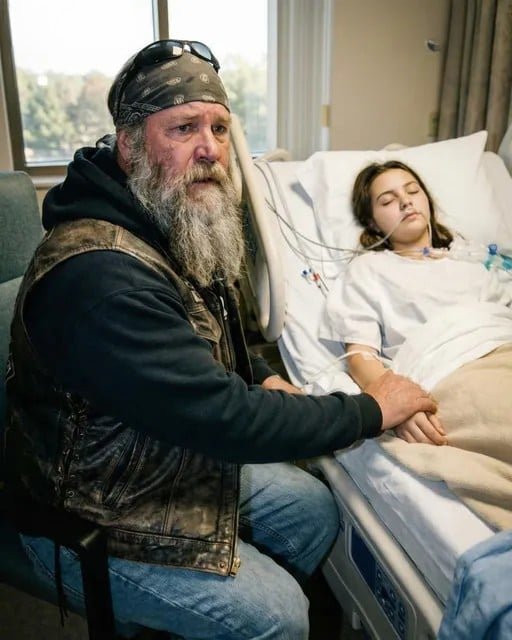
For six long months, my days followed the same exhausting pattern—hospital lights, vending machine meals, and a recliner that never quite let me sleep. My 17-year-old daughter, Hannah, lay unconscious after a devastating crash caused by a driver who ran a red light. And every single afternoon at exactly 3 p.m., something unexpected happened. A large, gray-bearded biker would quietly step into her room, nod politely at me, and sit beside her bed for an hour. He held her hand, sometimes read aloud from fantasy novels, and then left without a word. I didn’t know who he was, but his consistency was impossible to ignore—and so was the mix of comfort and fear that grew inside me each day he appeared.
Eventually, the questions became too heavy to carry alone. I stopped him in the hallway and asked who he was and why he kept coming. His answer knocked the air out of my lungs. He told me his name was Mike—and that he was the man responsible for the crash. He explained that he had served his sentence, completed rehabilitation, and stayed sober since that night. But guilt followed him everywhere. Sitting with Hannah, reading to her, and showing up day after day was the only way he knew to face what he had done. He didn’t ask for sympathy or forgiveness. He simply took responsibility and stayed present.
I told him I didn’t want him near my daughter anymore, and he respected that immediately. Still, time moved forward. Hannah’s condition slowly changed—small movements, faint reactions, signs of life returning. When she eventually woke and began the long process of recovery, she learned who Mike was. Her response wasn’t simple or dramatic. She didn’t excuse him, but she also didn’t want him erased from her life. What formed instead was something fragile and honest—a cautious connection built on accountability, not denial, and on showing up rather than making promises.
Nearly a year after the accident, Hannah left the hospital using a cane, carrying both scars and strength into the next chapter of her life. Mike remained quietly supportive, never overstepping, sometimes helping where he could, always respecting boundaries. Today, we mark the anniversary of that day not with anger, but with reflection—meeting for coffee, sharing silence when words aren’t enough. It isn’t forgiveness, and it isn’t forgetting. It’s three lives changed forever, choosing to move forward without pretending the past didn’t happen, and learning that responsibility, presence, and truth can coexist—even after unimaginable harm.