Jake Hollister’s cabin had echoed with just one voice—his own—for so long the walls had started answering back. He liked it that way: coffee when he wanted, silence when he needed it, and no one to notice the flour dust on his shirt or the way he talked to the horse like it might reply. Then the canyon sent him a girl—barefoot, braids snarled, finger pointed straight at his chest as if she’d been waiting for no one else.
“Home,” she said, the word small but steady, and Jake felt the floor tilt under his boots.
He took her in because the desert doesn’t leave lost things lying around for long. Named her Lina, taught her to knead dough without wearing most of it, and discovered she already knew how to laugh at his worst jokes. Weeks slid by—pancakes on Sundays, her stool beside his at the workbench, a second pair of boots by the door. He started calling her “my girl” without noticing until the sound of it hung in the room like lantern light.
Townfolk stared at first—cowboy and Apache child sharing a wagon seat—but Jake’s shoulders carried a warning, and curiosity backed off. Lina learned to whistle, to count eggs, to say “please” in English and Apache both. The cabin quit echoing; it hummed instead.
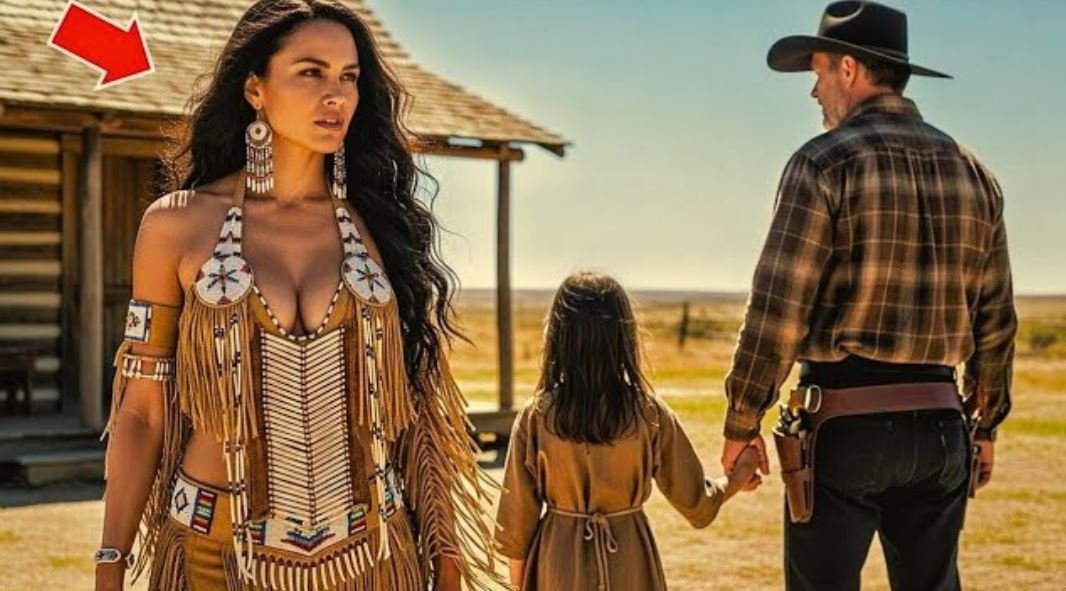
Then came the day the earth trembled—forty riders cresting the ridge, sun at their backs like a bronze shield. At their head rode Naya—tall, beaded, grief carved into the fine lines around her eyes. She dismounted before the porch, voice wind-steady: “My daughter was taken by storm and shadow. I have searched many moons.”
Lina shot forward, braids flying. “Mama!” The word cracked the sky open. Mother and child folded together on the packed dirt, tears falling where rain had never reached. Jake looked away, feeling suddenly like an intruder in his own yard.
When Naya rose, she kept one arm around Lina and studied Jake as if measuring the worth of every mile her child had traveled. “You kept her breathing,” she said. “You gave her fire and bread. My people owe a life-debt.”
Jake shifted, boot scuffing dust. “Just did what any man ought,” he muttered, but the words felt small under her gaze.
Naya’s eyes softened, yet her spine stayed spear-straight. “A widow does not forget the man who saves her child. Among my people such a man is tied to our story—whether he wills it or not.”
She offered no demands, only presence: Lina would walk in two worlds—Apache blood, cowboy heart. If Jake allowed it, the cabin could become a second home; if he refused, the door would close anyway, and the girl would lose a piece of herself.
Jake glanced at Lina—his girl—clutching her mother’s hand while the other reached for his sleeve, stitching them together without thread. He felt the future shift, big enough to scare him breathless, warm enough to pull him forward.
He met Naya’s gaze, steady as branding iron. “Reckon I can learn to share porch space with a woman whose strength could shake the frontier. Reckon we can both learn what belonging means—step by careful step, like crossing a flooded river.”
Naya’s lips curved—not quite smile, not quite surrender, but promise. “Then we begin,” she said. “Together. No promises beyond tomorrow, but tomorrow belongs to all three of us.”
Lina swung between them, boots off the ground, laughter scattering across sagebrush like bright seed. The cabin watched, boards creaking approval. Jake felt the girl’s weight on his arm and knew the canyon had not sent him a lost child; it had sent him a family—barefoot, stubborn, chosen by one small finger pointed straight at his heart.