The backyard looked exactly the way I’d imagined it would in all the quiet, hopeful moments leading up to that Saturday afternoon. Strings of bistro lights were woven overhead in neat crisscrosses, glowing softly as the sun dipped low, their warm light reflecting off the long folding tables I’d spent weeks arranging and rearranging until they felt just right. Forty felt important to me. Not because I was afraid of the number, but because I’d survived enough by then to know milestones deserved to be marked. I wanted laughter. I wanted music. I wanted one uncomplicated day where my family existed in the same space without tension tightening my chest.
Derek stood by the grill, tongs in hand, flipping burgers with the easy confidence of someone who genuinely enjoyed hosting. Smoke curled into the air, carrying the smell of charred meat and barbecue sauce across the lawn. Friends mingled near the drinks table. Paper plates clinked. Someone had already turned the speaker on low, classic rock humming in the background. For a moment, standing there with a plastic cup of lemonade sweating in my hand, I let myself believe the day would stay gentle.
Emma darted through the yard with her usual restless energy, her laughter ringing out as she wove between adults, her ponytail swinging against the back of her yellow sundress. Fourteen suited her. She was all long limbs and opinions, fiercely protective of the few things she truly loved. Every time she smiled, I felt that familiar swell in my chest, the quiet certainty that whatever else I’d failed at in life, I’d done something right with her.
My sister Vanessa arrived nearly an hour late, as always, sweeping in as if the timing itself were a statement. Oversized sunglasses covered half her face despite the fading sunlight, and she carried herself with the same practiced entitlement she’d had since we were kids. Brooklyn followed behind her, head bent over her phone, thumbs moving fast. Twelve years old and already bored with everything that wasn’t hers.
Vanessa barely acknowledged me as she passed, setting her bag down and scanning the yard like she was taking inventory. I told myself not to care. I told myself it didn’t matter. It was my birthday. I wasn’t going to let old patterns ruin it.
Emma’s bike leaned against the side of the garage, exactly where she’d left it. She’d gotten it two months earlier, a mountain bike she’d researched obsessively, saving her allowance for a year before Derek and I matched every dollar. She’d memorized specifications, watched comparison videos, learned more about gear systems than most adults ever bothered to know. It wasn’t just a bike to her. It was proof that patience and effort meant something.
Brooklyn spotted it almost immediately.
“I want to ride that,” she announced, loud and sharp, pointing as if the bike had appeared solely for her benefit.
Emma stopped mid-step, turning slowly. Her voice stayed polite, but firm. “Sorry, Brooklyn. It’s brand new. I’m still getting used to it. Maybe another time.”
Vanessa didn’t even hesitate. “Let her use it, Emma.”
The words cut cleanly through the chatter, drawing a few curious glances. Emma’s cheeks flushed, a splotchy pink creeping up her neck, but she didn’t back down.
“It’s really expensive, Aunt Vanessa,” she said. “I’d feel better if I was the only one riding it for now.”
Brooklyn’s face crumpled. “She’s being rude,” she whined, tugging at Vanessa’s arm.
I stepped closer, keeping my tone light, reasonable, the way I always had with my sister. “Emma’s right, Van. The bike was a big investment. Brooklyn can try it another day.”
Vanessa’s jaw tightened. “You’re raising her to be stingy,” she snapped. “That’s a lovely lesson.”
The air shifted, tension creeping in like a draft no one wanted to acknowledge. Before it could settle, Derek appeared with a tray of cupcakes, Brooklyn’s attention snapping toward frosting and sprinkles. Music rose a little louder. My mother complimented the potato salad. Conversation resumed. The moment passed, or so I thought.
Nearly an hour later, Emma went inside to use the bathroom. I watched her disappear through the sliding door, then turned back to a conversation with a neighbor, letting myself relax again. That was my mistake.
When Emma came back out, Brooklyn was already at the bike, wheeling it away from the garage. Vanessa sat in a lawn chair nearby, wine glass in hand, watching with a thin, satisfied smile.
“Brooklyn, no,” Emma said, breaking into a jog. “You can’t ride it.”
She reached for the handlebars just as Brooklyn swung a leg over the seat, the bike wobbling dangerously. Brooklyn yanked it away.
“Mom!” she shrieked. “Emma’s being mean to me!”
Everything after that happened too fast for my brain to catch up in real time.
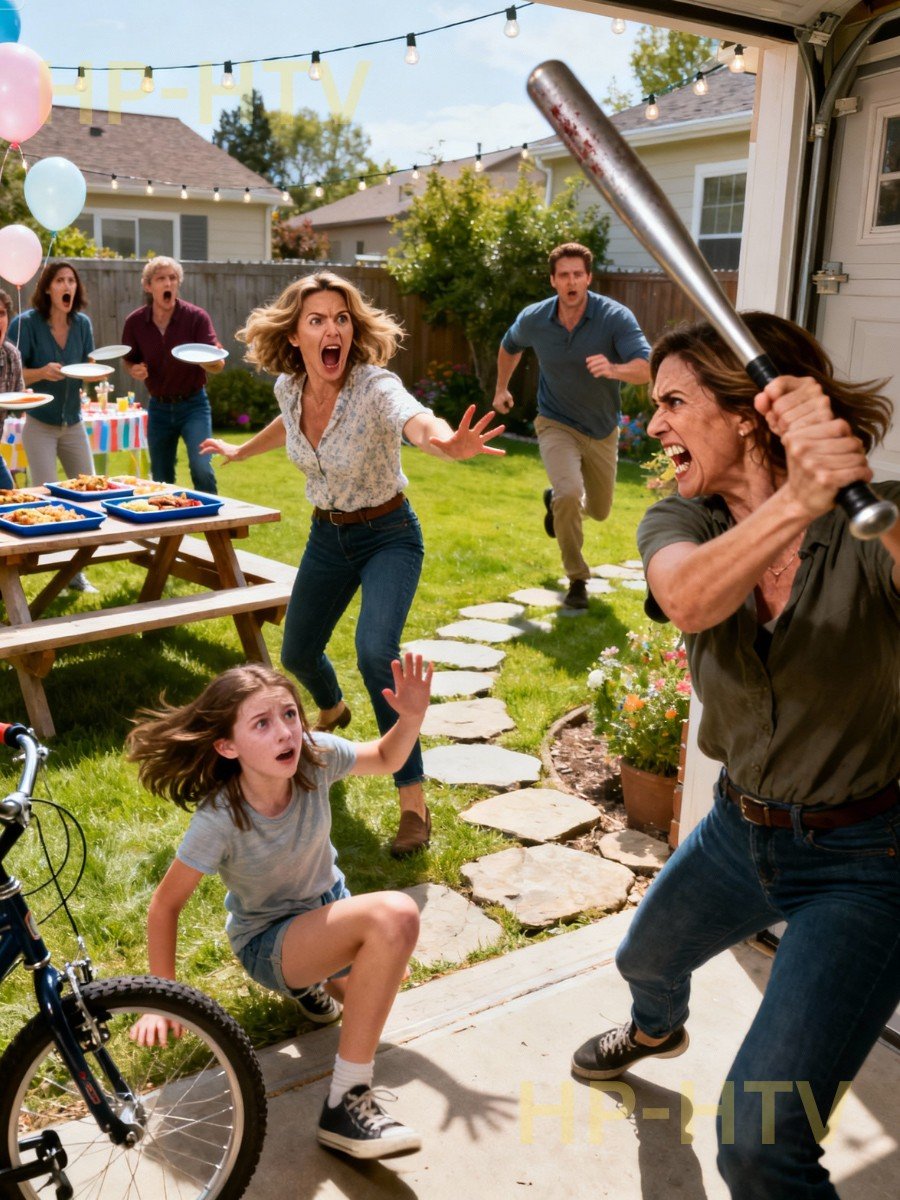
Vanessa stood. Her chair scraped loudly against the patio stones. Her face twisted into something I barely recognized, eyes sharp with a rage that felt sudden and ancient all at once. She reached for the aluminum baseball bat Derek had left leaning against the garage from playing catch earlier in the week.
She crossed the lawn in long, furious strides.
“You little brat,” she snarled, her voice cutting through the music. “You think you’re too good to share?”
The bat swung.
The sound it made was wrong. Too loud. Too solid.
Emma collapsed to the grass with a sound I’ll never forget, a breathless, broken gasp. Her face drained of color so quickly it terrified me. Red bloomed against the yellow of her dress. For a heartbeat, the entire world seemed to fracture, splintering into frozen images I couldn’t assemble into sense.
Then I was screaming. Derek was running. Plates hit the ground. Someone shouted my name. Brooklyn started crying. Vanessa dropped the bat, the metal clanging uselessly against stone.
“She was attacking Brooklyn,” Vanessa said, her voice suddenly shaky, defensive. “I was protecting my daughter.”
Emma couldn’t breathe properly. Each shallow inhale came with a thin, wheezing sound that made my stomach drop. Derek scooped her up, his hands careful but frantic.
“We’re going to the hospital,” he said, already moving. “Now.”
My mother rushed forward, but instead of checking on Emma, she grabbed Vanessa’s shoulders. “Oh, honey,” she said, her voice trembling. “Are you okay? Did she scare you?”
I couldn’t speak. The words lodged in my throat like broken glass.
At the hospital, everything moved with brutal efficiency. Doctors. Nurses. Machines. Emma’s injuries were worse than I could have imagined. Fractured ribs. Internal damage dangerously close to her lung. Surgery wasn’t optional. It was urgent.
Seven hours passed in a blur of waiting room lights and cold coffee. When the doctor finally came out, his face serious, my knees nearly buckled with relief when he said she would live. Recovery would take months. Physical therapy. Pain management. Complications we wouldn’t know about yet.
My phone buzzed constantly. Messages from my parents. From Vanessa. From relatives who hadn’t seen the scene but already had opinions. Variations of the same theme. She provoked her. It was an accident. Families forgive.
I turned the phone off and watched my daughter sleep, tubes and monitors surrounding her small body. When she woke briefly, she asked if she was in trouble. If Aunt Vanessa was mad at her. If her bike was okay.
Something inside me broke open then, clean and final.
Emma came home days later, weak and pale, our living room transformed into a makeshift bedroom because stairs were impossible. Cards arrived from classmates. Meals from neighbors. Support from people who weren’t related by blood but showed up anyway.
Vanessa sent a gift basket. No apology. Just a card that read, Hope you feel better soon.
My mother called, asking when we’d come to Sunday dinner.
That was when I stopped arguing.
I started acting.
A month later, I sat in a courtroom that smelled faintly of old paper and disinfectant, my hands folded so tightly in my lap they ached. Vanessa sat across the room, her posture stiff, my parents flanking her like sentries. Emma wasn’t there. She didn’t need to be.
The judge adjusted his glasses, his expression unreadable as he looked down at the file in front of him.
“The court has reviewed the evidence,” he said slowly, his voice carrying through the silent room. “And now, I will announce—”
CHECK IT OUT>>FULL STORY👇👇
AT MY 40TH BIRTHDAY PARTY, MY SISTER CRUSHED MY 14-YEAR-OLD DAUGHTER’S……..
At my 40th birthday party, my sister crushed my 14-year-old daughter’s ribs with a baseball bat just because my girl refused to let her daughter borrow a bike. My parents defended her. I didn’t argue. I acted. My whole family screamed in panic. One month later in court, the judge announced my sentence.
As the backyard looked perfect that Saturday afternoon, strings of beastro lights crisscrossed overhead, casting warm glows across the tables I’d spent weeks planning. 40 felt like a milestone worth celebrating, and I’d invited everyone who mattered. My husband, Derek, had grilled enough burgers to feed a small army.
Our daughter, Emma, bounced between guests with her usual energy, her ponytail swinging as she laughed with her cousins. My sister Vanessa arrived late as always, with her daughter Brooklyn behind her. Vanessa wore oversized sunglasses despite the late afternoon hour, and carried herself with that familiar air of entitlement. Brooklyn was 12, spoiled beyond reason, and had inherited her mother’s belief that the world owed her everything.
Emma had gotten a new mountain bike for her birthday two months prior. She’d saved her allowance for a year, and Derrick and I had matched her savings to buy the model she wanted. That bike meant everything to her. She’d researched every specification, compared dozens of models, and treated it like the treasure it was.
Brooklyn spotted it, leaning against our garage within minutes of arriving. “I want to ride that,” she announced, loud enough for half the party to hear. “Emma was polite, but firm.” “Sorry, Brooklyn. It’s brand new, and I’m still getting used to it. Maybe another time.” “Let her use it, Emma.” Vanessa’s voice cut across the yard before Brooklyn could respond.
“Don’t be selfish on your mother’s birthday.” My daughter’s cheeks flushed pink, but she held her ground. “It’s really expensive, Aunt Vanessa. I’d feel better if I was the only one riding it for now. She’s being rude Brooklyn weed, tugging on Vanessa’s arm. I approached them, keeping my tone light. Emma is right, Van. The bike was a big investment.
Maybe Brooklyn can try it another day when Emma is ready. Vanessa’s jaw tightened. You’re raising her to be stingy, Anita. That’s a lovely lesson. The tension simmerred, but didn’t boil over. Derk appeared with a tray of cupcakes, distracting Brooklyn. The party continued. Music played from the portable speaker.
My mother complimented the potato salad. Everything seemed fine. An hour passed. Emma disappeared inside to use the bathroom. Brooklyn made another attempt at the bike, wheeling it out from where Emma had secured it. Vanessa watched from her lawn chair, sipping wine and smirking. Emma emerged from the house and saw Brooklyn climbing onto the seat.
Brooklyn, no. Emma said, “You can’t ride it.” She ran across the yard, reaching for the handlebars. Brooklyn jerked away, nearly losing her balance. “Mom, Emma is being mean to me.” What happened next unfolded so quickly that my brain couldn’t process it until after. Vanessa stood, her face twisted with rage.
She grabbed the aluminum baseball bat Derrick had left near the garage after playing catch with Emma earlier that week. My sister crossed the lawn in four long strides. You little brat. Vanessa snarled at Emma. You think you’re too good to share? She swung the bat like she was aiming for a home run. The crack echoed across the yard, drowning out the music.
Emma crumpled to the grass, gasping. Her face went white. Blood seeped through her yellow sundress. Time fractured into fragments. Derrick was sprinting. I was screaming. Guests froze with plates in their hands. Brooklyn started crying. Vanessa dropped the bat, the metal clanging against the patio stones. She was attacking Brooklyn. Vanessa said, her voice shaking.
I was protecting my daughter. My mother rushed over, but instead of checking on Emma, she grabbed Vanessa’s shoulders. Oh, honey, are you okay? Did she scare you? Emma couldn’t breathe properly. Each inhale brought a weeze that made my stomach drop. Derrick scooped her up, careful but frantic. We’re going to the hospital right now.
My father finally appeared surveying the scene. He looked at Emma, then at Vanessa, then at me. Anita, let’s all calm down. I’m sure this was an accident. Vanessa would never hurt Emma on purpose. She hit her with a bat. My voice cracked. Over a bicycle. Emma was being difficult. My mother said her tone, suggesting this was somehow reasonable.
You know how kids get. I couldn’t speak. Words dissolved in my throat. Derrick was already carrying Emma to our car. I followed him numb and shaking. The emergency room doctor’s face went grave after examining Emma. Three ribs fractured. One had punctured tissue dangerously close to her lung. Internal bleeding required immediate surgery.
They wheeled her away before I could kiss her forehead. Derrick held my hand so tightly my fingers went numb. 7 hours. That’s how long we waited. A nurse finally emerged around midnight to tell us Emma would survive, but recovery would take months. Physical therapy, pain medication, possible complications down the road.
My phone buzzed constantly. Text messages from my mother, then my father, then Vanessa herself. All variations of the same theme. Emma had provoked her. Brooklyn felt traumatized. Why was I making such a big deal out of an unfortunate accident? Families forgive. Families move on. I turned off my phone and watched my daughter sleep in the hospital bed.
An oxygen tube running under her nose. Monitors beeping softly. Derick kept asking what I wanted to do. Press charges. Get a lawyer make Vanessa pay. But I couldn’t think clearly. Rage was a living thing inside my chest, hot and expanding. We stayed at the hospital for 3 days. Emma drifted in and out of consciousness.
the medications keeping her comfortable but distant. When she was lucid enough to speak, she asked if she was in trouble, if Aunt Vanessa was mad at her, if her bike was okay. That last question broke something in me. My parents visited once, staying for 15 awkward minutes. My mother brought flowers, but spent most of the time explaining how Vanessa was just going through a lot right now, and how these things happen in families.
My father nodded along, uncomfortable, but complicit. Emma will heal,” he said, patting my shoulder like I was a child. “Kids are resilient. You’ll both forget about this soon enough.” After they left, Dererick asked again about pressing charges. I told him I needed time to think. The truth was, I was already planning something else.
Emma came home on a Tuesday. We’d converted the living room into a temporary bedroom since stairs were impossible for her. Friends from school sent cards. Her teachers offered extensions on assignments. The community rallied around her in ways my own family never did. Vanessa sent a gift basket with a card that read, “Hope you feel better soon.
Love, Aunt Be and Brooklyn.” No apology, no acknowledgement of what she’d done. Just casual well-wishes like Emma had caught a cold. My mother called to ask when we’d be coming to Sunday dinner. It’s been 2 weeks, Anita. You can’t avoid family forever. Vanessa feels terrible about the misunderstanding. Misunderstanding? I repeated flatly.
Well, you know what I mean. Anyway, she’s your sister. Family forgives. I hung up without responding. Derrick worked from home those first weeks helping me care for Emma. She couldn’t shower alone, couldn’t dress herself, couldn’t laugh without wincing. The doctors warned us about pneumonia risks because deep breathing hurt too much.
Every cough sent panic through both of us. Brooklyn’s Instagram showed her at an amusement park grinning beside a new bicycle. Vanessa had bought her the exact model Emma owned. The caption read, “Best mom ever. Dreams do come true.” That post stayed with me. I started doing research late at night after Emma fell asleep.
Pennsylvania law, civil litigation, personal injury attorneys, negligence versus assault. I took notes in a leather journal documenting everything. Medical bills already exceeded $30,000. Emma’s therapy appointments, both physical and psychological, would continue for at least a year. But lawsuits take time.
and I wanted something more immediate. I thought about Vanessa’s life, mapping it out like a strategy board. She worked as a regional sales manager for a pharmaceutical company, a position she’d bragged about constantly. Her income supported the lifestyle she flaunted the luxury SUV, the private school tuition for Brooklyn, the designer handbags.
She’d been taking medications from sample closets at work for years, not for personal use. She sold them online through various accounts. I knew because she drunkenly confessed it during Christmas dinner two years ago, laughing about how easy it was to supplement her income.
They have so many samples nobody notices, she’d said, waving her wine glass. I thought it was reckless then. Now I saw it as an opportunity. Her company had a confidential ethics hotline. I found the number on their corporate website. Anonymous reporting was encouraged. All I needed was documentation. Vanessa had shown me photos once stupidly proud of her side hustle.
Pictures of her home office shelves lined with medication bottles bearing pharmaceutical company logos. She’d wanted to demonstrate how organized she was, how clever. I still had those photos in an old text message thread. She’d sent them 18 months ago when bragging about a particularly profitable month. I’d never deleted them.
Creating an anonymous email account took 5 minutes. Uploading the photos and writing a detailed report about her theft and illegal medication sales took another hour. I included dates, estimates of quantity based on what was visible in the photos and details about her employment. The ethics hotline confirmed receipt of my report within 24 hours.
They couldn’t tell me what actions they’d take, but they assured me all complaints were investigated thoroughly. I waited. Emma’s physical therapy sessions were exhausting for her. She cried sometimes from frustration, angry that her body wouldn’t cooperate the way it used to. The therapist said her progress was good, but good felt glacially slow.
Derrick noticed my mood shifting. “You’re planning something?” he said one evening after Emma had gone to sleep. “I submitted a report to Vanessa’s company about her stealing and selling medications.” He stared at me. “You what?” “She’s been doing it for years. I have proof. I sent it anonymously.” “Anita, that’s” He paused, choosing words carefully. That’s serious.
She could lose her job. She shattered our daughter’s ribs with a bat. Derek didn’t argue after that. Two weeks later, Vanessa called me for the first time since the party. Her voice was hysterical words, stumbling over each other. Someone reported me to corporate. They’re doing a full investigation. They’ve suspended me.
Anita, you have to help me. Tell them this is a misunderstanding. Tell them I would never steal. I can’t help you, I said calmly. But we’re family. You’re my sister. You hospitalized my daughter over a bicycle and my parents defended you. Family stopped meaning anything that day. She started crying then shouting, “You did this. I know you did.
You vindictive bitch.” I hung up and blocked her number. My mother called 30 minutes later. The conversation followed a predictable script. How could I do this to my sister Vanessa had made a mistake with Emma, but this was cruel. I was tearing the family apart. What would people think? People will think someone finally held her accountable.
I said she’s going to lose everything. She should have thought about that before she nearly killed my child. My father tried next, taking a different approach. Calm, rational, explaining how families work through difficulties together, suggesting therapy for everyone, promising that Vanessa had learned her lesson and would never do anything like that again.
Dad, she hasn’t even apologized to Emma. She sent a gift basket. She’s prideful, Anita. You know how she is. But she loves Emma. People who love children don’t attack them with weapons. He sighed heavily. You’ve changed. You’ve become hard. Emma’s ribs were crushed. Hard seems appropriate. The investigation at Vanessa’s company moved faster than I’d anticipated.
They found additional evidence during their audit. Inventory discrepancies going back 3 years, substantial enough to involve law enforcement. Within a month, Vanessa was fired and facing criminal charges for theft and illegal distribution of controlled substances. Her termination made local news. A pharmaceutical company executive arrested for stealing controlled substances.
It was exactly the kind of scandal people devoured over their morning coffee. I watched the news segment while feeding Emma breakfast, keeping my expression neutral, even as satisfaction bloomed in my chest. Emma noticed the television. Is that Aunt Vanessa? Yes, because of what you did. I turned off the TV and sat beside her. Because of what she did to you and to her company.
I just made sure the right people knew about it. Emma pushed her oatmeal around with her spoon, thinking, “Good.” She finally said, “She deserves it.” Hearing those words from my daughter should have troubled me. Instead, I felt validated. Even at 14, Emma understood the concept of proportional response better than my parents ever would.
Vanessa’s arrest photograph circulated on social media within hours. Someone from her company leaked it. Or maybe it was public record. Either way, her mugsh shot became fodder for neighborhood gossip groups and local Facebook pages. People who had envied her success for years suddenly had permission to tear her down. The Shod and Frea was palpable.
My phone rang constantly with calls from relatives wanting to know if I’d seen the news, if I knew what was happening, if I planned to help Vanessa through this difficult time. I let every call go to voicemail. Their concern for her, absent any concern for Emma, told me everything I needed to know about their priorities.
Brooklyn’s private school apparently asked Vanessa to withdraw her daughter due to the negative publicity. I learned this from a cousin who called specifically to tell me how much damage I’d caused to an innocent child. Brooklyn’s being punished for her mother’s mistake, she said accusingly. Emma was punished with a baseball bat for wanting to keep her own bicycle, I replied.
Where was your concern then? She hung up without another word. The ripple effects of Vanessa’s downfall spread wider than I’d anticipated. Her friends distanced themselves, not wanting to be associated with criminal behavior. Her social media accounts went dark. The perfect life she’d curated online designer clothes, exotic vacations, restaurant check-ins vanished overnight as if it had never existed.
My parents blamed me publicly. Family, friends called to express disappointment in my vendetta. Cousins took sides. Thanksgiving invitations were rescended. The family structure I’d known my entire life collapsed like a house built on sand. Derrick asked if I regretted it. I watched Emma practice her breathing exercises, still wincing with each inhale and told him no.
But Vanessa’s firing wasn’t enough. The rage hadn’t diminished. Every time I looked at Emma’s healing bruises, every time she struggled to lift her backpack, every time she flinched at loud noises, the anger grew. Vanessa had money saved. That much I knew. She bragged about her investments, her retirement accounts, her real estate aspirations.
Even without her job, she had cushion. I wanted to take that cushion away. Civil court moved slowly, but I hired the best personal injury attorney in Pittsburgh. We filed a lawsuit against Vanessa for assault battery and intentional infliction of emotional distress. The medical bills therapy costs, and Emma’s ongoing care provided clear damages.
My attorney was confident. Vanessa hired a lawyer who tried to paint Emma as the aggressor. A 14-year-old girl who weighed 90 pounds had somehow threatened a grown woman into self-defense. The argument was absurd, but they tried. Depositions were brutal. Vanessa sat across from me in a conference room, her attorney beside her, and claimed Emma had lunged at Brooklyn, that she felt her daughter was in genuine danger, that the bat had been nearby, and she’d reacted instinctively.
“Your instinct was to hit a child with a bat,” my attorney asked. to protect my daughter,” Vanessa said coldly. Emma had to give a deposition, too. She was terrified, but she told the truth clearly. Brooklyn had taken the bike without permission. She’d asked her to stop. Odd Vanessa had hit her while she was standing still.
The defense attorney tried to trip her up, suggesting she’d been aggressive or threatening. Emma started crying. The deposition ended early. My mother sent me a letter handwritten on her monogrammed stationary pages detailing how I was destroying the family, how Vanessa was suffering, how Brooklyn was traumatized by the lawsuit.
She questioned what kind of mother would put her own child through legal proceedings instead of simply forgiving and moving forward. I burned the letter in our fireplace and didn’t respond. Settlement offers started coming. Vanessa’s attorney proposed $20,000 to make it all go away. My attorney laughed. We countered with $400,000 the estimated cost of Emma’s medical care, future therapy, pain and suffering and punitive damages.
Vanessa would have to liquidate everything to pay that her savings, her retirement accounts. She’d be financially ruined. They’ll never agree to that. Derrick said, “Then we’ll go to trial.” The trial was scheduled for early December, almost 8 months after the party. Emma was doing better physically, but the psychological scars ran deep.
She developed anxiety around family gatherings, flinched when people moved too quickly near her, and had nightmares about the sound of the bat hitting her ribs. Her therapist documented everything. We had medical experts ready to testify about the severity of her injuries, the recovery process, the long-term implications. My attorney built a case that was airtight.
3 days before trial, Vanessa’s attorney requested an emergency meeting. They agreed to settle for $325,000. Everything Vanessa had essentially her retirement accounts would be drained. She’d have to sell her house to cover the remainder. Take it. My attorney advised a jury might award you more, but this is guaranteed money for Emma’s future.
I signed the settlement agreement. Vanessa sent me one final text message before I blocked her everywhere. I hope you’re happy. You’ve destroyed me. I was happy. That was the uncomfortable truth. Watching her lose everything brought me satisfaction I couldn’t pretend away. But there was still one more thing I needed to do. The settlement money was for Emma secured in a trust for her future medical needs and education.
But I wanted Vanessa to face criminal consequences, too. The pharmaceutical theft charges were being prosecuted separately, but I’d been quietly working with the district attorney’s office regarding the assault. Vanessa’s attorney had tried to plead it down to a misdemeanor. Simple assault probation and anger management classes. My victim impact statement made that impossible.
I wrote 12 pages detailing the attack, Emma’s injuries, the months of recovery, the psychological damage. I included photos of Emma’s bruises, her chest wrapped in bandages, her face contorted in pain. I described watching my daughter struggle to breathe, wondering if she’d survive surgery. The assistant district attorney called me personally to say they’d be pursuing felony charges, aggravated assault, substantial prison time if convicted.
The preliminary hearing happened in September. Emma didn’t have to testify, but I attended. Vanessa looked smaller somehow, worn down by the past months. Her attorney made arguments about her lack of criminal history, her status as a single mother, her remorse. The judge wasn’t swayed.
Using a weapon against a child over a bicycle dispute demonstrates a concerning lack of judgment and impulse control. This case will proceed to trial. Vanessa was released on bond, but fitted with an electronic monitoring bracelet. My mother called me a monster. My father said I’d gone too far. Extended family members I barely knew sent messages calling me cruel, excessive, unforgiving. I didn’t care anymore.
[snorts] The family that had failed to protect Emma didn’t deserve my consideration. The criminal trial was scheduled for late October, nearly a year after the party. Emma was 15 now, stronger physically, but still struggling emotionally. She’d started writing in a journal her therapist had suggested, processing her feelings about what happened.
She asked me once if I felt bad about what was happening to Aunt Vanessa. I thought carefully about my answer. She made a choice to hurt you. Choices have consequences. I won’t feel bad about making sure those consequences happen. Emma nodded slowly. I don’t feel bad either. Is that wrong? No, sweetheart. That’s called boundaries. The trial lasted 4 days.
The prosecution presented medical evidence, witness testimony, and expert analysis of Emma’s injuries. The bat was entered as evidence, the dent in the aluminum visible where it had struck her ribs. Dererick had to leave the courtroom during the medical testimony. Seeing the photographs of Emma’s injuries projected on a screen for everyone to see.
The massive bruising, the swelling, the surgical incisions proved too much for him. He stood abruptly and walked out, and I heard him crying in the hallway during the recess. I stayed in my seat, forcing myself to look at every image. The prosecutor methodically walked the jury through each photograph, explaining the medical implications.
Three fractured ribs, internal bleeding, emergency surgery, months of painful recovery, the possibility of lifelong complications. One juror, an older woman in the back row, wiped tears from her eyes. Another, a middle-aged man who had mentioned during selection that he had daughters, looked at Vanessa with undisguised disgust.
I watched their faces carefully, trying to gauge which way they were leaning. The defense called their witnesses on day three. Character references who spoke glowingly about Vanessa’s volunteer work, her dedication to Brooklyn, her community involvement. A neighbor testified that she’d never seen Vanessa be anything but kind and patient.
A former coworker described her as level-headed and professional. None of it explained why she’d attacked a child with a weapon. The prosecution’s cross-examination dismantled each character witness systematically. If Vanessa was so patient, why had she resorted to violence so quickly? If she was so level-headed, why hadn’t she walked away from the situation? If she was so dedicated to children, why had she shown no remorse for severely injuring her niece? The witnesses had no good answers.
They stammered and backtracked their carefully prepared statements, falling apart under scrutiny. Vanessa’s defense was weak. Her attorney tried to claim temporary insanity, a moment of poor judgment in a stressful situation. They brought character witnesses who testified about what a good mother she was, how involved she was in Brooklyn’s school, how this was completely out of character.
The prosecutor dismantled that defense systematically. If she was such a good mother, why had she violently attacked her niece? If this was out of character, why had she shown no remorse afterward? Why had she blamed Emma instead of accepting responsibility? Emma had to testify this time. She was terrified but brave. She wore a simple blue dress and answered questions clearly.
Yes, she’d refused to let Brooklyn borrow her bike. No, she hadn’t been aggressive or threatening. Yes, she remembered Aunt Vanessa hitting her. Yes, it still hurt sometimes when she breathed deeply. Vanessa cried during Emma’s testimony, but they felt like performative tears. Tears for herself, for what she was facing, not for what she’d done.
The jury deliberated for 6 hours. We waited in a small room adjacent to the courtroom. Derrick holding one of my hands, Emma holding the other. My whole body felt like a tensed wire. The verdict came back guilty. Aggravated assault. The courtroom erupted in whispers. Vanessa collapsed into her chair, sobbing. Brooklyn, sitting with my parents, started crying loudly.
My mother glared at me with pure hatred. I felt nothing, just a hollow space where the anger used to burn. Sentencing was scheduled for a month later. The judge would determine how much prison time Vanessa would serve. Pennsylvania guidelines suggested anywhere from 5 to 10 years for her conviction depending on various factors.
My parents begged me to write a letter requesting leniency. They called daily, sometimes multiple times, explaining how Brooklyn needed her mother, how Vanessa had suffered enough, how prison would destroy her. Emma needed her ribs, I said during one call. Vanessa destroyed those. They stopped calling after that.
The sentencing hearing was scheduled for late November. The courtroom was packed with family members, most of them supporting Vanessa. They’d organized a campaign collecting letters about what a wonderful person she was, how much she contributed to her community, how this was one terrible mistake.
Brooklyn read a statement about needing her mom. She was 13, now tall, and still spoiled, but genuinely distressed. Part of me felt sympathy for her. She hadn’t asked for any of this. Then I remembered her Instagram post about the bike and the sympathy evaporated. The prosecution presented victim impact evidence again. Emma’s continued therapy, her lingering anxiety, the permanent scar tissue in her chest.
Her grades had dropped significantly that first semester because she’d missed so much school and couldn’t concentrate through the pain and trauma. My attorney had prepared me to speak if I wanted to. I’d written something pages of rage and grief, but standing there in the courtroom, I realized I didn’t need to say any of it. Emma raised her hand slightly.
The judge noticed. Does the victim wish to speak? Emma stood her voice quiet but steady. I used to love my aunt. I thought she was cool and fun. After she hurt me, I had nightmares for months. I was scared to be around family. I still get nervous when people move too fast near me. She never said she was sorry.
She tried to blame me. I just want her to understand that what she did was really, really wrong. She sat back down and I squeezed her hand. The judge took a recess to review all the materials. We waited another 90 minutes. Vanessa’s attorney looked defeated. My parents sat stonefaced. When the judge returned, the courtroom went silent. Mrs.
Morgan, he addressed Vanessa. You attacked a child with a weapon over a trivial dispute. The evidence shows you used significant force against a victim who posed no threat to you or your daughter. The victim’s injuries were severe and could have been fatal. You have shown no genuine remorse, instead attempting to justify your actions and blame the child you harmed.
” He paused, looking down at his papers. “However, I must consider your lack of prior criminal history and your responsibilities as a parent. The court recognizes that incarceration affects not only the defendant, but also innocent family members, particularly your daughter.” My stomach dropped. He was going to be lenient.
That said, this crime was violent, intentional, and directed at a vulnerable minor. A message must be sent that such behavior is unacceptable regardless of family relationships or perceived provocations. He looked directly at Vanessa. You are hereby sentenced to 8 years in state prison with eligibility for parole after serving 5 years.
You will also be required to complete anger management and parenting courses, and upon release, you will serve 5 years of supervised probation. You are ordered to have no contact with the victim or her immediate family. The courtroom exploded. Brooklyn screamed. My mother started shouting about injustice.
My father tried to calm them both. Vanessa sat motionless, her face blank with shock. 8 years. She’d be nearly 50 when she got out. Brooklyn would be an adult. Everything she’d known, everything she’d built, gone. Dererick put his arm around me. Emma leaned against my shoulder. We sat there while chaos erupted around us. a small island of calm.
“Is it over?” Emma whispered. “Yes,” I said. “It’s over.” We left through a side door to avoid the family congregating in the hallway. I could hear my mother’s voice echoing off the marble walls, demanding to know how I could let this happen, how I could destroy my own sister. The late November air was cold against my face as we walked to our car.
Derrick drove while Emma dozed in the back seat, exhausted from the emotional weight of the day. “Do you feel better?” Derrick asked quietly. I thought about it honestly. The rage that had driven me for nearly a year had dissipated somewhere during the trial. What remained was exhaustion and a strange sense of completion.
I feel like Emma is safe now. I said like the world knows what Vanessa did and she can’t hurt anyone else for a while. Is that better? I don’t know, but it’s something. We stopped for burgers on the way home. Sitting in a familiar booth at Emma’s favorite diner. She ordered a milkshake and actually smiled when the waitress brought extra cherries.
Small moments of normaly returning. My phone buzzed with messages from relatives I hadn’t heard from in years. All condemning me for my role in Vanessa’s sentencing. I deleted them without reading most of them. Some family bonds aren’t worth preserving. That night after Emma went to bed, Derrick and I sat on our back patio where the party had taken place.
The beastro lights were long gone. The grass had been receded where Emma’s blood had soaked into the soil. Your family will never forgive you. Derek said, “You okay with that?” I thought about Emma’s ribs healing wrong, requiring a second surgery to correct. I thought about her nightmares, her anxiety, her stolen sense of safety.
I thought about my mother defending Vanessa while Emma lay in a hospital bed. I thought about my father’s disappointment that I hadn’t simply moved on. “My family had a choice,” I said. They could have supported Emma, acknowledged what Vanessa did, and made sure she faced appropriate consequences while maintaining family relationships.
Instead, they circled the wagons around her attacker and expected us to pretend it wasn’t that bad. They chose Vanessa over Emma repeatedly. “So, yes, I’m okay with losing people who were never really on our side.” Derrick nodded. “For what it’s worth, I think you did the right thing. All of it.
” The next morning, I woke up feeling lighter than I had in months. Emma was already awake, sitting at the kitchen table with her journal. She looked up when I entered. I wrote something, she said shily. Want to hear it? Of course, she cleared her throat. I used to think family meant you had to forgive everything.
That blood was thicker than anything else, and you had to accept people no matter what they did. But I learned something different this year. Real family protects you. Real family believes you. Real family doesn’t ask you to pretend you weren’t hurt just to keep everyone comfortable. Mom showed me that standing up for what’s right is more important than keeping peace with people who don’t deserve it.
I’m proud to be her daughter. Tears blurred my vision. I pulled Emma into a careful hug, mindful of her still tender ribs. I’m proud to be your mother. Later that week, I received a letter from the prosecutor’s office thanking me for my cooperation and commending Emma’s courage. They included information about victim services and resources for continued support.
Enclosed was a certificate acknowledging Emma’s bravery in testifying. She hung it on her bedroom wall next to her academic achievements and softball trophies. A strange addition, but meaningful to her. Brooklyn ended up living with my parents while Vanessa served her sentence. I heard through the extended family grapevine that she struggled with her mother’s absence acting out in school and requiring therapy.
Part of me felt guilty about that, but only a small part. Brooklyn’s childhood trauma was Vanessa’s responsibility, not mine. I hadn’t swung the bat. Emma’s 15th birthday came around in January. We kept it small, just immediate family and a few close friends. No extended relatives, no drama. Emma specifically requested that we don’t invite anyone from dad’s side of the family, and I honored that without question.
She got a new bike, an upgrade from the one that had caused so much destruction. This one was silver with teal accents, and she named it Phoenix. Because it rose from the ashes, she explained only half joking. Watching her ride around our neighborhood that afternoon, her ponytail streaming behind her, I felt something close to peace.
She was healing. We were healing. The civil settlement money sat in a trust account growing slowly. Emma’s future college tuition was secured. Her medical bills were paid. The lawsuit had been as much about accountability as money, but knowing she’d be taken care of financially helped. Derrick suggested we sell the house, start fresh somewhere without the memories.
I considered it, but Emma wanted to stay. This is our home, she said firmly. Aunt Vanessa doesn’t get to take that away, too. She was right. We repainted the garage, replaced the patio stones, and planted new flowers in the backyard, reclaiming the space rather than abandoning it. My former family continued to ostracize me.
Christmas cards didn’t arrive that year. Easter came and went without the traditional dinner invitation. My mother’s birthday passed and I didn’t call. The silence was mutual and surprisingly comfortable. Durk’s family embraced us fully, understanding what we’d been through. His parents visited regularly, always bringing Emma’s favorite foods and never once suggesting we should have handled things differently.
That’s what real family looked like, support without conditions. Emma started high school in the fall, a year and a half after the incident. She was nervous about new social dynamics, but she developed a confidence I hadn’t seen before. Standing up in court had given her a voice she knew how to use. When a girl at school tried to bully her about her family drama, news had spread through the small town gossip mill.
Emma shut it down immediately. My aunt assaulted me and went to prison for it. That’s not drama. That’s justice. If you have a problem with that, take it up with the judge. The girl never bothered her again. I went back to work full-time that year, settling into a new normal. Occasionally, someone would recognize our last name from the news coverage and ask if we were those people.
I learned to shut down those conversations politely but firmly. Our trauma wasn’t entertainment for strangers. On the anniversary of the party, Emma’s 16th birthday, we took a trip to the beach instead of hosting a celebration. Just the three of us watching waves and eating ice cream and pretending the past two years hadn’t happened.
Emma built an elaborate sand castle and kicked it down herself before the tide could reach it. “Why’d you do that?” Darrick asked. “Because I wanted to be the one to destroy it,” she said. “Control.” I understood completely. Vanessa became eligible for parole in November after serving 5 years. My victim notification alert told me about the hearing 6 weeks in advance.
Emma was 17 by then, a junior in high school, thinking about college applications and prom dresses. “Do you want to submit a statement opposing her release?” I asked Emma. She thought about it for several days before answering. No, she’s been in prison for 5 years. That’s enough. I don’t want to think about her anymore.
Her maturity astounded me. At 17, she’d moved past the rage I’d carried for so long. Vanessa’s parole was denied anyway. Insufficient completion of required programming and behavioral issues during her incarceration. She’d have another hearing in two years. My parents sent a venomous email blaming me for that, too, as if I had any influence over the parole board’s decision.
I didn’t bother responding. Emma got accepted to Penn State with a partial scholarship. She planned to study psychology inspired by her own therapy journey. She wanted to help other people process trauma and find their voices. “You gave me that,” she told me during her graduation party. “You showed me what it looks like to fight for yourself.
We’d come full circle, throwing a party in the same backyard where everything had fallen apart. Different people, different energy, different outcome. Emma’s friends filled the space with laughter. Derrick manned the grill. I watched my daughter, whole, healthy, happy, and felt the last remnants of anger finally dissolve.
The bat had been entered as evidence and never returned to us. I was grateful for that. Some objects carry too much weight to keep around. Looking back, people sometimes ask if I regret how I handled everything. If I went too far, destroyed, too much, held on to anger too long. The answer is complicated. I regret that Emma was hurt.
I regret that my family chose wrong. I regret that Vanessa’s choices devastated Brooklyn’s childhood. But I don’t regret holding someone accountable who never would have faced consequences otherwise. My parents expected me to forgive and forget because that’s easier than confronting ugly truths about people you love. They wanted me to prioritize family peace over my daughter’s justice.
That was never going to happen. Sometimes being a good mother means being the villain in someone else’s story. I became the monster my family accused me of being, and Emma grew up knowing she was worth fighting for. That trade seemed fair. The judge’s sentence echoed in my mind sometimes during quiet moments, eight years in state prison.
It sounded harsh when he said it, watching Vanessa’s face crumble. But then I’d remember Emma’s face in the hospital, pale and struggling to breathe, asking if she’d done something wrong. Justice isn’t clean. It’s messy and complicated and leaves scars on everyone involved. But it’s still necessary. Emma’s bike, the Silver Phoenix, still leans against our garage.
She rides it less now that she has a driver’s license, but she refuses to sell it. It’s a reminder she said once that I survived. We all survived in the end. Change scarred, but surviving. And sometimes that’s the best revenge of all. Simply refusing to let someone’s violence define your entire story. We wrote new chapters, built new traditions, found new family, and kept the people who showed up when things got hard.
The backyard lights still hang overhead on summer evenings. Different lights, different meaning. Emma sits beneath them, studying for exams or texting friends or planning her future. The space that once held so much pain now holds possibility again. That’s how you win, I think. Not by destroying your enemies, though that happens sometimes as a consequence, but by building something better than what they try to take away.
Vanessa took Emma’s safety and innocence. We built resilience and strength. She took our family unity. We found better people who actually deserve that word. 8 years was what the judge announced. But the real sentence was realizing that some people will protect you at any cost and others will sacrifice you to protect themselves. Knowing the difference and choosing accordingly made all the difference in our survival.
Emma graduates college in 3 years. She’ll walk across that stage with her head high ribs healed, spirit intact, and I’ll watch from the audience knowing I did exactly what I needed to do. No regrets.