PART 1 — “Your Wife Needs To Understand I Come First.”
My mother moved my wife’s family photos off our mantle like they were clutter. Then she replaced them with framed pictures of me as a kid—baseball grin, missing tooth, my whole childhood frozen in glossy 8x10s.
And when I stood there, stunned, she said it—so casually it almost didn’t sound real:
“Your wife needs to understand that I come first.”
Not in her house.
In my house.
In the kitchen of the home my wife and I had just bought together three weeks earlier—our supposed fresh start.
Rebecca was upstairs in our bedroom, unpacking boxes. She was still in that hopeful, exhausted glow of new-home excitement—labeling drawers, folding towels, turning empty rooms into a life. She had been so careful about everything. So gentle.
And my mother had shown up unannounced that Saturday morning with two suitcases and a garment bag, smiling wide and bright, saying, “I came to help you settle in.”
I was too surprised to say no.
Rebecca was too polite to object.
And now my mother was in my kitchen telling me—without blinking—that my wife of eight months needed to accept she would always be secondary to the woman who gave birth to me.
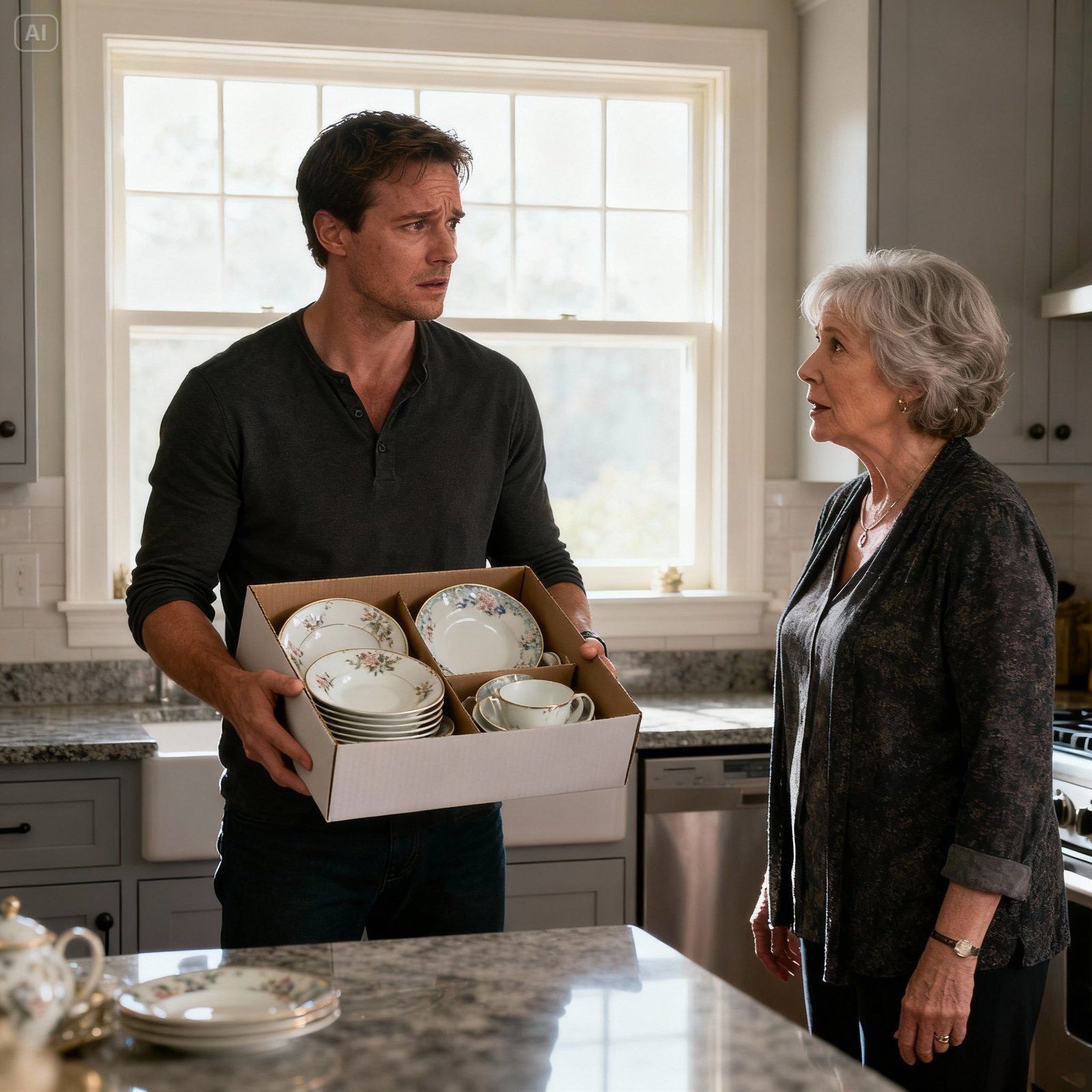
I set the box of my grandmother’s china down on the counter slowly, buying myself time to process the words.
My mother was already in the cabinets, arranging dishes like she owned the place. She’d pulled out Rebecca’s carefully organized stacks and started redoing them—plates moved, bowls swapped, everything “fixed” to match her idea of how a kitchen should look.
She’d already rearranged our living room furniture that morning, claiming the previous layout blocked the room’s “natural energy flow.” She’d shifted our couch two feet left like that mattered more than the fact it wasn’t hers to touch.
She’d moved Rebecca’s family photos off the mantle and set them on a side table in the hallway like they were an afterthought. Then she’d placed pictures of me as a child front and center, like she was reclaiming territory.
When Rebecca had gently suggested we keep things where we’d put them, my mother laughed and said, “You never knew how to properly set up a home.”
The way she said it—light, amused, like it was a harmless joke—made my stomach tighten.
Because it wasn’t a joke.
It was a message.
And now she was standing in our kitchen making declarations about marital hierarchy like she had any right to either.
I swallowed hard.
“What do you mean by that?” I asked.
My mother turned toward me with that patient expression—the one she uses when she’s explaining something “obvious” to someone she thinks is slow. Her mouth curved into a small smile, like she wasn’t insulting me, like she was doing me a favor.
She said Rebecca seemed to think marriage meant I belonged to her now.
But a man’s mother, my mother explained, was his first and most important relationship.
She said she’d noticed Rebecca “getting territorial” about my time and attention, and it needed to stop before it became a real problem.
I stood there trying to figure out when my wife had been territorial.
Rebecca was the least possessive person I’ve ever met. She encouraged me to spend time with my family. She never complained when I talked to my mother on the phone. She had been nothing but welcoming since the day we got engaged.
The only thing Rebecca had ever asked—asked—was that we keep Sunday dinners just for us, the two of us, so we could connect after busy weeks.
That was it.
That was the entire “boundary” my mother had apparently decided was a threat.
I must have looked confused because my mother softened her tone. She reached out and touched my arm like she was comforting me through a hard truth.
She said she knew this was difficult to hear, but she was only trying to help me avoid the mistakes other men make.
She said she’d watched too many marriages fail because wives drove wedges between sons and their mothers.
She said Rebecca was a sweet girl, but young wives always try to isolate their husbands from their families, and I needed to establish boundaries now before things got worse.
I pulled my arm away.
“Rebecca has never tried to isolate me from anyone,” I said, and my voice came out sharper than I intended.
For a split second, something cold flickered behind my mother’s eyes.
Then the patient smile returned like a mask slipping back into place.
She tilted her head.
“You’re being defensive,” she said. “Which proves my point.”
Before I could answer, Rebecca came downstairs carrying an empty box broken down flat. She smiled at both of us like she didn’t sense the tension radiating off the kitchen walls.
“Do you want tea?” she asked.
My mother answered before I could.
“That would be lovely,” she said brightly. Then she looked at Rebecca like a teacher testing a student. “Do you know where the good tea kettle is?”
Rebecca’s smile faltered—just a second. Not dramatic. Just a tiny crack.
“I think it’s in one of the kitchen boxes,” Rebecca said carefully.
My mother made a small sound of disapproval.
“I already checked those boxes,” she said. “I didn’t see anything suitable.”
Then—like it was the most natural thing in the world—she said she’d brought her own kettle and it was in her suitcase.
“Would you mind getting it?” she asked Rebecca.
I watched my wife’s face.
She didn’t argue. She didn’t ask why my mother couldn’t get her own kettle from her own suitcase.
She just said, “Of course,” and headed toward the guest room where my mother’s luggage sat unopened.
My mother watched her go, then turned back to me with a knowing look, like Rebecca’s compliance had just proven every point she’d been making.
And that’s when it hit me fully.
This wasn’t overbearing.
This wasn’t “helpful.”
This was dominance.
A slow, deliberate attempt to establish who mattered more in my marriage.
In my house.
In the life Rebecca and I were building.
I tried to breathe past the tightness in my chest.
I thought about the last few months since the wedding—things I’d brushed off, things I’d laughed at, things I’d labeled “adjustment” because I didn’t want conflict.
My mother had called me every single day.
Sometimes multiple times.
If I didn’t answer, she texted: Everything okay? You’re not too busy to talk to your mother, are you?
If I stayed on the phone too long with Rebecca in the room, she’d joke about how “new wives love to keep their husbands busy.”
She’d shown up at our old apartment unannounced at least once a week. Always with an excuse—she was “in the neighborhood,” she “made extra food,” she “just wanted to see you.”
She’d started commenting on Rebecca’s cooking, cleaning, career choices—always framed as helpful suggestions, but landing like criticisms.
I wrote it off as awkwardness.
My mother getting used to sharing her only son.
Now I was wondering if I’d been dangerously naive.
Rebecca returned with the kettle—a gleaming copper thing that looked expensive and out of place in our modest kitchen.
My mother took it from her with a bright smile.
“Oh perfect,” she said. “I’ll make the tea. I know exactly how you like it.”
Rebecca stood there for a second, uncertain, like she didn’t know if she was supposed to insist or step back.
Then she said she needed to finish unpacking the bedroom.
My mother waved her off cheerfully.
“Don’t work too hard,” she called.
Rebecca went upstairs.
And I felt something twist in my stomach—not just anger at my mother, but shame at myself for standing there and letting it happen.
My mother filled the kettle and moved around my kitchen with the confidence of ownership. She opened drawers and cabinets like she’d lived there for years, somehow finding things faster than I could.
When the tea was ready, she poured two cups and handed me one. Then she sat at our small kitchen table and patted the chair next to her.
I sat down because I didn’t know what else to do.
She asked if I was happy.
The question caught me off guard. It was so normal-sounding, so almost kind, that my defenses hesitated.
“Of course I’m happy,” I said. “I just married the woman I love. We bought our first house together.”
My mother nodded slowly like she was evaluating my answer.
Then she said she wanted to tell me something important—mother to son—and she needed me to really listen.
She told me she’d been married to my father for eighteen years before he died, and she’d learned things about marriage I needed to understand.
She said the biggest mistake a man could make was putting his wife before his mother because wives could leave.
But mothers were forever.
I felt like I’d stepped into an alternate reality where the rules of normal human relationships didn’t apply.
I held the tea cup in my hands like it was an anchor.
“Putting your spouse first is literally the foundation of marriage,” I said.
My mother laughed.
Actually laughed.
Like I’d said something cute.
“That’s modern nonsense,” she said. “Invented by people who don’t understand family bonds.”
She said in healthy families, the mother-son relationship was sacred, and wives needed to respect that.
She said Rebecca was young and didn’t understand these things yet, but I could teach her.
I stared at her.
“How exactly,” I asked slowly, “am I supposed to teach my wife that she comes second to my mother?”
My mother’s face hardened slightly.
She sighed like I was being dramatic.
“I’m not asking to come first in every little thing,” she said. “Just the important matters.”
“What qualifies as important matters?” I asked.
She smiled again—small, satisfied.
“You’ll know them when you see them,” she said.
My skin prickled.
That wasn’t an answer.
That was a trap.
Because it meant “important” would always be whatever she decided it was.
Rebecca called down the stairs then.
“Where did you put the hammer?”
I stood up too fast, grateful for the escape.
I went upstairs to our bedroom.
Rebecca was surrounded by boxes and bubble wrap, trying to hang a mirror. Her hair was pulled up, sleeves pushed to her elbows. She looked tired but determined—like she was building something.
I found the hammer in the hall closet and handed it to her.
“Thanks,” she said, then hesitated, voice quiet. “Did your mom say how long she’s planning to stay?”
My stomach dropped.
I realized I didn’t know.
Rebecca must have seen it on my face because she quickly softened.
“It’s fine,” she said too fast. “I’m just trying to plan meals.”
But her smile didn’t reach her eyes.
There was tension in her shoulders like a held breath.
“I’ll talk to her,” I promised.
Rebecca nodded and went back to hanging the mirror, but the way she moved—too careful, too quiet—made me feel like a coward.
I went back downstairs with my chest tight.
My mother was still at the kitchen table, scrolling on her phone like she’d been waiting.
She looked up and smiled.
She said she’d been thinking about what I said and maybe she’d come on too strong.
She said she just worried about me, and sometimes her protective instincts got the better of her judgment.
It was such a reasonable thing to say—such a normal mother thing—that I felt my defenses lowering.
She asked if I was upset with her.
“I’m confused more than upset,” I admitted.
She nodded like she understood.
Then she said we could talk more later—after Rebecca wasn’t around to overhear and misunderstand.
That phrasing bothered me.
The assumption that Rebecca would “misunderstand” rather than understand correctly.
But I didn’t have the energy for another circular conversation.
So I asked the practical question.
“How long are you planning to visit?” I said.
My mother’s expression shifted to surprise.
“Visit?” she repeated.
Then she said, calmly, like she was confused that I didn’t already know:
“I’m not visiting. I’m moving in.”
The room tilted sideways.
My breath caught in my throat.
“What?” I said.
My mother frowned like I was the unreasonable one.
“I gave notice at my apartment three weeks ago,” she said. “Most of my things are being delivered on Monday.”
My mouth went dry.
She said she assumed I knew that was the plan.
“That’s why you bought a house with three bedrooms instead of two,” she added.
I stared at her, heart pounding.
“We bought three bedrooms because we wanted space for guests,” I said, “and eventually children.”
My mother laughed.
“It’s the same thing, isn’t it?” she said. “I can help with the children when they come. And in the meantime, I’ll be here to help Rebecca learn to run a proper household.”
My hands started shaking.
I set my tea down before I dropped it.
“No,” I said, voice low. “No, you can’t move in with us.”
My mother’s face went very still.
“Why not?” she asked.
Because we’re newlyweds. Because we need privacy. Because this house is ours. Because you’re already trying to control my wife in her own kitchen.
But what came out was simpler.
“Because Rebecca and I need space to build our marriage,” I said.
My mother’s eyes narrowed.
“That’s selfish,” she snapped. “Short-sighted.”
She said she’d sold most of her furniture. Her lease ended in a week.
“Where exactly do you expect me to go?” she demanded.
I suggested she find another apartment. Maybe stay with her sister for a while.
My mother stood up so fast her chair scraped loudly against the floor.
“I can’t believe you,” she said, voice rising. “You’re choosing some woman you’ve known for three years over your mother who raised you alone after your father died.”
The guilt trip hit like a punch because it was old. Familiar. Like she’d been waiting to use it.
Rebecca appeared in the kitchen doorway, clearly having heard raised voices.
“Is everything okay?” she asked, eyes wide.
My mother turned to her instantly, tears springing like a switch had been flipped.
“He’s trying to make me homeless,” my mother sobbed.
Rebecca looked at me in confusion.
I tried to explain—quickly, poorly—that my mother apparently planned to move in without discussing it with us first.
My mother cut me off.
“I discussed it with you weeks ago,” she said, voice trembling with wounded innocence. “And you said it sounded fine.”
I hadn’t. I absolutely hadn’t.
Rebecca took a step forward, hands slightly raised like she was trying to calm a wild animal.
“Can we all sit down and talk about this calmly?” she offered.
My mother’s face hardened.
“There’s nothing to talk about,” she said. “My things are being delivered Monday.”
She looked at Rebecca with thin disgust wrapped in politeness.
“I hoped my new daughter-in-law would be more welcoming,” she said. “But apparently modern women have no sense of family obligation.”
The next few hours blurred into tense circular conversation.
My mother insisted she told me. I insisted she didn’t. Rebecca tried to mediate—suggesting we help her find a place nearby.
My mother claimed she couldn’t afford rent, which didn’t make sense because I knew she had a decent pension from my father’s workplace death benefits and her own retirement savings.
Every attempt at a solution was met with tears, anger, or guilt trips about abandonment.
Finally Rebecca excused herself and went upstairs.
I heard our bedroom door close a little too firmly.
I turned back to my mother.
“You need to leave,” I said.
She stared at me like she couldn’t believe I was saying it.
“Are you really throwing me out?” she whispered.
“I’m not throwing you out,” I said. “But you can’t stay here. We need space to figure this out.”
She gathered her things with exaggerated slowness, making sure I watched. Making sure I saw how “hurt” she was.
At the front door, she turned.
“This isn’t over,” she said. “Rebecca is already changing you. Making you cold.”
Then she left.
And I stood in my hallway feeling like I’d just survived a natural disaster.
Upstairs, I found Rebecca sitting on our bed with her laptop open.
She looked up at me and I saw she’d been crying.
“I’m looking at apartments,” she said quietly.
My stomach dropped.
“Why?” I asked.
Rebecca’s voice shook.
“I refuse to be the reason you’re estranged from your mother,” she said. “I can get my own place. We can slow things down until she adjusts.”
I sat down next to her and closed the laptop gently.
“My mother is the problem,” I said. “Not you.”
Rebecca leaned into me, still trembling.
“I don’t understand what just happened,” she whispered.
“I don’t either,” I admitted. “But we’re going to figure it out together.”
That night, my mother called six times.
I didn’t answer.
And as I lay in bed listening to Rebecca breathe beside me—uneven, exhausted—I knew one thing with terrifying clarity:
My mother hadn’t just come to “help us settle in.”
She came to claim the house.
To claim my marriage.
And she wasn’t going to stop unless I made her.
PART 2 — She Didn’t Move In… She Invaded
The next morning, my mother showed up at 8:00 a.m. with breakfast pastries and coffee.
Like nothing happened.
Like she didn’t spend the day before demanding a key to “her new room.” Like she didn’t accuse my wife of being a modern woman with no family values. Like she didn’t try to move in without ever asking.
I opened the door and she swept past me before I could decide whether to block her.
“Yesterday got a little emotional,” she said brightly, as if she’d just spilled a drink at dinner. “We should start fresh.”
Her perfume filled the hallway. Sweet and heavy. The scent of my childhood and every boundary I never learned to defend.
Rebecca came downstairs in her bathrobe, hair damp, face pale with exhaustion. My mother’s expression flickered—disapproval, quick and sharp—then smoothed back into brightness.
She laid out pastries on our kitchen counter and started making coffee using her copper kettle—the one she’d “accidentally” left behind like an anchor.
I tried to speak. Tried to bring up the conversation we didn’t finish.
“Mom,” I said carefully, “we need to talk about boundaries.”
My mother smiled.
“Of course,” she said. “After breakfast. Family should never discuss difficult topics on an empty stomach.”
She said it like it was wisdom.
It was control.
Because “after breakfast” became after coffee, then after the dishes, then “later,” then “not now,” then the day disappeared under her presence again.
And over the next two weeks, my mother showed up every single day.
Sometimes she brought food.
Sometimes she brought mail that had been “forwarded to her old address.”
Sometimes she claimed she was “in the neighborhood.”
Each time she stayed for hours, rearranging, criticizing, correcting.
She commented on Rebecca’s work schedule—suggesting Rebecca should consider part-time hours “so she can focus more on homemaking.”
She criticized how Rebecca folded laundry.
How she loaded the dishwasher.
She questioned our grocery choices.
Our weekend plans.
And if I tried to establish a boundary, she became tearful and accused me of shutting her out.
If Rebecca tried to politely redirect her, my mother claimed Rebecca was being controlling and hostile.
It was constant.
And it was exhausting.
Rebecca started working late more often—not because she suddenly loved overtime, but because she was avoiding coming home while my mother might be there.
We started whispering at night like teenagers hiding from a parent.
“What do we do?” Rebecca asked in the dark one night, voice trembling. “Do we move? Do we involve counseling? Do we just… wait?”
I didn’t have an answer.
Because the terrifying thing was: my mother had invaded our marriage without ever actually moving in.
She didn’t need a bedroom. She didn’t need a closet.
She just needed access.
And she was taking it.
So I started documenting everything.
Not because I had a plan.
Because something in my gut told me I was going to need proof.
I kept a notebook in my car.
Every visit, every comment, every rearranged object, every criticism disguised as “help.”
I wrote down dates, times, what she said, what she moved.
It felt ridiculous at first. Like I was overreacting.
Then it started feeling like the only sane thing.
Because what she was doing was designed to be deniable.
Small enough each time that if you described it out loud, you sounded dramatic.
But together?
Together it was a pattern.
A siege.
Then it escalated.
One Thursday, I came home from work and found my mother in our house alone.
She was in the kitchen with a pot roast on the stove.
My favorite meal from childhood.
She’d set the table for two.
Like she was my wife.
Rebecca was working late again, and my mother had “surprised” me.
I stared at her, stunned.
“How did you get in?” I asked.
She smiled like I was silly.
“I have a key,” she said.
My stomach dropped.
“What?” I said.
She explained it like it was obvious:
She’d made copies from the emergency spare key Rebecca kept in her car.
As if that was normal.
As if that was her right.
I felt my hands start shaking.
“You copied our key,” I said slowly.
My mother waved a hand dismissively.
“Mothers don’t need permission to access their son’s home,” she said.
I demanded the key back.
She laughed.
She said I was being paranoid and controlling—just like Rebecca was “making” me.
That was the word she kept using: making.
As if my choices were never mine.
As if my wife was casting a spell.
As if the only way I could disagree with my mother was because someone else controlled me.
That night, I called a locksmith.
We had every lock changed.
My mother showed up the next morning.
Her key didn’t work.
She rang the doorbell repeatedly until I answered.
She demanded to know why I locked her out.
I said, “Because this is my house. Not yours. You don’t get to come and go as you please.”
My mother started crying on the front porch loud enough that neighbors looked out their windows.
She said I’d never treated her this way before Rebecca.
She said Rebecca was poisoning me.
She said she’d never forgive this betrayal.
I closed the door while she was still talking.
I listened to her ring the doorbell for another five minutes before she finally left.
Rebecca stood behind me the whole time, silent, hand pressed to her mouth like she was trying not to fall apart.
When the bell finally stopped, she whispered, “I feel like I’m living in someone else’s life.”
I turned toward her and saw the exhaustion in her face.
And something in me hardened.
Not against Rebecca.
Against myself.
For letting it get this far.
That weekend, the family calls started.
Not because my mother wanted to understand.
Because she wanted backup.
My aunt called asking why I was being so cruel.
My uncle called to tell me I needed to respect my elders.
My cousin sent a long text about family loyalty.
None of them asked my side.
None questioned whether my mother was distorting the truth.
The assumption was automatic:
Mothers don’t lie.
Wives are suspicious.
Sons who side with wives are being controlled.
Rebecca and I sat at our kitchen table and wrote out everything that had happened since the day my mother declared she came first.
Daily invasions.
Copied key.
Guilt trips.
Family campaign.
Looking at it all laid out, the pattern was undeniable.
This wasn’t a mother struggling to adjust.
This was a deliberate campaign to assert dominance and undermine my wife.
I decided to call my mother’s sister—my aunt Diane—because she’d always been more level-headed than the rest.
When I explained what was really happening, she was quiet for a long time.
Then she said something that made my stomach drop.
“My sister has always been possessive,” Diane admitted. “Even when your father was alive.”
She told me my father struggled with it too. He loved my mother and tried to manage her.
Diane said she’d hoped my mother would improve after I grew up, but clearly that never happened.
Then Diane suggested family therapy.
She even offered to pay for it if money was an issue.
“She needs to hear from a professional that her behavior is damaging,” Diane said.
I thanked her and told Rebecca.
Rebecca was supportive… but skeptical.
“She has to admit there’s a problem,” Rebecca said softly. “And she hasn’t shown any sign she will.”
“I know,” I said. “But we have to try something.”
Because what we had now wasn’t living.
It was surviving.
The next day, I researched family therapists who specialized in mother-son-spouse conflict.
I found Dr. Patricia Gaines—18 years of experience, excellent reviews.
I made an appointment for the following week.
Getting my mother to agree was harder than finding the therapist.
When I called and suggested it, she got defensive immediately.
“Why do I need therapy?” she demanded.
“It’s family therapy,” I said carefully. “For all of us. To improve communication.”
“Our communication was fine until Rebecca came along,” she snapped.
So I said the sentence that tasted like fear and freedom at the same time.
“Either you come to therapy,” I told her, “or you won’t be welcome in our lives at all.”
There was a long silence.
Then she said, “Fine.”
But her tone was sharp.
“I’ll go,” she said, “but only to prove Rebecca is the real problem.”
I took it as a win anyway.
Because at that point, any session was better than letting her keep running our marriage from the outside.
The appointment was set.
And even though my stomach was tight with dread, I felt something else too:
A line forming.
A boundary that wasn’t just in my head anymore.
Something I could finally enforce.
PART 3 — Therapy Didn’t Fix Her. It Exposed Her.
The day of the therapy session, my stomach felt like it was full of stones.
Not because I thought therapy would magically change my mother.
Because I knew what she was going to do: perform.
Cry.
Narrate.
Reframe.
Make herself the victim.
And if the therapist wasn’t strong enough to hold the line, my mother would bulldoze the session the way she bulldozed everything else.
Rebecca rode with me in silence. Her hand was on her knee, fingers tapping lightly—an anxious habit she’d developed over the last few weeks. She looked tired in a way that didn’t come from work. Tired from living in a home that didn’t feel fully hers anymore.
When we arrived, the office was calm—soft lighting, neutral colors, the faint smell of peppermint tea. The waiting room had old magazines and a small water cooler. The kind of place designed to make people feel safe enough to tell the truth.
My mother walked in five minutes late—of course she did—wearing a conservative cardigan and that practiced “I’m a grieving widow” softness.
She smiled at the receptionist. She smiled at the therapist.
She did not smile at Rebecca.
Dr. Gaines—calm, professional, kind eyes, no-nonsense posture—introduced herself and invited us in.
She explained the basics: safe space, no interruptions, speak from your own experience, we’re here to understand each other.
My mother nodded solemnly like she was the most reasonable person in the room.
Then the session began.
And my mother launched into her narrative before Dr. Gaines could even finish her first question.
She cried—real tears, but the kind I’d seen before, the kind that appeared on cue.
She talked about raising me alone after my father died.
She talked about sacrificing everything.
She talked about how she’d been “abandoned” the moment I married Rebecca.
She said I used to be warm and close, but now I was cold and distant.
She said Rebecca had changed me.
Rebecca was “isolating” me.
Rebecca was “controlling.”
Rebecca was “hostile.”
My mother spoke like she was reading a script she’d rehearsed in the mirror.
Dr. Gaines listened without interrupting, taking notes, letting my mother empty the performance onto the table.
When my mother finally paused to wipe her eyes, Dr. Gaines turned to me gently.
“Thank you,” she said. “Now, I’d like to hear your perspective.”
I took a breath and did what I’d been doing in my notebook for weeks.
Facts.
Not feelings.
Because my mother was counting on feelings to blur the truth.
So I laid it out.
The Saturday morning she arrived unannounced with suitcases.
The kitchen declaration: “Your wife needs to understand I come first.”
The rearranging of our furniture.
Moving Rebecca’s family photos.
The attempted move-in without discussing it with either of us.
The daily unannounced visits.
The criticism disguised as “help.”
Then the escalation: the copied key.
Letting herself into our home while Rebecca was at work.
The claim that mothers don’t need permission.
The front porch crying scene loud enough for neighbors to watch.
The family campaign—calls and texts from relatives who never asked my side.
My mother interrupted repeatedly.
“That’s not what I said.”
“You’re exaggerating.”
“You’re remembering it wrong.”
“I was just trying to help.”
Dr. Gaines held up a hand gently.
“You’ll have a chance to respond,” she told my mother. “Let him finish.”
My mother’s face tightened.
I finished.
Then Dr. Gaines turned to Rebecca.
“Rebecca,” she said softly, “can you share your experience?”
Rebecca’s voice was quiet.
Not weak—controlled.
And the calmness of her account made it devastating.
She described feeling unwelcome in her own home.
The constant correction.
The way nothing she did was “right.”
The way she started staying late at work to avoid coming home to a surprise visit.
The way she felt like she was failing at being a wife because my mother acted like she was failing at being a woman.
She didn’t insult my mother.
She didn’t call her names.
She just described reality.
And somehow that was worse—because there was nothing to argue with.
When Rebecca finished, the room was quiet for a moment.
Dr. Gaines looked at my mother.
“Can you understand,” she asked carefully, “why your behavior might feel invasive to Rebecca?”
My mother’s lips pressed together.
“I was only trying to help,” she said.
Dr. Gaines didn’t let it slide.
“What specific help did Rebecca request?” she asked.
My mother blinked, thrown.
“Well—” she started.
Dr. Gaines waited.
My mother faltered.
“She didn’t request it,” my mother admitted, defensive. “Young wives always need help whether they ask for it or not.”
Dr. Gaines nodded slowly.
“Have you considered,” she asked, “that unsolicited help can feel like criticism?”
My mother’s face hardened.
Her eyes sharpened.
And then she said the line that revealed everything.
“Therapists always take the wife’s side,” she snapped.
Dr. Gaines stayed calm.
“This isn’t about sides,” she said. “It’s about boundaries.”
My mother stood up abruptly.
“I’m leaving,” she announced.
Dr. Gaines didn’t panic. She didn’t plead.
“That’s your choice,” she said evenly. “But walking out won’t resolve the underlying issues.”
“There are no underlying issues,” my mother snapped. “The only issue is Rebecca’s hostility.”
Then she walked out.
Just like that.
Rebecca and I sat there, stunned.
And in that moment, therapy didn’t fix my mother.
It exposed her.
Because she didn’t come to learn.
She came to win.
And the second she realized she wasn’t going to be handed a therapist-approved victory, she left.
Rebecca and I stayed for the rest of the session.
Dr. Gaines didn’t sugarcoat her assessment.
She said my mother showed signs of enmeshment—an unhealthy blurring of boundaries between parent and child.
She explained that enmeshment often intensifies when the child marries because marriage threatens the enmeshed relationship.
She said my mother likely saw Rebecca not as a daughter-in-law, but as competition.
And unless my mother was willing to do serious work, the situation would escalate.
Not improve.
Escalate.
Dr. Gaines recommended firm boundaries and consistent enforcement—even if that meant reducing contact with my mother.
Protecting my marriage had to be the priority.
I asked what boundaries looked like practically.
Dr. Gaines was specific:
No unannounced visits
Scheduled phone calls instead of daily contact
Absolutely no criticism of Rebecca
No involving other family members in disputes
Clear consequences if boundaries were violated
She told us to put it in writing.
Not to be cold.
To be clear.
And she warned me: my mother would likely test the boundaries dramatically.
She said I needed to follow through or the boundaries would mean nothing.
Rebecca squeezed my hand so hard it hurt.
Because we both knew: the hard part wasn’t writing the boundary.
It was enforcing it against someone who’d trained an entire family to believe she was untouchable.
That night, I drafted an email to my mother.
Clear. Specific. No room for “misunderstanding.”
No visits without calling first and getting confirmation.
Phone calls limited to twice a week at scheduled times.
No criticism of Rebecca or our marriage.
No involving other family members in our disagreements.
I wrote that these weren’t punishments. They were necessary for healthy relationships.
And if she couldn’t respect them, we would take a break from contact entirely.
Rebecca read it twice.
Then she looked at me and asked quietly, “Are you sure?”
My throat tightened.
“Yes,” I said.
I hit send before my fear could talk me out of it.
My mother’s response came within an hour.
It was three pages long.
She called me ungrateful. Cruel.
She said I’d been brainwashed by Rebecca.
She said she would not be dictated to by her own son.
She said if this was how I wanted things, fine—she’d leave me alone and I’d regret it when she was dead and I hadn’t spoken to her in years.
Then she said she’d tell the whole family what I’d done so they’d all know who I really was.
And just like she promised, the family calls started immediately.
Voicemail from my uncle calling me selfish and spoiled.
A text from my aunt about how I was my mother’s whole world.
Cousins posting vague social media rants about ungrateful children and “modern society destroying family values.”
It was coordinated.
Overwhelming.
Rebecca held me while I listened, not speaking, just being there.
And I realized something with terrifying clarity:
My mother wasn’t just trying to control my marriage.
She was trying to control the story.
Because if she controlled the story, she didn’t have to change.
She could just recruit an audience.
I posted publicly.
Not emotional. Not messy.
Just truth.
I wrote that I loved my mother, but needed boundaries in my marriage, and anyone who had questions could call me directly instead of believing secondhand information.
Only three people called.
Aunt Diane—who already knew.
And two cousins who admitted they felt pressured by my mother to take her side.
Everyone else chose the version that required the least thinking.
And that was another kind of grief I didn’t expect:
Realizing “family” didn’t mean people would ask you for the truth.
It meant they would choose the story that kept the peace.
Even if it destroyed you.
Then my mother crossed a new line.
She showed up at Rebecca’s workplace.
Rebecca called me from her office, voice shaking.
“She’s in the lobby,” she whispered. “She’s demanding to see me.”
My blood went cold.
I told Rebecca not to go down.
I called building security.
I explained the situation and asked them to remove my mother.
A patient security guard named Thomas said they’d handle it.
Twenty minutes later, Rebecca called back.
“She’s gone,” she said. “But she made a scene.”
Rebecca’s boss witnessed it and asked if everything was okay at home.
Rebecca had to explain—humiliating, exhausting, invasive.
My mother had now invaded her workplace.
Her professional life.
The one place she had left that wasn’t already contaminated.
That was the moment I realized: boundaries without legal teeth were just suggestions to my mother.
So that afternoon, I filed for a restraining order.
PART 4 — The Restraining Order
Filing for a restraining order against your own mother feels like stepping into someone else’s life.
It felt humiliating in a way I wasn’t prepared for. Not because I was ashamed of protecting my wife—but because the world doesn’t expect mothers to be the threat. The world expects you to be exaggerating, or confused, or ungrateful.
That afternoon, after Rebecca called me shaking from her office—she’s in the lobby demanding to see me—I drove straight to the courthouse with my notebook in my hand like it was the only thing keeping me from being dismissed as “dramatic.”
I’d never pictured myself explaining to a judge that my mother was harassing us. Even saying the words felt wrong, like the universe would correct me for it.
The judge looked skeptical. Not hostile—just that subtle expression that says, Really? Your mother?
But I came prepared.
I brought the documentation notebook. I brought Dr. Gaines’s notes. I brought a statement from Rebecca’s employer about the workplace incident.
I laid it all out—calmly, clearly, not as a story, but as a pattern.
The judge granted a temporary order.
My mother would be prohibited from coming within 500 feet of us, our home, or Rebecca’s workplace. Thirty days. A hearing scheduled to determine whether it should be extended.
When my mother was served, she called me screaming.
She said I’d had her arrested, which wasn’t true.
She said I’d humiliated her in front of her neighbors when the process server came to her door.
She said she would never forgive me.
She said I was dead to her.
Then she hung up.
And I stood there in my living room with my phone in my hand, feeling two things at the same time:
Devastated… and free.
Because for most of my life, I’d been managing my mother’s emotions like it was my job. I’d adjusted my tone, my choices, my entire nervous system to keep her calm.
Now I didn’t have to.
Not because she suddenly became reasonable.
Because a legal document finally said: no.
For thirty days, the temporary restraining order gave us breathing room.
It was like someone finally turned off the constant hum in the background.
Rebecca started coming home at reasonable hours again. We cooked dinner together. We watched movies. We unpacked boxes we’d left sealed during the “siege.” We hung pictures. We arranged furniture the way we wanted.
For the first time since we bought the house, it started feeling like ours.
It should’ve felt like victory.
Instead, I kept waiting for the other shoe.
Because people like my mother don’t accept boundaries.
They test them.
And they test them hardest when you’re about to make them permanent.
The shoe dropped the night before the hearing.
My phone rang at midnight.
Unknown number.
I almost ignored it. Then I saw the caller ID: hospital.
My stomach dropped so hard it felt like falling.
A nurse’s voice came through, tired and direct.
“Your mother has been admitted,” she said. “She took too many sleeping pills.”
Everything in me went cold.
They’d pumped her stomach, the nurse said. She was stable. But she had listed me as her emergency contact. She’d been asking for me repeatedly.
I threw on clothes so fast my hands fumbled buttons. Rebecca was already awake, sitting up in bed, hair messy, eyes wide.
“What happened?” she whispered.
“My mom’s in the hospital,” I said, and the words tasted like panic.
Rebecca didn’t argue. She didn’t say don’t go. She just got dressed and grabbed her keys like she understood that fear doesn’t care about logic.
We drove in silence—both of us terrified, both of us bracing for the worst.
At the hospital, a doctor met us—tired, blunt, the kind of man who’s seen too many nights like this.
“She’s medically stable,” he said, “but psychiatrically concerning.”
He told us my mother claimed the overdose was accidental, but the amount suggested otherwise.
He asked about stressors, family history.
I explained the restraining order, and I watched his expression shift—the skepticism dissolving into something like understanding.
Then a woman introduced herself.
Dr. Rachel Foster, hospital psychiatrist.
She asked to speak with me privately.
We went into a small consultation room. The door clicked shut. The fluorescent light made everything feel too sharp.
Dr. Foster looked at me calmly.
“Your mother is medically stable,” she said. “But this is not a simple accident.”
She told me my mother had said to the intake nurse that her son had abandoned her and she had nothing left to live for.
She said my mother met criteria for an involuntary psychiatric hold.
Then she said something that made my stomach turn.
“This isn’t the first time she’s been in this hospital,” Dr. Foster said.
I blinked. “What?”
She checked her computer.
“Three admissions in the past fifteen years,” she said. “Two for suicide gestures. One for suspected factitious disorder.”
My throat went dry.
Factitious disorder.
She explained it gently—someone presenting medical crises that can’t be substantiated, often tied to attention and control.
Each time, Dr. Foster said, my mother had been released after short stays because she presented well to staff and promised outpatient treatment.
“There’s no record she ever followed through with outpatient care,” Dr. Foster added.
I felt like I might throw up.
I asked if she was saying my mother did this on purpose.
Dr. Foster was careful.
“I can’t say definitively,” she said. “But the pattern is suggestive.”
Then she said the part that made my skin prickle.
“The timing—right before the restraining order hearing—is unlikely to be coincidence,” she said.
She said my mother specifically asked the nurse to call me despite the active restraining order. That indicated calculated thinking.
Dr. Foster told me they’d keep my mother for at least a 72-hour evaluation and recommend intensive outpatient treatment afterward.
Then she asked, gently, “Do you want to see her?”
My whole body said no before my mouth did.
“No,” I said.
Dr. Foster nodded like she expected it.
When I walked back to the waiting room, Rebecca’s face searched mine immediately.
“What did she say?” Rebecca asked quietly.
I told her everything. The history. The pattern. The timing.
Rebecca looked horrified.
“What are we supposed to do?” she whispered.
I shook my head.
“I don’t know,” I admitted. “But I’m not dropping the restraining order.”
We drove home as the sun came up—exhausted, shell-shocked, both of us silent because there were no words big enough.
In the car, I called my aunt Diane and told her what happened.
She was quiet for a long moment, then she said something that made my stomach drop again.
“I’m not surprised,” she admitted.
She told me my mother had pulled similar stunts when my father tried to set boundaries. Once, she said, my mother crashed her car into a tree after an argument and claimed the brakes failed—mechanics found nothing wrong.
My father always backed down after these incidents, Diane said, because he felt too guilty to hold his ground.
And I sat there gripping the steering wheel thinking: This has been happening for years. I just didn’t know the name for it.
The restraining order hearing happened while my mother was still on psychiatric hold.
Her lawyer appeared and requested a continuance.
The judge denied it.
My lawyer presented everything—our documentation, therapy notes, the workplace incident, and now the suspiciously timed overdose.
The judge granted a one-year restraining order.
I walked out of the courthouse feeling like I’d won something…
…and like I’d lost something fundamental.
I had legally banned my own mother from my life.
Even though it was necessary, it felt monstrous.
My mother was released after five days.
She called from a number I didn’t recognize.
I made the mistake of answering.
Her voice sounded weak and fragile—soft, wounded.
“I can’t believe you extended the restraining order while I was hospitalized,” she said.
“You were hospitalized because you took too many sleeping pills,” I said flatly.
“It was an accident,” she insisted. “I was confused about my medication.”
I told her Dr. Foster had said otherwise.
She gasped like I’d slapped her.
“She had no right to discuss my medical information with you,” my mother snapped.
“Dr. Foster was concerned about a pattern of manipulation,” I said, voice steady.
My mother started crying.
“I can’t believe you’d side with strangers over me,” she sobbed.
Then she hung up.
And I stood there realizing: even after everything, her instinct was still the same.
Not accountability.
Control.
Rebecca and I met with Dr. Gaines again.
We told her about the overdose, the hospital history, the hearing.
Dr. Gaines didn’t look shocked.
She looked… sadly unsurprised.
“This is escalation,” she said. “Predictable escalation.”
She explained that when enmeshed parents lose control, they often manufacture crises to force contact and restore the old dynamic.
She called the suicide gesture a classic manipulation tactic—especially when timed right before a court hearing.
She said the fact my mother ensured I’d be called despite the restraining order was significant.
Then she warned us:
Prepare for more escalation.
She might use other family members.
Show up at my workplace.
Attempt more dramatic gestures.
“The key is absolute consistency,” Dr. Gaines said. “Every violation gets the same response. Every time.”
I told her I felt like a terrible person.
Dr. Gaines leaned forward, eyes steady.
“Your mother may be in pain,” she said, “but that pain is the result of her own unhealthy attachment patterns—not your boundaries.”
She said enabling her wouldn’t help her. It would reinforce that manipulation works.
“The most loving thing you can do,” she said, “is refuse to participate in the dysfunction—even if she calls it abandonment.”
I nodded, but my chest hurt.
Because the truth is, it still felt like abandonment sometimes. Even when I knew it wasn’t.
Two weeks later, my mother violated the restraining order.
She showed up at my workplace with a birthday cake.
A birthday cake.
Building security called the police.
I watched from my office window as two officers talked to her in the parking lot. She was animated and tearful, pointing at the building—probably explaining I was her son and she just wanted to celebrate me.
One officer came inside and found me.
His name was Officer James Thornton. Twelve years on the force. Professional. Calm.
He asked if I wanted to press charges.
My stomach twisted.
And then I thought of Rebecca shaking in her office lobby. I thought of the copied key. The porch crying. The hospital call at midnight.
“Yes,” I said.
Officer Thornton nodded and walked back out.
My mother was arrested.
She spent six hours in custody before being released on her own recognizance with a court date.
Somehow it made the local news.
The headline was something like:
“Local woman arrested trying to deliver birthday cake to son.”
They painted her as tragic. A loving mother criminalized for trying to celebrate.
They didn’t mention the restraining order.
They didn’t mention the years of harassment.
They didn’t mention Rebecca.
My phone exploded with messages from people I hadn’t heard from in years.
All telling me I’d gone too far.
“She was just trying to be nice.”
“How could you have your own mother arrested?”
I wrote a response and sent it to the newspaper. I explained—without excessive detail—that there was a restraining order in place for documented harassment and she chose to violate it.
They printed a heavily edited version.
But enough got through that some people started asking questions.
A few reached out privately to apologize for judging without knowing the full story.
Most stayed silent.
Or doubled down.
The court date felt surreal.
My mother appeared with her lawyer, dressed conservatively and looking frail.
She told the judge she hadn’t realized delivering a birthday cake counted as contact.
The judge asked if she’d read the restraining order.
She said yes—but she thought it only meant she couldn’t threaten me, not that she couldn’t do “nice things.”
The judge was unmoved.
Violating a restraining order is serious regardless of intent.
He sentenced her to 30 days in jail, suspended, with two years probation. If she violated the order again, she’d serve the jail time.
My mother looked shocked.
Outside the courthouse, she tried to approach me.
Her lawyer physically stopped her, reminding her about the restraining order.
My mother called out that she loved me—she’d always loved me—and that Rebecca destroyed our family.
I kept walking.
Rebecca was waiting in the car.
When I got in, she asked, “Are you okay?”
I didn’t know.
I felt numb.
Life developed a new normal after that.
My mother stayed away physically—at least most of the time.
But she found other ways to make her presence known.
She sent letters we returned unopened.
She sent gifts to Rebecca’s workplace that Rebecca donated to charity.
She left comments on my social media posts from fake accounts until I made everything private.
She told anyone who’d listen that she was being persecuted by her ungrateful son and manipulative wife.
Some people believed her.
Fewer than I expected.
But enough that it still hurt.
Then something unexpected happened.
Rebecca’s boss—the one who witnessed the lobby scene—told her her grace under pressure impressed him.
Rebecca got promoted. Better hours. More money.
And she stopped looking over her shoulder constantly.
We started talking about trying for a baby.
Before, the idea felt impossible. How do you raise a child while your mother is actively trying to break your marriage?
Now—with distance and boundaries—it felt possible.
Not easy.
But possible.
And that felt like reclaiming a future my mother tried to steal.
Then one of my mother’s friends called me.
A woman named Patricia.
She’d known my family for years.
She said she needed to tell me something and wasn’t sure I’d want to hear it.
I told her to go ahead.
Patricia said my mother had been telling people I was abusive toward Rebecca. That the restraining order was really Rebecca’s idea and I was too weak to stand up to her. That Rebecca isolated me from everyone who loved me.
Patricia admitted she believed it at first.
Then she ran into Aunt Diane at the grocery store and Diane told her the truth.
Patricia said she felt sick realizing she’d spread lies without checking facts.
Then she said something else—something that hit like a final puzzle piece.
“My mother has a history of this,” Patricia said. “Even when your father was alive. She tried to drive wedges between him and his family. Dramas. Conflicts. Anything to keep him focused on her.”
After my father died, Patricia said, my mother transferred all that intensity onto me.
Patricia apologized. She offered to help set the record straight. She said she’d been talking to other people in my mother’s social circle, and several were expressing doubts now.
Rebecca looked relieved when I told her.
“It matters,” she said quietly. “That people are starting to see through it.”
And she was right.
Because the hardest part wasn’t just my mother’s behavior.
It was feeling like we were the only ones who could see it.
A year after the restraining order, Rebecca got pregnant.
We kept it quiet at first—close friends, Rebecca’s family, Aunt Diane.
We didn’t tell anyone on my side except Diane because we knew my mother would find out eventually, and we needed a plan.
Dr. Gaines helped us think through scenarios: What if she tries to contact us? Show up at the hospital? Claim grandparents’ rights?
We consulted a family law attorney—David Brennan, 23 years in practice.
He explained grandparents’ rights in our state only applied if the grandparent had an established relationship with the child.
Since our baby wasn’t born yet, my mother had no standing.
“Document everything,” he said. “And if she violates the order, call the police every time. Consistency matters.”
My mother found out when Rebecca was six months along.
Someone from Rebecca’s work posted something. One of my mother’s friends saw it and told her.
My mother sent a letter addressed to both of us.
Congratulations. She’d always love her grandchild. She hoped someday we could heal for the baby’s sake. She said she’d been in therapy and understood she’d been too controlling and was sorry.
Rebecca read it and looked at me.
“Do you believe it?” she asked.
I wanted to.
But I didn’t.
The apology was too clean. Too perfectly phrased. It didn’t acknowledge specific behaviors. It didn’t sound like understanding—it sounded like strategy.
Dr. Gaines read it and said it was a step, but not enough.
“Real change requires consistent action over time,” she said. “Not just words.”
She recommended we acknowledge receipt but maintain boundaries.
So I sent a brief reply: we received it, we hope she’s working on herself, we’re not ready to resume contact, we wish her well.
I didn’t mention the baby beyond acknowledging her congratulations.
My mother didn’t respond.
I took that as a good sign.
Our daughter was born on a clear morning in October.
Labor was long. Rebecca was incredible.
When they placed our daughter in my arms, something shifted in my chest.
This tiny person was depending on me to protect her. To create a healthy family for her. To make better choices than the generation before me did.
We named her Lily, after Rebecca’s grandmother.
Aunt Diane came to visit and cried holding Lily.
Rebecca’s parents flew in and were wonderful—respectful, helpful, never invasive.
We had visitors who followed our rules: call first, keep visits short, respect our space.
It was everything bringing a baby home should be.
Then my mother sent another letter when Lily was two weeks old.
She said she’d heard about the birth. She wanted to congratulate us. She respected our boundaries, but hoped we’d reconsider letting her meet her granddaughter.
She said she’d been in therapy consistently and made progress.
She included a signed permission form allowing her therapist to speak with us.
This letter was more thorough. More specific.
And for the first time, I didn’t know what to do with it.
Rebecca and I talked for days.
Part of me wanted to believe my mother could change.
Part of me wanted Lily to have a grandmother.
Part of me was terrified of letting my mother back in and having to rebuild all the walls we fought so hard to build.
Dr. Gaines suggested we speak with my mother’s therapist.
So we did.
Dr. Leonard Hayes had been working with my mother for eight months.
He was careful and ethical. He confirmed she was his client. He said she’d made progress recognizing unhealthy patterns. He said she’d been consistent in therapy. He couldn’t guarantee the future, but he confirmed she’d been doing the work.
He said the decision was ours. Proceed cautiously, if at all.
Rebecca and I decided on a test.
One supervised meeting. Public place. One hour. We’d be present the whole time.
If it went well, we’d consider more.
If it went poorly, we’d return to no contact.
We sent my mother a letter outlining the terms.
She agreed immediately.
We set a date three weeks out at a park near our house.
The day of the meeting, I was more nervous than I’d been for my wedding.
Rebecca kept asking, “Are you sure?”
I said the truth: “No. But we have to try.”
We got to the park early and chose a picnic table in a visible area.
My mother arrived exactly on time.
She looked different—older, subdued.
She stopped a respectful distance away and asked if she could approach.
I said yes.
She looked at Lily in Rebecca’s arms and her eyes filled with tears.
She asked if she could hold her.
Rebecca looked at me.
I nodded.
Rebecca handed Lily over carefully.
My mother took her with shaking hands and whispered she was beautiful.
For an hour, my mother sat with us and asked gentle questions about how we were adjusting. She didn’t criticize. She didn’t give unsolicited advice. She didn’t mention the past.
When the hour was up, she handed Lily back without protest and thanked us.
Before she left, she asked if we could do it again.
I said maybe.
She nodded and said she understood. Rebuilding trust took time. She was willing to go as slowly as we needed.
Then she hugged me briefly and walked away.
Rebecca and I sat there after she left, processing.
“That went better than I expected,” Rebecca admitted.
“I agree,” I said. “But one good meeting doesn’t erase years.”
Still—something shifted.
Not into trust.
Into possibility.
We allowed another meeting a month later. Then another.
My mother stayed consistent.
No unannounced visits. No criticism. She respected our rules.
After six months, we allowed short supervised visits at our home.
After a year, we allowed short unsupervised visits with Lily—starting with one hour, gradually extending time.
Two years after Lily’s birth, my mother became a regular but boundaried presence. Twice a month visits. Once a week calls. Friendly with Rebecca in a way that felt genuine rather than performative.
She still had moments where I could see old patterns trying to surface—but she’d catch herself and correct course.
She stayed in therapy.
She rebuilt her social life.
She wasn’t solely focused on me anymore.
I’d be lying if I said everything was perfect.
There are scars. Weariness. A part of me that will always be watchful.
But one evening, sitting in my living room watching my mother play with Lily while Rebecca made dinner in our kitchen, I felt something I hadn’t felt in years.
Peace.
Not the peace of distance—though the boundaries remained important.
The peace of a broken family being repaired carefully, slowly, without pretending the past didn’t happen.
My mother looked up and caught me watching.
She smiled.
I smiled back.
We would never forget what happened. We would never go back to how things were.
But we found a way forward.
And sometimes… that’s enough.
the end