You hit publish, and for a moment the room goes quiet in the way a gunshot does.
Not silence, exactly. More like the air is waiting to see what happens next.
You set the phone down on the mattress, hands shaking, and you stare at your baby’s tiny chest rising and falling like the world is still normal.
Outside, a motorcycle backfires, and you flinch like you’re made of glass.
You tell yourself it’s just a post.
A vent. A cry into the void.
Maybe your friends will comment heart emojis. Maybe your aunt will call your mom and start a family war.
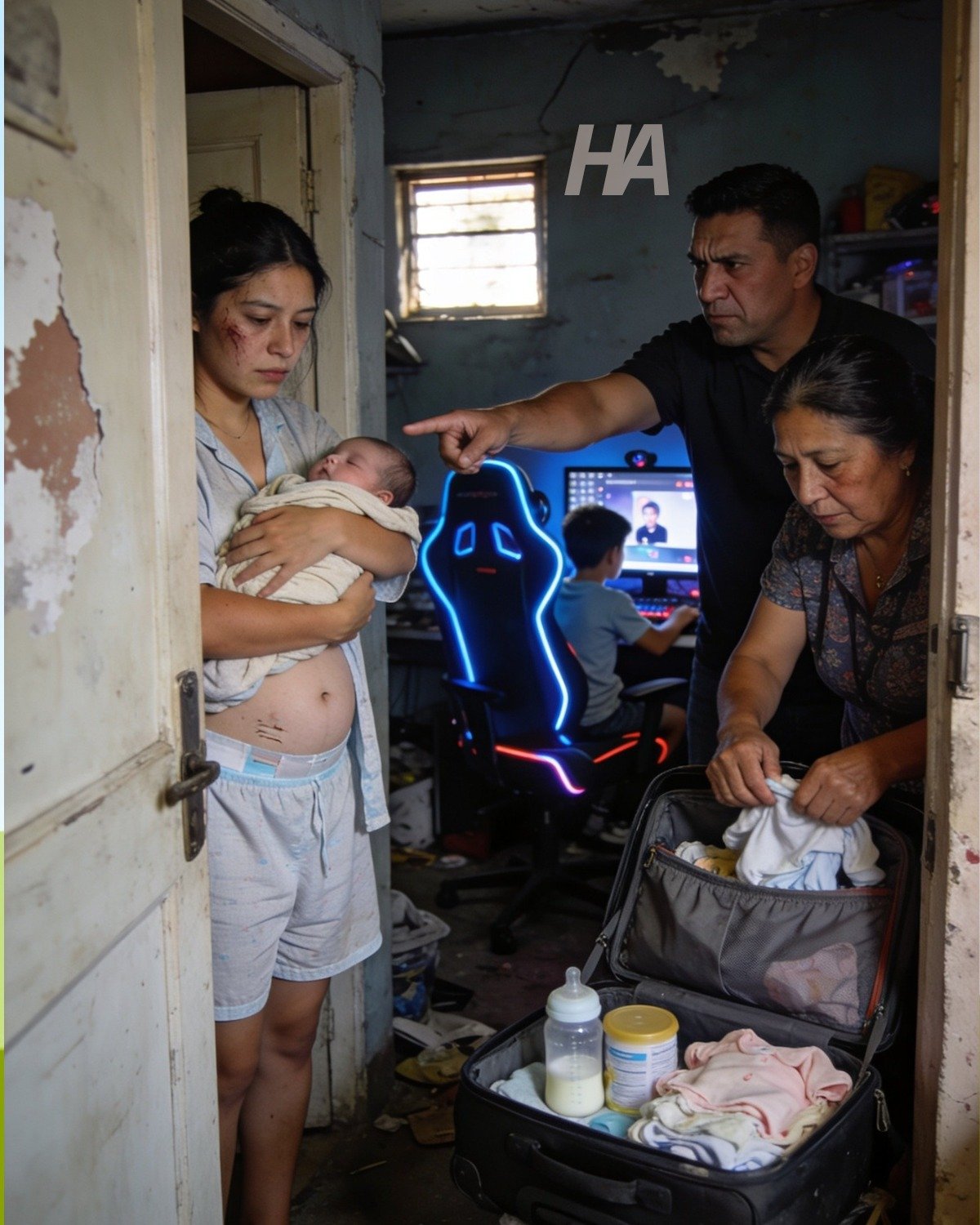
Then it’ll fade, and you’ll still be here, in a damp apartment with a newborn and staples in your skin.
But your phone doesn’t fade.
It lights up again in less than a minute.
A notification. Then two. Then ten.
The screen starts vibrating so fast it feels like it’s trying to climb out of your hand.
A girl you barely know from high school shares it to her story with the caption: THIS IS EVIL.
A mom account reposts your photo and tags a local women’s rights page.
Then a nurse influencer comments: POSTPARTUM PATIENTS NEED CARE. THIS IS NEGLIGENCE.
You blink, dizzy, because this isn’t pity. It’s momentum.
You pull Bruno closer to your chest, carefully, because your scar screams if you move wrong.
You scroll with your thumb, eyes burning.
People are asking where you are, if you’re safe, if you have diapers, if you need formula, if you need someone to come sit with you.
Strangers are offering cash like they’re passing a bucket at a fire.
Then the first message from Sergio hits.
DELETE THAT RIGHT NOW.
All caps. No hello. No “how’s the baby.”
Your stomach tightens, because even through a screen, his voice feels like he’s still taking your space.
You don’t answer.
A second message comes.
YOU’RE RUINING MY LIFE FOR ATTENTION.
You almost laugh, but it turns into a cough, and your incision stabs you for it.
You look down at Bruno and whisper, “We’re not doing this anymore,” like the baby can understand vows.
Your phone rings.
Mom.
You stare at her name like it’s a trap.
You answer anyway, because you’re still the version of you that hopes she’ll surprise you.
“Are you happy,” your mother says, voice tight with rage.
“No,” you whisper. “I’m in pain. I’m alone. I’m bleeding.”
She snorts. “You’re dramatic,” she snaps. “You always have been.”
You squeeze your eyes shut.
“It’s a baby,” you say. “It’s your grandson.”
“Don’t guilt me,” she replies instantly, like she rehearsed it. “Sergio has sponsors watching. You don’t understand what you’ve done.”
You feel your blood turn cold.
“Sponsors,” you repeat. “That’s what matters.”
“It matters,” she says, sharper. “Because he’s going to pull us out of this. Not you.”
The call ends with a click that feels like a door lock.
You sit there shaking, and the apartment smells like damp and old smoke and your own fear.
Bruno makes a small sound, a soft squeak, and your whole body leans toward him instinctively.
You adjust his blanket with fingers that can barely work, and you realize your baby is the only person who has not asked you to be smaller today.
You open Instagram again.
Your post has crossed into places you’ve never seen.
A popular gossip page has turned it into a carousel: your photo, your words, a screenshot of Sergio’s Twitch profile, and a headline that makes your stomach drop.
STREAMER KICKS POSTPARTUM SISTER OUT FOR “CONTENT ROOM.”
The comments are brutal.
But they’re brutal in your favor, and that scares you too, because internet anger is a wild animal.
It doesn’t just bite the guilty. It bites everything nearby.
And Sergio is live.
You don’t mean to open it.
Your thumb just moves, like a bad habit.
The stream loads, and your brother’s face fills your screen, bright ring light, your childhood posters behind him… except they’re gone now, replaced by neon signs and a new microphone you recognize because it used to be your birthday money.
Sergio is smiling too hard.
He’s trying to laugh it off.
“Chat,” he says, leaning into the mic, “y’all know my sister’s always been… sensitive.”
The chat is a waterfall.
APOLOGIZE.
SHOW THE ROOM.
WHERE’S THE BABY?
STOP MILKING IT BRO?
He flinches at that last one, because it’s his own catchphrase coming back like a boomerang with teeth.
He swallows, then tries to pivot.
“Look, she’s fine,” he says, waving a hand. “We got her a place. She’s being dramatic for clout.”
Your mouth goes dry.
A donation alert goes off.
Not the happy kind. The sharp kind.
A stranger pays five dollars just to make a message appear on his screen.
YOU KICKED OUT A WOMAN WITH STAPLES IN HER BODY FOR A RING LIGHT. YOU’RE DISGUSTING.
Sergio’s smile cracks.
He looks off-camera like someone is standing behind him.
You know that look. That’s your mother in the room, hissing instructions.
“Chat, relax,” Sergio says quickly. “You don’t know the full story.”
Then another donation comes.
Ten dollars.
A longer message.
I’M A NURSE. POST-C-SECTION PATIENTS CAN’T CLIMB STAIRS WITH A NEWBORN. YOU ENDANGERED HER.
Your brother’s face changes.
Not guilt. Not empathy.
Fear.
Because sponsors don’t like liability.
You watch his eyes flick to the corner of his screen where sponsorship overlays sit.
You watch him realize the audience isn’t just watching.
They’re archiving.
Clips start spreading in real time.
Accounts on TikTok repost his words with your photo stitched beneath.
You see the same caption again and again: “Sensitive.”
And every time it lands, it sparks another thousand people who remember what it’s like to be dismissed in pain.
Your phone buzzes again.
A message from an unknown number.
Hi. This is Paula from Casa Luz (women’s shelter). We saw your post. Are you safe right now?
You blink, stunned.
Your throat tightens as you type with shaking fingers.
I’m not safe. I’m alone. I don’t have a car. I can barely move.
A reply comes instantly.
We can send someone. What’s your address?
You hesitate, because trusting strangers is scary.
But then you look at the door with its cheap lock and the wet stain creeping down the wall like mold learning your name.
You think of Bruno needing warmth and clean air and someone who will actually hold him while you breathe.
You send the address.
Within twenty minutes, there’s a knock.
You nearly drop your phone.
You freeze, listening, heart pounding, because your family taught you that knocks mean demands, not help.
“Hi,” a woman’s voice calls softly through the door. “It’s Paula. I’m alone. I’m from Casa Luz. I brought diapers.”
You crack the door just enough to see.
Paula is middle-aged, wearing a puffy jacket with a volunteer badge.
Behind her stands another woman, younger, holding a thermal bag that smells like soup even through the plastic.
Their faces are calm, not curious.
You unlock the chain and open the door wider, and suddenly you start crying without warning.
Not loud. Not dramatic.
Just tears falling like your body finally found permission.
Paula steps inside, eyes scanning the room with a quick, professional sadness.
“Oh honey,” she murmurs, then catches herself like she doesn’t want to make you feel small.
“Okay,” she says instead. “We’re going to get you out.”
You try to stand, and the world tilts.
Pain slices through you, bright and immediate, and you gasp.
The younger volunteer moves fast, supporting your elbow with careful hands.
“Slow,” she says. “You don’t have to prove anything to us.”
That sentence hits you harder than any comment online.
Because your whole life has been proving you deserve space.
They pack quickly.
Not your “things,” because most of them are gone, locked in your parents’ storage like your life got boxed without your consent.
They pack what matters: Bruno’s diapers, his blanket, your meds, your phone charger, the hospital paperwork.
Paula notices your incision bandage and frowns.
“Have you been checked since discharge,” she asks.
You shake your head, embarrassed. “I didn’t… I couldn’t…”
Paula nods like she’s heard this a thousand times. “We’re taking you to a clinic first,” she says. “Then the shelter.”
As they help you down the stairs, each step feels like a test you weren’t supposed to pass.
Your legs shake. Your breath catches.
But you make it, because Bruno is warm against you and someone is finally holding the weight with you.
In the car, your phone keeps buzzing.
You glance at it, and your stomach tightens again.
Your father.
A text, short and sterile.
Come home. We need to talk.
You stare at the words until they blur.
Paula watches your face. “You don’t have to,” she says quietly.
You swallow hard. “They’re only texting because they’re scared,” you whisper.
Paula nods. “That’s usually when the truth starts,” she says.
At the clinic, the nurse takes one look at you and her face changes.
Not pity. Anger.
She checks your incision, your blood pressure, your pain level, and you see her jaw tighten.
“You should not have been climbing stairs,” she says.
You laugh once, bitter. “Tell that to my parents.”
The nurse’s eyes sharpen. “We will,” she says, like it’s a promise.
By the time you arrive at Casa Luz, it’s evening.
The building is simple, but it’s warm, and it smells like laundry detergent and food and clean air.
A staff member helps you into a room with a real bed.
You lie down, and for the first time since the hospital, your muscles unclench.
Bruno sleeps in a bassinet beside you.
You stare at him, and your heart aches with love and fury all mixed together.
Your phone rings again.
This time it’s not your mother.
It’s a number you don’t recognize, but the caller ID shows a company name.
BrightWave Talent Management.
You answer, confused.
A man’s voice comes through, crisp and professional.
“Hello,” he says. “We represent Sergio Reyes.”
You almost laugh, because your brother suddenly has representation when you’ve had staples and loneliness.
“We’re calling to request you remove your post,” he continues, “as it contains allegations that could harm our client’s brand.”
Your hand tightens around the phone.
“My brand,” you whisper, voice shaking, “is staying alive.”
There’s a pause.
The man clears his throat. “We can offer compensation,” he says. “A settlement. If you agree to delete and post a clarification.”
A settlement.
The word lands like a trap dressed in money.
You glance at Bruno, tiny and perfect, and you see the future in his closed fists.
You imagine signing your silence away and watching your brother grin on camera while you swallow your pain again and again.
You inhale slowly.
“No,” you say.
The man’s voice tightens. “Excuse me?”
“I said no,” you repeat, stronger. “You want me quiet because it’s convenient.”
Your voice shakes, but it doesn’t break. “Convenience is what almost killed me.”
The call ends abruptly.
Minutes later, Sergio goes live again, but this time his tone is different.
It’s not smug. It’s frantic.
You watch clips later, because you can’t bear it in real time.
He’s trying to cry on camera, eyes red but dry.
“I love my sister,” he says, voice cracking like he’s acting. “I would never hurt her.”
The chat doesn’t buy it.
Then the truth slips out.
“My parents did what they thought was best,” Sergio blurts, too fast. “They needed my setup— I mean, I needed space— for work.”
Work.
He calls streaming “work,” but you don’t hate that.
What you hate is that he called your recovery a minor inconvenience.
A sponsor logo disappears from the corner of his screen mid-sentence.
You see it vanish like a light turning off.
Sergio freezes.
His eyes widen.
His mouth opens, but nothing comes out.
And the chat explodes.
SPONSOR DROPPED YOU LIVE.
KARMA IS REAL.
APOLOGIZE TO YOUR SISTER.
In that moment, you feel something complicated.
Not joy. Not satisfaction.
Just a quiet sense of balance returning, like the world finally noticed what your family refused to see.
The next morning, a staff member at Casa Luz hands you an envelope.
“Someone dropped this off,” she says.
You open it with shaking fingers.
Inside is a handwritten note in a shaky script you recognize immediately.
Your grandmother’s.
Mija, I saw what they did. I’m coming. Don’t answer their calls. You’re not alone anymore.
Your throat tightens so hard you can barely breathe.
Because your grandmother is the one person who ever told you the truth when everyone else tried to polish it.
She’s the one who used to say, “Family is not a title. It’s a behavior.”
Later that day, your parents show up at Casa Luz.
You don’t see them at first.
You only hear the receptionist say, “No, you can’t go in,” and then your mother’s voice rising, angry, familiar.
“We are her parents,” your mother snaps. “We have a right.”
Paula knocks on your door gently.
“You don’t have to see them,” she says.
You stare at Bruno.
Your incision aches.
Your hands are still trembling.
But something in you has already been lit, and you know you can’t unlight it.
“I’ll see them,” you whisper. “But not alone.”
Paula walks you to a small office with two chairs and a table.
A counselor sits with you, calm and steady.
Your grandmother arrives five minutes later, breathless, scarf around her neck, eyes blazing.
When your parents walk in, they don’t look worried.
They look annoyed.
Your father crosses his arms.
Your mother rolls her eyes.
They both glance at the counselor like the counselor is an inconvenience.
“Look at you,” your mother says. “Making a whole show.”
Your grandmother stands before you can speak.
She steps forward and slaps a folded paper onto the table.
A printed screenshot of your post.
And beneath it, another page.
A list of donations.
Messages. Offers of housing. A job lead. A pro bono lawyer’s contact.
An entire network of humans who saw you and chose you.
Your grandmother points at it like it’s a verdict.
“This,” she says, voice shaking with fury, “is what strangers did in one night.”
She looks at your parents. “And you couldn’t do it in forty years.”
Your father’s face darkens. “Don’t talk to us like that.”
Your grandmother leans in, fearless.
“I’ll talk to you however I want,” she says. “Because you broke your daughter when she was stitched together.”
Silence drops heavy.
Then your father tries a new tactic, quieter.
“We didn’t know it would blow up,” he says, as if the problem is publicity, not cruelty.
Your jaw tightens.
You finally speak, voice low.
“You didn’t care about the pain,” you say. “You cared about the noise.”
Your mother scoffs. “You’re being dramatic.”
Your grandmother’s eyes flash.
“No,” she says. “She’s being honest.”
Your father shifts, uncomfortable.
“We can fix this,” he says. “Come home. Sergio’s willing to apologize. We’ll make it right.”
Your heart pounds.
“Make it right how,” you ask.
Your mother sighs, impatient.
“We’ll give you the room back,” she says. “Okay? He can stream somewhere else.”
And there it is.
They still think your value is a room.
You look at them, really look, and you realize the truth: if Sergio had never gone viral, if sponsors hadn’t fled, if strangers hadn’t seen you, your parents would still be sleeping fine in that house tonight.
They’re not here because they love you.
They’re here because consequences arrived and knocked.
You inhale slowly, feeling your grandmother’s hand on your shoulder like an anchor.
“No,” you say.
Your father blinks. “No?”
“No,” you repeat, steadier. “I’m not coming back to be tolerated.”
Your mother’s face tightens. “So what, you’re going to punish us?”
You shake your head.
“I’m going to protect my son,” you answer.
Your grandmother smiles, small and fierce.
The counselor nods, calm.
Your father’s voice rises. “You’re making us look bad!”
Your grandmother cuts him off.
“You did that yourselves,” she says. “She just turned the lights on.”
You stand carefully, pain flaring but controlled.
You don’t need to scream.
You don’t need to win a debate.
You just need to draw the line.
“You can see Bruno,” you say, voice firm, “when you learn what respect looks like.”
“And Sergio,” you add, eyes steady, “can build his career without stealing my recovery.”
Your mother opens her mouth to argue, but your grandmother steps closer and points to the door.
“Out,” she says. “Before I say things in front of staff that you can’t take back.”
Your parents leave, stunned, offended, still convinced they’re victims.
And as the door closes behind them, you feel something strange.
Not revenge.
Relief.
Weeks pass.
You heal slowly.
The staples come out.
Your strength returns in inches, not leaps.
But every day, you wake up in a place where nobody calls your pain “drama.”
A pro bono lawyer helps you file for child support and establishes boundaries.
A women’s advocacy group connects you with a small grant for postpartum recovery.
A local family clinic offers follow-ups and mental health support.
And your brother?
His channel doesn’t disappear completely, but it changes.
He goes live one night with no sponsor overlays, no neon signs, just his bare face and a cheap mic.
He looks smaller without the spectacle.
“I messed up,” he says, and this time his voice sounds real.
Not because he’s sorry about losing money.
Because he finally says the only line that matters.
“I didn’t look at the baby,” he admits. “I looked at my numbers.”
That clip spreads too, but differently.
Not as a cancellation.
As a warning, and maybe a beginning.
Your grandmother sits with you on a bench outside Casa Luz one afternoon, Bruno sleeping on your chest.
She watches the sunlight on your baby’s eyelashes and murmurs, “They thought they threw you out.”
She smiles. “They threw you forward.”
You laugh softly, and it doesn’t hurt.
Because you’re no longer a room someone borrows.
You’re a mother.
You’re a door that won’t open to disrespect again.
And when you post your next photo, it isn’t your incision.
It’s Bruno’s tiny hand wrapped around your finger, and your caption is simple.
“We’re home.”
THE END