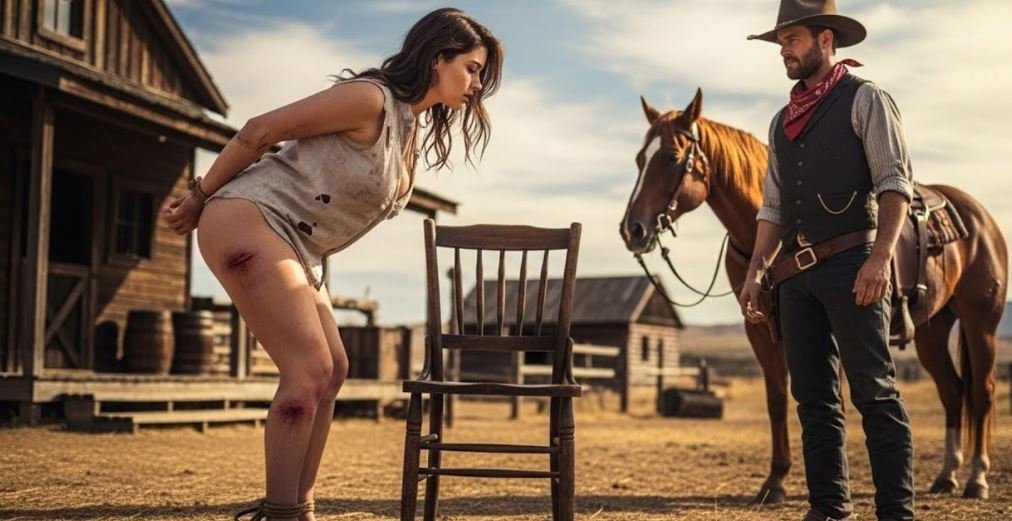
Dodge City’s noon sun didn’t shine—it flogged. Elias Crow felt it beat on his hat brim while he tied his mare outside the sheriff’s office, planning no more than a handshake and a complaint about a missing steer. Instead he found Lydia Harden—sheriff’s wife, wrists lashed to a porch post, shirt in tatters, skin mapped with bruises. She swayed like a broken reed but refused to weep. Elias had seen men gut-shot and quieter than her eyes.
He sliced the rope. She collapsed into his arms, whispering the kind of truth that rewires a man’s backbone: Roy Harden, lawman and town god, had tied her there to bake—for failing to give him a child she could conceive but he could not. A doctor’s letter hidden in his desk proved it. Roy’s shame wore her skin.
Inside the house Elias cleaned wounds while the clock ticked toward Roy’s return. Lydia’s voice cracked but held. “I want a child,” she said. “And I want that child from you.” The words landed between them like a live shell. Before Elias could answer, boot heels hit the porch—Roy, bottle in fist, badge on chest, ego flaring.
The confrontation detonated fast: accusations, shoves, a gun half-drawn. Elias’s bullet tore through Roy’s gun hand; the badge skittered across blood-slick boards. Townsfolk gathered, heard Lydia hold up the crumpled letter, heard Roy curse God and her and the hand that failed him. The deputy pried the star loose as if it burned. In that instant Dodge City chose a new story: the day a woman told the truth and the law learned it could bleed.
Weeks later whispers followed Lydia down the street like stray dogs, but she walked taller each time. She moved to Elias’s ranch under wide sky where gossip lost breath. He taught her to mend tack; she taught him laughter could start soft and grow loud. They married in the little white church while some watched for scandal and others for hope.
Three seasons passed. One spring evening Lydia pressed Elias’s hand to the swell beneath her apron. “Took us both to make,” she said, “and the whole town to believe in.” When the baby cried its first note into Montana night, even the doubters on the back fence felt something shift—proof that love built slow and stubborn can outlast any lie told by a badge or a bottle.
Years on, folks still point to the scar on the meeting-house floor where Roy’s star landed. They tell how courage looks like a rancher drawing second, like a woman lifting her face to a crowd, like two people building a life the town didn’t approve of until it saw the child they raised—strong, loud, and utterly unashamed of the story that gave it breath.