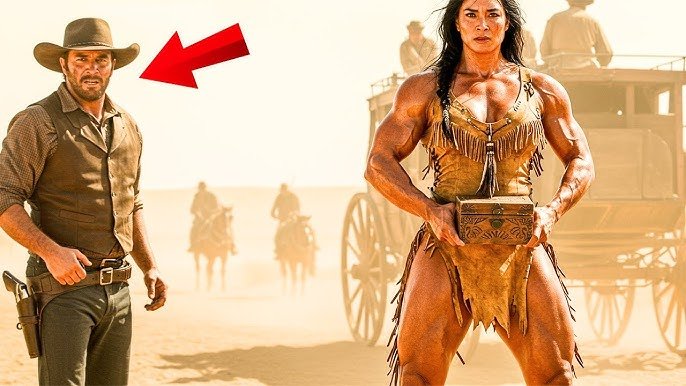
The Sopoora desert, 1887—sun like a branding iron, sky like hammered copper. A lone rider drifted through the heat waves: a Mexican-born man everyone called the Texan because his gun spoke English. Two months earlier he had put a bullet in a landowner’s son to stop the boy whipping a Yaqui woman; since then the rurales had kept his saddle warm with their chasing. His horse was ribs and hide, his canteen nearly empty, his hope dryer than the dust he swallowed.
He almost rode past the red rock, but motion flickered. A woman—no, a mountain carved into woman shape—lay against the stone. Three yards tall, easy, legs long as mesquite trunks, hair black enough to cut your fingers. White dress torn, blood drying where fangs had punched her calf. Two dead rattlesnakes lay nearby, heads crushed by her bare hands. The Texan’s thirst forgot itself. He dismounted slow, the way you approach a sleeping cougar, and offered the last of his water.
She drank, eyes opening like night lakes, and spoke in an old Apache tongue. “Tala, daughter of Nana,” she said, and told of the ambush that killed her father, the three days she had walked leaking poison. The Texan heated his Bowie knife, crossed the bites, sucked the black blood, and spat it into the sand. She never flinched; the wind did her wincing for her. When he tore his shirt to bind the wounds, his knuckles brushed skin hot as campfire iron. Silence stretched, thin and bright.
Night dropped sudden as a curtain. They shared beans and the last pinch of coffee while stars burned holes above. Apache scouts arrived like smoke—twelve painted warriors led by Mangas Coloradas, Tala’s promised husband, pride sharp as his lance point. For a breath it looked like the Texan would die for touching what was not his. Tala stepped between them, a walking cliff, and declared the stranger had saved her life. Mangas lowered his rifle but kept the hatred in his eyes. Before the argument could bite deeper, bugles sounded on the ridge: Mexican rurales and blue-coat Americans hunting Apache scalps.
Bullets turned the night into a hornet storm. The Texan fought beside giants, reloading until his Winchester burned his hand. Tala hurled boulders no four men could budge. When Mangas fell bleeding, she carried him like a child and roared so the canyon trembled. At dawn the survivors slipped away into secret passes, leaving spent shells and fresh graves behind. In a hidden spring high in the Sierra Madre, the Texan became brother-by-blood to men who had wanted to kill him hours earlier.
Days blurred into healing and waiting. Tala’s leg mended; something else knitted beneath the skin. One evening she led the Texan beyond the firelight, took the hand that had once slipped, and placed it where curiosity had first trespassed. “Now it is no accident,” she whispered, and lifted him as easily as hoisting a saddle. They loved each other under an ancient mesquite while sentries pretended not to hear the desert itself breathing hard.
Morning found them mounted side by side. Mangas, arm in a sling, raised a hand in farewell—no smile, but no more murder in his eyes either. The couple rode south, shadows stretching thirty feet across the sand. Weeks later, when patrols finally stumbled on the empty oasis, they found only hoofprints heading deep into Mexico—two sets, one twice the size of the other.
Folks along the border still talk about the giant woman and the man who dared touch her. Some say the child she carried will grow taller than saguaros and kinder than the wind. Others claim the Texan’s gun hangs unused above a ranch gate far south, where every sunset paints two shadows—one large, one small—walking home together.