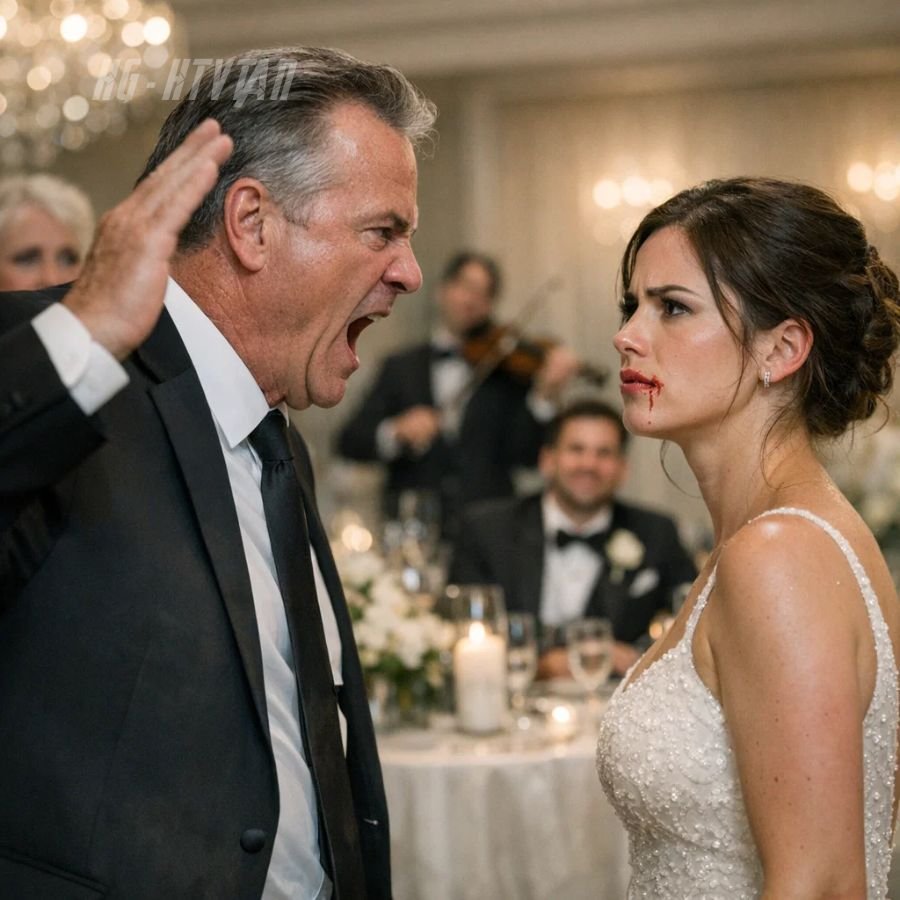
The sound hit before the pain. A sharp, explosive crack that sliced through the music and laughter, freezing every guest mid-sentence. The string quartet faltered, one violin note shrieking into silence. Crystal glasses trembled. Two hundred eyes turned toward me.
My cheek burned.
The taste of copper filled my mouth, metallic and warm, and for one unreal second I thought maybe it hadn’t happened—that the echo ringing through the reception hall wasn’t the sound of my father’s palm colliding with my face.
But the red bloom spreading across my skin told the truth.
“You selfish little brat,” he hissed, voice thick with champagne and decades of unchecked power. “After everything we’ve done for you—”
His words blurred under the blood rushing in my ears. The chandeliers above seemed to sway. I stared at him—not in disbelief, not even in pain—but in the kind of detached clarity that comes when the world stops pretending.
This was who he’d always been.
Around us, silence held like glass. My mother’s hand flew to her chest, eyes wide not with horror, but with embarrassment. She wasn’t thinking about me. She was thinking about the country club members watching her family unravel.
And there, at the head table, my brother Noel smiled. Not a grin, not a smirk—something smaller, crueler. Satisfaction. Beside him, his new wife Grace rested a manicured hand over his, her eyes gleaming with triumph.
The perfect family tableau: the son who could do no wrong, the daughter who refused to obey, the father who’d rather strike than listen.
My name is Victoria. I’m twenty-nine, a software developer, and that moment—standing in my brother’s wedding reception with blood on my lip and laughter dying around me—was the exact second I stopped being their daughter and became something else entirely.
Free.
Just thirty minutes earlier, I’d been cornered near the dessert table. My mother’s perfume hit before her words did—sweet, suffocating, desperate.
“Your brother needs a proper home to start his family,” she’d said, voice sugar-coated with manipulation.
I had smiled tightly. “He already has one. That luxury condo Dad bought him last year.”
Her painted lips pursed. “That was before the… unfortunate business issue.”
The “issue” was Noel’s cryptocurrency startup imploding in spectacular fashion, taking a few million dollars of investor money with it. He’d called it bad luck. The rest of the family called it a learning experience.
I called it fraud.
“Be reasonable, Victoria,” she’d said, her voice tightening. “You’re just one person in that enormous penthouse. Noel and Grace need space to start a family.”
“My penthouse,” I’d corrected, evenly. “My name’s on the deed. I bought it. I pay the mortgage. I’m not giving it to anyone.”
That’s when my father appeared, cheeks flushed pink from champagne, tie loosened, ego wide awake.
“This isn’t a request, Victoria,” he’d said, each word slicing through the air. “Your brother is the man of the family now. You’ll do as you’re told.”
Something in me snapped. Quietly, calmly, I’d replied, “No.”
And when he raised his hand, when it came down before anyone could stop him, I didn’t cry.
I smiled.
Because for the first time, I saw it clearly—the game they’d been playing all my life. The one where I worked myself to exhaustion, bought what I earned, and then handed it over in the name of “family.”
But not anymore.
Straightening, I met his shocked eyes, my voice steady as the room held its breath. “You’ll regret this,” I said. “All of you will.”
Then I turned, heels striking marble like a countdown, and walked out beneath the chandeliers.
Behind me, whispers flared like wildfire. My mother’s voice chased me—“Victoria! Don’t you dare make a scene!”—but it was too late. The scene had been made.
In my car, I gripped the steering wheel until my knuckles whitened. My reflection in the rearview mirror looked foreign—lip bleeding, eyes sharp, mascara smudged but alive. The tears came, but not from pain. From clarity.
This was my reward for being the reliable one, the responsible one, the daughter who didn’t ask for help.
A slap.
A demand to hand over my life’s work to a brother who’d never earned a damn thing.
My phone buzzed nonstop. Messages flooded the screen:
Mom: Come back inside. You’re embarrassing us.
Noel: Don’t be dramatic, Sis.
Grace: You should be ashamed. Your brother deserves that penthouse more than you.
Dad: You will give him the keys tomorrow. This isn’t a discussion.
I powered the phone off.
They wanted obedience. Silence. Surrender.
Instead, I drove downtown—to the small coffee shop that had fueled my years of late-night coding sessions, where I’d built the very software that paid for my penthouse. My sanctuary before I could afford one.
The barista, Kyle, looked up from behind the counter. His eyes widened at the sight of my swollen cheek.
“Bad day?” he asked quietly.
“My father slapped me at my brother’s wedding,” I said flatly, surprising even myself with how calm I sounded. “Because I wouldn’t give them my penthouse.”
Kyle blinked. “Your penthouse? The one you bought after working sixty-hour weeks for three years?”
I nodded.
He shook his head slowly. “That’s insane.”
“Family tradition,” I said dryly.
He slid a chocolate muffin across the table. “On the house. You look like you need it.”
I smiled faintly, the first real one in hours. “Thanks, Kyle.”
As twilight painted the windows, my anger settled into something colder, sharper, more dangerous: purpose.
They wanted to take what was mine. They thought they could shame me into submission.
They had no idea who they were dealing with.
I opened my laptop. The screen lit my face as I began typing. Emails to my lawyer and financial advisor. Secure backups of my documents and property deeds. Encrypted code commits to a private GitHub repository. And finally—a message to my real estate agent.
“Remember that oceanfront property we talked about?” I typed. “I’m ready to make an offer.”
By the time my coffee was gone, my entire counterstrike was already in motion.
They had drawn first blood at a wedding.
But the war would be fought on my battlefield—data, assets, leverage, truth.
And I never lost when I played by my own rules.
The next morning, the doorman called before they even reached my floor.
“Ms. Barrett,” he said, voice hushed. “Your parents are here. They’re… agitated.”
I smiled. “Let them up.”
I was ready.
My father burst through the door first, veins bulging, followed closely by my mother clutching her pearls like a lifeline.
“Where are you going?” she demanded as I locked the door behind me, laptop in one hand, coffee in the other.
“To work,” I said calmly. “Some of us earn our living.”
My father’s face darkened. “After your behavior yesterday—”
I turned, meeting his fury head-on. “Touch me again,” I said quietly, “and I’ll have security escort you out.”
He froze.
“The country club’s cameras caught everything,” I added. “You might want to worry less about my behavior and more about how that footage will look when your clients see it.”
The blood drained from his face. My mother gasped softly.
“You wouldn’t,” she whispered.
“Try me.”
The elevator doors opened behind me. I stepped in, turning just once to face them. “Oh, and don’t bother sending anyone to collect my things. I moved everything valuable to secure storage last night.”
The doors slid shut, cutting off their stunned faces.
By the time I reached my car, I was laughing—quietly at first, then harder.
For the first time in my life, I wasn’t their victim.
I was their consequence.
And they had no idea how far I was willing to go.
By the end of that week, silence became their new language. It began with ignored calls, then escalated into guilt-laced emails that reeked of desperation wrapped in parental authority. Each one a little angrier than the last.
My mother’s messages were sugarcoated threats disguised as concern:
“Your father didn’t mean it, sweetheart. He’s just worried about your brother’s future. We all are.”
My father’s were blunt, calculated, stripped of any emotion except rage:
“You’ll regret this childish stunt. We built you. Don’t forget who paid your way through school.”
And Noel—predictably—didn’t bother pretending. His texts were arrogant, entitled, dripping with venom.
“You’re making this harder than it has to be. Just sign the transfer papers. You’ll get another place. Maybe Dad can help you find one.”
He really believed that. That money and guilt and manipulation still worked.
But they didn’t know I’d spent a decade preparing for this—unintentionally, at first, then methodically. I’d learned early that in my family, the only protection against control was information. While they dismissed my tech career as a “cute little job,” I was building my empire line by line of code—and quietly collecting the leverage I’d one day need.
That day had arrived.
I spent the next three nights in my home office, curtains drawn, screens glowing with cascading lines of encrypted data. My fingers moved quickly over the keyboard, unlocking every backdoor I had ever planted in their devices. Passwords, emails, cloud backups, digital paper trails—they’d all trusted me to set them up.
And they’d never once thought to change the credentials.
My father’s company accounts were a labyrinth of shell corporations, offshore transfers, and fake consulting contracts. My brother’s startup documents painted a picture of a man with more ego than ethics—funds rerouted into “development costs,” which in reality funded a luxury car, a Bali vacation, and a diamond engagement ring for Grace.
Fraud. Plain and simple.
It wasn’t just greed—it was arrogance. The kind that believed nobody would ever hold them accountable.
I wasn’t going to destroy them. Not yet.
But I was going to remind them who they were dealing with.
On the tenth day of silence, my mother walked into my office without an appointment. My assistant tried to stop her, but mothers like mine didn’t ask permission—they issued declarations.
She stood across my desk, pearls gleaming under the fluorescent light, her expression caught between pity and panic. “Your father is sorry,” she said. “He’s been under stress. You know how he gets when he’s worried about Noel.”
I didn’t look up from my screen. “Worried about Noel,” I repeated. “Not about the investors suing him for missing funds? Or about what might happen if the SEC sees the financial transfers tied to your husband’s company?”
Her mouth fell open, the practiced calm draining from her face. “I don’t know what you’re talking about.”
“Oh, I think you do.”
I turned my laptop toward her. The files glowed on the screen—emails, invoices, timestamps, transaction records. My father’s signature at the bottom of every one.
Her breath hitched. “Victoria… how did you—”
“Because I built the systems that hid it,” I said. “I made sure my work was secure, remember? Turns out that skill works both ways.”
She clutched her purse tighter, as if that might hold her world together. “You’re bluffing.”
“Am I?”
I clicked a key. The sound echoed like a gunshot in the small office. On the screen appeared a familiar company logo—my brother’s failed startup—and a folder titled Proof of Misconduct.
Her face went white.
“This,” I said, “isn’t a threat. It’s insurance. You stay out of my life, my home, and my business. You leave me in peace. If you or Dad try to take anything else from me, these files go public.”
Her voice trembled. “You’d destroy your own family?”
“No,” I said quietly. “You did that when you asked me to give up my home. When Dad hit me. When Noel laughed.”
The silence stretched, heavy and sharp. She stood there a moment longer, eyes searching my face for the daughter she used to control. That girl was gone.
She left without another word.
That night, I poured myself a glass of wine and sat on the balcony of my penthouse, the city lights glittering below like electric stars. The skyline had always calmed me—geometry and chaos stitched together into something beautiful.
My phone buzzed with a message from my real estate agent.
“Congratulations. The oceanfront property is officially yours.”
I stared at the text for a long time, the corners of my mouth lifting slowly. The very building Noel and Grace had been dreaming about for months—their dream apartment complex—was now under my ownership.
Call it poetic justice.
As I scrolled through the building plans, another idea began to take shape—something small, brilliant, ruthless.
My latest side project, a property management software I’d been developing for months, could easily integrate into the new building’s system. And with one update, I could see everything—tenant records, rent payments, maintenance logs. A quiet reminder of who truly held power.
Minutes later, my phone lit up again. Noel.
Noel: Mom told me what you’re doing. You can’t prove anything.
Me: I already did.
(Screenshot attached.)
The typing bubble appeared, disappeared, appeared again. Then:
Noel: What do you want?
I smiled, typing slowly, deliberately.
Me: Distance. Complete and total. You stay away from me, my home, and my life. You stop using my work, my name, and my money. Otherwise, every file I have goes public.
Another pause. Then:
Noel: You’ve changed.
Me: No. I just stopped pretending to be the daughter you could exploit.
I turned off the phone and let the night air wash over me. Below, traffic pulsed through the veins of the city like light and noise and life itself.
The slap that had humiliated me in front of hundreds had become my catalyst. The bruise had faded, but the fire it lit still burned bright.
They thought I’d fold.
They didn’t realize they’d just created a woman with nothing left to lose—and everything to take back.
The city had changed in subtle ways since that night, or maybe I had. The skyline looked sharper, cleaner from my balcony — the kind of beauty that comes from distance. It had been three months since my father’s slap and the aftermath that followed. Three months of silence from my family, three months of peace.
And three months of building.
My new property—the oceanfront complex—had transformed from an idea into a thriving enterprise. I’d spent the first weeks after acquiring it redesigning everything from the ground up. I hired my own contractors, updated the systems, and quietly integrated my custom management software into the infrastructure. Every security camera, every lease, every digital record now ran through a network I controlled.
It was beautiful—clean, efficient, perfect.
But the real satisfaction wasn’t in the money. It was in the symbolism.
Because tucked into the tenant roster, under Apartment 1203, were two familiar names: Noel and Grace Barrett.
They had signed a lease before I finalized the purchase. My agent, keeping my name off the paperwork, had let it happen. I hadn’t planned it this way—but when I saw the names on the tenant list, I didn’t stop it either.
They wanted to live high on the ocean breeze. They wanted their dream apartment.
Fine.
They could rent it—from me.
For two months, I didn’t interfere. I just watched. They paid on time at first. Grace uploaded selfies from the balcony with captions like “Manifesting success!” and “When you work hard, dreams happen.” The irony didn’t escape me.
But by the third month, things began to unravel.
A red alert appeared on my dashboard: Unit 1203 – Payment overdue.
Then a second: Second notice issued.
Then a third: Eviction proceedings eligible in seven days.
I stared at the screen for a long moment, heart steady, unbothered.
I didn’t need revenge. Life had already done the work for me.
Still, I sent one last update to my lawyer—authorization to proceed with the eviction per policy. Professional. Routine. No emotion.
By the end of the week, Unit 1203 was empty.
It was the knock at my door that broke the silence.
When I checked the camera feed, I froze. My father stood there, hands in his pockets, eyes older, posture smaller than I remembered. For a long moment, I considered ignoring him. But curiosity won.
I opened the door but didn’t step aside.
“What do you want?” I asked, voice level.
He shifted on his feet, glancing around the marble foyer he used to criticize as “pretentious.” “Five minutes,” he said quietly. “Please.”
Five minutes. Once, he wouldn’t have needed to ask.
I nodded. “Five.”
He stepped inside, looking like a man stripped of his armor. His suit didn’t fit right anymore. His hair, once immaculate, had turned white at the edges. His eyes darted to the walls, the floor, anywhere but me.
“Noel and Grace moved out of their place,” he said finally. “They couldn’t afford it.”
“I know,” I said. “I own the building.”
He blinked. “You… what?”
“I bought it three months ago.” I folded my arms. “Their dream apartment. My investment property.”
He looked stunned. For the first time in my life, my father—my towering, unshakable father—looked small.
“You…” he whispered. “You really did all this.”
“Yes,” I said. “Because I’m good at what I do. I always was. You just never noticed.”
He leaned against the wall, his composure cracking. “Your mother misses you,” he said, softer this time. “We all do.”
I let out a laugh—short, cold, unamused. “No. What you miss is control. What you miss is me cleaning up your messes. That’s what you really lost.”
He flinched at that. The silence stretched between us.
“I was wrong,” he said finally. “About the penthouse. About Noel. About a lot of things.”
The admission should’ve meant something, but it didn’t. It sounded less like apology and more like surrender.
“I know,” I said.
He looked up, eyes tired. “I’ve lost everything, Victoria. The company, my reputation—”
“Because of choices you made,” I cut in. “Because you raised a son who thought he could steal and a daughter you thought you could slap into obedience. Actions have consequences, Dad. You taught me that—just never thought it’d apply to you.”
He didn’t argue. He just nodded, slowly.
After a moment, he reached into his jacket and pulled out an envelope.
“Your mother wanted you to have this,” he said. “It’s an invitation. Her birthday dinner next week. She… she really wants to see you.”
I took the envelope but didn’t open it. “I’ll think about it.”
He nodded once, almost relieved. Then he turned to leave. But before he reached the door, I spoke.
“Dad?”
He paused.
“You told me once that Noel was the man of the family,” I said quietly. “That his needs mattered more than mine. You remember that?”
He turned, shame flickering across his face. “Yes.”
“Well,” I said, opening the door for him, “tell him the new head of the family says hi.”
The words hung in the air like smoke. He nodded once, eyes down, and left.
When the elevator doors closed, I finally looked at the envelope. Thick cardstock. My mother’s handwriting in looping cursive.
Victoria—please come home.
Home. The word felt foreign now. My penthouse wasn’t just an address; it was my independence made visible. Every polished surface, every line of code, every cent in my bank account—they were all proof that I didn’t need their approval to build a life.
But something inside me shifted, just slightly. Not forgiveness. Not yet. But the curiosity of what it would feel like to walk into a room they no longer ruled.
To look them in the eye and know that the power balance had finally—finally—changed.
The night of the dinner, I arrived late. Not by accident. I walked in wearing confidence like armor—tailored black dress, heels that clicked like punctuation marks. Heads turned as I entered.
My mother’s eyes filled with tears the second she saw me. My father straightened his back, instinctively reverting to authority before remembering it no longer worked.
“Victoria,” my mother breathed, her voice breaking. “You came.”
I gave her a polite smile. “You invited me.”
Noel and Grace were there too, of course. Gone were the designer clothes. Their smiles were thin, brittle. Grace wouldn’t meet my eyes. Noel did—then looked away first.
We sat through dinner in a strained politeness that felt like theater. My mother asked about my work, my properties, my “projects.” I gave short, polite answers. My father stayed mostly silent, his hands fidgeting with his napkin.
At one point, Noel tried for small talk. “Heard you’ve been busy,” he said, voice forced.
“Extremely,” I said. “You’d be amazed what people can build when they stop funding other people’s failures.”
Grace nearly dropped her fork. My father coughed into his napkin.
The silence afterward was delicious.
I stayed exactly forty-five minutes. Long enough for them to feel my presence, short enough to keep the upper hand. When I stood to leave, my mother touched my wrist.
“Can we see you again soon?” she asked.
“Maybe,” I said, smiling softly. “On my terms.”
And then I left.
Outside, the air was cool, sharp, alive with the hum of city traffic. As I walked to my car, I realized that true revenge wasn’t about destruction. It wasn’t about watching them crumble.
It was about choice.
For the first time in my life, I had all of it.
A year later, I stood on the balcony of my penthouse—the same one my family had once tried to take from me—and watched the city glitter like a living constellation. Below, traffic flowed like veins of light through the streets, and somewhere down there, a younger version of me had once driven home crying after being slapped in front of two hundred guests.
That girl was gone.
In her place stood a woman who built an empire from the ashes of that humiliation. A woman who understood that sometimes, destruction wasn’t the end—it was the blueprint.
Three months after that awkward birthday dinner, I invited people over for the first time since everything happened. Not family. My people.
Kyle came, the barista who’d handed me a muffin and a moment of grace when my life cracked apart. My real estate agent, who’d helped me quietly acquire the properties that became the backbone of my portfolio. My lawyer, who had handled the delicate art of making my family’s silence legally binding.
We ate on the balcony—roasted vegetables, grilled salmon, good wine. The conversation was easy, laughter light, the way it never was at those suffocating family gatherings.
“To Victoria,” Kyle said, raising his glass, “the woman who turned a slap into an empire.”
Laughter erupted, glasses clinked, and for the first time in a long time, I allowed myself to feel it: peace.
After dinner, Kyle and I stayed behind while the others drifted home. The city shimmered below us. The wind was soft. He leaned against the railing beside me, his voice quiet.
“Do you ever miss them?”
I thought about it. My father’s booming presence. My mother’s cold elegance. Noel’s smug grin. Grace’s performative sweetness.
“Sometimes,” I said honestly. “But not the way they were. I think I miss the version of them I used to hope existed.”
Kyle nodded. “Maybe that’s what growing up really is. Realizing some people will never become who you needed them to be.”
“Maybe.”
We stood in silence for a while. Then he turned to me. “Do you ever think about forgiving them?”
Forgiveness. The word had felt impossible for so long—soft, fragile, too generous for people who’d treated me like a resource instead of a daughter.
“I don’t think forgiveness is a gift for them,” I said finally. “It’s something I give myself. So that I don’t have to keep carrying what they did.”
He smiled a little. “That sounds like forgiveness to me.”
I smiled back, because maybe it was.
Months passed. My business grew. The oceanfront complex filled with tenants—young professionals, families, couples. I bought another property, then another. I coded late into the night, refining my management software until it became something worth licensing nationwide. My name began circulating in real estate and tech circles alike: Victoria Barrett, the quiet disruptor.
The penthouse that had once been my only sanctuary became my headquarters, my command center, my home.
And then, one ordinary Wednesday morning, an email arrived.
From: Noel Barrett
Subject: Thank you.
I almost deleted it unread. But curiosity got the better of me.
Victoria,
You don’t have to respond. I just wanted to say thank you.
For not destroying me when you could have. For letting me fail on my own instead of dragging me down publicly.
Grace and I split up. I’m working again—construction, mostly. It’s honest work. I needed the crash, I guess. I see that now.
I know I was awful to you. I was jealous. I thought Dad’s approval made me untouchable. You proved otherwise.
You don’t owe me anything, but… thank you.
—Noel
I read it three times.
Then I hit archive.
Not delete. Not reply. Just archive. Because closure doesn’t always require conversation—it just requires an ending.
A few weeks later, my father called.
The number flashed on my phone, and for a long moment I stared at it. Then, almost without thinking, I answered.
“Victoria.”
“Dad.”
His voice was softer now, thinner. “I heard from Noel. He’s doing better.”
“I know.”
A pause. “You did good, kid.”
It was the first genuine compliment he’d ever given me. It didn’t erase everything, but it landed somewhere deep—like a bandage over an old scar.
“Thanks,” I said quietly.
“I’m proud of you,” he added, voice breaking just a little. “Even if I don’t say it the right way.”
For a long moment, I couldn’t speak. Then I exhaled. “That’s a start.”
He laughed softly. “Your mother wants to host a small dinner next month. Just family. No drama. Would you—”
“I’ll think about it.”
He didn’t push. “That’s fair.”
When I hung up, I didn’t feel anger anymore. Just distance. A kind that didn’t ache.
A year to the day after my brother’s wedding, I hosted another dinner in my penthouse. This time, it wasn’t revenge or rebellion—it was celebration.
My team had just signed a licensing deal that made my software one of the top property management systems in the country. I stood at the head of the table—my table now—and raised my glass.
“To the women who stop apologizing for their success,” I said. “And to the ones still finding their voice. May they never forget what happens when they decide they’re done being told who to be.”
Everyone cheered.
Later that night, when the guests were gone and the city had quieted, I walked to the floor-to-ceiling windows and looked out.
The reflection that stared back wasn’t the timid girl who once swallowed her anger for approval. It was a woman who’d learned that sometimes, the most powerful revenge isn’t public—it’s silent.
It’s success.
It’s peace.
It’s sitting in the home they tried to steal, knowing they’ll never touch it again.
I picked up my phone, opened a blank note, and wrote eight simple words:
The slap didn’t break me. It built me.
And I smiled. Because it was true.
The night they tried to take everything from me was the night I learned I could create anything.
Including myself.
And this time, no one—not family, not fear, not even the past—could take that away.