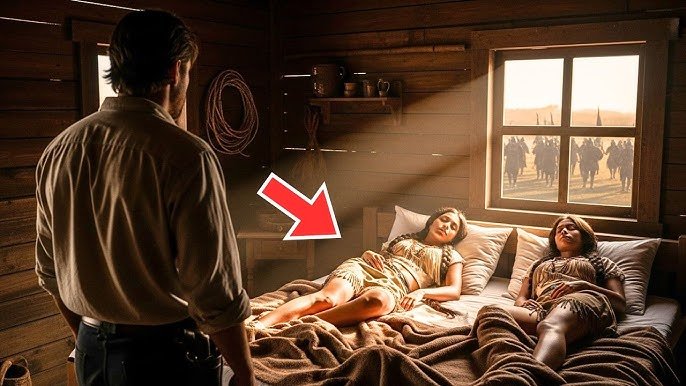
Collier Brennan woke to a sound no rancher ever wants to hear—hundreds of hooves drumming the frozen ground like war drums. Dawn had barely cracked, yet the ridge was already lined with Apache riders, their silhouettes ink-black against the snow-bright sky. One man sat center, feathers rippling like a battle flag. Behind Collier’s thin plank door slept two Apache girls he had carried in from the storm the night before, one burning with fever, the other burning with suspicion. Now their world had come to collect them, and Collier’s heart beat against his ribs like a trapped sparrow.
He could have reached for the rifle above the door; instead he reached for his boots. Fear rode his spine, but habit pushed him forward—he had once translated peace talks between cavalry and Apache, had seen what happens when pride meets powder. The door creaked open, cold slicing his lungs. One hundred fifty warriors watched him step barefoot into the snow, hands empty, breath rising white and steady. He felt their eyes measure the length of his life in heartbeats.
Inside, the girls woke. Aayita, the elder, pressed a knife to the windowpane, her face a storm of worry. Kimla, still weak, whispered urgent strings of Apache too fast for Collier to catch, but the tone was clear: do not harm this man. They stumbled outside, sister bracing sister, and placed themselves between Collier and the circle of horses. The chief dismounted—short, solid, age carved into his cheeks like canyon walls. He studied his daughters first, then the cabin, then the white man who had dared give them shelter. No one spoke; the wind spoke for them, hissing through sage and cedar.
At last the chief walked past them all and entered the house. Collier felt the ground tilt beneath him; every step the man took inside was a sentence being written on his life. He touched the blankets still warm from the girls’ bodies, lifted the damp cloth that had cooled Kimla’s brow, traced the chair where Collier had sat all night listening to fever dreams. When he re-emerged, snowflakes clung to his braids like small white witnesses. He raised his voice, words rolling out across the clearing—calm, deliberate, final. Aayita translated, her voice cracking only once: “You gave water, fire, your own bed. You asked nothing. My father says the People will remember. Any Apache who passes this place will know you as friend.”
The chief extended his hand. Collier took it, feeling the calluses of decades of rein and rope, the weight of every treaty ever broken. Around them, warriors pressed palms to their chests, a gesture like a promise sealed in bone. Then the circle loosened, horses turning, dust rising pink in the morning light. The girls mounted behind their father; Kimla looked back once and pressed a beaded bracelet into Collier’s hand before the herd flowed away over the ridge, swallowed by distance and drifting snow.
Two weeks later three drifters rode up, eyes hungry for easy pickings. Collier was mending fence when they spoke their thin compliments about his land. He answered quiet, but his gaze drifted to the ridge where three Apache sat their ponies like watching statues. The drifters followed his look, faces blanching under sunburned skin. They left without another word, hoofbeats fading faster than courtesy. Collier touched the bracelet on his wrist—leather old as grief, beads bright as new hope—and understood the chief had given him more than gratitude; he had given him armor made of reputation.
Spring came early that year. Green ran through the valley like water through a cracked cup. Collier sat on his porch at dusk, turning the bracelet while swallows stitched the sky overhead. He thought of the wife who had died by lamplight while he held her hand and could do nothing but translate her pain into useless prayer. He thought of the girls who had lived because he chose to open the door. Somewhere beyond the mesas Napishni’s camp moved with the wind, but the promise stayed rooted like a cottonwood by the creek—deep, growing, impossible to break.
Collier Brennan had come to the territory to disappear; instead he had been seen. Not by soldiers, not by settlers, but by two fevered girls and the father who still knew how to honor kindness. The world outside was tightening, fences marching west like iron caterpillars, but inside his small valley the old law held: protect the hearth, protect the guest, protect the fragile thread that ties one heart to another. He rubbed his thumb across the beads one more time, felt the future humming beneath the leather, and allowed himself the first easy breath he had taken since the day he buried his wife. The night settled warm around him, and for the first time in three winters, Collier did not feel alone.