At my sister’s wedding, her fiancé’s mother pulled me aside with shaking hands and said, We finally found you. I laughed because I thought she was joking and told her she must mean my sister. She shook her head, eyes filling fast. No. I mean you. Then she showed me an old, worn photo from twenty years ago—a baby wrapped in a hospital blanket, a tiny birthmark in the exact spot as mine. You were taken from us, she whispered. I sprinted to my parents with my heart pounding, and when I demanded the truth… they just stared at me in silence like they’d been waiting for this day.
The wedding reception was loud in the way happiness always is—music thumping, glasses clinking, people laughing too close to each other under warm lights. My sister, Lydia, was spinning in her dress like she’d finally stepped into the life she deserved. Her new husband, Evan, looked at her like the whole room was background.
I should’ve been celebrating. I was—until Evan’s mother touched my elbow and asked me to come with her.
She didn’t smile. Her fingers were shaking as she guided me behind a curtain near the hallway that led to the bathrooms and catering doors. It was quieter there, just the muffled sound of the band and the dull hum of air conditioning.
Up close, I saw tears in her eyes.
“We finally found you,” she said.
I blinked, confused, and actually laughed because it sounded like she’d mixed me up with someone else. “I think you mean Lydia,” I said, still half-smiling. “She’s the bride.”
She shook her head hard. “No,” she whispered. “I mean you.”
My stomach tightened so quickly it made me nauseous. “What are you talking about?”
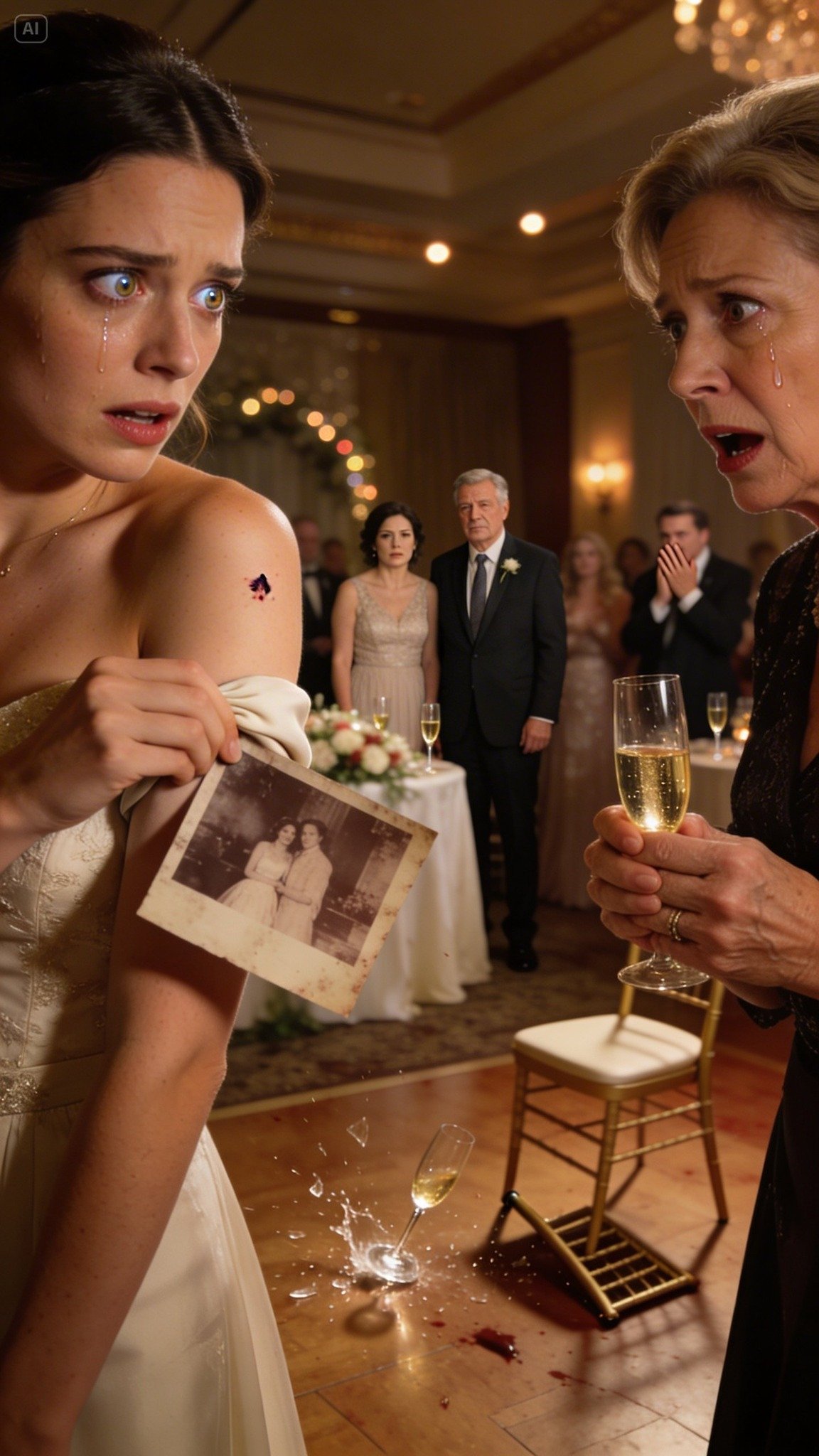
She reached into her clutch and pulled out a faded photo—creased, soft at the edges like it had been held too many times. It showed a baby wrapped in a hospital blanket, tiny face turned toward the camera. At first it meant nothing. Babies look like babies.
Then I saw the mark.
A small birthmark near the baby’s collarbone—the same shape, the same spot as mine. The one I’d had my whole life, the one my mother used to joke was my “little stamp.”
I stared so hard my eyes ached. My fingers lifted without permission, touching my own skin through my dress as if to confirm it was still there.
Evan’s mother’s voice broke. “You were taken from us,” she said. “Twenty years ago. We’ve been looking ever since.”
The hallway tilted. My mouth opened, but no sound came out. My thoughts crashed into each other: This is insane. This is impossible. This is a scam. But her face wasn’t the face of someone selling a story. It was grief held together by force.
“Who are you?” I whispered.
She swallowed. “My name is Marianne Caldwell,” she said. “And that baby is my daughter.”
My chest tightened until I couldn’t breathe properly. “No,” I said, shaking my head. “No, I’m— I’m Lydia’s sister. I’m—”
“Ask them,” Marianne whispered. “Ask your parents. Look at their faces when you say the words.”
My legs moved before I decided. I pushed past the curtain, heart pounding hard enough to drown out the music. The room looked the same—smiling faces, dancing guests, candles—but I felt like I’d stepped into a different life.
I spotted my parents near the head table. My mother was laughing at something a bridesmaid said. My father held his drink and looked proud, relaxed, normal.
I walked straight at them, ignoring the way people glanced at me, ignoring the way my sister’s maid of honor frowned like she sensed trouble.
“Mom,” I said. My voice sounded wrong, thin and sharp. “Dad.”
They turned.
I held the photo up with a shaking hand. “Tell me this is fake,” I demanded. “Tell me you don’t know what this is.”
My mother’s smile fell away like it had been wiped off. My father’s eyes flickered once—quick, guilty, familiar.
I waited for them to laugh, to scold me, to tell me I was being dramatic.
They didn’t say a word.
Not one.
And in that silence, with my sister’s wedding music still playing behind me, my entire childhood cracked open like it had been built on glass
The first thing that hit me after their silence wasn’t anger.
It was memory.
Not clear images, not cinematic flashbacks—just small, jagged pieces that suddenly felt sharp instead of harmless. A hospital bracelet my mother kept in a box but never let me touch. The way my parents avoided certain questions about my birth. The fact that there were almost no photos of my mother pregnant with me, only pictures of her holding me after. The way my father got stiff whenever someone joked that I “didn’t look like” either side of the family.
All those details had lived in my head as coincidences. Now they felt like fingerprints.
The reception kept moving around us. People didn’t know what was happening yet, but they sensed something. Whispers started—soft and curious. A few guests stared openly. My sister was still on the dance floor, smiling, unaware her world was about to be split in half.
My father finally spoke, but it wasn’t denial. It wasn’t explanation. It was a warning disguised as care.
“Not here,” he said, voice low.
My mother’s eyes were glossy. She looked like a person trying to hold a door shut while something heavy pushed from the other side. “Please,” she whispered. “Not tonight.”
Marianne had followed me out of the hallway and now stood a few steps behind, clutching her purse like it was an anchor. Evan—my sister’s groom—had noticed something wrong and was walking toward us, his expression tightening.
“What’s going on?” he asked.
My sister turned at the sound of his voice, her smile fading as she read the tension. “Why are you all standing like that?” she called, laughing nervously. “What happened?”
I didn’t answer her. I couldn’t. My throat felt locked.
My father reached for my elbow. “Come outside,” he said, trying to guide me away.
I pulled back. “No,” I said, louder this time. “Answer me.”
A few heads snapped toward us. The band kept playing, but the room’s energy shifted. My sister stepped off the dance floor, lifting her dress slightly as she hurried closer, confusion replacing joy.
“Is this about you?” she asked me, eyes wide. “Are you sick? Are you—”
I thrust the photo toward her. “Look,” I said.
Lydia’s eyes moved to the baby, then to the birthmark, then to my collarbone. Her mouth parted in shock. “What is this?”
Marianne’s voice trembled. “It’s you,” she said quietly. “It’s her.”
Lydia looked from Marianne to our parents, her face turning pale. “Mom?” she whispered. “Dad?”
My mother’s hands started shaking. She pressed them together as if praying. My father’s jaw worked like he was chewing words he couldn’t spit out.
Evan stepped between Lydia and Marianne instinctively, protective. “Mom,” he said sharply, “what are you doing?”
Marianne flinched but didn’t back down. “I’m telling the truth,” she said. “I didn’t want it this way. But I couldn’t watch this wedding and pretend I didn’t recognize her.”
My father’s voice came out tight. “Marianne,” he said, and my blood went cold.
He knew her name.
The room blurred. I couldn’t hear the music anymore, only the rush of my own pulse. “You know her,” I whispered.
My mother closed her eyes like she’d been slapped. My father’s shoulders sagged, just slightly, like a man who had been holding a secret too long and was tired of the weight.
“Let’s go,” my father said, voice strained, trying again to steer us away.
But Lydia stepped back from him like he was a stranger. “Don’t touch me,” she said, voice shaking. “What is happening?”
People were watching now. A bridesmaid had stopped mid-laugh, mouth frozen open. Someone near the bar whispered, “Oh my God.” The band faltered, then quietly faded into background noise as the sound tech noticed the mood.
My father finally said it, not cleanly, not bravely—just because there was no place left to hide.
“We didn’t take you,” he said to me. “We… we were given you.”
My knees went weak.
Marianne made a choked sound. “Given,” she repeated, rage and grief colliding. “Like a package.”
My mother started crying. “We were told you’d died,” she whispered. “We were told there was no one. We were told—”
“Who told you?” I demanded.
My mother looked at me and I saw something I’d never seen in her eyes before: fear. Not fear for me—fear of being exposed.
“My cousin,” she said. “She worked at the hospital back then. She said… she said the baby’s mother didn’t want you. She said she could—”
“Stop,” Marianne snapped, voice breaking. “Stop lying to make it softer.”
Evan grabbed Lydia’s hand. Lydia’s fingers were ice-white from gripping. “We’re leaving,” Evan said, voice tight.
Lydia shook her head, tears spilling. “No,” she whispered. “No, this is my wedding—”
“It’s not your wedding anymore,” Evan muttered, not cruel, just stunned. “This is… something else.”
My world narrowed to one question, sharp and relentless: Who am I?
My parents looked like they were falling apart, but I couldn’t feel sorry yet. Sympathy required trust, and my trust had just shattered in a room full of witnesses.
Marianne stepped closer to me. “I have records,” she said softly. “I have a police report. I have a case number. I have the hospital name. I have everything. I never stopped looking.”
I stared at her. She had my eyes. Not exactly, but close enough to make my stomach flip.
Lydia made a small sound, like she was choking on her own breath. “So… what does that make us?” she whispered.
I looked at her—my sister, my best friend, the person I’d shared rooms with and secrets with—and for the first time, I didn’t know what word fit.
The room felt too bright. The air felt too thin.
And my parents’ silence had finally turned into something louder than any confession: proof that my entire life had been built on a lie.
We left the venue in pieces.
Lydia and Evan disappeared into a side room with the wedding coordinator, voices muffled but urgent. Guests spilled into the lobby, pretending they were “going for air” while actually chasing the drama. My mother sat on a bench shaking, mascara streaking down her cheeks. My father paced like a man trying to outwalk the past.
Marianne waited near the exit, posture rigid, hands clenched. She didn’t look triumphant. She looked like someone who’d survived a long, slow drowning and finally broke the surface—only to find the air still hurt.
I stood outside under the venue’s string lights, the night wind cold against my skin. My birthmark felt like it was glowing, like it had become the center of the universe.
Marianne approached carefully. “I know this is violent,” she said, meaning emotional violence, the kind that rearranges your insides. “I know you don’t owe me anything.”
I swallowed. “Why are you here?” I asked. “Why now?”
Her eyes filled again. “Because I saw your name on the seating chart,” she said. “Because Evan showed me a photo from your family’s engagement party months ago and I couldn’t sleep after. Because I recognized the mark. And because your parents were never going to tell you.”
That last sentence hit like a punch.
My father came up behind me. “Please,” he said, voice cracked. “We loved you. We raised you. We—”
“You lied,” I snapped, turning on him. My voice surprised me with its strength. “You watched me grow up and you never thought I deserved the truth?”
My mother stood, hands trembling. “We were afraid,” she whispered.
“Afraid of what?” I demanded.
She looked at Marianne, then away. “Afraid you’d leave,” she said.
Marianne let out a sound that was half laugh, half sob. “So you stole her twice,” she said. “Once from her body, and once from her history.”
My father’s face tightened. “It wasn’t like that,” he said, but his words were weak. Because what else could it be?
Marianne pulled a folder from her bag and held it out toward me. “You don’t have to take this,” she said. “But this is the file. Police report from 2006. Hospital incident notes. The investigator’s contact. The birthmark description is in there. Everything.”
My hands shook as I took it. Paper shouldn’t feel heavy. But this did.
I flipped it open and saw my birthmark described in plain typed words, like a signature: small crescent-shaped mark near left collarbone. Date of report. Time. Location. A name I didn’t recognize listed as “suspected.” My stomach turned.
Lydia came outside then, her dress gathered in her fists like she was trying to hold her life together. Evan followed, jaw clenched, eyes hard. Lydia’s makeup was smeared, her expression shattered.
She looked at me like I was the only solid thing left. “Tell me we’re still sisters,” she whispered.
I stepped toward her, and my voice broke. “You’re the only part of this that’s real,” I said, and I meant it. Whatever blood said, whatever paperwork said, Lydia was the person who had loved me without manipulation.
She cried openly then, and I hugged her. It wasn’t a neat moment. It wasn’t comforting. It was grief wrapped around grief.
Evan looked at his mother across the parking lot. “Did you know?” he asked Marianne, voice low.
Marianne shook her head quickly. “I didn’t know it was her until I saw the photo,” she said. “I didn’t engineer this wedding. I didn’t plan to destroy it. I just… couldn’t pretend anymore.”
Evan’s face softened slightly, then hardened again. “This is my wedding day,” he said, but it wasn’t accusation—it was mourning.
My father tried again. “We can fix this,” he said. “We can talk, we can—”
“You can’t fix twenty years with one conversation,” I said quietly. My anger had shifted into something colder and more focused. “But you can tell the truth now.”
My mother sobbed. “We didn’t buy you,” she whispered. “We didn’t arrange it. My cousin—she said the baby’s mother was gone. She said you needed a home. We believed her.”
Marianne’s eyes flared. “What was your cousin’s name?” she demanded.
My mother hesitated.
I leaned forward. “Say it,” I said, and my voice didn’t shake.
My mother whispered the name: Cynthia Malloy.
Marianne’s face changed, like she recognized it instantly. “That name was in the report,” she said. “She was questioned. She disappeared afterward.”
My father looked sick. “We didn’t know,” he said again.
“But you knew enough to stay quiet,” I replied.
That night, I didn’t go home with my parents. I went with Lydia and Evan to their hotel suite because Lydia begged me not to disappear. We sat on the carpet in wedding clothes and cried like kids. Evan ordered water and snacks we didn’t touch. Lydia kept repeating, “I’m sorry,” even though none of it was her fault.
The next morning, Marianne met me at a quiet diner off the highway. She brought more photos: a toddler with my eyes and my birthmark, a family Christmas shot, a missing-person flyer that made my throat close. She didn’t demand I call her “Mom.” She didn’t push. She just offered reality.
I asked questions until my voice gave out. Where was she from? What happened? Why did the investigation stop? Did she have other children? Did she ever suspect my parents?
Marianne answered everything she could. When she didn’t know, she admitted it. That honesty felt like oxygen.
Over the next weeks, a process started that wasn’t dramatic but was relentless: contacting the investigator, requesting records, speaking with a family law attorney, arranging a DNA test. It wasn’t about revenge. It was about identity. About refusing to live inside a lie anymore.
My parents tried to call every day. I didn’t block them. I didn’t scream at them either. I told them one sentence: “If you want to be in my life, you tell the whole truth, including what you did wrong.”
Some truths are slow. Some people can’t bear them.
But I was done living in silence.And Lydia—my sister in every way that mattered—stood beside me through all of it, even as her wedding photos became evidence of the day my life split open.
Because the most controversial part wasn’t just that I was taken.
It was that everyone had been smiling while the lie held.
Until one woman finally said, “We found you.”
And my parents couldn’t deny it anymore.