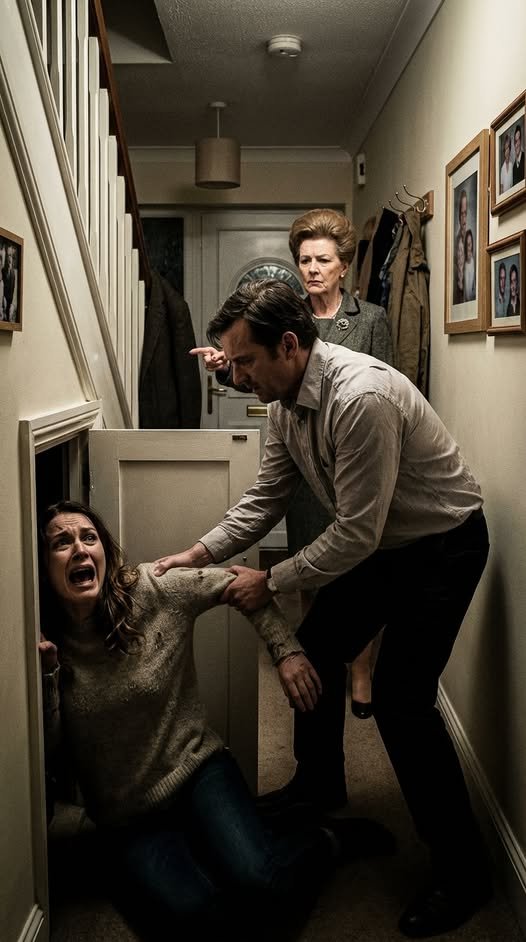
The Storeroom: A Requiem for a Marriage
Chapter 1: The King of Dust
I never thought she would actually leave. The human mind is excellent at rationalizing cruelty when it is disguised as tradition. I told myself she wouldn’t dare go anywhere. Her parents’ home was five hundred kilometers away, a dusty drive across state lines. Here in Dallas, she had no one but me. No job, no close friends, and—thanks to my careful management—no access to our savings account.
So, I went to bed that night feeling a sick, twisted sense of pride. I rested my head on a tall, goose-down pillow in the guest room, sleeping just down the hall from my mother, while my wife slept on a concrete floor.
My mother, Martha Keller, had always seen herself as the ultimate martyr, the sacrificial lamb who had bled for our family. In exchange for her “sacrifice,” she demanded absolute fealty. She expected my wife to be a ghost: quiet, obedient, and eternally grateful for the crumbs of affection thrown her way.
And I—like the dutiful son I believed myself to be, the soldier in Martha‘s private army—agreed.
“A wife should just endure a little for the sake of family harmony,” I often muttered to myself, washing my hands of the guilt. “What’s wrong with a little discipline?”
But looking back, I realize the rot had set in long before the storeroom.
Hannah was from the coast, a woman with salt in her hair and a laugh that used to fill a room. We met during our college years. She was vibrant, opinionated, and alive.
When I first brought up the subject of marriage, Martha’s face had twisted into a mask of pure disdain.
“Her family lives too far away,” she had sneered, stirring her tea with a silver spoon that clicked aggressively against the china. “She’s an outsider, Ryan. She’ll be a burden. She’ll want to visit them all the time. She won’t understand our ways.”
Hannah cried that day. I remember the way her shoulders shook. But she wiped her eyes and stayed firm.
“Don’t worry,” she told me, squeezing my hand with a strength I didn’t deserve. “I love you, Ryan. I’ll be a good daughter-in-law. I’ll take care of your family, even if it means I sacrifice my own comfort.”
Eventually, after months of pleading, Martha agreed. But it wasn’t an acceptance; it was a ceasefire. She never forgot that Hannah wasn’t one of us.
Every time I wanted to take Hannah and our infant son, Liam, to visit her parents, Martha would invent a crisis. A sudden migraine. A dizzy spell. A “feeling of impending doom.” And like a puppet with cut strings, I would cancel the trip, leaving Hannah to unpack her suitcase in silence.
But the silence broke the week Liam turned ten months old.
The tension in the house had become a physical weight, heavy and suffocating like a wet wool blanket. Suddenly, every decision was a battlefield.
I kept siding with Martha. It was easier. It was safer.
“She only wants the best for her grandson,” I would lecture Hannah late at night. “Why can’t you just follow her advice? She raised me, didn’t she?”
“She raised you to be afraid of her,” Hannah shot back once. It was the first time she had ever snapped.
Martha screamed, slammed dishes, and then fell “ill” for three days, forcing Hannah to wait on her hand and foot.
The final straw—the match that burned the house down—came on a Tuesday. Liam caught a high fever. His little body was burning up, his cries rasping and weak.
Martha stood in the doorway of the nursery, pointing a shaking finger at Hannah.
“You can’t even take care of my grandson properly?” she hissed. “You let him play near the window! This is your negligence! How could you let this happen?”
I looked at my exhausted wife. She hadn’t slept in twenty-four hours. Her eyes were bruised with fatigue, her hair a mess.
“Mom is right,” I said, my voice cold. “You need to be more careful.”
Hannah looked at me then. It wasn’t anger in her eyes. It was something worse. It was the death of hope.
That night, Hannah didn’t sleep. She paced the floor with Liam, rocking him, cooling his forehead with damp cloths.
Exhausted by the “stress” of the situation, I went upstairs to sleep in the guest room near my parents, leaving my wife to battle the fever alone.
By morning, Liam’s fever had broken, but Hannah looked like a corpse walking.
That was when the doorbell rang. Aunt Clara and Uncle Ben had arrived for an unannounced visit.
Martha, looking fresh and rested, marched into the kitchen where Hannah was trying to boil water for tea. She slapped a twenty-dollar bill onto the counter.
“Go to the market,” she ordered. “Buy chicken and vegetables. Cook a proper meal for our guests.”
Hannah leaned against the counter for support. “Mom,” she whispered, her voice cracking. “I’ve been awake all night with Liam. I can barely stand. Can we just order food? Or maybe Ryan can go?”
I opened my mouth to volunteer, but Martha snapped her head toward me, her eyes flashing.
“If he goes to the market, people will laugh at us!” she barked. “Since when does the husband do the shopping when the wife is at home? Cooking is her job. It is her duty.”
Hannah didn’t move. She stared at the twenty-dollar bill. Then, very slowly, she looked up.
“I am not going,” she said. Her voice was hoarse, but steady. “These are your guests, Martha, not mine. I am your daughter-in-law, not your indentured servant.”
Martha’s eyes widened. The air left the room.
I felt the heat rise in my neck. The shame was instant and blinding. My wife was defying the hierarchy. She was embarrassing me.
Furious, blind with a rage that belonged to my mother, I grabbed Hannah’s arm.
“Come with me,” I growled.
I dragged her past the stunned guests, down the hallway, to the small storeroom under the back stairs. It was a windowless box used for old coats and broken vacuum cleaners. It smelled of mothballs and dust.
“This time, I have to be strict,” I said, my voice trembling with adrenaline. “You need to learn respect. You need to learn your place.”
I shoved her inside.
There was no mattress. No blanket. Just the cold linoleum floor.
She didn’t scream. She didn’t beg. She just looked at me with those dead, empty eyes as I slammed the door and turned the lock.
Click.
That sound would haunt me for the rest of my life.
Chapter 2: The Empty Cage
When I woke up the next morning, the house was silent.
The sun was streaming through the curtains, casting cheerful beams of light that felt like a lie. I stretched, feeling a momentary sense of justification. Surely, Hannah had learned her lesson. Surely, she would be humble this morning.
I walked downstairs, unlocked the storeroom door, and pulled it open, ready to deliver a lecture on family values.
“You can come out now,” I said.
Silence.
I stepped inside. The room was empty.
Panic hit me like a physical blow to the gut. I spun around, checking the corners, as if she could hide in the shadows. But she wasn’t there. The back service door, which connected to the storeroom, was unlatched.
I ran to the nursery.
Liam’s crib was empty. The sheets were stripped. The diaper bag was gone.
I sprinted to the living room, my heart hammering against my ribs. “Mom!” I shouted. “Mom!”
Martha came out of the kitchen, wiping her hands on a towel. “What is all the shouting for, Ryan? You’ll wake the neighbors.”
“She’s gone,” I gasped, bracing myself against the doorframe. “Hannah is gone. And she took Liam.”
Martha turned pale for a second, but then her face hardened into that familiar mask of arrogance. She scoffed, waving her hand dismissively.
“Don’t be dramatic. She probably just went for a walk. Where would she go? She has no money.”
I wanted to believe her. I desperately wanted to believe her.
But then the doorbell rang.
It was Mrs. Gable, our elderly neighbor from across the street. She looked at me with a gaze that withered my soul.
“I saw her,” Mrs. Gable said, not waiting for an invitation to speak. “Last night. Around 2:00 AM.”
“You saw Hannah?” I asked.
“I saw a young woman crying, dragging a suitcase down the street with a baby strapped to her chest,” Mrs. Gable said, her voice dripping with judgment. “I went out to her. She was shivering, Ryan. She told me everything.”
I swallowed hard. “What… what did she say?”
“She said she couldn’t take the cruelty anymore,” the neighbor said, looking past me to where Martha stood frozen in the hallway. “She said you locked her up like a dog. I gave her fifty dollars for a taxi to the bus station.”
My phone slipped from my hand and hit the floor with a dull thud.
Martha stepped forward, her face red. “You interfered in private family business! You had no right!”
Mrs. Gable laughed—a dry, bitter sound. “Cruelty isn’t private business, Martha. It’s a crime. She said she’s going home.”
I slammed the door shut and scrambled for my phone. I dialed Hannah’s number. It went to voicemail. I dialed again. And again.
Finally, on the fifth try, it connected.
“Hannah?” I shouted. “Hannah, where are you? Bring Liam back right now!”
Her voice came through the speaker. It wasn’t the voice of the crying girl from the night before. It was cool, detached, and terrifyingly calm.
“I’m at my parents’ house, Ryan,” she said. “I arrived an hour ago.”
“You… you stole my son!” I sputtered.
“I protected my son,” she corrected. “And I protected myself. I’ve already contacted a lawyer here. In a few days, you will receive the filing for divorce.”
The world spun. “Divorce? Hannah, stop. You’re overreacting. Just come back, and we can talk about—”
“There is nothing to talk about,” she cut in. “Our son will stay with me. Given the circumstances of my departure—the abuse, the imprisonment—my lawyer is confident I will get full custody. And the property? Half of it is mine.”
“Hannah, please,” I whispered, the fight draining out of me.
“Do not call me again,” she said. “Speak to my attorney.”
The line went dead.
I looked at Martha. I expected her to fix it. I expected her to have a plan.
But she just crossed her arms and sneered. “She’s bluffing. She won’t dare divorce a Keller. She’s just trying to scare us into submission. Wait a week. She’ll run out of money and come crawling back.”
But deep down, in the pit of my stomach, I knew.
This time, Hannah wasn’t bluffing.
Chapter 3: The Paper Trail
Three days later, the brown envelope arrived.
It was delivered by a courier who asked for my signature with a pitying look. I tore it open in the kitchen, my hands trembling so violently I ripped the paper.
Inside were official divorce documents, stamped with the state court’s seal.
I scanned the pages, my vision blurring, until I reached the section labeled Grounds for Dissolution.
…Petitioner cites prolonged mental cruelty, financial abuse, and unlawful confinement. Petitioner alleges that on the night of October 12th, Respondent forcibly confined her in a storage room without basic amenities…
It wasn’t just a breakup. It was an indictment.
I sat at the kitchen table, staring at the words. Unlawful confinement.
I still held onto a shred of hope. I thought maybe I could go there, apologize, and charm her back.
But the news spread through our extended family faster than fire in a drought.
Aunt Clara called me that evening.
“Ryan,” she said, her voice sharp. “Is it true? Did you really lock a nursing mother in a closet?”
“It… it was a storeroom,” I stammered, as if the distinction mattered. “I was just trying to—”
“You’ve lost your mind,” she interrupted. “She just had a baby. That is vile, Ryan. Absolutely vile.”
Others weren’t so direct. They just whispered. I heard it at the grocery store. I saw it in the way neighbors crossed the street to avoid me.
“The Keller family… always thought they were better than everyone… turned out they’re monsters…”
“Who will ever marry into that house now?”
Each word cut deeper than the last because I couldn’t defend myself. I knew they were right.
Martha, however, was enraged. Not at herself, but at the audacity of the victim.
“How dare she!” Martha screamed, pacing the living room. “Divorce brings shame to our name! She is doing this to spite me! Forget her, Ryan. Let her go. She will regret it when she realizes no other man will want a divorcée with a child.”
But I wasn’t angry. I was terrified.
The house was quiet. Too quiet.
I walked into the nursery. The crib was still empty. The smell of Liam—that sweet mixture of milk and baby powder—was starting to fade, replaced by the sterile scent of dust.
I sat in the rocking chair where Hannah used to sit. I remembered the way she looked at me when we first met. I remembered the trust she had placed in me.
I’ll take care of your family, she had promised.
And in return, I had treated her like an enemy combatant in my mother’s war.
That night, I defied Martha’s orders and called Hannah again. I blocked my number so she would answer.
“Hello?”
“Hannah,” I whispered. “Don’t hang up. Please.”
Silence on the other end.
“I just… I want to see him,” I said, tears leaking from my eyes. “I miss Liam. I miss you.”
She laughed. It was a dry, hollow sound that hurt more than screaming.
“Now you remember your son?” she asked. “Where was this concern when you watched your mother scream at me while I held him? Where was this love when you locked me in the dark?”
“I was wrong,” I choked out. “I was so wrong.”
“You weren’t just wrong, Ryan. You were cruel,” she said. “It’s too late. I’ve already enrolled Liam in daycare here. I’ve got a job interview on Monday. I’m rebuilding the life you tried to erase.”
“Is there… is there any chance?” I asked, desperate.
“Ryan,” she said softly. “The man I married died a long time ago. The man in that house is just Martha’s son. And I don’t want to be married to a child.”
She hung up.
Chapter 4: The Crossroads
In the days that followed, I wandered through the house like a ghost haunting my own life.
I couldn’t work. I called in sick three days in a row. I couldn’t eat; the food Martha cooked tasted like ash.
Every night, I dreamed of Hannah walking away down a long, dark tunnel. I would run after her, shouting her name, but my feet were stuck in concrete.
Only then did I understand the weight of what I had done.
I had failed the fundamental duty of a husband. I hadn’t protected her. I had been her persecutor.
One morning, sitting on the porch, my Uncle Ben stopped by. He was a man of few words, but he sat beside me on the steps.
“Ryan,” he said gently, placing a heavy hand on my shoulder. “When a woman like Hannah leaves, it takes a lot to get her to that point. And it takes a miracle to bring her back.”
I nodded, staring at the ground.
“You have two choices,” he continued. “You can stay here, in this house, with your mother, and let her rewrite the history of what happened. You can let her tell everyone Hannah was crazy.”
He paused, looking at the closed front door.
“Or,” he said, “you can grow a spine. You can admit what you did. You can humble yourself. But remember, this isn’t just about getting her back. It’s about who you want to be. Do you want to be a husband, or do you want to be a son?”
He patted my shoulder and left.
The pressure from Martha was suffocating. She wanted me to fight for custody just to hurt Hannah. She wanted me to hide the assets. She wanted war.
But looking at the stars that night, standing alone in the cold courtyard where Hannah used to tend her small garden, I felt the crushing weight of the silence.
I realized that even if Hannah never took me back, I couldn’t stay here.
I walked back inside. Martha was sitting in front of the TV, complaining about the neighbors.
“Mom,” I said.
She didn’t look up. “What?”
“I’m leaving.”
She froze. “What did you say?”
“I’m packing my bags,” I said, my voice shaking but growing stronger with every word. “I’m moving out. I’m going to find an apartment near Hannah‘s parents. I’m going to fight for my son, and I’m going to try to earn her forgiveness.”
Martha stood up, her face twisting. “You would leave me? After all I’ve done for you? She has brainwashed you!”
“No,” I said sadly. “You did this. We did this. I locked my wife in a room, Mom. That isn’t normal. That isn’t love. That’s sickness.”
“If you walk out that door,” Martha hissed, pointing a finger at me, “don’t you dare come back. You are ungrateful!”
I looked at her—really looked at her—for the first time in years. I saw a lonely, bitter old woman who would rather be right than be happy.
“I know,” I said. “But I’d rather be ungrateful than be you.”
I walked upstairs. I packed two suitcases.
I drove five hundred kilometers through the night. I didn’t know if Hannah would open the door. I didn’t know if she would ever let me hold Liam again without a lawyer present.
But as the sun rose over the highway, illuminating the road ahead, I knew one thing for sure.
I was finally driving away from the darkness of the storeroom. I was finally waking up.
And even if I had lost her forever, I had to try to find myself.
Like and share this post if you believe it’s never too late to change.