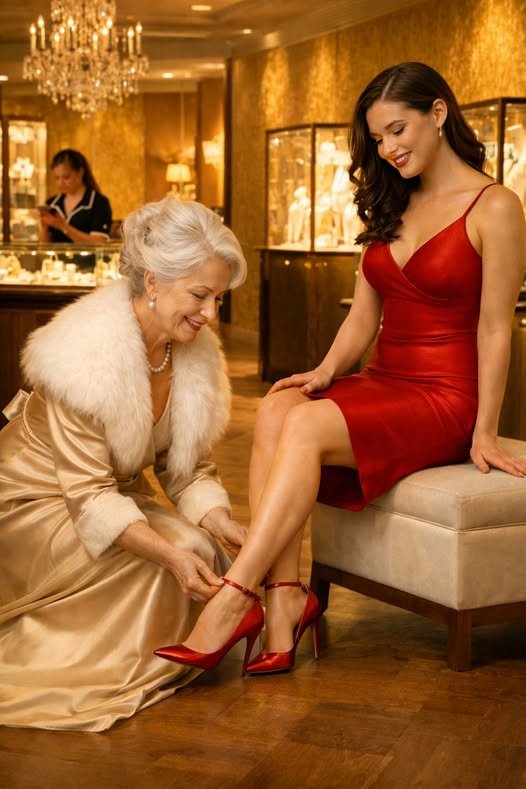
While my mother-in-law helped my husband’s mistress try on a pair of 76,000-peso heels — with my credit card — I watched from across the store. I didn’t cry. I canceled their black card, froze the accounts and smiled when they both had their payments rejected.
When I married Ethan Sinclair, I thought I was marrying “up.” He came from old money, summers in Valle de Bravo and black-tie galas where his mother, Victoria Sinclair, reigned as social royalty. I was the scholarship girl from Guadalajara: intelligent, hardworking, not exactly of her social level. But I built my own. At 32, she was the CFO of a luxury hospitality group with multiple properties and a net worth well above Ethan’s.
The funny thing about men like Ethan: they marry powerful women out of ambition… and then they punish them for it.
I discovered the infidelity on a Tuesday. His assistant—who owed more to me than to him—told me. His message was simple:
“It’s in Saks. With her. And there’s also Victoria.”
I didn’t believe it. I couldn’t. His mother always made a show of despising infidelity… at least when it was someone else’s scandal. But when I checked the transaction history of our Centurion card, there it was: 76,000 pesos at Manolo Blahnik, 2:13 PM.
That card was mine.
I paid every bill. The penthouse in Polanco: in my name. The Tesla truck and its classic Porsche: mine. I built this life for both of us while he “mentored startups,” which really meant playing golf and making big plans that never came to fruition.
I took a car north of town and entered Saks just in time to see it: Ethan laughing, his hand on the waist of a woman no more than 25, red-soled stilettos in her hand. And Victoria? Holding a pair of Louboutins against the girl’s ankle, nodding approvingly.
I didn’t cry.
I smiled.
Then I went out and made a single call to my private banker.
“Cancel the black card,” I said. Permanently.”
“But, Mrs. Sinclair—”
“No,” I replied, firmer this time. “It also freezes the joint account. Move all assets to my private portfolio. And cancels access to the penthouse elevator for Ethan, effective immediately.”
It took twelve minutes.
By the time Ethan tried to pay at the checkout, his card was declined. Twice.
Victoria’s face turned red as if someone had slapped her. The mistress looked confused. Ethan picked up his phone.
He called me.
I let it play.
Some empires burn slowly.
Mine started with a single card swipe…
When I left Saks, the city seemed noisier than usual, as if all that chaos of cars, restless horns, and scattered voices was an improvised orchestra announcing the beginning of something irreversible. My hands were not shaking. Not once did I look back. I walked to the sidewalk, inhaled the cold afternoon air, and for the first time in many months, I felt the presence of my own body: my legs, my breathing, the quickening but steady pulse that marked a silent beat in my chest.
I wasn’t going to break down. Not because of Ethan. Not because of Victoria. Not because of the girl whose heels cost more than the monthly rent of most people I knew before this marriage.
The service car arrived. I got in without saying a word to the driver. He didn’t need a destination. I just needed movement.
As the vehicle drove along Reforma, I stared out the window, watching the reflections of the buildings turned into liquid lines. My phone kept vibrating. It almost made me laugh. The insistence, the despair that he must have been feeling at that moment, was a delicious irony. For years, I was the one who waited. The one who forgave. The one that justified silences and absences with an optimism that now seemed clumsy to me.
The first call I answered wasn’t his.
It was my banker’s.
“Everything is in order, Mrs. Sinclair. Transfers made. Accesses revoked.”
Her voice was neutral, professional, but there was a slight tension, as if she were aware that she was witnessing a delicate chapter in the story of an important client. Or maybe he sensed that I was no longer the same person who wrote checks with the perfect smile of an exemplary wife at charity events.
“Thank you,” I replied, and hung up without adding more.
When the car stopped in front of the penthouse, the receptionist looked up with some trepidation. I knew something was wrong; Luxury buildings are small villages where walls have ears. I gave her a minimal smile—the one necessary for her to understand that I was okay, that nothing could knock me down at that moment—and I went up alone.
The elevator closed, enveloping me in a silence so dense that it forced me to take a deep breath. I looked at my reflection on the mirrored wall: the hair pulled back in a flawless bun, the expensive woollen coat I had bought myself, the makeup almost intact. She didn’t look like a wounded woman. She looked like one who was about to rewrite her story.
The 41st floor shone with that warm light that I always chose to make the home feel less like a museum and more of a refuge. But that day I didn’t feel any refuge. Everything was orderly, exact, almost theatrical. And yet, there was a void that I could no longer ignore. The silence of the penthouse was a huge mirror that, for the first time, allowed me to see myself without filters.
I took off my coat, left it on the couch and walked to the kitchen to pour myself water. I wasn’t hungry. Nor do I dream. But he was clear.
Clarity hurts. But it also illuminates.
Two hours later the doorbell rang.
It wasn’t Ethan.
It was victory.
“Open the door,” he ordered, as if he still had authority over me.
I didn’t.
She insisted.
“I know you’re there. We need to talk.
I laughed to myself. That woman, who for years called me “practical,” “convenient,” “helpful,” was now demanding a conversation. I looked at the videophone camera. His expression was a mixture of contained fury and bewilderment. Perhaps for the first time in her life she felt vulnerable, displaced.
“Victory,” I said finally, approaching the microphone. I don’t need to talk. And you shouldn’t need it either. Go home. Or better… go for your child.
“You can’t do this to him!” he exclaimed, raising his voice.
“I can. And I already did.
I cut the connection, ignoring the blows that followed. Blows that gradually became weaker. More disorderly. More humiliated.
When all was silent, I leaned my forehead against the door and let out a sigh that had been trapped for months. It wasn’t you who should be ashamed, I said to myself. It was never you.
That night I didn’t sleep. Not out of sadness. Not out of anguish.
It was the first night in a long time that my mind was awake with excitement, with disbelief, with something like hope. Although I still did not know for sure where that hope pointed.
At dawn, I made coffee. The aroma filled the kitchen almost therapeutically. As I took the first sip, I felt something, inside me, settle down.
I went to the computer.
I opened files, reviewed investments, projected scenarios. He was CFO; Working under pressure was my comfort zone. But then, in the midst of that rational analysis, I stood still.
What did I want?
Not what he should do legally.
Not what would be more elegant in society.
Not what Ethan’s circle or the media expected.
What did I really want?
The answer took me by surprise: I wanted to be happy again. And not the superficial happiness of charity dinners and summer trips. Not the happiness that is presumed. But the one that is felt. The one that is built from oneself, without asking anyone’s permission.
I took another cup of coffee, opened a notebook and began to write. No list of expenses. No financial plan.
I wrote my future life.
A simple, intimate, imperfect sketch. With a tone that I would never have allowed myself while standing by the Sinclair family’s side. There I put trips that I did not make to accommodate them, goals that I postponed to sustain other people’s projects, dreams that I hid because “they did not fit the profile” of a wife of her status.
And as I wrote, a quiet force began to expand in my chest. A soft, almost warm certainty that made me smile.
At ten o’clock in the morning, the intercom rang.
I knew who he was before I saw him.
I gave him access to the lobby.
Minutes later, the service elevator – the only one that still had access – opened.
Ethan showed up with his suit wrinkled, his hair in a mess and that pleading look that only appears when someone loses, for the first time, the control he thought was eternal.
“We need to talk,” he said, entering without permission.
“You need to talk,” I corrected, without getting up from the couch. I need distance.
He closed the door awkwardly.
“I didn’t want to… it wasn’t… You don’t understand what happened.
“I understand it perfectly,” I replied, crossing my legs. You wanted to feel powerful. She looked at you as you needed. Your mother applauded you. And you believed that I was always going to be here, holding the world so you wouldn’t have to.
Ethan opened his mouth, but closed it immediately.
“It was just a mistake,” he insisted, almost in a whisper.
“No,” I replied calmly. It was a decision. Several, in fact. And all yours.
There was a long silence. An awkward silence, full of invisible cracks.
“Are you really going to destroy our marriage because of a misunderstanding?” He asked, raising his voice.
“Our marriage?” I repeated slowly. Ethan, what marriage? I’ve been married to the version of you you promised to be for years. Not with the one you chose to be.
His features cracked. He approached, as if looking for the short distance could rewrite what had happened.
“You don’t have the right to take everything from me,” he blurted out suddenly, in a high-pitched, almost childlike tone.
“I didn’t take anything from you,” I said with a serenity that surprised me even. I only got back what was mine.
There were tears in his eyes. I don’t know if they were true or if they were part of that emotional theater that I resorted to whenever things didn’t go the way I wanted. I didn’t mind analyzing it. It was no longer my responsibility to interpret their emotions or dampen them.
I took an envelope from the cabinet next to me and left it on the table.
“This is mine,” I said. And it’s yours too. Read it.
Ethan took it with trembling fingers. Inside was a printed document: a letter I had written during the early hours of the morning. Not with anger, but with a clarity that no one had allowed me to have for years.
It was my formal request for separation. He did not insult, he did not accuse, he did not dramatize. It only laid out facts, decisions and a firm will to move forward without him.
“You’re serious,” he murmured, as if paralyzed by the very thought.
—More than ever.
“And that’s all?” Is this how it ends?
“No,” I replied, looking him straight in the eye. That’s how it begins.
He put his hands to his face. For a moment I thought he would collapse. But he didn’t. He just looked down, finding nowhere to lean. I had never seen that fragility. Not in him, who always played at being invincible at the cost of everything.
Then, without strength, without struggle, without even dignity, he left.
I didn’t stop him.
I didn’t say goodbye.
I only heard his footsteps disappear in the hallway, and when the elevator closed, the air in the penthouse became lighter. As if the column of smoke from a fire had stopped entering through the window.
The following days were not full of celebrations or euphoria. They were calm, honest, the kind that allows a wound to breathe without becoming infected. I continued working, but this time with a different feeling: that of building something for myself, not to hold someone else’s showcase.
My colleagues noticed that I talked more, laughed more, even ate lunch outside the office. I paid my cards smoothly, organized my financial life with surgical precision, and hired a lawyer whose steadfast gaze and humane manner became a kind of emotional anchor.
I didn’t seek revenge. I had my dignity. And that was enough.
Victoria tried to contact me several times. Calls, messages, even flowers. I never answered.
The lover… well, I never heard from her again. Maybe she got another older man. Maybe she regretted it. Maybe she showed off the heels she never managed to buy. I didn’t care.
Ethan sent a couple of emails asking for “another chance.” One apologizing, another insulting me, and one more begging. I didn’t answer any of them.
A month later, my lawyer informed me that the process was progressing smoothly. The agreement would be clean, fair, transparent. As it should be.
But what transformed my life the most did not come from a legal document, nor from a transfer, nor from a closing of a chapter.
Came from something smaller. More organic.
One afternoon, while I was organizing my things to temporarily move to a house in San Miguel—a place I’ve always wanted to visit without haste—I went to a new coffee shop near Lincoln Park. I needed air, light, a break.
The barista, a man with a friendly smile and agile hands, served me with a simple, unpretentious warmth. We talked about coffee, books, the music that was playing in the place. His name was Lorenzo.
The conversation lasted only a few minutes. But when I left the place, I felt something unexpected: lightness. Not in the form of immediate romance, not in the form of an illusory promise, but in the form of possibility.
The possibility that life would surprise me again.
That there were still unmapped paths.
New laughter.
People without a shared past who could leave beautiful footprints.
Spaces where my name was not tied to anyone else.
And that idea—small, soft, luminous—was the first brick of my new empire.
Not one made of properties, black cards or surnames of lineage.
But one made of me.
Of my decisions.
Of my strength.
Of my autonomy.
Of the self-love that, after so many silences, he had finally learned to pronounce.
The move was the next step. I left the penthouse through an impeccable legal agreement. I kept my assets, my investments, and my freedom. Victoria couldn’t stand the social embarrassment, and as I learned, she distanced herself even from Ethan when he could no longer sustain the family image.
But that stopped being my story.
My story was different.
In San Miguel, the house I rented had terracotta walls, a terrace full of bougainvillea and a small studio where I worked with a view of the sunset. The nights smelled of firewood, and the days brought a warm sun that settled on the colorful mosaics.
I wrote there. A lot. About business, about emotions, about new goals. I started giving lectures on female leadership. I opened an internal unit in my company dedicated to the development of women in executive positions. I traveled from one side of the country to the other, from Monterrey to Mérida, sharing experiences with women who were also rebuilding their lives.
And every time I finished a talk, when I saw faces shining with renewed determination, I felt that everything—absolutely everything—had been worth it.
Included the day at Saks.
Including the fire that destroyed what he thought was home.
Because from that fire something truer was born.
Months later, I returned to the city for a hospitality group event. I walked through Polanco like someone visiting someone else’s life. I passed in front of the café where I had met Lorenzo. He was there, arranging cups. He saw me. He smiled in surprise.
“Long time without seeing you,” he said in that calm, honest voice.
“I’ve been away,” I replied.
“Do you want the usual one?”
I didn’t think about it too much.
“Yes.
We talked for a while. Traveling. Of plans. Of small things. The conversation was not forced. There was no hurry. There was no weight. It was light as the afternoon air.
As we said goodbye, Lorenzo hesitated for a moment before handing me a piece of paper with his number on it.
“In case you ever want a coffee…” outside the bar.
I took it.
And for the first time since all that, I felt a warm, deep, surprising spark.
Not a replacement.
Not a refuge.
Not a cure.
Only the possibility of something good, authentic, healthy.
Something that came when I was no longer looking for it.
Something that came when I already knew how to live alone, smile alone, choose alone.
Something that came just in time.
That night, in my room in San Miguel, I opened the windows to let in the cold air of the altiplano. I sat down in front of my notebook – the same one where I wrote my future life – and added one more line, simple, clear, luminous:
I’m ready for whatever comes. And whatever comes will be beautiful.
Because I understood that not all empires must be huge.
Some are intimate.
Some are built in silence.
Some are born when a woman decides that she will no longer live in anyone’s shadow.
My empire — the real one — began the day I stopped crying for people who didn’t know how to love me.
And it continued the day I looked in the mirror and finally recognized myself.
Reborn.
Strong.
Free.
And, for the first time in many years… Deeply happy.