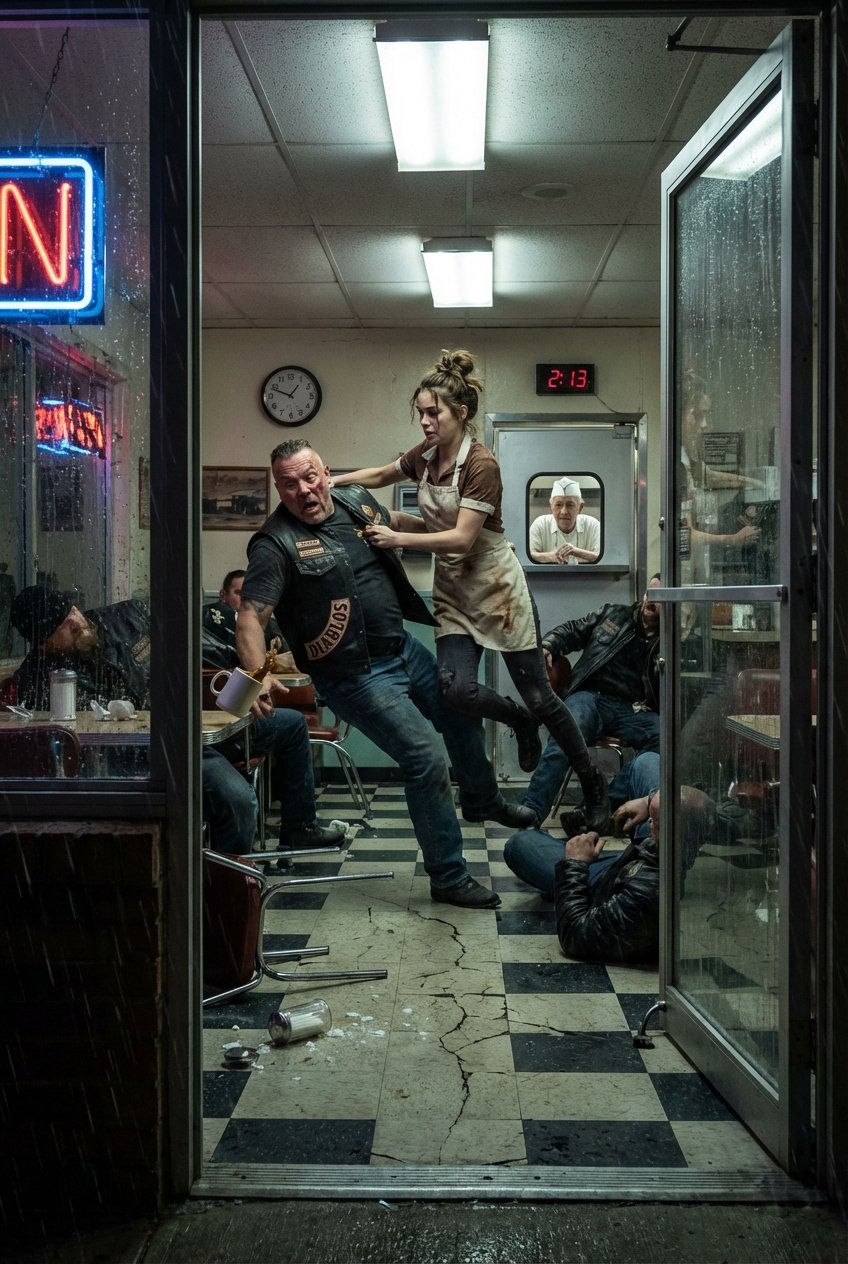
At exactly 2:13 a.m., when most of the world had surrendered to sleep and even the stray dogs had given up arguing with the rain, the neon sign outside the Rustline Diner flickered like a tired pulse, humming in uneven rhythm against the wet Florida highway, and inside that narrow rectangle of fluorescent light stood a woman who looked, to anyone glancing through the streaked windows, like nothing more than another graveyard-shift waitress trying to stretch a paycheck past its breaking point, her hair tied back in a loose knot, her apron creased from too many washes, her expression composed in the way service workers learn to compose themselves when they know they are being looked at but not truly seen, and if you had asked anyone passing by who she was, they would have shrugged and said her name was Maris Cole, twenty-nine, recently divorced perhaps, the kind of woman who worked nights because daytime belonged to someone else with better luck, and they would have been wrong in ways they couldn’t have imagined.
The diner smelled faintly of burnt coffee and disinfectant, and at the counter sat a single customer—a long-haul trucker named Daryl Baines—whose baseball cap was damp from the storm and whose eyes flicked up every time thunder rolled across the flat horizon, not because he was afraid of the weather but because men who live on highways learn to read tension the way sailors read waves, and something about that night felt too still, as if the air were holding its breath in anticipation of a disruption that hadn’t yet announced itself.
Maris wiped down the counter for the third time in twenty minutes, her movements unhurried, almost meditative, while beneath the surface of that calm exterior her awareness stretched outward in invisible threads, mapping the room, counting the steps between the counter and the exit, measuring the distance to the kitchen door where old Bernard Pike, the owner who pretended he was too stubborn to retire, clanged pots louder than necessary whenever he felt nervous, which was often these days, given that business had slowed and rumors had begun circulating about a motorcycle club using roadside diners as unofficial territory markers.
The door didn’t simply open; it burst inward with a violence that sent the bell above it into a frantic metallic shriek, and the rain swept in alongside five men wearing leather vests heavy with patches that told stories of allegiance and aggression, their boots striking the tile with deliberate force as though announcing dominion rather than requesting service, and at their center walked a man named Victor Hale, tall enough that he had to duck slightly beneath the doorway, a scar curving from the corner of his eyebrow down toward his cheekbone like a signature left by someone who believed in permanent impressions.
They did not wait to be seated.
They did not remove their gloves.
They occupied the center booth and spread outward like oil in water, helmets slamming onto tabletops, chains clinking, laughter spilling too loudly for the small space, and Victor’s gaze roamed until it landed on Maris with the slow appraisal of a man accustomed to being feared, a man who believed that every room was a stage designed for his performance.
“Well now,” he drawled, voice thick with whiskey or arrogance or both, “what kind of hospitality does this place offer at this hour?”
Maris approached with a notepad in hand, her steps measured, neither hurried nor hesitant, and she offered a polite smile that did not reach her eyes because her eyes were busy cataloging details—the way the second man to Victor’s left, a wiry redhead named Owen Griggs, kept scanning the corners, the way the youngest of the group, a broad-shouldered kid called Tyler Mays, tried too hard to appear relaxed, the way the heavyset man near the aisle, Brandon Kincaid, rested his palm too casually against his vest where something angular pressed beneath the leather.
“What can I get you gentlemen tonight?” she asked, her tone smooth but not submissive.
Victor leaned back, boots scraping across tile as he propped one foot onto the opposite seat, and his grin carried the lazy cruelty of someone who finds amusement in testing the limits of strangers.
“Surprise me,” he said. “Something strong enough to keep me entertained.”
The others chuckled, low and conspiratorial, and Owen reached deliberately for the sugar dispenser only to knock it off the table in a slow, theatrical motion that ended with glass shattering at Maris’s feet, crystals scattering like pale rain across the floor.
“Damn,” Owen said, not sounding sorry in the slightest. “Clumsy of me.”
Bernard’s shadow flickered behind the kitchen window, but he did not step out; he had seen enough over the years to know when intervention might escalate rather than calm, and fear has a way of gluing older men to familiar ground.
Maris crouched to gather the larger shards first, her movements unflustered, and when Victor flicked a folded bill from his pocket and let it drift to the floor near the spill, he tilted his head as if presenting her with a challenge disguised as generosity.
“Pick it up,” he instructed, voice quiet now, intimate in its menace.
The trucker at the counter shifted uneasily, then stood, placing a few dollars beside his mug before heading for the door without looking back, because survival often means recognizing when a story is about to become dangerous and choosing not to be written into it.
Maris reached down and lifted the bill with her hand, not her mouth, and she placed it atop the table without comment, her composure scraping against Victor’s pride like sandpaper.
“You missed the part where you say thank you,” he murmured, rising to his feet so that his shadow swallowed hers, and he stepped close enough that she could smell the metallic tang of cigarettes on his breath.
“I’m here to serve food,” she replied evenly, “not gratitude.”
The shift in the room was subtle but palpable, like the moment before lightning strikes when static gathers invisibly in the air, and Victor’s hand shot forward, fingers wrapping around her wrist in a grip designed not merely to restrain but to demonstrate ownership, and he squeezed hard enough to leave crescents in her skin.
“Apologize,” he demanded softly.
And that was when the story turned.
Maris did not yank free; she did not flinch; she did not plead; instead she adjusted her stance by inches, weight settling into the balls of her feet, shoulder rotating in alignment with his elbow, and beneath the counter her thumb pressed against a concealed switch embedded into the wood months earlier, a silent alarm that sent a coded signal through a reinforced line because the cell towers in this corridor had been mysteriously unreliable ever since reports surfaced about signal interference devices being used during illicit exchanges.
Victor tightened his grip, mistaking stillness for fear.
“Apologize,” he repeated.
She moved.
The first motion was almost imperceptible, a subtle inward rotation that leveraged his own strength against him, and in less than a heartbeat his center of gravity shifted forward as she redirected his momentum, hip anchoring against his thigh while her forearm pressed sharply against the joint of his elbow, and then the world tilted for him in a way he had not anticipated, his boots leaving the ground before slamming into tile with a force that rattled dishes and pride alike.
The others reacted not with strategy but with instinct, which is often the undoing of men who mistake brute force for skill, and Owen lunged first, swinging wide, telegraphing his punch so clearly that Maris stepped aside as though moving through a practiced dance, her palm snapping upward beneath his chin, teeth cracking together with a sound that cut through the din, and she followed with a knee that struck the outer thigh where muscle meets nerve, causing his leg to buckle beneath him so suddenly that he collapsed sideways into the booth.
Brandon’s hand dove toward his vest, but Maris intercepted his wrist mid-draw, twisting sharply until his fingers released the compact pistol he had half-withdrawn, and it clattered across tile only to be kicked under the counter before anyone else could track its path, and then she pivoted to meet Tyler who charged from behind, grabbing a fistful of his jacket to redirect him headfirst into the edge of the jukebox, glass splintering as neon flickered in protest.
Forty-seven seconds is not long enough to boil water or compose regret, but it was long enough for four men to find themselves disoriented on a diner floor that moments earlier they had believed belonged to them.
The fifth man, silent until then, remained near the door, and his name was Dominic Shaw, broader and heavier than the rest, with eyes that calculated rather than reacted, and from his vest he withdrew not a weapon but a small rectangular device whose antenna blinked faintly red, and Maris recognized it instantly for what it was—a portable signal jammer capable of disrupting calls within a limited radius, which explained why Daryl’s attempt to dial out earlier had failed despite clear skies on the weather map.
“Stay back,” Dominic warned, though uncertainty edged his tone.
She stepped toward him with the same calm she had displayed when wiping down counters, and she closed the distance before he could fully activate the device, two fingers pressing sharply into the nerve cluster beneath his collarbone, causing his grip to falter just long enough for her to strip the jammer from his hand and slam it against the metal edge of the counter until its casing cracked open, wires exposed like veins.
He swung in anger, but rage slows precision, and she ducked beneath his arm, driving her elbow into his ribs with controlled force before hooking her foot around his ankle and sending him backward into the door which she immediately locked with a decisive slide of the deadbolt.
Outside, faint but growing louder, sirens cut through the rain.
Victor groaned where he lay, fury bleeding into disbelief as he stared up at the woman he had moments ago attempted to humiliate.
“Who the hell are you?” he rasped.
She crouched beside him, removing a second magazine from inside his jacket with efficient detachment, and her voice, when she answered, carried no triumph, only clarity.
“Not the woman you thought you could break.”
Red and blue lights began to pulse through the windows, painting the diner in alternating hues of authority and consequence, and within minutes the door shook with the arrival of state troopers whose weapons were drawn not because they feared the waitress but because they had been waiting for confirmation that the men they tracked for months had finally exposed themselves on camera.
Yes, on camera.
Because what Victor and his crew had not realized in their eagerness to document humiliation for later bragging rights was that the Rustline Diner’s security system had been quietly upgraded six weeks earlier, high-resolution lenses installed above the counter and near the booths, and the footage was streaming not only to a hard drive beneath Bernard’s desk but to a secure federal server monitored by a task force investigating interstate arms trafficking along this highway corridor.
Maris’s real name was not Maris Cole.
It was Dr. Elara Quinn, former special operations strategist turned federal intelligence operative specializing in embedded surveillance within civilian infrastructures exploited by organized crime networks, and she had accepted this assignment not because she enjoyed pouring coffee at ungodly hours but because Victor Hale represented the missing link in a chain that stretched across three states and had already resulted in the disappearance of two undercover officers whose last known location pinged within twenty miles of this diner.
When the troopers flooded the room and cuffed the bikers who could no longer muster resistance, Dominic stared at her with something akin to awe or betrayal.
“You set this up,” he muttered.
“No,” she corrected quietly. “You walked into it.”
As they were escorted outside, rain soaking leather patches that once symbolized dominance, the youngest, Tyler, looked back and asked with a tremor in his voice, “Why not just call the cops?”
“Because evidence matters,” Elara replied, and she gestured subtly toward the phones they had used to film their own cruelty, devices that now contained recordings of threats, admissions about shipments, and careless boasts about distribution routes.
Bernard finally emerged from the kitchen, his face pale but his eyes steady, and he approached Elara with a mixture of gratitude and confusion.
“You could’ve told me,” he said, voice cracking.
“And put you at risk?” she answered gently. “You did exactly what you needed to do. You stayed out of their way.”
By dawn the storm had passed, leaving the highway slick and reflective, and yellow tape marked the entrance while investigators cataloged weapons and devices inside evidence bags, and Elara untied her apron slowly, folding it with the same care she had given every mundane task during her weeks undercover, because endings deserve as much respect as beginnings.
Before she left, a federal agent named Marcus Vale stepped inside, handing her a sealed envelope containing her next assignment.
“Different corridor,” he said. “Same pattern.”
She nodded, though her expression did not brighten, because victories in her line of work rarely felt like celebrations; they felt like temporary pauses in an ongoing war against those who preyed on perceived weakness.
As she stepped outside, the sunrise cut across the horizon in thin gold lines, illuminating the now-empty parking lot where five men had arrived expecting entertainment and left facing charges of illegal firearm possession, assault, conspiracy to traffic weapons, and obstruction of communication networks, their carefully constructed image of invincibility reduced to paperwork and court dates.
What none of them understood until too late was that humiliation is a weapon that often ricochets, and when you attempt to degrade someone in order to affirm your own power, you reveal more about your fragility than their worth, and sometimes the quietest person in the room is not silent because they are powerless but because they are listening, measuring, waiting for the precise moment when action will carry not only impact but consequence.
The lesson, if there must be one drawn from that rain-soaked night, is that strength does not advertise itself with noise or spectacle, nor does it require cruelty to validate its existence; real strength observes before it acts, prepares before it confronts, and when it finally moves, it does so not out of ego but out of purpose, and those who mistake kindness for weakness often learn, in the most jarring ways, that composure can conceal capability far beyond their imagination.