At seventy-one, I bought a senior pool pass, rolled onto my back, and finally faced the day nobody noticed I was drowning.
“Senior admission is on Tuesdays too, ma’am.”
The girl at the desk pushed the plastic wristband across the counter. My hand trembled so violently I nearly dropped my wallet. It wasn’t the cost that frightened me.
It was the water.
That spring the new public pool rose across from my apartment, claiming the empty lot that had once gathered broken bottles and weeds. From my kitchen window I watched it take shape—steel beams, cement, that startling blue tile. Every morning, coffee in hand, I stared at the impossible color as though it were whispering my name.
My name is Madeline. I am seventy-one, widowed, mother to three grown children who love me, I think, in the hurried, distant way grown children do. One in Texas, one in North Carolina, one in Arizona. They call when memory nudges them. They worry most when I mention my knees.
“Mom, maybe it’s time for more help.”
More help. A gentle way of saying less life.
So I bought the pass, pulled on the plain black swimsuit I’d ordered online, and entered the locker room feeling ancient, exposed. I hadn’t been in a pool since I was nine.
At summer camp in 1964 I slipped from the shallow ledge during free swim. Whistles shrieked, children screamed, counselors laughed among themselves. I swallowed water, clawed at emptiness, watched faces turned the wrong way. A boy finally yelled that I was under. Someone hauled me out.
What lingered was not only terror, but the lesson: you can vanish in plain sight and no one will see.
Sixty-two years later I clutched the rail of the warm-water pool as if it could anchor my life.
Then I saw her.
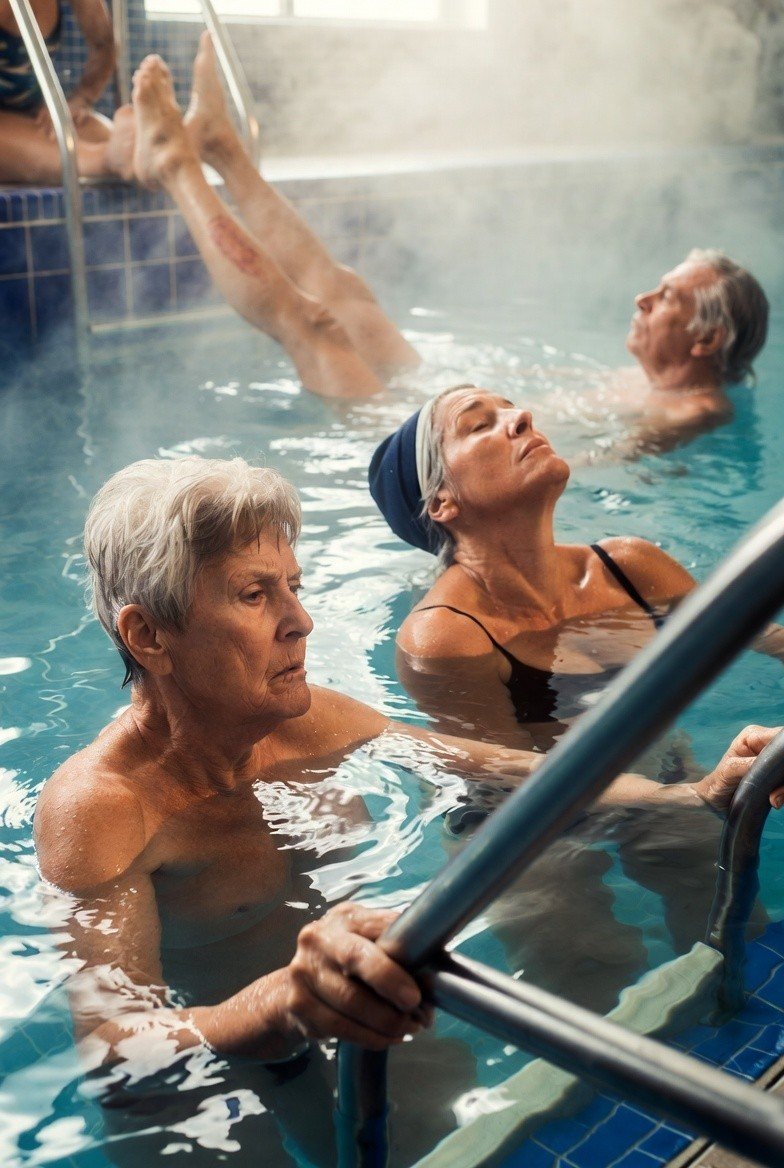
Short silver hair, strong shoulders, navy swim cap. Every morning from my window I had watched her glide before dawn, then turn onto her back and float—motionless, eyes on the ceiling—like peace had finally chosen a body.
I wanted that peace.
Not the cap. The surrender.
She glanced at me once and understood.
“First day?”
I nodded.
“I’m Rose,” she said. “Stay in the warm pool. Just walk today. Let the water help.”
No condescension. No lecture on bravery. She pushed off and drifted away.
So I walked. Back and forth. At first I felt absurd, my fear blazing like a beacon. But after ten minutes my knees quieted. After twenty my shoulders eased. When I climbed out, my breath reached deeper than it had in years.
I returned the next morning at seven. Rose was there. So was Walter, an old man doing slow leg lifts against the wall.
“Doctor said pills or pool,” he grumbled once. “I chose the cheaper trouble.”
And Elena, perhaps fifty, a long scar tracing one leg.
“Truck hit my car last winter,” she said. “In here, the limp fades.”
That became our small circle. Not friends in the usual sense—no last names, no brunches, no holiday cards. But every morning at seven we shared the same humid air, the same warm water, making quiet space for one another.
One day Rose stood beside me. “Ready to float?”
I laughed too quickly. “No.”
“Yes,” she said. “Your body remembers. Your mind resists.”
It annoyed me. Which is why I tried.
She taught me to lift my chin, open my arms, stop fighting.
The first attempt I sank instantly, panic roaring back across six decades. I surfaced coughing, furious.
Rose didn’t rescue me. She didn’t soothe. She only said, “Again.”
I hated her for three seconds. Then I tried again. And again.
For eleven mornings I stiffened like wood, felt foolish, nearly quit.
On the twelfth, something gave way. My ears slipped under. The world softened. The ceiling dissolved in steam.
For the first time in my life, the water held me.
I floated.
Thirty seconds, perhaps. It felt like a locked door splintering open.
Tears came—raw, ungraceful—right there in the pool.
Rose floated beside me in silence. It was the gentlest gift anyone had given me in years.
Our mornings continued. Then Walter vanished.
One day. Three. Five.
The desk wouldn’t share details. Rose left a message with his listed emergency contact. Two days later his daughter called back: stroke, rehab.
He had asked if the morning pool crowd noticed he was gone.
That question cracked something inside me—not whether we missed him, but whether we had seen.
So we went. One by one. Ten minutes, fifteen. We carried pool news like talismans: the finicky heater, Elena’s new deep-water lane, Rose scolding a newcomer about stretching.
The first time I entered his room, Walter looked up and wept.
“You came.”
“Of course,” I said. “You belong to us.”
Until then I hadn’t realized how desperately I needed to belong to someone too.
Four months later Walter returned—cane in one hand, rail in the other. No applause, no fuss. We simply made room and watched him ease into the water like a man stepping back into church after a long, hard winter.
That was our way: presence, not performance.
Last month three newcomers arrived: a mechanic post-surgery, a woman whose face carried constant pain, a teenage boy whose mother said the water quieted his panic.
Rose greeted them the same way she had greeted me: “Stay in the warm pool. Walk. We’re here every morning.”
Elena no longer needs therapy but still comes.
“Why?” I asked.
She looked at the water. “When Walter disappeared, you all went looking. No one has ever looked for me before.”
I am seventy-one.
For sixty-two years I believed water had defined my life.
It hadn’t.
Being unseen had.
Now every morning at seven I step into that warm blue with people who notice limps on rainy days, who hear the joke masking fear, who know when to offer a word and when to offer quiet, who say “Again” when someone falters.
We don’t share politics or voting records or the full weight of private griefs.
We know enough.
My children still call from afar. My knees still ache with the weather. My apartment is still silent at night.
But for one hour each morning I am not alone.
I float.
And someone notices.