THE MAFIA BOSS CAME HOME EARLY AND HEARD HIS SILENT TRIPLETS SINGING FOR THE FIRST TIME IN 14 MONTHS — BUT WHEN HE SAW THE HOUSEKEEPER HOLDING THE DAUGHTERS HE COULD NOT REACH, HIS JEALOUSY DESTROYED THE MIRACLE
Dominic Russo came home without warning.
No call.
No text.
No warning to the guards.
A mafia boss did not announce his schedule, not even to his own house.
The Long Island mansion was silent when he stepped inside, just as it had been for 14 months. That terrible, polished silence. The kind that turned marble floors colder, made crystal chandeliers feel useless, and filled 15 bedrooms with the sound of everything that had been lost.
Then he heard it.
A sound from somewhere deep inside the house.
His heart slammed once against his ribs.
By instinct, his hand moved to the gun at his side.
Dominic Russo had survived too long by assuming every unexpected sound was danger. He controlled the ports, the underground casinos, and half the protection rackets in Manhattan. Men whispered his name with fear. Enemies trembled when he walked into a room. Everything he touched either turned to gold or turned to blood.
But this sound was not danger.
It was worse.
It was impossible.
It was laughter.
For one full second, Dominic did not move.
Then he followed it.
Past the sitting room. Past the grand staircase. Down the hall toward the kitchen.
With every step, the sound grew clearer.
Children laughing.
Children singing.
His children.
His three daughters, who had not spoken a single word since the day their mother was murdered.
Dominic reached the kitchen door and stopped with his hand on the knob.
It was trembling.
He pushed the door open.
And the world stopped.
Late afternoon sunlight poured through the big windows, turning the kitchen gold. Dust floated in the air like tiny sparks. On the wall beside the window, a purple crayon butterfly had been taped in a place of honor, its wings uneven, its body crooked, its little antenna bent.
And in the middle of the room, his daughters were alive again.
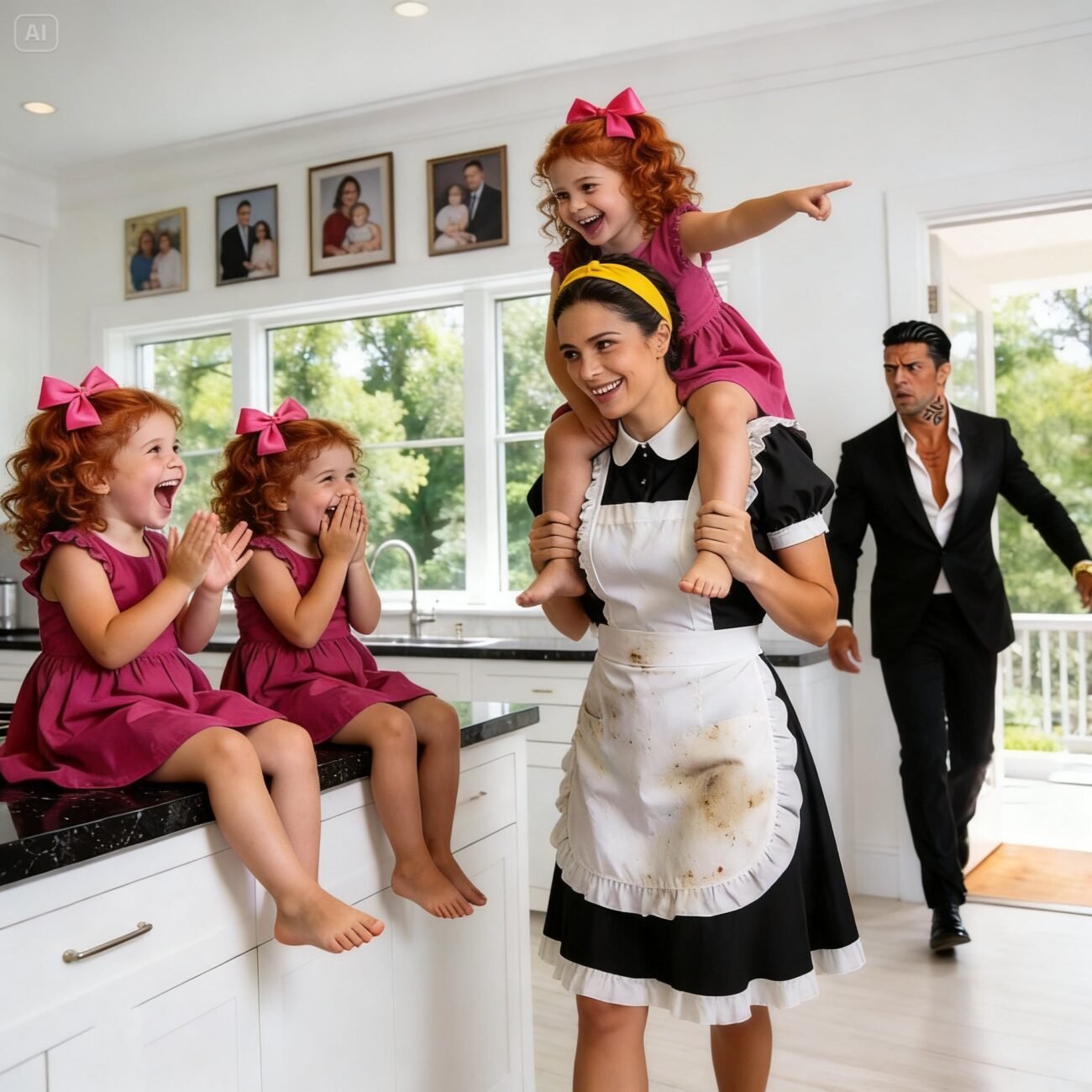
Mia sat on a woman’s shoulders, her small hands tangled in the woman’s dark hair, laughing so hard her whole tiny body shook. Lucia and Valentina sat on the kitchen table, legs swinging, cheeks flushed, eyes bright.
All three of them were singing.
The song was familiar.
A song about sunshine.
The song Isabella used to sing to them every night.
Their words were messy. Their voices did not match. They missed notes and stumbled over each other. But none of that mattered.
They were singing.
After 14 months of absolute silence, Dominic Russo’s daughters were singing.
The woman in the center of it all was folding tiny dresses. She smiled as she sang along, moving gently to make Mia laugh harder.
Elena Vasquez.
The housekeeper he had barely noticed in the hallway.
The girl he had looked past like furniture.
His briefcase slipped from his hand.
The sound was not loud enough for anyone in the kitchen to hear. They kept laughing. Kept singing. Kept living.
For three seconds, joy flooded him so violently that it almost broke him.
His daughters were talking.
His daughters were laughing.
His daughters had come back.
For three seconds, he felt gratitude for the first time since Isabella died. He wanted to run into that kitchen, gather his girls into his arms, fall to his knees, and tell them Daddy loved them, Daddy had never stopped loving them, Daddy had been waiting for them in the dark for 14 months.
Then Mia shouted, “Sing louder, Miss Elena!”
Miss Elena.
Not Daddy.
Not him.
Elena.
And something inside Dominic shifted.
Fast.
Ugly.
Like someone flicked a switch in the deepest part of him.
Joy disappeared.
In its place came jealousy.
Shame fed it. Pride sharpened it. Anger gave it somewhere to go.
This woman had done what he could not.
This housekeeper with no power, no degrees, no money, no army, no reputation, had brought his daughters back from a place Dominic could not reach.
He had spent millions.
The best child psychologists from the best hospitals. Specialists from Europe. Therapy after therapy. Private trips to Disney World, the Hamptons, a Caribbean island. Puppies. Ponies. A toy castle in the garden big enough to shame most houses.
Nothing had worked.
Then Elena Vasquez walked in and did it in eight weeks.
His daughters looked at her with trust.
Mia tugged her hair like she belonged to them.
Lucia and Valentina sang beside her like the sound had been hiding inside their bodies, waiting only for her.
Dominic hated her in that instant.
Not because she had done anything wrong.
Because she had shown him exactly how helpless he was.
And because he could not hate himself, the darkness needed somewhere else to go.
“What the hell is going on in here?”
His voice ripped through the kitchen like gunfire.
The singing stopped instantly.
Silence slammed down so hard it stole the air from the room.
Mia went rigid on Elena’s shoulders. Her little face crumpled. Lucia and Valentina shrank back on the table, clutching each other’s hands.
Elena froze.
Then, very carefully, she lifted Mia down from her shoulders, slow and gentle, like she was handling something fragile enough to shatter.
“Sir,” she said, voice small but steady, “I was just—”
“You were hired to clean,” Dominic roared, stepping into the kitchen. “Not to turn my kitchen into a circus.”
Mia began to cry.
A small, strangled sound.
She ran behind Elena’s legs and grabbed her skirt with both hands.
Elena’s body shook, but she did not bow her head.
“The girls were happy, sir,” she said. “This is the first time in 14 months they’ve talked, laughed, sung. Can’t you see that?”
“I do not need you telling me what my children need.”
Dominic moved closer. His face was flushed. A vein stood out in his neck. His fists clenched so tightly his knuckles went white.
“They are my children. Not yours. You have no right.”
Elena stepped back once, not because she was afraid, but because Mia was behind her and she needed to shield the child.
Then she looked straight into Dominic’s eyes.
“I’m the only one who got them to speak again,” she said clearly. “How many experts did you hire? How much money did you spend? No one could do it. I did. In eight weeks. You can fire me, but you can’t deny that.”
Dominic went still.
No one spoke to him like that.
Not his men. Not his enemies. Not bosses from rival families. Not politicians who owed him favors. Everyone measured words around Dominic Russo.
But this young woman stood in his kitchen and threw the truth directly at him.
And the truth hurt worse than any bullet.
“You’re fired,” he snarled. “Pack your things. Get out right now.”
Elena looked at him for a long moment.
There was no fear in her eyes.
No begging.
Only disappointment.
And that made him even angrier.
Footsteps sounded in the hallway. Rosa rushed in, breathless, face pale. She had been with the Russo family for 15 years. She had watched Dominic grow from a hot-headed street kid into one of the most feared men in New York. She had been at his wedding. She had held his daughters when they were newborns. She had stood beside him when Isabella lay in her coffin.
“Boss,” she pleaded. “You don’t understand. She’s done what no one else could. The girls are talking. The girls are laughing. Please don’t—”
Dominic turned on her.
His stare pinned Rosa to the doorway.
For the first time in 15 years, she looked afraid of him.
“Get out of my house,” he said to Elena, voice cold as ice. “Before I do something we will both regret.”
Elena bent down and gently pried Mia’s hands off her skirt.
Mia cried harder.
“Miss Elena, don’t go. Miss Elena.”
Elena knelt in front of her and wiped the tears from her cheeks.
“You’ll be all right, angel,” she whispered. “You’ll all be all right.”
Then she stood.
She walked past Dominic with her chin lifted and her back straight. Tears slid silently down her cheeks, but she did not hide them. She did not plead. She did not look small.
She walked out of the sunlit kitchen, leaving behind three crying little girls, one trembling old housekeeper, and a mafia boss breathing hard with rage he no longer knew what to do with.
Only minutes earlier, that kitchen had been full of music.
Now it held nothing but the sound of children breaking all over again.
Before Isabella died, the Russo mansion had not been silent.
Lucia used to read books to her dolls, making up voices for each one.
Valentina used to ask why about everything. Why did stars shine? Why did the ocean move? Why did Daddy’s men wear black suits? Why did Mommy smell like jasmine?
Mia used to sing in the bath, making up nonsense songs and laughing at herself until Isabella came in and sang along.
They were identical triplets. Four years old. Black curls. Brown eyes. Isabella’s eyes.
Then came the ambush.
Isabella had been picking the girls up from preschool when the Mendes cartel made their move. A rival family wanted to send Dominic a message. They opened fire on the car in broad daylight.
Isabella used her own body as a shield.
She died on the spot.
The girls survived without a scratch.
Dominic had been in Chicago when the call came.
By the time he reached New York, his wife was gone, and his three daughters had vanished inside themselves.
At the funeral, something sealed shut inside them.
All three stopped speaking at the same time.
Not one word.
Not one laugh.
Not one sob.
Fourteen months of silence.
They held hands and stared into empty space like ghosts.
Dominic did what a powerful man does when power is the only language he trusts. He spent money. He summoned specialists. He threatened doctors with more money if they failed and paid them anyway when they did. He took the girls anywhere he thought joy might still exist.
Nothing reached them.
So he did the other thing he knew how to do.
He hunted down the Mendes cartel.
One by one, he made them pay. It took three months to wipe them off the map.
But revenge did not bring Isabella back.
And blood did not make his daughters speak.
So Dominic ran without leaving.
He buried himself in business. Eighteen-hour days. Trips every week. Miami. Chicago. Las Vegas. Atlantic City. Anywhere that was not the mansion. Anywhere he did not have to sit across from three silent little girls and admit that the man who controlled half the underworld could not reach his own children.
Rosa finally broke.
One evening, she stood in the doorway of Dominic’s study and said, “Boss, I need to talk to you.”
Dominic did not look up from the pile of papers on his desk.
“Speak.”
“I can’t take care of this house and the girls alone anymore. The house is too big. The girls need more care than I can give. I need to hire more people.”
His pen kept moving.
“Hire whoever you want, Rosa. Check their background thoroughly.”
That was all.
Three days later, Elena Vasquez stood in front of the Russo estate’s iron gate.
She looked up at the cameras, at least five she could count, probably more she could not see. The gate opened without her ringing anything. They had been watching her since the moment she stepped off the bus.
Inside, the mansion rose at the end of a stone driveway like a fortress pretending to be a home.
Two men in black suits stood by the front door. They did not smile. They did not greet her. They simply scanned her with hard eyes.
She noticed the bulges beneath their jackets.
Guns.
Go back, a voice inside her screamed.
But Elena needed the job.
She needed money for Miguel’s lawyer.
Fear was a luxury she could not afford.
Rosa interviewed her in the sitting room. For a long moment, she studied Elena without speaking.
Then she asked, “Are you scared?”
Elena knew Rosa did not mean the work.
She meant the cameras.
The guns.
The armored vehicles.
The air of danger that lived inside every hallway.
Elena looked straight into Rosa’s eyes.
“Yes,” she said. “I’m scared. But I’ve been scared of many things in my life. I’m still here.”
Something like respect flickered across Rosa’s face.
“You’re hired.”
On the tour of the house, Elena saw Dominic only once. He stepped from a room at the end of the second-floor hallway, speaking into his phone with a voice like a knife.
“Tell Santino if he doesn’t pay within 48 hours, he won’t need to pay anymore. Ever.”
He stopped when he saw Elena and Rosa.
His eyes swept over Elena with no interest at all, as if she were a chair someone had moved into the hallway.
Then he walked past.
“That’s the boss,” Rosa said quietly. “You don’t need to know much about him. Do your job well and stay out of his way.”
Elena nodded.
Then she saw the girls.
They stood on the fifth step of the staircase, holding hands, looking down at her.
Three small angels with black curls and brown eyes.
But their eyes were empty.
“That’s Lucia, Valentina, and Mia,” Rosa said. “The boss’s girls. They don’t talk to anyone. It’s been 14 months.”
Elena looked at the girls.
And the girls looked back.
For the first time in 14 months, their eyes followed a stranger not with fear, but with curiosity.
An invisible thread tied itself between them.
None of them understood it yet.
Elena began work at six the next morning.
She cleaned shelves of books that seemed endless. She vacuumed Persian rugs worth more than everything she had ever owned. She polished statues she was afraid to ask the price of.
Rosa watched everything.
Near noon, they stopped outside the girls’ room.
Rosa asked, “Do you have experience with children?”
Elena froze.
The question pulled her backward three years.
Back to the Bronx.
Back to her father’s auto repair shop on 17th Street.
Antonio Vasquez had been the best mechanic in the neighborhood. A decent man. A hardworking man. Everyone knew him. Everyone loved him.
Two men from Los Diablos came into his shop demanding protection money. They said the neighborhood belonged to them.
Antonio refused.
He had worked there for 20 years. He owed no one.
They shot him outside his own shop.
Three bullets.
Chest.
Stomach.
Head.
Elena had been coming home from a café shift when she heard the shots. She ran two blocks as fast as she could, but by the time she reached him, her father was lying in a pool of blood with his eyes open to the sky.
Her mother, Maria, did not survive the grief. Six months later, she died in her sleep. The doctor called it a heart attack. Elena knew it was a broken heart.
Then came Miguel.
Her little brother. Nineteen. Kind. Brilliant. Dreamed of becoming an engineer. He was set up with drugs in the trunk and a gun in the closet. Sentenced to 10 years for a crime he did not commit.
That left Elena alone.
Twenty-seven years old. No father. No mother. Brother in prison. Two jobs. Night classes in early childhood education. Every extra dollar going toward lawyers who promised hope and delivered nothing.
Three years of pain.
Three years of waking up and reminding herself she did not have the right to fall apart.
Elena blinked and returned to the hallway.
“Yes,” she said. “I have experience with children. But more than that, I understand the pain of losing someone. I live with it every day.”
Rosa looked toward the closed door.
“The boss has hired everyone,” she said softly. “No one has been able to do anything.”
“Maybe they don’t need someone to fix them,” Elena said. “Maybe they just need someone who understands.”
In her first week, Elena did nothing special.
She worked.
She dusted. Swept. Folded clothes. Cleaned rooms.
But she moved gently, as if the house itself was recovering from trauma and one sudden motion might break it.
And she sang.
Quietly.
Not for attention.
For breath.
Cielito Lindo, the song her mother used to sing when Elena was small.
She sang while wiping the stairs. Sang while polishing the banister. Sang while folding bed linens.
On the third day, while mopping the second-floor hall, Elena felt someone watching.
She did not turn.
Out of the corner of her eye, she saw Lucia standing in the doorway of the girls’ room, one hand on the frame.
Five minutes passed.
Ten.
Twenty.
Lucia stayed.
Elena wanted to smile. To speak. To kneel.
Instead, instinct told her not to force it.
So she kept singing.
When she finally glanced back, Lucia was gone.
But it was the first time in 14 months one of the girls had chosen to watch anyone that long.
The second week, Valentina came into the laundry room.
Elena was folding little dresses — pink, purple, blue — and singing under her breath. Valentina walked in and sat on the floor three feet away.
She said nothing.
Elena did not look directly at her. She kept folding. Kept singing. Let a faint smile sit on her lips like it belonged to the song, not the child.
Valentina stayed an hour.
Before she left, she looked back once.
The next day, Mia appeared.
She stood in the laundry room doorway with her head tilted like a small bird listening for a faraway melody.
Elena kept singing.
Her heart beat faster.
Something was changing.
In the third week, the first miracle came on paper.
Elena lifted a stack of clean sheets and found a crayon drawing lying on top.
A butterfly.
Purple.
Uneven wings. Bent antenna. Crooked body.
To Elena, it was the most beautiful thing she had ever seen.
She knew Lucia had drawn it.
She also knew Lucia was watching from behind the half-open door.
Elena did not turn.
She only whispered, “So beautiful. This butterfly is so beautiful.”
Then she carried the drawing to the kitchen and taped it beside the window where morning light would fall on it every day.
“Perfect,” she murmured.
From the hallway, Lucia watched.
And when she saw her picture displayed in the kitchen like treasure, something flickered in her eyes.
A spark.
Tiny.
But real.
In the fourth week, Mia spoke.
Elena was dusting in the sitting room, singing Cielito Lindo softly, when she felt a presence behind her. She did not turn.
Then came one word.
Small as breath.
“Sing.”
Elena went still.
Her hand stopped in the air.
That was the first word any of them had spoken in 14 months.
Mia.
The youngest.
The one who used to make up songs in the bath.
Elena wanted to cry. Wanted to run for Rosa. Wanted to gather the child into her arms.
She did none of that.
She kept singing.
Softer now.
Gentler.
Then she heard it.
A tiny hum.
Mia was not using words, but she was following the melody.
After 14 months of silence, Mia was singing.
In the fifth week, Valentina asked the first question.
Elena was folding clothes in the girls’ room. She was allowed inside now. The girls no longer shut the door when she came.
That day, Elena sang a sadder song, the one her mother had sung in the final days after Antonio died.
Valentina watched for a long time.
Then she asked, “Why do you sing so sadly?”
Elena looked up carefully.
The first sentence.
Not just a word.
A whole question.
She set the dress down and knelt so her eyes were level with Valentina’s.
“Because sometimes sadness is beautiful too, sweetheart. It means we once loved someone very much. So much that when they are gone, we still remember. Love doesn’t disappear just because the person we love isn’t here anymore.”
Valentina stared at her.
Then she whispered, “I’m sad too.”
“I know, angel,” Elena said. “I’m sad too.”
Valentina reached out and touched Elena’s cheek, light as a butterfly wing.
Elena let the tears fall.
Sometimes tears were proof that a person was still alive.
By the sixth week, the wall began to crumble.
Lucia spoke of Isabella first. Her mother sang while cooking. Sang while bathing them. Sang beautifully. She had long black hair and brown eyes like theirs. She smiled all the time.
Then Lucia’s little voice trembled.
“Then Mommy stopped smiling. Then Mommy went away.”
Elena did not interrupt.
She let the words pour out like water finally breaking through a dam.
The next day, Valentina asked why their mother had to go.
Elena did not have a perfect answer. She only told her that sometimes bad things happen to good people, and no one knows why. But it did not mean Isabella wanted to leave.
“No mother wants to leave her children,” Elena said. “Never.”
That night, Mia remembered the smell of Isabella’s hair.
Jasmine.
She said she tried to remember it, but could not.
Elena stroked her hair and whispered, “You’ll remember with your heart.”
Then Mia cried.
Not silent tears.
Real sobs.
Lucia and Valentina joined her.
The three girls climbed into Elena’s arms, and the four of them cried for Isabella, for 14 months of silence, for all the pain no one had known how to carry.
Elena cried for Antonio, for Maria, for Miguel, for herself.
That night, the pain was shared.
And once shared, it was a little less heavy.
By the eighth week, laughter returned.
Lucia helped fold laundry badly but proudly.
Valentina watered plants and asked the name of every flower.
Mia baked with Elena, got dough on her face, licked sugar from the spoon, and laughed like wind chimes.
They sang together in the kitchen.
That was what Dominic walked in on.
That was what he destroyed.
After Elena left, the girls stopped crying and stood in a line.
Lucia moved first, then Valentina, then Mia. Their faces emptied as if the light Elena had brought back had been switched off.
They looked at Dominic with stranger’s eyes.
Then they turned away, hand in hand, and walked back to their room.
Elena reached their door just after it closed. She placed her palm against the wood.
Inside was silence.
Heavy.
Painful.
Familiar.
“Goodbye, my angels,” she whispered. “I love you. I’ll always love you.”
No answer.
She walked out past the guards, past the iron gate, and disappeared down the road.
Rosa found Dominic in his study later with whiskey in his hand.
“You just fired the only person who got the girls to speak again,” she said.
“Get out, Rosa.”
“Fourteen months, boss. No one could do anything. That girl did it in eight weeks. And you threw her out for what? Pride? Jealousy?”
“Get out.”
Rosa’s eyes filled.
“The girls went silent again the second she left. They haven’t said a word. They look at you like you’re a stranger. And this time, I’m not sure anyone can save them anymore.”
Then she left him alone with the truth.
The next days were worse than the silence before.
Because now the silence had a target.
Dominic.
At breakfast, the girls stood and left the table as soon as he sat down.
When he entered their room, they turned their backs to him.
He apologized. Begged. Promised.
Nothing.
On the third night, he went to their room while they slept. Moonlight covered their faces. They lay pressed together, hands clasped even in sleep.
He reached toward Lucia’s hair.
She opened her eyes.
She did not startle.
She only looked at him.
“You sent Miss Elena away,” she said.
Her voice was cold and clear.
“I hate you.”
Three words.
Three bullets.
Then Lucia turned toward the wall and closed her eyes.
Dominic stumbled back to his study. He drank whiskey straight from the bottle. On his desk, Isabella smiled from a silver frame beside the girls in a photo taken six months before her murder.
“I failed, sweetheart,” he whispered. “I failed the girls. I destroyed everything.”
Then he cried.
For the first time since Isabella’s funeral, tears ran down Dominic Russo’s face.
When the pain became too much, it turned into the only language he had used for years.
Rage.
He called Marco Benedetti, his right hand.
“Find me someone,” Dominic said. “Anyone. I need to kill someone. I need to let this rage out.”
Silence filled the line.
Then Marco said gently, “Killing doesn’t bring the girls back, boss. You wiped out the Mendes cartel. Did it bring Isabella back? Did it make the girls speak? Violence doesn’t solve pain. You know that.”
Dominic threw the phone at the wall.
It shattered.
But Marco had already told him the truth.
By morning, Dominic looked like a dead man sitting upright.
When Marco arrived, Dominic said only two words.
“Find her.”
Marco stared.
“She didn’t do anything wrong, boss. You fired her. She left. She doesn’t owe you anything.”
“I know,” Dominic said, eyes red. “I was wrong. I need to fix it. Please, Marco.”
In 15 years, Marco had never heard Dominic say please.
So he found Elena.
He found more than her address.
Elena Vasquez, 27, Puerto Rican, living in a small Bronx apartment, working café shifts by day, cleaning offices at night, college in the evening.
Daughter of Antonio Vasquez, mechanic, murdered by Los Diablos for refusing to pay protection money.
Marco went still when he saw the name.
Los Diablos.
Two years earlier, the Russo family had expanded into the Bronx. Los Diablos tried to block them. Dominic ordered them erased. Marco led the team. Twenty-three men gone in one night.
Dominic Russo had avenged Elena’s father without knowing Elena existed.
Marco dug deeper.
Maria Vasquez, dead of heart failure six months after Antonio.
Miguel Vasquez, framed for drug and weapons possession, sentenced to 10 years at Sing Sing. Evidence too perfect. Witness unreliable. Public defender useless.
Elena had lost everything and still loved three broken little girls back to life.
Marco drove back to the estate and told Dominic all of it.
Dominic listened in silence.
“Does she know I killed the men who killed her father?”
“No,” Marco said. “She only knows her father died and no one was punished.”
“Where is she now?”
Marco gave him the address.
Dominic stood.
“Take me there.”
He found her at the café.
Elena was behind the counter making cappuccino when she looked up and saw him sitting in the corner.
No bodyguards.
No armored SUV outside.
Just Dominic Russo in a black suit, watching her.
Her first instinct was to run.
She did not.
If a mafia boss wanted to hurt her, he would hurt her whether she ran or not.
So she finished the coffee.
She served customers. Wiped tables. Washed cups. Treated him like a ghost.
At two, her shift ended.
She stepped outside.
Dominic was waiting.
“I need to talk to you,” he said.
His voice was not cold anymore.
It sounded tired.
“What do you want, Mr. Russo?” Elena asked. “Did you come here to get me fired from this job too? Or are you planning to run me out of the city altogether?”
He flinched.
“I deserve that.”
“Yes,” she said. “You do.”
He asked for ten minutes.
She gave it to him only because Rosa had called the night before, crying about the girls.
They walked to a small park and sat on a battered bench with space between them like strangers.
“My girls went silent again,” Dominic said. “The second you walked out. They won’t look at me. They hate me.”
“I know. Rosa called.”
Dominic turned toward her.
“You know who I am?”
“Yes, Mr. Russo. My whole Bronx knows who you are.”
“Then why aren’t you afraid?”
Elena gave a soft, sad laugh.
“Because I’ve already lost everything. My father was shot dead three years ago outside his shop. Three bullets. My mother died six months later because she could not survive it. My brother Miguel was set up and sent to prison for 10 years. I work 16 hours a day trying to pay lawyers who do nothing.”
She looked him straight in the eyes.
“What else can you take from me? My life? Take it. It isn’t worth much anyway. But don’t expect me to fear you. I have nothing left to fear.”
Dominic looked at her then.
Really looked.
Not as a housekeeper.
Not as the girl who dared challenge him.
As a person who had endured too much and still had enough love left to save his children.
“I was wrong,” he said. “I was jealous. You did what I couldn’t. You made my daughters speak, laugh, sing. Instead of being grateful, I was angry. I destroyed everything.”
Elena stared at the falling leaves.
“You’re right,” she said. “You destroyed everything.”
“I want you to come back.”
“What?”
“Come back. Work for me. Stay with my daughters. You’re the only one they trust. Please.”
She laughed without warmth.
“I can’t.”
“I’ll pay double. Triple. Ten times. Any number you want.”
Elena stood.
“You think this is about money? Do you know what it felt like to be thrown out like a criminal in front of children I loved? Do you know Mia’s crying still haunts me every night?”
She drew a sharp breath.
“I get up at five. I go to bed at one. I’m so tired some days I forget how to breathe. But every night, I still think about those girls. I still worry. I still pray for them, even after you threw me out like a dog.”
She looked at him.
“Sorry isn’t enough. Money isn’t enough. Nothing is enough.”
She turned to leave.
“Your brother,” Dominic said.
Elena froze.
“What did you just say?”
“Miguel Vasquez,” Dominic said. “Twenty-two now. Serving 10 years at Sing Sing. Drugs and weapons. But he didn’t do it. He was set up.”
Fury flashed across her face.
“You investigated me? And now what? You’re using my brother to force me back?”
“No.”
She stared at him.
“No,” he said again. “I’m not bribing you. I’m going to help your brother whether you come back or not. I have the best lawyers. I have connections. I can reopen the case. I can find who set him up. I can get him out.”
“Why?” she whispered.
“Because it is the right thing. I’ve done too many wrong things. The blood on my hands will never wash off. But maybe I can still do one right thing. Help an innocent man get out of a place he does not belong. No conditions. No trade. Whether you come back or not, I help Miguel. That is a promise.”
Elena searched his face for a lie.
For manipulation.
For the trap.
She found only exhaustion and regret.
She sat down again.
For a long time, neither spoke.
Then she said, “I hate you.”
“I know.”
“I hate the way you treated me. I hate the way you screamed in that kitchen. I hate that you terrified those little girls. I hate that you think money can buy everything.”
“I know.”
“But I love those children,” Elena said. “Lucia with her pretend strength. Valentina with her endless why questions. Mia with her tiny singing voice. I was with them eight weeks, and I love them like my own.”
She turned to him.
“If I come back, you have to change. Really change. Not apologize and forget. Real change.”
“How?”
“You have to be home. Actually home. Breakfast. Dinner. Bedtime stories. Know their teachers. Their friends. Their songs. Their fears. Their dreams. They don’t need a mafia boss. They need a father.”
Dominic opened his mouth.
“My work—”
“Your work stole their mother,” Elena cut in.
He went still.
“Isabella died because of who you are. Because of the enemies you made. Blood calls for blood in your world. Don’t let your daughters pay anymore. Don’t let your work steal their father too.”
“You’re asking me to give up everything.”
“No,” Elena said. “I’m asking you to choose. Your daughters or your empire. You can’t have both. You tried. Isabella died. The girls went silent. You almost lost them forever. So choose.”
Dominic stared at her as if she had placed a question in front of him he had spent his life avoiding.
Elena stood.
“Two days. Prove you want to change. If you can, I’ll come back. If you can’t, don’t look for me again.”
Dominic nodded.
“Two days.”
That day, he called Marco.
“I’m not going anywhere this week. You handle everything.”
“Everything, boss?”
“Chicago. Atlantic City. The Gambino problem. All of it.”
“What’s going on?”
“I’m trying to save what’s left of my family.”
Then he hung up.
The next morning, Dominic woke at six. He went to the kitchen, where Rosa was making breakfast.
“Boss,” Rosa said, stunned. “You’re not going to work?”
“I’m making breakfast. For the girls.”
“But boss… you can’t cook.”
“I’ll learn.”
Thirty minutes later, Dominic put three plates of burnt eggs and scorched toast on the table.
Rosa looked quietly devastated but said nothing.
The girls came down. Sat. Stared at the food. Then at Dominic standing in an apron with butter on his hands.
They did not eat.
But they did not leave.
They watched him like they were trying to understand what was happening.
Dominic sat with them.
He did not force words.
He simply stayed.
For the first time in 14 months, he was truly present.
On the second day, he did not leave the house. Did not open his laptop. Put his phone in a drawer and did not look at it.
In the afternoon, the girls played silently in the sitting room while Dominic sat a few feet away.
One hour.
Two.
Three.
He did not demand anything.
He just stayed.
Near sunset, Mia stood with a doll in her hand and walked slowly toward him.
Dominic did not breathe.
She stopped in front of him, looked up, then touched his hand.
Only for a second.
Light as a butterfly.
Then she ran back to her sisters.
Dominic let the tears gather.
That night, he sat beside their bed.
“Girls,” he said gently. “Daddy has something to say.”
No response.
“Miss Elena is coming back. Daddy found her. Daddy apologized. She’s going to come back. And Daddy is going to be here too.”
Lucia turned her head.
“Really?”
The hope in that one word almost shattered him.
“Really, sweetheart.”
When Elena returned, the girls ran to her.
Lucia reached her first, wrapping both arms around her waist.
Elena knelt and held her tightly.
“I’m staying,” she said. “I promise. I’m not leaving again.”
Lucia cried then, real crying, the kind of crying that releases a child from pain too heavy for her body.
Valentina turned to Dominic.
“Daddy found Miss Elena, didn’t he?”
Dominic knelt beside them.
“I did. Daddy found Miss Elena. Daddy apologized. Daddy asked her to come back because Daddy loves you, because you need her, and because Daddy was wrong.”
Lucia looked at him.
Then she reached out and took his hand.
“Are you staying with us too? Like Miss Elena? Are you going to be home?”
Dominic felt his heart break open and rebuild itself in the same breath.
“I’m staying,” he said. “I promise. I’m going to be home with you every day.”
Valentina took his other hand.
Mia climbed into his lap and wrapped her arms around his neck.
Dominic Russo, mafia boss, killer, king of an empire built on fear, knelt on the floor and cried with his children.
Elena sat beside them with tears on her cheeks.
Rosa stood in the doorway crying without a sound.
And for the first time in 14 months, the mansion was not silent.
Six months passed.
Dominic was still Dominic Russo. The empire still existed. The ports, the casinos, the protection operations. But he no longer ran every piece of it himself.
Marco handled Chicago. Marco handled Atlantic City. Marco handled meetings with the Gambinos.
Dominic supervised from a distance.
Four days a week, he worked from home, only a few hours in the morning. The rest belonged to his daughters.
He learned their teachers’ names.
Miss Thompson for Lucia.
Miss Martinez for Valentina and Mia.
He learned their friends’ names. Sophie. Emma. Olivia.
He learned Mia still loved Disney songs, Valentina liked pop music, and Lucia had started listening to Taylor Swift.
He ate breakfast with them. Rosa taught him to cook. His pancakes became edible.
He ate dinner with them and listened to every story from school.
He read bedtime stories. His voice was not as good as Elena’s, but the girls did not care.
They needed him there.
Elena was no longer just the housekeeper.
The girls called her Aunt Elena.
She ate at the family table. She went on picnics with them. Central Park. The Hamptons. The Russo family’s private beach. She and Dominic alternated bedtime stories, one night him, one night her.
And she taught him the hardest thing he had ever learned.
How to listen.
“Don’t try to fix everything, Mr. Russo,” she told him one night after the girls were asleep. “Sometimes they just need someone to sit there and hear them.”
Dominic was used to solving problems by removing obstacles.
But grief could not be shot.
Sadness could not be bought.
Children could not be commanded back to life.
They could only be loved there.
Four months after Elena returned, Dominic kept his promise.
He hired the best lawyers in New York for Miguel. They tore through the case and found what Elena had known all along. Evidence planted too perfectly. A witness with a record and gang connections. No fingerprints on the gun or drugs.
They filed the appeal.
Presented new evidence.
Put pressure on the system.
Four months later, Miguel Vasquez walked out of Sing Sing a free man.
Elena waited at the prison gate since early morning, though the release was not until two in the afternoon. Her hands shook. Her heart hammered.
Three years.
Three years of work.
Three years of prayer.
Three years of hoping.
The gate opened.
Miguel appeared, thinner and paler, but with the same bright eyes of the 19-year-old boy who dreamed of becoming an engineer.
“Sis,” he called, voice breaking.
Elena ran.
She wrapped herself around him and sobbed, “You’re home. You’re home.”
Dominic stood by the black car, keeping his distance.
He did not intrude.
After a while, Miguel saw him.
“You’re the one who…”
“I’m the man who owes your sister a great deal,” Dominic said. “She saved my family. Helping you is the least I can do.”
Miguel did not understand everything.
But he understood enough.
“Thank you,” he said. “Whoever you are, thank you.”
Dominic nodded.
“Don’t thank me. Live a good life. That’s how you thank me.”
In the weeks that followed, something shifted between Dominic and Elena.
No one said it out loud.
Rosa saw it.
Marco saw it.
Even the girls saw it.
Lingering looks. Quiet porch conversations after bedtime. Tea cooling in cups while they talked about life, wounds, fear, dreams, and all the things neither had been allowed to want for too long.
They did not call it love.
Not yet.
But it grew in the silences.
One Saturday afternoon, the sky turned orange and pink over the garden.
Dominic went looking for his daughters and found them in the backyard with Elena, all four kneeling in the soil, hands covered in mud, laughing.
“What are we planting?” he asked.
Four faces lifted.
“Sunflowers, Daddy!” Mia shouted.
“Aunt Elena said Mommy liked sunflowers,” Lucia added. “So we’re planting them for Mommy. So she can see them from heaven.”
Dominic’s throat tightened.
He looked at Elena.
She nodded gently, as if telling him it was all right.
Dominic knelt beside his daughters. His expensive suit sank into damp dirt. He did not care.
“Your mom loved sunflowers,” he said. “So much.”
“Why?” Valentina asked. “Why sunflowers and not roses?”
Dominic looked at the tiny seeds in the packet, then at the sky turning purple.
“Your mom once told Daddy that sunflowers always turn toward the light. No matter how dark it gets. No matter how black the clouds are. No matter how hard the storm comes. Sunflowers still face the sun. They don’t give up. They keep searching for the light.”
Lucia looked at him.
“Like us,” she said softly. “We’re like sunflowers, aren’t we, Daddy? We were in the dark for a long time. But then we found the light.”
Dominic pulled her into his arms.
“That’s right, sweetheart,” he whispered. “You found the light. Daddy did too.”
They stayed there in the garden, all five of them, digging, dropping seeds, watering, working together like something that had once been broken but had learned how to grow anyway.
Then Mia pointed at the sky.
“Daddy, look.”
A purple butterfly drifted over them.
It settled on the sunflower seed packet, violet wings shimmering in the last light of day.
For a few seconds, it stayed there, as if watching them.
As if making sure they were all right.
The girls went silent in awe.
Mia whispered, “It’s Mommy, isn’t it? Mommy came to visit us.”
Elena stroked her hair.
“Yes, sweetheart,” she said softly. “Mommy is watching you. In the wind, in the sunshine, in butterfly wings. Mommy never leaves you.”
The butterfly lifted off and disappeared into the evening.
Dominic looked at Elena across the garden.
She looked back at him with soft eyes and mud on her hands.
The man who had once believed power meant making the world afraid of him finally understood the truth.
Power had never saved him.
Revenge had never healed him.
Money had never brought his daughters back.
It had taken a young woman who had lost almost everything, a song sung softly in a hallway, a purple crayon butterfly, and three little girls brave enough to turn toward the light.
The mansion was no longer silent.
And Dominic Russo, for the first time in years, was finally home.