Six months after the winter storms began arriving early that year, the city of Boston had learned how to dress pain in elegance. On the night before Christmas Eve, snow melted into rain that slid down glass towers like a quiet confession, blurring the skyline until everything looked softer than it truly was. Inside Harrington Medical Center, the illusion was complete. Polished stone floors reflected wreaths trimmed with warm lights, a string quartet played near the lobby café, and the air smelled faintly of pine and citrus, as if suffering itself had been politely asked to wait outside.
But suffering never asks for permission.
The sliding doors burst open just after 9 p.m., and a woman stumbled inside, soaked to the bone, clutching a small boy whose body hung too loosely in her arms. Her boots left dark prints on the marble. Her hair clung to her cheeks. Her breath came in broken sounds that no longer resembled words.
“Please,” she said to no one in particular, then to everyone. “Someone help me. Please.”
The boy was no more than seven. His skin was hot, his lips pale, his eyelids fluttering like they couldn’t decide whether to stay open or surrender. In the woman’s clenched fist was a crumpled envelope with a few damp bills inside—everything she had managed to save.
People slowed. Some stared. Some whispered. A few lifted their phones, instinctively recording rather than responding.
At the reception desk, a young clerk stood frozen, torn between protocol and instinct. “Ma’am,” she began carefully, “do you have insurance? We need—”
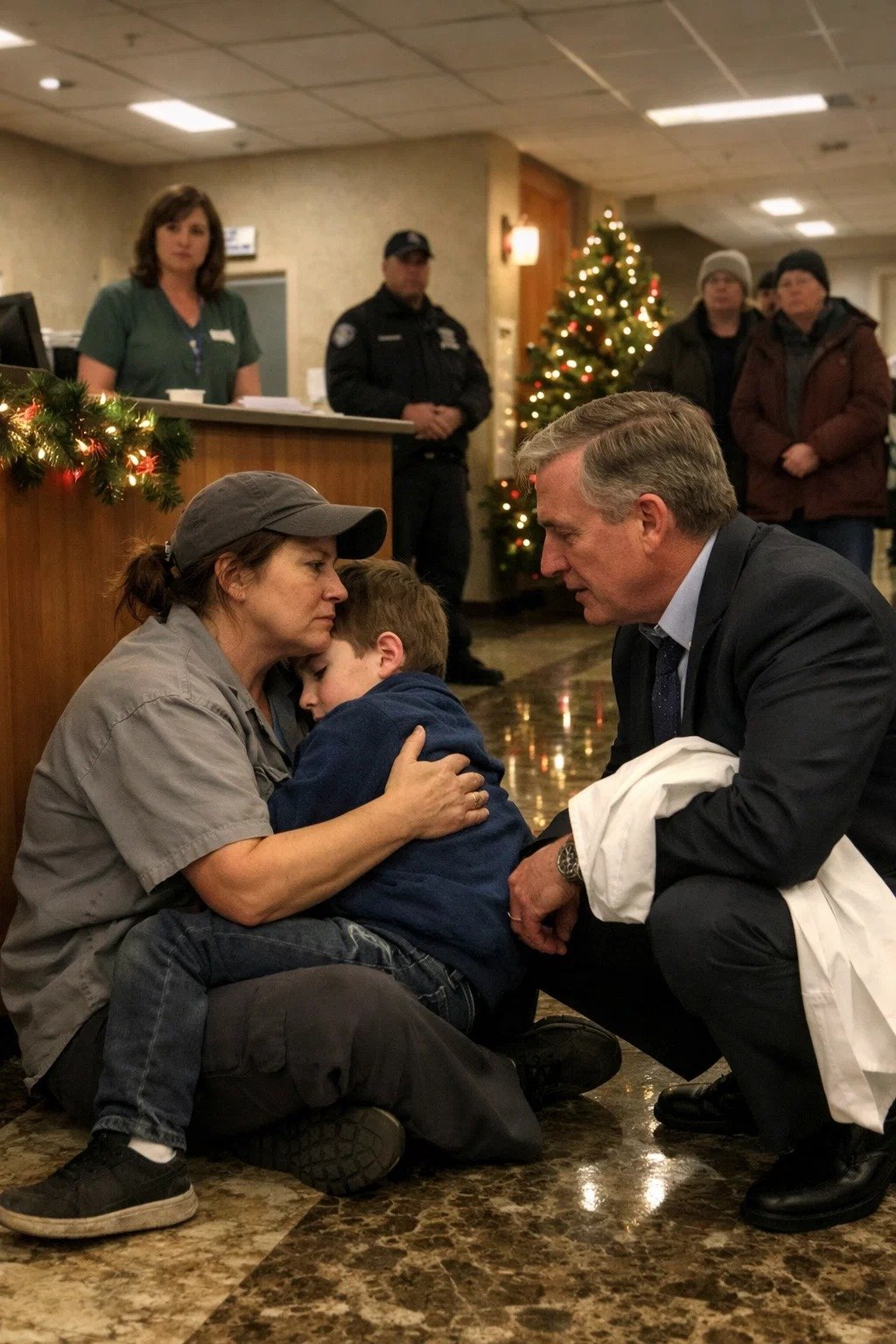
The woman’s knees buckled. She dropped to the floor, shielding the boy with her body as if the building itself might harm him.
“I clean here,” she said, voice cracking. “Every night. I scrub the hallways. Please. His name is Leo. He’s all I have.”
A security guard stepped forward, uncertain, glancing around for guidance.
And then a voice cut through the lobby—calm, precise, impossible to ignore.
“Move.”
Dr. Samuel Reinhart had just stepped off the elevator from the surgical wing, his white coat folded over his arm, his tie loosened after a procedure that had lasted longer than planned. He was a man people recognized instantly, even outside operating rooms. Tall, composed, silver beginning to line his dark hair, success written into every careful movement. He had built a reputation not only on skill, but on control.
But the moment his eyes fell on the child, something in that control fractured.
He crossed the lobby in long strides and knelt directly on the wet marble beside the woman, ignoring the water seeping into his suit. He placed two fingers on the boy’s neck, his expression tightening.
“Call pediatrics,” he said sharply. “Prep an operating room now.”
The security guard hesitated. “Doctor, she doesn’t have—”
“Take your hands off her,” Samuel said without raising his voice. The authority in it made the guard step back immediately.
The hospital administrator, a man named Collins who usually smiled through crises, rushed over, face tense. “Dr. Reinhart, this isn’t how admissions work. The liability alone—”
Samuel stood slowly, his gaze unwavering. “I am assuming responsibility.”
“But the cost—”
“I’ll cover it,” Samuel replied. “Every cent.”
The lobby went silent.
The woman looked up at him, disbelief flooding her exhausted face. “Doctor,” she whispered, “I can work. I’ll clean. I’ll do anything.”
Samuel met her eyes, and for a moment, the world behind him disappeared.
“Stand up,” he said gently. “You don’t need to beg.”
Because he wasn’t seeing a stranger.
He was seeing himself.
The boy’s face—feverish, fragile—was painfully familiar. And the woman’s eyes, burning with fear and resolve, carried the same look his mother had worn decades ago on a night he had tried to forget.
Samuel hadn’t been born into privilege. His childhood had unfolded in a narrow apartment above a laundromat in a neighborhood people crossed the street to avoid. His father, Elias, worked maintenance jobs until his back gave out. His mother, Rosa, cleaned offices at night, leaving meals wrapped in towels on the counter for Samuel when she got home too late to eat with him.
“There’s no shame in working hard,” she used to tell him. “Only in forgetting who you are.”
When Samuel was thirteen, a drunk driver ran a red light and shattered everything. The man responsible had money. Lawyers. Connections. Elias died. The case disappeared. Rosa aged overnight.
Samuel learned early that the world didn’t care how honest you were if you couldn’t afford to be heard.
He studied with desperation, earned scholarships, clawed his way through medical school. When success finally came, it came wrapped in distance. He moved away. Changed how he spoke about his past. Let people assume he’d always belonged where he was.
Rosa died before she ever saw his name on a hospital wing.
And that regret never left him.
Back in the present, Samuel lifted the boy into his arms and walked toward the surgical wing without waiting for permission. The woman—her name, he learned quickly, was Elena Morales—followed, shaking, whispering prayers into the air.
The surgery lasted nearly five hours.
In the waiting area, Elena sat rigidly on the edge of a chair too nice for someone like her, clutching the envelope of money like it was a lifeline. Nurses passed, offering water, quiet words. She barely heard them.
At 3:12 a.m., the doors opened.
Samuel emerged, exhaustion etched into his face, but his eyes were clear.
“He’s stable,” he said softly. “We caught it in time.”
Elena’s breath left her in a sound halfway between a sob and a laugh. She stood too quickly, swaying, then reached for Samuel’s hand, pressing the envelope against his palm.
“Please,” she said. “Take it.”
Samuel gently closed her fingers back around it. “Keep it,” he said. “You’ll need it more than I do.”
The days that followed unraveled faster than anyone expected.
A visitor’s video of the lobby confrontation spread online. The story of the wealthy surgeon kneeling on the floor went viral. Reporters dug. Questions were asked.
And Samuel, for the first time, didn’t hide.
At a press conference held a week later, he stood not in front of awards or donor plaques, but beside a simple bronze sign newly installed near the entrance. It bore two names: Elias and Rosa Reinhart.
“I spent years believing success meant distance,” Samuel told the cameras. “I was wrong. It means responsibility.”
He announced the creation of a foundation that would guarantee emergency care for families regardless of income, funded by his own shares in the hospital.
His first appointment to the board?
Elena Morales.
She protested, stunned. “I don’t belong in rooms like that.”
Samuel smiled. “You belong exactly where decisions are made.”
Leo recovered slowly, stubbornly, the way children do when given a real chance. Samuel visited often, not as a benefactor, but as a quiet presence. Years later, Leo would tell people he wanted to become a doctor—not because of money, but because someone once saw his life as priceless.
On Christmas morning, snow finally replaced rain. Elena and Leo walked past the hospital lobby, no longer invisible, their reflections clear in the glass.
Some acts of kindness don’t just save a life.
They return one.