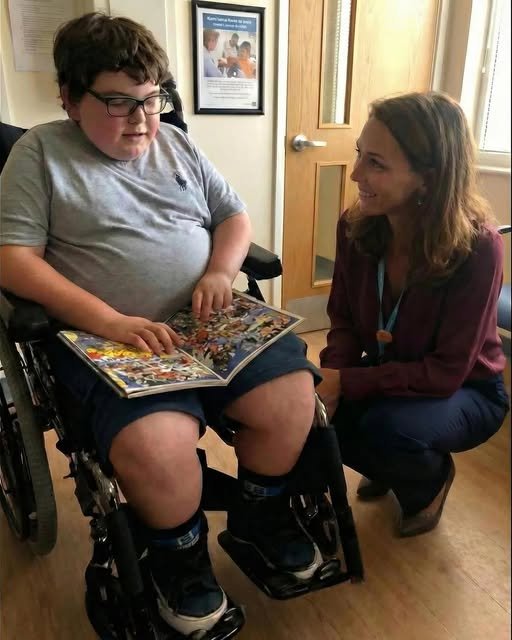
I’ve been teaching English for years, but on my first week at a new K–8 school, something caught my attention that I couldn’t ignore. It wasn’t loud or obvious—no shouting, no bullying, no dramatic conflict. It was quieter than that. One student, Eli, seemed to vanish in plain sight. He used a wheelchair and arrived early each morning, rolling to the same spot near the wall, opening his notebook, and sitting so still it was like he was trying to take up as little space as possible. During group activities, classmates naturally paired off without looking his way, not because they were cruel, but because they were used to overlooking him. The moment I realized it wasn’t just a “shy kid” situation was the day I found him eating lunch alone in a library hallway, pretending to read a comic book while staring at the same page for far too long.
When I sat beside him and asked what the comic was about, his voice changed. Under the quiet surface was a thoughtful, funny child with ideas that deserved space in the room. The next morning, I spoke with the school counselor to better understand what was happening. I learned Eli had lost his mother when he was young, and his father worked long hours just to keep life steady. Eli had also missed school during medical treatments, which made friendships harder to build and easier to lose. The counselor said something that stuck with me like a pin: “You can’t file a report for being treated like air.” That was exactly it—Eli wasn’t being bullied, but he also wasn’t being included. And I knew if I didn’t do something carefully, that silence would become his normal forever.
I didn’t want to embarrass him by making him the center of attention, so instead I built a lesson around the idea of being unseen. I introduced a short story about a character who helps everyone but is rarely acknowledged, and I asked the class to describe what that kind of loneliness feels like over time. Then I handed out anonymous scenario cards—small moments of exclusion that weren’t “mean,” but still hurt. I asked two questions: what that child might feel when they go home at night, and what they would want others to do if that child were their brother or sister. The room got unusually quiet, the kind of quiet that means students are actually thinking. Before class ended, I passed out index cards and asked them to finish one sentence: “I will make room by…” No names, no pressure—just a promise to themselves. As Eli rolled past my desk, he paused for half a second and whispered, “Good lesson.” And for the first time, I saw a real smile cross his face.
The next day, I saw that lesson turn into action. On the playground, a group of students called Eli over to join their game, and without being told, they adjusted the rules so he could play comfortably. It wasn’t forced or performative—it looked natural, like something that should’ve been happening all along. Eli laughed out loud, the kind of laugh that comes from feeling safe. That evening, I received a short message from his father thanking me for whatever had helped Eli feel included again. I know one lesson doesn’t erase loneliness overnight, and there will still be hard days. But that week, a child who had been living on the edge of every room finally stepped into the center of connection—and it reminded me that real inclusion doesn’t start with grand speeches. Sometimes, it starts when someone finally decides to see what’s been right in front of them all along.