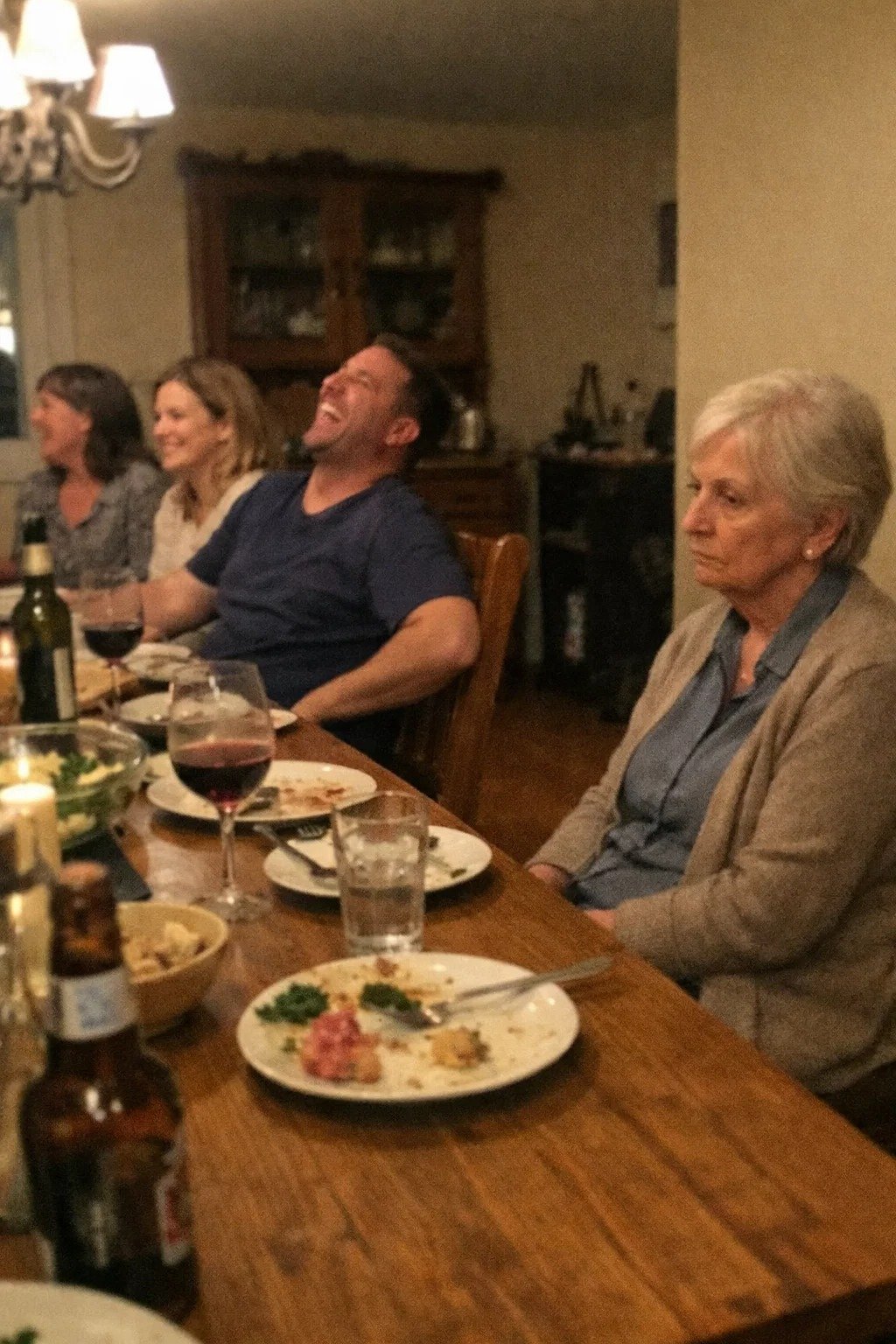
“If you disappeared tomorrow, no one would miss you,” my son said, and the table erupted in laughter, the kind that pretends to be lighthearted but carries the sharpness of something rehearsed, something long overdue.
The words didn’t land like an insult at first; they landed like confirmation, like a door finally closing on a room I’d been standing in alone for years, and as the sound of forks clinking and wine being poured filled the space that should have held silence, I realized that this was not a joke that slipped out, but a belief that had been living comfortably in their minds for a long time.
I smiled, not because it was funny, but because the decision had already formed somewhere deep inside me, solid and irreversible.
That was the night I chose to disappear.
Three days later, my phone would vibrate itself off the nightstand with missed calls, voice messages, and panicked texts, but by then the locks would be changed, the accounts would be sealed, and I would be watching their carefully constructed lives wobble under the weight of reality from a place they could never reach.
My name is Eleanor Price, and I am seventy-one years old.
For nearly five decades, I worked in commercial development across the Midwest, starting as a junior estimator in an era when women were expected to bring coffee, not blueprints, and ending as the majority shareholder of a private firm that specialized in infrastructure projects so unglamorous yet essential that entire cities depended on them without ever knowing my name.
I built things meant to outlast me.
I just never expected my greatest miscalculation would be my own child.
The dinner took place in a sprawling home outside Evanston, Illinois, a house with high ceilings, imported stone floors, and a sweeping staircase that made guests feel important the moment they stepped inside, and every inch of it, from the foundation to the custom lighting, had been paid for by me.
My son Aaron sat across from me, relaxed, confident, his posture shaped by a life that had never truly tested him, while his wife Juliet adjusted the placement of the centerpiece, more concerned with how it looked through her phone camera than with the people seated around it.
They spoke easily about plans, vacations, upgrades, and opportunities, never once acknowledging the invisible hand that funded every word.
When the conversation turned to “legacy,” Aaron leaned back, lifted his glass, and said it casually, almost lazily.
“If Mom disappeared tomorrow, nothing would change.”
A pause. Then laughter. Juliet laughed first. Then her friends.
Then Aaron again, louder this time, pleased with himself.
No one noticed that I set my fork down carefully, that I folded my napkin with the same precision I once used to sign contracts worth millions, or that I stood without a word, collected my coat, and walked out into the cold night without looking back.
They assumed I would return. They always did.
What they didn’t know was that I had spent my entire career preparing for worst-case scenarios, and love, I had learned too late, was no protection against betrayal.
The hotel room overlooked Lake Michigan, its dark surface reflecting nothing but wind and distant city lights, and as I sat there with a glass of wine I hadn’t denied myself, I made a single phone call.
“Proceed,” I said.
That was all it took.
By morning, the illusion cracked.
Aaron’s credit cards declined first, followed by the account he used to pay the mortgage, then the corporate card tied to his “executive” role, a role he believed he earned rather than inherited.
Juliet discovered the shift publicly, in a boutique she frequented often enough that the staff knew her name but not her balance, and the embarrassment of standing at the counter while a purchase was quietly refused did more damage than any argument ever could.
Aaron called me before noon. I didn’t answer.
He called again, then again, his confidence draining with each unanswered ring, until the messages shifted from irritation to confusion, and finally to something dangerously close to fear.
By the end of the day, he learned the truth the way most people do when privilege expires: abruptly, and without apology.
The company he worked for placed him on immediate leave pending an internal review, not because I requested it, but because my silent withdrawal as a shareholder exposed the reality of his performance, or rather, the lack of it, once my protection vanished.
When he finally stood in my hotel room days later, uninvited and unannounced, he looked smaller, not physically, but in a way that stripped him of the authority he once wore like a costume.
“You did this to punish me,” he said, voice tight.
I looked at him calmly.
“No,” I replied. “I did this because you told me my absence wouldn’t matter.”
Juliet cried. Aaron argued.
They accused me of cruelty, manipulation, abandonment.
I listened. Then I spoke.
“I spent my life making sure you never felt the weight of consequence,” I said evenly. “And in doing so, I robbed you of the chance to become someone capable of standing without me. This isn’t revenge. This is correction.”
They left without reconciliation.
Months passed. The house was sold. The lifestyle dissolved.
Aaron took a job he never would have considered before, one that required punctuality, humility, and accountability, and while it broke him at first, it also reshaped him.
Juliet left when the comfort disappeared.
I heard about it through mutual acquaintances.
I wished her no harm.
Only distance.
As for me, I returned to a quieter life, one filled with mornings that belonged to me and evenings unburdened by obligation disguised as love, and while my son eventually reached out again, his voice softer this time, less entitled, more human, I understood that reconciliation, like construction, requires a stable foundation.
Some structures collapse.
Others are rebuilt.
And some, finally, are left behind.
I didn’t disappear after all.
I simply stopped being invisible.