On a warm April morning in 2016, sunlight slid through the thin curtains of a small brick house on the edge of Sandrock, Alabama, and fell across a kitchen table cluttered with mail.
On top of a pile of coupons and utility bills lay a folded copy of the Northeastern Alabama Gazette.
MARIAH FINCH, twenty-nine years old and hollow-eyed from another restless night, almost didn’t notice it at first. She shuffled toward the coffee pot, hair twisted into a careless knot, the faded T-shirt hanging from her shoulders. Her phone buzzed with another message she ignored.
Her neighbor, Mrs. Caldwell, had slipped the paper through the screen door just after dawn and knocked twice. By the time Mariah opened the door, the older woman was already halfway down the walkway.
“There’s something in there you need to see, baby,” she called over her shoulder. “I’m so sorry.”
Now, in the kitchen’s dim light, the phrase echoed in Mariah’s head as she poured coffee and stared at the newspaper like it might bite.
She reached out, fingers trembling, and pulled it closer.
The headline hit her like a slap.
MINISTER’S ROBE AND BAG DISCOVERED IN CAVE AFTER 28 YEARS
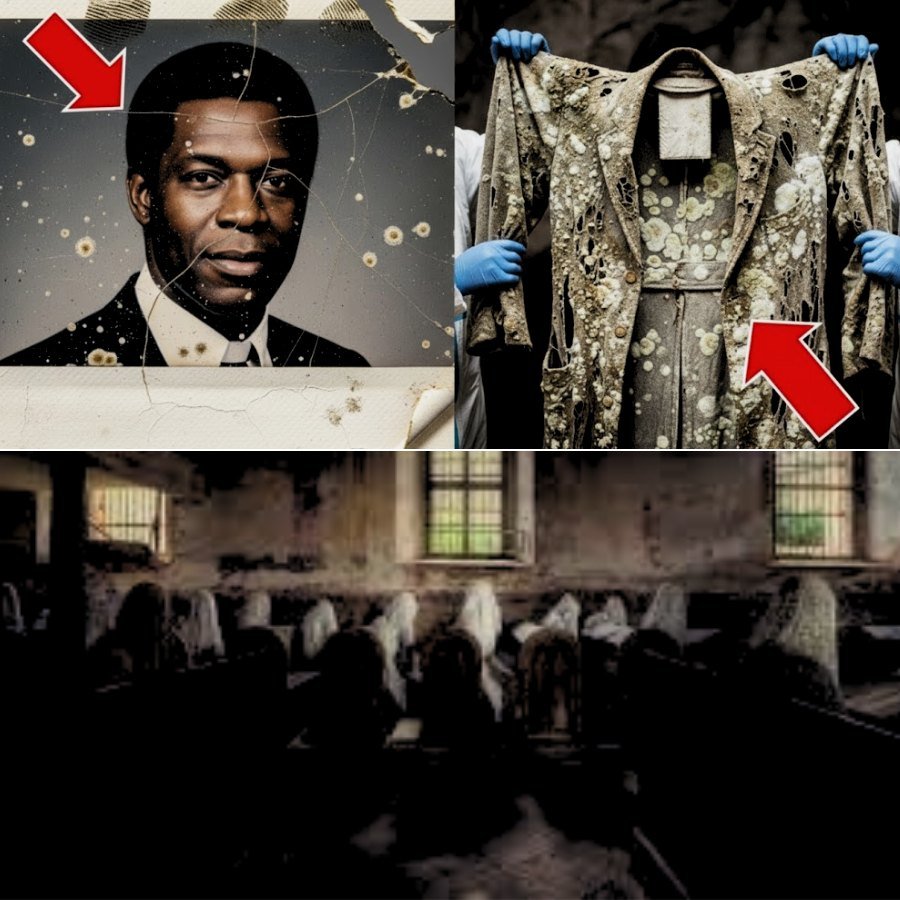
There was a picture beneath the headline—grainy, but clear enough. A long dark robe, mottled and stained, lay spread across a white evidence table. Beside it, a battered leather satchel with a broken strap. A smaller photo showed a cassette recorder, its little red light glowing.
Her father’s robe.
Her father’s bag.
Her father’s recorder.
The mug slipped from her fingers and shattered on the linoleum. Hot coffee splashed across her bare feet, but she barely flinched.
For a moment, the world narrowed to the rectangle of newsprint in front of her. The hum of the refrigerator grew loud, the ticking clock thundered in her ears. Her chest tightened until she couldn’t draw breath.
She lifted the paper with both hands, bringing it closer. In her mind, the images didn’t stay still. They bled and shifted, dissolving into an older picture—one that started on another morning, in another June, half a lifetime ago.
The day her father walked into Hollow Rock Cave and never came out.
June 12, 1988 had begun like any other Sunday, with sunlight pooling over red clay roads and a damp hush clinging to the pine trees that ringed the town.
At New Dawn Baptist Church—a simple white-clapboard building perched on a low hill—the parking lot filled with trucks and old sedans. Women in pressed dresses and hats moved up the steps in a soft rustle of fabric. Men in suits nodded to one another and held the door.
Inside, the sanctuary smelled of lemon oil and old hymnals. Wooden pews gleamed under the glow of oil lamps, and the stained glass window behind the pulpit threw colored fragments across the floor: blue, green, and crimson shards of light scattered over polished wood.
Four-year-old Mariah held tight to her mother’s hand, small fingers buried in Evelyn Finch’s palm. The church always felt too big to her, ceilings too high, the choir loft looming like a wooden cliff. Still, she loved the music. She loved watching her father.
He was the reason the pews were full.
At thirty-five, PASTOR ALISTAIR FINCH carried himself with a quiet authority that made people sit up straighter when he entered a room. He was tall and lean, with dark skin and a narrow face softened by a ready, gentle smile. His eyes, though, were intense—deep brown, quick to crinkle with laughter, but equally quick to harden when he spoke of injustice.
He stood in his office that morning buttoning the cuffs of his charcoal-gray suit, the fabric hanging perfectly over the breadth of his shoulders. His black leather satchel rested on the chair beside him, half unzipped. Inside lay his well-worn Bible, sermon notes clipped neatly together, and—nestled in the corner—a handheld PA recorder he always used to capture his sermons.
His fingers hovered over it for a beat, as if debating whether to bring it.
“You’re going to be late, Al,” Evelyn warned from the doorway, smoothing her choir robe. The corners of her mouth quirked. “You do remember you’re the one everyone’s here to see.”
He smiled over his shoulder, that warm flashing grin that had once made her forget her lines at choir practice. “I remember.” He grabbed the satchel, then scooped up the recorder. “And I remember you insisted we keep a record of every word in case history needs receipts.”
Evelyn rolled her eyes, though pride glowed beneath her exasperation. “Just don’t forget to turn it off this time. I don’t need three hours of you talking about potluck logistics captured for all eternity.”
“If the Lord sees fit to preserve my chili recipe, who am I to argue?” he teased.
She swatted his arm, laughing, and some of the tightness in her chest eased—for a moment.
Out in the sanctuary, music rose. The choir hummed a warm-up hymn, notes floating up into the rafters. As people filed in, conversations swelled and then dropped to a hush when the first chord rang from the piano.
Evelyn took her place in the choir loft, smoothing her sheet music with practiced hands. From there, she could see everything: the front row where the older deacons sat stiffly, the middle pews full of young families, the back row where teenagers leaned close and whispered into each other’s shoulders.
And at the far left aisle, dressed in a ruffled yellow dress and clutching a cloth doll, Mariah stared up at the pulpit like it was a stage and her father the only performer that mattered.
The service moved in familiar rhythm. An opening hymn (“Blessed Assurance” this Sunday), then announcements, then a second hymn. Voices joined, rising and falling like waves, filling the small sanctuary with sound.
By the time Alistair stepped up to the pulpit, the air inside the church felt charged.
He laid his satchel by the base of the podium, set the PA recorder on top, and pressed the red button. The cassette wheels spun to life with a quiet whir.
“Good morning, church,” he began, and his voice rolled out rich and steady, filling every corner of the room.
“Good morning, Pastor,” the congregation echoed.
Mariah perched on the edge of her seat, legs swinging, eyes bright. Evelyn watched from above, heart swelling and aching all at once. There was something different in him these past months—an urgency beneath his sermons, a restless energy that made his words sharper.
Today, that urgency burned.
He opened his Bible and read a passage about shepherds who abandon their flock, about wolves that creep into the fold. When he lifted his gaze, his eyes swept the room slowly, lingering a heartbeat too long on the row of deacons near the front: Deacon Samuel Wright, gray hair slicked back, jaw clenched. Deacon Jeremiah Tucker, hands folded so tightly his knuckles went pale.
“We have children in this town who did not make it home,” Alistair said, voice threading through the stillness. “We have mothers who lay awake wondering if they did something wrong, if they should have walked their baby to the bus stop, if they should’ve driven instead of letting them walk.”
A murmur rippled across the pews. Some heads bowed; others stiffened.
“We call them accidents,” he went on. “We say ‘the Lord took them.’ We accept cause-of-death boxes checked by hands that never met those babies. But I’m telling you this morning—some of what we call accident is neglect. Some of what we call fate is evil wearing the mask of bureaucracy.”
Evelyn’s fingers tightened around her hymnal. She’d heard pieces of this in the kitchen at night, when he thought she was asleep—his frustration with the coroner’s office, the inconsistencies in reports. She knew he’d been visiting families who’d lost children. She knew he’d started making notes, timelines, lists.
She also knew he had enemies.
“Faith,” he said now, his voice rising, “is not pretending everything is fine. Faith is picking up a flashlight and walking into dark places. It is calling things by their rightful names. It is protecting the least among us—especially when doing so makes people uncomfortable.”
He paused. The room held its breath.
“At some point,” he added softly, “we must decide whose comfort matters more: the powerful… or the innocent.”
From her seat near the back, an elderly woman whispered, “Preach, Pastor.” A few heads nodded. Others stared straight ahead, jaws set.
On the front pew, Deacon Wright shifted in his seat. Tucker glanced at him, then at the floor.
The sermon built to a fever pitch, weaving scripture and stories and quiet, cutting questions that left people staring at their hands. Alistair spoke of hidden sin, of systems that afforded some families justice and others a shrug. He did not name names, but they could all feel the pointed shapes of his words.
When he finished, sweat beaded along his hairline. He closed his Bible with a soft thump and bowed his head.
“Let us pray.”
The prayer was short, focused, almost fierce—a plea for courage, for clarity, for protection. When he lifted his head again, his eyes found Evelyn in the choir loft. For a heartbeat, they simply looked at each other.
Then he smiled. A small, tired thing she felt more than saw.
The final hymn rose—“Amazing Grace”—and the congregation sang, some with wet cheeks, some with blank faces. Once, years later, Mariah would hear a scratchy tape of that closing song and swallow a sob at the sound of her own tiny voice somewhere in the mix.
At the time, it just felt like any other Sunday.
After the benediction, people lined up down the center aisle to shake Alistair’s hand. He greeted each one with the same warmth—calling them by name, asking after sick relatives, crouching to ruffle the hair of children. His leather satchel hung from one shoulder, heavy with Bible and notes.
“You stirred things up, Pastor,” murmured a farmer named Robins, cap in hand. “But… maybe they needed stirring.”
“Truth comes before peace,” Alistair replied quietly. “Sometimes that’s the only way to find the real kind of peace.”
A few people avoided his eyes altogether as they passed, muttering perfunctory thanks. Deacon Wright’s grip on his hand was brief and clammy. Tucker’s gaze skittered away, landing somewhere near Alistair’s shoes.
Evelyn watched, unease coiling low in her stomach.
At last, the crowd thinned. Mariah burst through, doll waving above her head.
“Daddy, you yelled,” she reported solemnly. “Miss Lila jumped.”
He laughed and lifted her easily, pressing a kiss to her cheek. “Sometimes when people are asleep, baby, you gotta raise your voice.”
“Are we going home now?” she asked, wrapping her arms around his neck.
“In a little while.” He set her down gently. “Daddy has to go pray first.”
“You can pray here,” she pointed out, as if she’d caught him in a clever trick.
“Not the way I need to,” he said softly.
Evelyn came up beside them, tucking a curl behind Mariah’s ear. “Hollow Rock?” she asked.
He nodded.
“I don’t like there,” Mariah whispered, grabbing at the hem of his robe. “It’s dark.”
“I know.” He crouched to her level, expression serious. “That’s why I go. To ask God what to do about dark places.”
She bit her lip. “Can I come?”
“Not this time.” He hesitated, then pulled a small handkerchief from his pocket—white with a little blue flower embroidered in one corner, stitches slightly crooked where Mariah had tried to mimic her mother’s sewing. “But you let Mama give this a good wash, and the next time I go somewhere pretty, you can come and wave this at me so I can find you in the crowd.”
She nodded solemnly. “Okay.”
He slipped the handkerchief into his satchel, kissed Evelyn’s forehead, and stepped out into the bright Alabama sun.
He never remembered to turn off the recorder.
The path to Hollow Rock Cave snaked through scrub and pine, down a slope where honeysuckle clung to sagging fence wire. Alistair walked it alone, the hem of his custom robe brushing dry grass, satchel bumping against his hip.
The mouth of the cave yawned from a limestone outcrop, jagged edges framing darkness. Locals said it looked like a giant skull half-buried in the hill. To Alistair, it had always looked like an accusation.
He paused at the threshold, the air shifting from sticky heat to cool damp as he stepped into shadow. The silence inside was a different kind of quiet than the one in the church—thick, pressing, broken only by distant drips.
He pulled a flashlight from his bag and thumbed it on. A yellow beam sliced through the gloom, catching dust motes in its path. The cave walls glistened with moisture, pale rock fluted and smoothed by centuries of water.
Near the entrance, on a flat slab of stone, he set the PA recorder. The red light blinked steadily, the tape rolling, capturing the soft scrape of his boots and the rustle of his robe.
“Lord,” he murmured, voice low in the cavern. “If this is foolishness, stop me. If this is courage, stay with me.”
He started forward.
The passage sloped gently downward, twisting like a buried road. He’d walked this route many times in the past, using the cave as a place of solitude, a place where his thoughts could unspool without interruption. Today, there was no peace in it.
Today, he was looking for something.
A week earlier, a mother named Denise Carter had pressed a shaking hand into his and whispered, “They said he slipped. They said he drowned. But his shoes were clean, Pastor. Clean. How does a boy drown in mud and come home with clean shoes?”
Two months before that, a family on the far side of town had buried a nine-year-old after what the coroner called “a tragic fall in unstable terrain.” No autopsy. No investigation.
In his study at the parsonage, Alistair had laid the clippings and reports side by side. Dates. Locations. Details that didn’t quite fit. And in the margins of his notebook, his pen had traced words he didn’t want to write.
Patterns.
Ritual.
Sites.
He’d circled the date June 12, 1988—today—with a red pen and written two words beside it: Hollow Rock.
The flashlight beam glanced off the walls as he walked, revealing ripples and pockets, shadows that seemed to flinch back from the light. The air grew colder the deeper he went.
At a narrow bend, the beam caught something that made him slow.
Dark streaks smeared across pale limestone, not quite black, not quite brown.
He stepped closer, breath shallow, and reached out with gloved fingertips. The substance was dry but had once been thick and wet. It flared across the rock in arcs and lines that looked, to him, disturbingly like someone had dragged their fingers there, painting on stone.
He rubbed thumb against forefinger. His stomach knotted.
Not paint.
He straightened, scanning the wall. The smears weren’t random. They arced and branched, forming shapes he couldn’t quite name, though something deep in him recoiled from them instinctively.
“God,” he whispered, anger rising through the fear now. “If there’s something here… show me. Or give me the sense to run.”
He pulled a coil of rope from his satchel and looped it around his chest, tying a simple harness. From another pocket, he produced a small trowel and a folded map—hand-drawn sketches of the cave’s known passages, annotated with his own observations and scraps of rumor.
He moved forward again, shoes scuffing on damp stone. The flashlight flickered once, then steadied. His breath echoed, his heart audible in his ears.
Somewhere ahead, there was a soft sound. A scuff, like someone shifting their weight.
He froze, listening.
“Hello?” he called. His voice bounced off the walls, returning in thin, distorted fragments.
No answer.
He took another step. The sound came again, closer this time. Not the uneven shuffle of an animal. Human.
He held the light higher, sweeping it across a junction where the passage split: one tunnel curving left into tighter space, the other opening into a lower, wider corridor. On the wall near the fork, faint scratches marred the stone—vertical lines crossing horizontal ones, like tallies or a crude crosshatch.
His flashlight flickered again, more sharply. He thumped it with his palm.
“Not now,” he muttered. “Not now.”
The beam sputtered—and died.
Darkness fell like a dropped curtain. It was absolute, swallowing even the vague outlines he’d grown used to. For a moment, panic flared in his chest. He sucked in a breath and forced it out slowly.
“Yea, though I walk through the valley,” he whispered into the darkness, the words of Psalm 23 steady on his tongue, “of the shadow of death, I will fear no evil…”
He fumbled in the satchel, fingers brushing spare batteries, the cool metal of the recorder’s empty case, the crackle of paper.
Behind him, very close, something breathed.
Hot air tickled the back of his neck.
He whipped around, but there was nothing to see. Nothing but the press of black.
His hand found the rope again and gripped it. His other hand curled around the familiar worn leather of his Bible.
“…for Thou art with me,” he finished, though his voice shook now. “Thy rod and Thy staff, they comfort me…”
The breathing came again, from his left this time. A faint scrape of shoes. Rustle of fabric. More than one person.
He swallowed.
“They know I saw them,” he said into the darkness, not sure if he was speaking to God or to some unseen witness. “Help me.”
Those were the last words the PA recorder captured. His voice, taut with fear, echoing down the tunnel until it faded into the hiss of tape.
Up on the hill, in the bright June sun, the red recording light blinked on and on, unnoticed.
They noticed his absence in pieces.
At first, it was just time—minutes stretching into an hour.
Evelyn cleaned up after service, stacked hymnals, oversaw a brief choir meeting. Mariah played with other children in the field behind the church, her yellow dress streaked with dust.
“Where’s Pastor?” one of the choir ladies asked as they wrapped up.
“Praying,” Evelyn answered, trying for lightness. “You know him. Once he starts talking to the Lord, he loses track of time.”
But by late afternoon, the easy jokes felt strained.
She drove home, expecting to see his car out front and him inside, sleeves rolled up, rolling dough for biscuits or humming to himself as he scribbled new sermon notes. The house was empty. The bed still half-unmade from where he’d sat to put on his shoes.
His Bible wasn’t on the nightstand.
A little voice in the back of her mind whispered, Check his office. Check the church.
She called the church. No answer.
She drove back, heart knocking against her ribs, Mariah quiet in the backseat, sensing something was wrong. The sanctuary was locked. His office light was off.
On the way home, her eyes flicked to the path that led to Hollow Rock Cave.
The knot in her stomach tightened.
By the time the sun started to drop, she knew he wasn’t just “running late.”
She called a deacon. Then another. Within an hour, cars were pulling up in front of the church, doors slamming, voices rising in confusion.
“Maybe his car broke down,” someone offered.
“He would’ve called,” Evelyn snapped, fear sharpening her voice.
Mariah hovered at her side, clutching her doll so tightly its stitched smile pulled crooked.
They found his car parked near the trailhead, keys gone, driver’s door locked. His Bible was nowhere in sight.
When the sheriff’s deputy arrived, his cruiser kicking up dust, the world of Sandrock shifted on its axis.
The search began that night, under floodlights strung between trees and the frantic beam of flashlights bobbing through the undergrowth. Volunteers from nearby farms, retired miners familiar with underground work, and congregants still dressed in Sunday clothes all converged at the cave entrance.
The new deputy, MARCUS CALDWELL, twenty-eight and fresh from a larger county downstate, tried to impose order on the chaos.
“Okay, listen up,” he shouted over the clamor, clipboard in hand. “No one goes in alone. You don’t separate from your partner for any reason. We tag every branch we search, we mark everything we disturb. We are not losing anyone else down there, you hear me?”
They heard him. Whether they listened was another matter.
The first teams went down on ropes, lanterns swinging from their belts. The cave swallowed them one by one, the glow of their lights shrinking until it was just a faint flicker in the dark.
Evelyn stood behind the hastily strung yellow tape, arms wrapped around herself, body aching to bolt after them.
“Let them do their job, honey,” an older woman murmured, pressing a paper cup of coffee into her hand.
“My husband is their job,” Evelyn shot back, voice cracking.
Near her, Mariah pressed her face into Evelyn’s hip, eyes fixed on the hole in the rock where her father had disappeared.
“Is Daddy hiding?” she asked.
Evelyn opened her mouth to lie, then closed it again. “He’s… lost,” she whispered instead. “They’re looking for him.”
Hours passed. Volunteers came back up, faces gray with dust, eyes wide.
“Passages are collapsing,” one reported to Caldwell, stripping off a hard hat. “Loose rock everywhere. It’s like somebody took a hammer to the supports.”
“Natural erosion?” Caldwell asked.
The miner snorted. “Rock doesn’t fall in neat walls like that on its own. Those collapses look… built.”
The word lodged in Caldwell’s mind like a splinter.
Behind them, someone muttered about voices in the dark, about shapes glimpsed in flickering lamp light. A teenage boy swore he’d seen people in robes moving among the trees at dawn, “like ghosts or something.”
Most dismissed it as nerves. Others crossed themselves, lips moving silently.
By sunrise the next day, they had mapped and searched every accessible passage and found nothing—no robe, no satchel, no trace of Pastor Finch.
Cave engineers were called in, blueprints unrolled across the hood of a sheriff’s cruiser. They pointed at collapsed side shafts, blocked tunnels.
“See here?” one said, tapping an area marked as an old passage. “This shouldn’t be sealed. And this rockfall? Those edges are too clean. Somebody braced and dropped those intentionally.”
Caldwell felt a chill creep up his spine. “Intentionally for what? To trap someone? Or to hide something?”
The engineer didn’t answer.
Behind them, two deacons stood shoulder to shoulder watching the scene. Wright, stiff and pale. Tucker, face unreadable.
“Maybe the Lord took him,” someone said later in the fellowship hall, voice hushed.
“Maybe the Lord had help,” someone else replied, and the room fell silent.
Time washed over the town in numbing waves.
Days became weeks. The search efforts shrank: fewer volunteers, shorter shifts, less equipment. The national news trucks that had come in the first week rolled slowly back out, attention drifting to the next tragedy, the next mystery.
In Sandrock, life tried to resume—but nothing fit quite the same.
On Wednesdays, choir practice limped along with fewer members. Evelyn kept coming, kept directing, even when her hands shook turning pages. She sang the alto harmony like it was a thin rope she could cling to.
Sometimes, in the quiet between hymns, she would glance at the pulpit and imagining his outline there, just for a heartbeat. The image always vanished before she could latch onto it.
At home, she left his Bible on the nightstand, spine cracked open to Psalms. Mariah started wrapping herself in the hem of his spare robe when she slept, burying her face in the folds to inhale the fading trace of his aftershave.
Around town, whispers coiled like smoke.
About the cave. About chants heard on cloudy nights. About children gone too soon. About men in positions of trust whose eyes darted too quickly away when the pastor’s name was mentioned.
And somewhere, behind locked doors, other conversations took place.
In a dilapidated barn at the edge of a soybean field, three men met under the flicker of a single bare bulb that summer.
Samuel Wright. Jeremiah Tucker. And DR. LOL HAYES, the county coroner.
Blueprints of Hollow Rock Cave lay across a makeshift table, corners held down by bricks. A cheap cigarette smoldered in a glass ashtray, its smoke curling lazily up toward the rafters.
“You should have never let him get hold of those files,” Tucker hissed, jabbing a finger at Hayes.
“I told you I didn’t,” Hayes snapped back, eyes darting. “He was just… nosy. Asked too many questions. You can’t keep people from thinking.”
“You can keep them from finding things,” Wright said quietly. His voice was calm, but his hands gripped the edge of the table hard enough to whiten his knuckles. “Which is what you’re going to do from now on.”
Hayes stared at the map, at the heavy black X marking one particular side shaft.
“What about him?” he asked. His voice was small, barely audible over the hum of insects outside. “What if they find… anything?”
“They won’t,” Tucker said. “We’re making sure of that.”
They leaned over the map, tracing lines, planning collapses, signing the fate of passageways that had existed for centuries. They used words like “stabilization” and “public safety” on their paperwork.
Their real purpose had nothing to do with safety.
Twenty-eight years later, the ground made a different decision.
On an otherwise unremarkable April morning in 2016, a section of earth above one of the old sealed shafts caved in without warning. Trees leaned, roots exposed. A jagged circle of dirt and rock dropped several feet in a slow, grinding collapse.
A farmer spotted the fresh crater when he drove his ATV along the ridge and called the sheriff’s office, expecting talk of sinkholes and property damage.
The call eventually reached Auburn University, where DR. ROSCO JENKINS, a cave geologist with a clipped beard and a habit of narrating his observations under his breath, squinted at the photos and felt a twinge of curiosity.
Within twenty-four hours, he stood at the lip of the sinkhole, harness strapped tight around his waist, helmet light gleaming.
He lowered himself slowly, boots searching for purchase against jagged rock. Cameras from local news crews tracked his descent, lenses glinting in the morning light.
“This shaft lines up with old maps from the eighties,” he called up to the deputy holding his rope. “It’s been sealed for a long time.”
The air grew cooler as he dropped. The smell of disturbed earth mixed with something older—damp stone, mold, a faint metallic tang.
His boots hit solid ground at last. He adjusted his headlamp. The beam swept across rubble piles, then froze.
“Sheriff?” he shouted. “You’re gonna want to see this.”
He moved closer slowly, heart rate spiking even before his brain fully registered what his eyes saw.
On a raised slab of rock, arranged with deliberate care, lay a heavy robe. The fabric was dark with age, edges stiff, stained in irregular patches that looked disturbingly like old blood.
Beside it sat a leather satchel. Jenkins recognized the kind from his own days sitting in small town pews—preachers’ bags, worn soft in the places where hands always reached.
This one was torn, the strap frayed and looped awkwardly over a broken stone, as if it had been hooked there.
Next to the bag rested a recorder. A little church PA machine—the kind used to capture sermons.
A single red light blinked faintly on its front.
Jenkins’ breath hitched. “No way,” he whispered, more to himself than anyone.
He crouched carefully, taking photos from multiple angles. His gloved fingers hovered for several seconds before he finally reached out, gingerly lifting the robe’s edge. Underneath, something small and white peeked out—a handkerchief, embroidered with a tiny blue flower. The stitches were crooked, uneven. A child’s work.
He swallowed hard.
“Sheriff!” he called again, louder.
By the time he emerged from the sinkhole, cradling the sealed evidence bags in his arms like they might shatter, the crowd above had tripled.
Deputy Marcus Caldwell—no longer a rookie, his hair threaded now with gray—stepped forward to receive them, expression grim.
Jenkins handed over the bags one by one: the robe, the satchel, the recorder, the handkerchief tucked inside.
“This belongs in your cold case files,” he said.
Caldwell nodded. “It never really left.”
Back in the present, in her cramped kitchen, Mariah stared at the newspaper photos through a haze of memory and disbelief.
Her phone buzzed again. Unknown number.
She answered without taking her eyes off the page. “Hello?”
“Ms. Finch?” A man’s voice, careful and measured. “This is Detective Marcus Caldwell, Jackson County Sheriff’s Office. I’m sorry to call so early.”
She gripped the phone tighter. “You found my father’s things.”
He exhaled softly. “Yes, ma’am. We did. I’d like to talk with you about them. There’s… more we need to go over. Evidence that was, frankly, mishandled back then.”
“Mishandled,” she repeated, tasting the word. It felt like a bandage slapped over a bullet wound.
“I can explain better in person,” he said. “If you’re willing to come down to the courthouse today, I can meet you in the archives room.”
She almost said no. Almost hung up, crawled back into bed, and pretended the headline was just a bad dream.
Instead, she heard herself say, “I’ll be there.”
She hung up, looked back at the paper, and for the first time in years, felt something nudging aside the numbness that had settled over her grief.
It wasn’t hope.
It was anger.
The county courthouse’s archive room smelled like dust and old paper. Metal shelves lined the walls, heavy with boxes stamped with years and case numbers.
Mariah sat at one end of a scarred oak table, hands folded in her lap. Her hair was pulled back in a neat twist today, a nervous attempt at control. She wore a plain black blouse, the hem tucked into jeans. At her feet, the strap of her bag coiled like a snake.
Caldwell entered with a manila folder under his arm and a small box in his hands.
“Ms. Finch,” he greeted, offering a hand. “Thank you for coming.”
“Let’s skip to why you asked me to,” she replied. The bluntness surprised even her, but she didn’t soften it.
He nodded, accepting the tone without protest, and sat across from her. He opened the folder and slid a few photocopied images across the table—photos of evidence bags, labels marked with dates, chain-of-custody signatures.
“First, I want you to know that we’re reopening your father’s case in full,” he said. “Not as a missing person. As a likely homicide, tied to other crimes in this county.”
Her chest tightened. “You’re twenty-eight years late.”
“I know.” He glanced down, jaw clenching briefly. When he looked up again, his gaze was steady. “Some of that is on me. I was green back then, and I… trusted the people above me more than the evidence in front of my face.”
An apology rested in the hollow behind his words.
He reached for the small box and opened it. Inside lay three items she recognized instantly, even through the plastic: her father’s tiny pocket Bible, its spine battered; a spiral notebook with “SERMON NOTES” scrawled on the cover in his handwriting; and a cassette tape in a labeled case.
Her hand moved before her mind could catch up. She touched the edge of the notebook’s bag, fingertips tracing the curve of her father’s letters beneath.
“These were logged as closed evidence in ‘88,” Caldwell explained. “Filed in the wrong box, under an unrelated burglary case. I found them yesterday when we pulled everything connected to the cave.”
“Mistake?” she asked.
“Best case,” he said. “Worst case, somebody wanted them forgotten.”
He pushed the tape toward her.
“This is the recording from the day your father disappeared,” he said quietly. “We… we played it.”
She stared at the cassette. It was just plastic and magnetic tape, a cheap bit of technology. But it felt like a relic, a relic that might hold his voice, trapped from a day when her legs were still short and her world still whole.
“Can I hear it?” she whispered.
“Of course.” He reached into his bag and pulled out an old player, the kind schools used in classrooms long before smart boards and tablets. He clicked the tape into place and hit play.
For a few seconds, there was only static. Then the faint echo of a church organ drifted through, followed by layered voices singing a familiar hymn. Mariah closed her eyes, and the room spun back in time.
She heard her father’s voice next. Clear. Confident. Preaching the same sermon she had watched from the pew decades ago. For several minutes, Caldwell let it play—long enough for her to remember the cadence of his speech, the rise and fall, the way he paused after saying something that needed to sink in.
Then there was a clunk, a rustle, and different sounds: footfalls on stone, the crackle of fabric.
The atmosphere inside the little archive room shifted. It felt colder.
They listened as his breathing grew heavier, as the squeak of his shoes echoed.
Then his voice again, but different now—quieter, strained. Snatches of scripture. The clatter of something hitting rock. The tap of a flashlight against his palm.
Silence.
And then, at the very end, the line that had been echoing in Caldwell’s head since he first heard it.
“They know I saw them. Help me.”
There was a sharp exhale. A scrape. Then nothing but the soft spin of tape until it clicked off.
Mariah realized she was gripping the edge of the table so hard her fingers hurt. Her throat burned.
“Who’s ‘they’?” she managed. “Who did he see?”
“That’s what we’re trying to figure out,” Caldwell said. “And I think he started to answer that himself, before he went into the cave.”
He nodded toward the notebook.
“Your father was keeping track of something,” he went on. “Names. Dates. I’d like you to help me decipher his notes.”
She opened the evidence bag with shaking fingers, slid the notebook out, and flipped it open.
The pages inside were filled with his neat handwriting. At first, it was ordinary enough—verses, outlines, little arrows linking ideas. But several pages near the back were different.
Columns of names. Ages. Dates spanning the late seventies and early eighties.
Clara Robbins. March 12, 1979.
Jonathan Carter. October 5, 1981.
On and on.
Beside some names, her father had written words in the margins: “safe?” “crossroads,” “ceremony,” “ask Hayes,” “who signed?”
Some names were circled twice. Others were crossed out with violent strokes.
At the top of one page, he had written in red ink: “NOT FAITH—RITUAL.”
Mariah’s vision blurred.
“These are the kids,” she whispered. “The ones who… died.”
“Or were said to,” Caldwell said. He pulled another folder from his bag, thicker this time. “I had our clerk pull every file with those names. Death certificates, coroner reports, police incident notes.”
He fanned them out between them like a grim deck of cards.
“All signed by one man,” he said. “Dr. Lol Hayes, county coroner at the time.”
She scanned the forms. Line after line: “Accidental fall.” “Drowning.” “Unspecified trauma, case closed.”
“No autopsies?” she asked.
“Almost none.” His jaw tightened. “Which is unusual. Especially in cases involving minors and ambiguous circumstances.”
He flipped open a different document—property records.
“There’s more,” he added. “In 1987, two men set up a company called New Dawn Holdings and bought land around the cave. They filed permits to ‘stabilize’ Hollow Rock, hired outside engineers, and had a certain inspector sign off on work that was never fully documented.”
He tapped the names at the bottom of the deed.
“Samuel Wright and Jeremiah Tucker,” he said. “Church deacons.”
The room tilted slightly. Mariah sat back, as if a physical blow had struck her. She remembered Wright’s hand on her head when she was small, rough but gentle, blessing her. She remembered Tucker’s smile, his booming laughter.
All of it felt like a lie now.
“We’ve already spoken with the engineer listed on those permits,” Caldwell went on. “He says they were pushed to hurry the job, to block specific side passages instead of shoring up the dangerous ones. And a retired county inspector—Hannah Brooks—just swore out a statement that she was forced to sign off on work she never inspected.”
He tapped the notebook again.
“I think your father figured out the pattern,” he said quietly. “I think he realized those kids’ deaths were tied to specific places—caves, river bends, crossroads—and that certain people in power were using our systems to cover it up.”
“And he went into Hollow Rock to find proof,” she finished, the words hollow.
Caldwell nodded.
“And ‘they’ knew he saw them,” she said, hearing the tape echo in her mind. “They made sure he never came back.”
Silence settled between them—heavy, shared.
Finally, she straightened, wiping her eyes impatiently.
“What do you need from me?” she asked.
He blinked, surprised.
“You said you wanted my help,” she continued. “You’ve got evidence. You’ve got paperwork. You don’t have what he had.”
“What’s that?” Caldwell asked.
“His brain,” she said simply. “The way he thought. The way he connected things.” Her hand rested on the notebook. “I spent my whole childhood trying to follow his sermons. You think I didn’t learn his patterns?”
He looked at her for a long moment, then nodded slowly.
“Then we work together,” he said.
They worked.
Days bled into weeks as the investigation moved on parallel tracks: the quiet, meticulous labor in the archives and the loud, public stir as news of the cave discovery spread through Sandrock like fire.
Reporters camped outside the sheriff’s office. The Gazette ran follow-up pieces almost daily, written by SIMONE TURNER, a sharp-eyed journalist who had come to town years earlier chasing small stories and found herself at the center of a big one.
In Simone’s cramped office, walls lined with clippings and index cards, she marked up a whiteboard with names and dates, mirroring what Caldwell and Mariah did downtown. She tracked down old relatives, dug through microfiche, connected the children in the notebook to obituaries, missing persons notices, and quiet, buried news briefs from decades past.
Back in the archives room, Mariah read her father’s marginalia aloud.
“Here,” she said one afternoon, tapping a note beside the name “Clara R.” “He wrote ‘ask about altar’ next to her date. And he underlined a verse in Ezekiel about blood defiling the sanctuary.”
“You think he meant a literal altar?” Caldwell asked.
“Or something made to mimic one,” she replied. “Somewhere they thought was sacred.”
“Hollow Rock,” he murmured. “Or somewhere like it.”
They laid his Bible open on the table, tracing the underlined passages. In Ezekiel: condemnations of priests who profaned holy places. In Leviticus: strict prohibitions against sacrificing children in rituals masquerading as worship.
Beside one verse, her father had written in capital letters: “THIS IS NOT GOD. THIS IS THEM.”
“Them,” Caldwell echoed, feeling a chill despite the stifling air in the archive room.
Meanwhile, forensic techs in a lab hours away analyzed fibers from the robe Jenkins had found. The patterns matched older photos of Pastor Finch in the church archives—same stitching, same fabric weight. The faint traces of blood on the hem didn’t belong to him. Too small. Too many different DNA markers.
Children.
When the lab report landed on Caldwell’s desk, he sat with his head in his hands for several long moments before picking up the phone.
“Time to move,” he told the DA.
The arrests came at dawn, because that was when men like Wright and Tucker least expected anyone to knock on their doors.
At 5:45 a.m., the soybean field around Wright’s house still lay in mist. The farmhouse itself looked as it always had—porch sagging slightly, a dog chained out back, a rocking chair tipped against the wall.
At 5:46, three sheriff’s cruisers rolled silently up the dirt drive.
At 5:47, Caldwell stood at the front door, warrant in hand.
Wright opened it in a bathrobe, hair flattened on one side from sleep. His eyes flicked from Caldwell’s badge to the cluster of uniforms on the porch and beyond.
“What’s this about?” he demanded, voice rough.
“Samuel Wright,” Caldwell said, reading from the paper, “you are under arrest for obstruction of justice, conspiracy to commit homicide, and participating in ritualistic killings of minors under color of religious authority. You have the right to remain silent…”
The words sounded surreal even to his own ears, but they’d been triple-checked by lawyers and judges. Each charge had a paper trail backing it.
“Ritual what?” Wright sputtered, face flushing a mottled red. “That’s absurd. I’m a deacon.”
“You’re a lot of things,” Caldwell said. “Right now, you’re coming with us.”
The search team fanned out through the house as Wright spluttered and protested. In a locked drawer of his desk, they found ledgers that matched the cave reinforcement invoices. In the attic, they unearthed old robes—plain gray, hooded, stained at the cuffs.
Two miles down the road, a similar scene unfolded at Tucker’s tidy brick bungalow. Wind chimes tinkled incongruously as officers led him, handcuffed, down his front path. His wife sobbed on the porch. His teenage daughter watched with dry, stunned eyes, fingers white around the strap of her backpack.
“You don’t understand,” Tucker insisted, voice cracking. “We were protecting this town. Protecting it from worse things. The children—”
“One word of advice, Jeremiah,” Caldwell said, steering him toward the cruiser. “Don’t finish that sentence without a lawyer present.”
Later that morning, they picked up Dr. Lol Hayes at his small rental on the outskirts of town. He was thinner now, hair wispy, skin sallow. He looked like a man who had not slept through the night in years.
When Caldwell read out the charges, Hayes sagged into a kitchen chair as if his legs had been cut from under him.
“They made me sign those certificates,” he whispered. “They said it was… part of something sacred. That God required…”
“Save it for your statement,” Caldwell cut in. “You’ll get a chance to explain.”
In the patrol car, as trees blurred by outside, Hayes stared at his hands.
“I tried to stop them, sometimes,” he said quietly. “Tried to check more boxes, ask more questions. But they said if I didn’t cooperate, my own grandkids…” He trailed off. “There’s always somebody higher up. You think you’ve found the top, but there’s always someone else.”
“Who?” Caldwell pressed, but Hayes just shook his head, lips clamped shut.
In Sandrock, the news hit like a thunderclap. Deacons. The coroner. Men once cited as pillars of the community now being led into the courthouse in chains.
Some refused to believe it. Others said they’d suspected all along, though most hadn’t.
Evelyn, hair streaked with gray now, sat at her kitchen table with a mug of tea gone cold in her hands and listened to the local radio announcer stumble over the words “ritualistic activity.” She stared at the wall, at a framed photo of Alistair holding a toddler-aged Mariah in his arms.
“Does this help?” her sister asked, standing at the stove.
Evelyn’s mouth twisted. “It hurts differently,” she said at last. “Maybe that qualifies as help.”
The cave did not give up its secrets easily.
Even with permits and demolition teams and specialized equipment, Hollow Rock fought back. Every cleared rockfall threatened another. Dust choked the passages. The air in some shafts was thin and stale.
Still, they went in.
Caldwell descended with the forensic team, ignoring the way his knees protested the climb. He’d avoided this place for years, haunted by the knowledge that somewhere in this darkness lay the answer he’d failed to find as a young man.
Now, the glow of multiple headlamps bounced off the walls, revealing graffiti from long-ago teenagers, mineral deposits glowing faintly in the beams.
They reached the chamber Jenkins had partially uncovered. The robe and satchel were long gone, secured in evidence, but the stone altar remained.
So did other things.
Bones.
Tiny ones, arranged deliberately along the floor in ringed patterns. Some larger fragments too—a femur here, a rib there. Skulls so small that even hardened techs had to swallow hard and look away.
Feathers, long since dried, still stuck out from cracks in the rock, tied in bundles with thin leather cords. Wax drippings from long-burned candles clumped on the floor like frozen tears.
Someone had spent a lot of time down here. Someone had believed this place mattered.
Caldwell moved carefully among the evidence markers, flashlight trembling just enough that he could feel it.
Near one wall, partly buried under fallen stones, lay a familiar object.
A Bible, its cover torn, pages fanned out and stuck together by damp and time. His heart seized. He gestured for a tech to bring a bag.
When he picked it up, part of the spine flaked away, but the ribbon marker was still there, sodden but intact. It fell open easily to a page in Ezekiel. The underlined verses bled red and blurred, but he could still make out a few words.
Blood.
Sanctuary.
Profane.
He swallowed.
“Pastor,” he whispered, because it felt wrong to call him anything else, even after all these years. “We hear you now.”
They bagged every bone, every feather, every scrap of cloth, tagging them carefully. Outside, a winch hummed as evidence was hoisted up the shaft one load at a time.
Reporters clustered behind the perimeter tape at the surface, cameras trained on the cave mouth. Simone stood among them, mic in hand, eyes glistening with something more than professional excitement.
When Caldwell finally emerged, sweat plastering his shirt to his spine, she stepped forward.
“Detective,” she called. “Can you confirm whether the remains are human?”
He met her gaze, thinking of the ring of tiny bones, the altar, the underlined words in the Bible.
“Yes,” he said, voice steady for the benefit of the cameras. “We can confirm that human remains were found. Multiple individuals. We believe many of them to be children.”
A murmur rippled through the gathered crowd. Somewhere behind the barricade, a woman sobbed.
“Do you believe this proves a ritualistic cult operating in Sandrock?” another reporter shouted.
Caldwell thought of the men in handcuffs, of Hayes’ haunted eyes, of Hannah Brooks’ shaking voice as she’d described what she’d been forced to sign.
“I believe this proves crimes were committed under the guise of religion,” he said. “Crimes that our community—and our justice system—failed to stop for far too long.”
He glanced at Simone. “And I believe Pastor Finch died trying to expose them.”
That night, the story ran on regional news, then state, then national. Footage of the cave, of the altar, of Wright and Tucker being led into the courthouse looped across screens.
In Sandrock, though, the most important story unfolded in a quieter room.
The sanctuary of New Dawn Baptist Church looked smaller to Mariah now, standing in the back as people trickled in for the candlelight vigil.
The pews were the same. The stained glass window still scattered color over polished wood. The pulpit, draped in black cloth, seemed both too big and too small.
She’d stood on that same carpet as a flower girl at three weddings. Kissed a boy in the back pew once when she was fifteen and stupid. Sung in the choir until leaving for college and never really coming back.
Now, she walked slowly down the center aisle with her mother, each carrying a slim taper candle. The air smelled of wax and perfume and the faint tang of old wood.
At the front, a brass stand waited with rows of empty holders.
Evelyn set her candle in the front slot with trembling hands. Mariah placed hers beside it. They stepped back as others moved forward, one by one.
Twenty-eight candles followed. One for each child in Pastor Finch’s notebook. For each name that had been circled, questioned, pursued in private and ignored in public.
Parents. Siblings. Cousins. Friends. Some faces Mariah recognized. Others she didn’t. Grief mapped itself differently on each of them—tight mouths, red eyes, stiff backs.
Caldwell stood near the side aisle, suit rumpled, hair hastily combed. Simone lingered near the back, notebook closed for once.
When all the candles were set, someone turned out the overhead lights.
The sanctuary plunged into darkness for one suspended heartbeat.
Then the flames bloomed—tiny suns in a structured cluster, flickering, reflecting off glass and metal and wet cheeks.
A soft murmur rose—prayers, sniffling, whispered names.
Evelyn stepped forward again, fingers laced around the edge of the pulpit. She hadn’t planned to speak. She didn’t think she could. But when she looked at the candles, the words came.
“My husband,” she began, voice wavering then gaining strength, “believed light belonged in dark places. That was… stubborn in him. Annoying, sometimes.” A few people laughed weakly, grateful for the release. “He also believed that hiding evil didn’t protect anyone. It just gave the devil more room to work.”
She paused, swallowing.
“For twenty-eight years, we didn’t know what happened to him. For twenty-eight years, people whispered. People wondered if maybe he’d just… run away. Lost his mind.” Her voice hardened. “He didn’t.”
She looked out over the rows of faces.
“He died doing the thing God called him to do,” she said simply. “Tell the truth. Protect the innocent. Call the wolves by their names.”
She stepped back, eyes shining.
There was no altar call that night. No neat conclusion. People stayed in their seats long after the last official prayer, candles burning slowly down, wax pooling.
At one point, Mariah drifted to the stained glass window and stared at the colors splayed across her hands. She remembered her father lifting her up years ago so she could touch the cool glass.
“See that sheep?” he’d asked then, pointing at a small white figure in the scene. “Who takes care of it?”
“The shepherd,” she’d answered.
“And if the shepherd goes into the dark to find it,” he’d said, “do you think that sheep ever forgets he tried?”
She hadn’t understood at four. She did now.
Caldwell joined her at the window, hands in his pockets.
“I wish I’d listened to him more,” he said quietly. “Back then. When he was still here to argue with me.”
Mariah huffed a faint, humorless laugh. “He did love an argument.”
“Yes, ma’am, he did.”
They stood in silence for a few beats.
“What happens now?” she asked finally.
“Trials,” he said. “Years of them, probably. A lot of ugly truths laid out in front of people who’d rather not hear them. Maybe more names that weren’t in your father’s notebook. Maybe… more bodies.”
She nodded.
“And you?” he asked. “What happens for you?”
She looked at the candles again, little flames stubbornly burning against the dark.
“I don’t know yet,” she admitted. “But I know I’m done pretending this is just something that happened to me. It happened to this whole town. To those kids. To the Black families who weren’t believed as quickly. To whoever else those men hurt.”
She drew a breath.
“My father’s notebook ended in the middle of a sentence,” she said. “Somebody’s got to finish it.”
Caldwell studied her profile, saw the lines that echoed Alistair there, softer but unmistakable.
“If you ever want a job digging through old files and making my life difficult,” he said, “I know a guy who’d hire you.”
She smiled for real then, a small, fierce thing.
“I’ll think about it,” she said.
Outside, night settled over Sandrock, folding the town in its familiar darkness. Hollow Rock Cave lay quiet on its ridge, scarred by sinkhole and excavation, its passageways no longer secret.
The evil done there could not be undone. Bones would not knit themselves back together. Childhoods would not be restored.
But in a courtroom months later, when jurors listened to tapes and looked at maps and photographs, when Hannah Brooks’ trembling testimony met the ledgers and permits and bloody altars, a new kind of story took root.
One where a Black pastor’s disappearance was not a footnote but a fulcrum. One where “accidents” stopped hiding deliberate harm. One where light, once cast into a hollow rock, refused to go out.
And in a small house on the edge of town, under a roof that had seen too many storms, a woman named Mariah sat at her own kitchen table one evening, her father’s notebook open in front of her, a fresh pen in hand.
She turned to a blank page, wrote a date at the top, and began to write—not just what had been taken, but what would be rebuilt.
She wrote about a town learning to name its shadows.
About a little girl who’d once trembled at the mouth of a cave and now walked into archives and courtrooms instead.
About a man whose last recorded words had finally been heard.
“They know I saw them,” he’d said.
Now, at last, everyone did.