Part 1 — The Boy at My Window
For most of my adult life, I believed miracles were stories people told themselves when logic failed them.
I trusted numbers instead.
Numbers were predictable. Profit margins didn’t betray you. Contracts didn’t disappear without explanation. Balance sheets didn’t die in plane crashes and leave you wondering why.
At thirty-four, numbers had made me one of the wealthiest men in Chicago.
I was the sole owner and CEO of Vance Gastronomy, a luxury restaurant and food-development company with forty-seven locations across the country. Business magazines liked to call me a visionary. Investors said I had a gift for finding dying restaurants and turning them into multimillion-dollar successes.
None of them knew the truth.
I hadn’t built an empire because I loved money.
I had built it because work was the only thing powerful enough to silence grief.
Twelve years earlier, when I was twenty-two, my parents, Robert and Clara Vance, had died when their private plane went down on the way to New York.
One day, I had a family.
The next, I had an inheritance, a funeral, and a silence so enormous I didn’t know how to survive it.
So I worked.
I turned the modest company my father left behind into something neither of us could have imagined. I bought restaurants, developed new brands, acquired competitors, and slept four hours a night.
People called it ambition.
I knew better.
It was escape.
By the spring of my thirty-fourth year, I lived alone in a penthouse above Chicago, surrounded by glass walls, expensive furniture, and rooms no one ever used.
Then March 15th arrived.
The anniversary of my parents’ deaths.
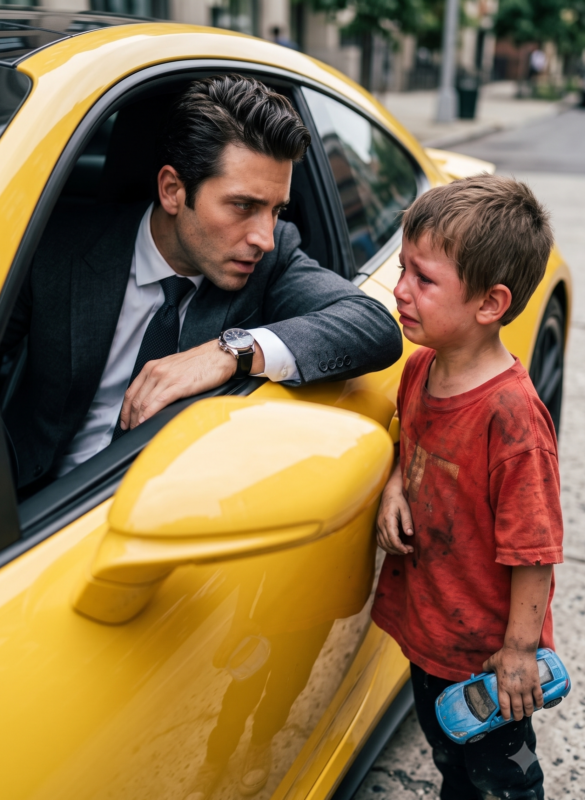
That morning, I was driving down Michigan Avenue in my yellow Ferrari 488 Spider, already irritated by traffic. I had an important presentation at ten with a group of international investors, and every minute I sat motionless behind another car felt like money disappearing.
I glanced at my watch.
Then something slammed against my window.
Once.
Twice.
Again.
I turned sharply.
A little boy stood beside my car.
He couldn’t have been older than five.
His oversized red shirt was dirty and torn. His black trousers hung loosely around his thin legs, and the sneakers on his feet had no laces.
But I barely noticed his clothes.
I noticed his eyes.
They were swollen from crying.
Terrified.
Desperate.
He pounded both hands against my window.
“Please!”
His voice barely penetrated the glass.
I lowered the window.
“Please, mister!” he cried. “Help my mom!”
Traffic horns blared behind me.
I should have stayed in the car.
I should have called emergency services and gone to my meeting.
That was what the man I had become would normally have done.
Then the boy said something that reached straight through twelve years of emotional armor.
“She won’t wake up.”
His mouth trembled.
“She told me to find a miracle.”
For one terrible second, I wasn’t thirty-four anymore.
I was twenty-two, standing in a private airport terminal while someone told me there had been an accident.
I remembered that helplessness.
That feeling that the entire world was collapsing while everyone around you continued breathing as though nothing had happened.
I put the Ferrari in park.
Behind me, someone leaned on his horn.
I didn’t care.
I opened the door and stepped into traffic.
“Where is she?”
The boy pointed toward an alley between two buildings.
I crouched in front of him.
“What’s your name?”
“Leo.”
“All right, Leo. Show me.”
He grabbed my hand.
His fingers were freezing.
In his other hand, he clutched a small, battered blue toy car.
We ran.
At the far end of the alley, underneath a rusted fire escape, a woman lay motionless on an old mattress covered with cardboard.
Her face was pale gray.
Her lips had turned blue.
I dropped beside her and pressed two fingers against her neck.
A pulse.
Weak, but there.
“Mom?” Leo whimpered.
I didn’t think.
I simply lifted her into my arms.
She weighed almost nothing.
“Come with me.”
I carried her back toward the Ferrari while Leo ran beside me.
People stared.
A billionaire in an expensive suit carrying an unconscious homeless woman through downtown Chicago was apparently enough to make strangers stop and take photographs.
I didn’t care about that either.
I placed her carefully inside the car, helped Leo climb in, and called Mercy General.
“This is Julian Vance,” I told the hospital operator. “I’m bringing in an unconscious woman with severe respiratory distress. Have a trauma team ready.”
“Mr. Vance—”
“Now.”
I drove faster than I had ever driven in my life.
Leo sat squeezed beside his mother, holding her hand.
“Stay with me, Mommy,” he whispered.
Then he looked at me.
“You’re the miracle, right?”
I didn’t know how to answer.
“I’m going to try.”
We reached Mercy General minutes later.
Doctors and nurses rushed toward us with a gurney. The woman disappeared through the emergency doors while Leo stood frozen against my side.
A nurse approached with a clipboard.
“Sir, do you know the patient’s name?”
“No.”
I looked down at Leo.
“Do you know your mom’s full name?”
He shook his head.
“She’s just Mommy.”
Around the woman’s neck, I had noticed a small leather pouch.
Leo had been holding it during the drive.
I opened it gently.
Inside was an old employee identification badge.
The moment I saw the logo, my breath stopped.
Vance Gastronomy.
Not the modern logo.
The original one.
My father’s logo.
Then I read the name.
Eleanor Cross.
The hallway seemed to tilt beneath my feet.
I knew that name.
I had known it for twelve years.
After my parents’ crash, investigators had recovered part of a burned handwritten note from my father’s luggage.
Most of it was unreadable.
But one sentence had survived.
If anything happens to us, find Eleanor Cross. She knows why.
Authorities searched for her.
So did I.
Eleanor Cross had disappeared the same day my parents died.
Eventually, everyone told me to accept that she was either dead or had deliberately vanished.
And now she was lying twenty yards away in an emergency room.
Her five-year-old son had just knocked on my Ferrari window.
On the anniversary of my parents’ deaths.
For the first time in twelve years, I wondered whether miracles might actually exist.
And whether some miracles arrived carrying terrible truths.
Part 2 — The Woman Who Was Supposed to Be Gone
Eleanor survived the first several hours.
Doctors stabilized her and moved her to a private recovery room.
Leo eventually fell asleep on a small cot beside her bed, still holding the battered blue car against his chest.
I remained in the room.
I told myself I was waiting because Eleanor might know what happened to my parents.
But that wasn’t the whole truth.
I couldn’t leave Leo.
Every time I looked at him, I saw the frightened child I had once been.
Near midnight, Dr. Harrison, the hospital’s chief toxicologist, entered.
He closed the door behind him.
“Mr. Vance, we completed Ms. Cross’s blood work.”
Something in his face told me I wasn’t going to like what came next.
“What’s wrong with her?”
“She’s been poisoned.”
I stared at him.
“What?”
“Her symptoms initially resembled severe malnutrition and organ stress. But the toxicology results are clear. She has been exposed repeatedly to an arsenic-based industrial compound.”
“How?”
“That’s the troubling part.”
He lowered his voice.
“This wasn’t one large dose. Someone has been giving her very small quantities over a period of months.”
I looked toward Eleanor.
“Someone has been trying to kill her slowly?”
Dr. Harrison nodded.
“If Leo hadn’t found help today, she probably wouldn’t have survived another two days.”
My stomach tightened.
Twelve years in hiding.
Then deliberate poisoning.
And suddenly Eleanor resurfaced on the exact anniversary of my parents’ deaths.
My phone rang.
The name on the display made me hesitate.
Marcus Vance.
My father’s older cousin, though I had always called him Uncle Marcus.
After my parents died, Marcus had become my mentor.
He taught me how to deal with investors. He introduced me to board members. He helped me navigate the company when I was too young and grief-stricken to understand what half the paperwork meant.
Recently, however, our relationship had become strained.
Marcus wanted Vance Gastronomy merged with an enormous offshore conglomerate.
I didn’t.
The deal would make everyone rich, but the Vance company would effectively cease to exist.
I answered.
“Julian.”
His familiar voice sounded almost paternal.
“I heard you missed the investor presentation.”
“I had an emergency.”
“Yes. Apparently you brought a homeless woman and her child into Mercy General.”
I looked at Eleanor.
“How did you hear about that?”
A pause.
“People talk. You’re a public figure.”
Something about his answer disturbed me.
Marcus continued.
“The merger vote is approaching. You cannot afford distractions now.”
“A woman nearly died.”
“Then let the hospital handle her.”
His voice hardened slightly.
“You have responsibilities, Julian.”
“So do I.”
“To shareholders.”
“To people.”
Another pause.
Then Marcus said quietly, “Do not allow sentimentality to destroy everything your father built.”
My grip tightened around the phone.
“You don’t need to remind me about my father.”
I ended the call.
For several minutes, I stood beside the window.
Then I looked at the date displayed on my phone.
March 15.
Suddenly I noticed something I had somehow overlooked.
Marcus had scheduled the final merger proceedings around the anniversary of my parents’ crash.
And Eleanor Cross—the one person my father had wanted me to find—had reappeared on the same date.
I stayed that night.
At 3:15 in the morning, the hallway outside Eleanor’s room grew strangely quiet.
The hospital lights flickered once.
Then I saw a man approaching.
Blue scrubs.
Surgical mask.
Nothing obviously unusual.
Except he had no chart.
No badge that I could see.
And he walked like a man who already knew exactly where he was going.
I stepped beside the door.
He entered.
Instead of checking the monitors, he moved directly toward Eleanor’s IV.
From his pocket, he withdrew a syringe.
My entire body went cold.
“Step away from her.”
He spun.
For half a second, we stared at each other.
Then he dropped the syringe and reached beneath his scrubs.
A knife flashed.
He lunged.
I moved sideways and caught his wrist.
We crashed into the metal railing beside Eleanor’s bed.
Leo woke screaming.
The attacker tried to drive the knife toward me again.
I slammed his wrist against the bed frame.
Once.
Twice.
The knife fell.
I hit him hard across the jaw.
He stumbled backward, grabbed a metal tray, and threw it toward me.
I raised my arm instinctively.
By the time I recovered, he was running.
I chased him into the corridor.
He disappeared through the emergency stairwell before security arrived.
When I returned, Leo was crying beside his mother.
I knelt.
“It’s okay. You’re safe.”
I wasn’t sure whether I believed my own words.
Then I noticed something on the floor.
A small black phone.
The attacker must have dropped it.
The screen illuminated.
A message appeared.
Finish it tonight. Julian Vance loses everything tomorrow anyway.
I read it twice.
Then a third time.
Someone wasn’t merely trying to kill Eleanor.
They knew who I was.
And whatever had started twelve years ago was no longer buried in the past.
It had come back for all of us.

Part 3 — When Everything Was Taken From Me
By eight the next morning, my name was everywhere.
My attorney, Marcus Thorne, entered Eleanor’s room looking as though he hadn’t slept.
“Turn on the television.”
A financial news anchor appeared.
My photograph filled the screen.
The headline beneath it read:
VANCE CEO UNDER INVESTIGATION
The allegations were astonishing.
Fourteen million dollars supposedly missing.
Fraudulent transactions.
Unauthorized corporate accounts.
Payments allegedly connected to Eleanor.
According to anonymous board sources, I had been secretly using company money to finance an illegal operation involving a former employee.
I laughed once.
Not because it was funny.
Because the lie was so enormous that my mind momentarily refused to accept it.
Thorne looked at me.
“They forged your electronic authorization.”
“Who?”
He didn’t answer.
He didn’t have to.
I already knew.
Marcus.
My banking app stopped working minutes later.
Then my corporate access disappeared.
Then came the court notice.
My personal assets had been temporarily frozen pending investigation.
My voting authority within the company had been suspended.
Someone had constructed the entire trap in advance.
Saving Eleanor had merely given them the final piece.
The hospital administration informed us that unless payment arrangements were secured, Eleanor would be transferred to a public facility.
I nearly lost control.
“She could die if you move her.”
“I’m sorry, Mr. Vance.”
For the first time since becoming wealthy, I discovered how powerless a man could feel when money stopped opening doors.
I walked outside into the hospital courtyard.
Everything I had built was disappearing.
My company.
My reputation.
My access to my own money.
Perhaps my freedom.
Worse, Eleanor might die before telling me what she knew.
I sat on a stone bench and lowered my head.
Then someone touched my knee.
Leo.
He climbed beside me.
“Are you sad?”
“A little.”
He thought for a moment.
Then he held up the old blue toy car.
“Mommy said this protects us.”
I looked at it.
“She did?”
“She said if the bad men came back, I should never lose it.”
My attention sharpened.
“What bad men?”
Leo shrugged.
“She didn’t tell me.”
Then he added, “She said the car belonged to the man who made the stars.”
Before I could ask what that meant, the toy slipped from his hand.
It struck the concrete.
The brittle plastic split open.
Leo gasped.
“My car!”
I reached down.
“It’s all right. I’ll replace—”
I stopped.
Something metallic was hidden inside the hollow body.
Wrapped in waterproof material was a microSD card.
My heartbeat accelerated.
Then I saw two letters scratched into the inner shell.
R.V.
Robert Vance.
My father.
For several seconds, I couldn’t speak.
I remembered him sitting beside me when I was a boy, showing me how to build miniature cars.
Leo’s toy had belonged to my father.
Or, more accurately, it had been built by him.
“Leo,” I whispered, “your mother didn’t give you a toy.”
I picked up the tiny memory card.
“She gave you a safe.”
Thorne had an encrypted offline computer in his briefcase.
We inserted the card.
A password prompt appeared.
Twelve digits.
I tried dates.
Nothing.
Then I thought about my father.
He never trusted obvious passwords.
He loved places more than dates.
Especially the first restaurant he and my mother opened together.
I entered its old location coordinates and founding year.
The screen changed.
ACCESS GRANTED.
Folders appeared.
Hundreds of them.
Bank records.
Internal memos.
Audit documents.
Offshore transfers.
And one audio recording created the night before my parents died.
I clicked it.
My father’s voice came through the speakers.
Older than I remembered.
Tired.
But unmistakably his.
Another voice answered him.
Marcus.
“You’re being sentimental, Robert,” he said.
Then came the words that ended the last illusion I had about my family.
“If you refuse to sign the offshore liquidation documents, the board will remove you one way or another. You’re flying tomorrow, aren’t you? Mechanical failures happen.”
My hands went numb.
Marcus continued.
“And if Eleanor Cross opens her mouth, she’ll disappear before anyone hears a word.”
My father answered calmly.
“I gave Eleanor everything. If something happens to me or Clara, the records will survive.”
The recording ended.
For twelve years, I had believed my parents died in an accident.
For twelve years, Marcus had hugged me at memorial dinners.
Advised me.
Praised me.
Called me his boy.
And all that time, he had known.
Thorne stared at the computer.
“Julian…”
I couldn’t speak.
The door opened.
Police officers entered.
“Julian Vance?”
One officer held up a warrant.
“You are under arrest.”
The handcuffs closed around my wrists.
As they led me through the hospital, I saw Marcus standing beside the elevators.
Perfect suit.
Perfect posture.
Perfect expression of sorrow.
“Julian,” he said loudly enough for others to hear, “I’m devastated.”
Then he moved closer.
Only I heard his next words.
“By tomorrow, the shareholders will remove you. Eleanor will disappear. The company will be sold. And no one will believe anything a disgraced criminal says.”
For the first time, I looked at the man who had raised me after my father’s death and saw what had been hiding beneath the smile.
“You made one mistake,” I whispered.
He smiled.
“What mistake?”
“You left me alive.”
His expression changed for only a fraction of a second.
Then the officers took me away.
Part 4 — The Meeting Marcus Thought He Had Won
I spent six hours in a federal holding cell.
Six hours thinking about my father.
About my mother.
About Eleanor.
About Leo knocking on my window.
I had spent twelve years believing grief had made me alone.
Now I understood that grief had also made me blind.
I had trusted Marcus because trusting him had been easier than questioning the only family member I had left.
At four in the afternoon, my cell opened.
Thorne stood outside.
“You’re being released.”
“How?”
“I gave a federal magistrate a verified copy of the recording. Your arrest warrant is now being challenged, and the larger evidence has triggered a sealed investigation.”
“And Eleanor?”
“Moved.”
My heart jumped.
“Where?”
“Somewhere secure. Marcus believes she’s still at Mercy General.”
I exhaled for what felt like the first time all day.
“What about tomorrow’s meeting?”
“Marcus still plans to hold it.”
Thorne almost smiled.
“He thinks you’re in psychiatric custody.”
That was when the plan formed.
“Good.”
The following morning, Vance Gastronomy headquarters looked like it was hosting a coronation.
Investors filled the ballroom.
News crews lined the walls.
A giant screen displayed the logo of the offshore conglomerate that would swallow my family company the moment Marcus signed the deal.
He stood onstage holding a glass of champagne.
“Today,” he announced, “we honor the past by embracing the future.”
I watched from the hallway beyond the closed ballroom doors.
Beside me stood federal officers.
Thorne.
And Eleanor.
She was still pale.
Still weak.
But standing.
Alive.
Marcus lifted a gold pen.
The ballroom doors opened.
Hundreds of heads turned.
Marcus looked up.
The pen froze in his hand.
I walked inside.
For the first time in my life, I saw genuine fear on his face.
Then he saw Eleanor.
The fear became panic.
“Security!”
No one moved.
A federal marshal stepped forward.
“Remain where you are.”
Marcus pointed at me.
“This man is under investigation!”
“Not anymore.”
I walked toward the stage.
Cameras followed me.
“You told everyone I lost my mind.”
Marcus stared at me.
“You have.”
“No.”
I stopped beneath the giant screen.
“I finally found the truth.”
Thorne connected the encrypted laptop.
The merger logo disappeared.
My father’s photograph appeared.
Then his voice filled the ballroom.
“You’re being sentimental, Robert…”
The room went completely still.
Marcus lunged toward the sound controls.
Federal officers blocked him.
When the recording ended, he shouted, “Fabricated! That recording is fake!”
So I showed the next file.
Financial transfers.
Shell corporations.
Forged board documents.
Payments made to intermediaries tied to Eleanor’s poisoning.
The evidence rolled across the screen page after page.
Marcus’s confidence collapsed.
Then Eleanor took the microphone.
For twelve years, she had lived in fear.
But her voice didn’t shake.
“Robert Vance discovered that Marcus was secretly diverting company money through offshore accounts. He asked me to protect the audit because he no longer trusted members of the board.”
She looked directly at Marcus.
“After Robert and Clara died, I knew I was next.”
She explained how she disappeared.
How she moved repeatedly.
How Marcus’s people eventually found her.
How she became sick.
How she realized someone was poisoning her but had no proof and nowhere safe to go.
“So I hid the evidence in something no one would steal from a poor child.”
She looked toward me.
“Leo’s toy car.”
Around us, reporters were broadcasting every word.
Board members began shouting.
Investors tore merger packets in half.
Marcus backed away from the podium.
“You can’t do this!”
I looked at him.
“No, Marcus.”
Federal agents approached.
“You did this.”
The officer read the charges.
Conspiracy.
Corporate fraud.
Attempted murder.
And charges connected to the deaths of Robert and Clara Vance.
Handcuffs closed around Marcus’s wrists.
He stared at me.
The man who had controlled my life for twelve years suddenly looked old.
Small.
Defeated.
“You’ll destroy the company,” he whispered.
I shook my head.
“My father built the company.”
Then I looked around the ballroom.
“You nearly destroyed the family.”
They led him away.
The merger documents remained unsigned.
For twelve years, I had imagined discovering the truth about my parents would somehow heal me.
It didn’t.
Truth doesn’t erase grief.
It simply gives grief the correct name.
But when Eleanor touched my arm, I understood something else.
Justice wasn’t about bringing my parents back.
It was about making sure Marcus could never destroy another family again.

Part 5 — What My Father Really Left Me
Six months passed.
Marcus was convicted after a lengthy federal investigation uncovered evidence far beyond what had been stored on the memory card.
Several executives who had knowingly helped him manipulate company records were prosecuted as well.
The merger collapsed.
Vance Gastronomy survived.
But I didn’t want the company to continue exactly as before.
Too much power concentrated in too few hands had nearly destroyed everything my father created.
So I changed it.
I placed forty percent of the company’s voting shares into a protected employee and research trust.
No single executive—including me—would ever again be able to control the company without meaningful oversight.
Eleanor recovered slowly.
Years of fear had left scars no hospital could heal quickly, but physically she grew stronger every week.
Eventually, she agreed to return to Vance Gastronomy as the head of research and development.
Not because she owed the Vance family anything.
She didn’t.
She returned because the work had once mattered to her.
And because she wanted Leo to grow up seeing his mother as more than a woman who had spent years running from dangerous men.
As for Leo…
He changed my life in ways I still struggle to explain.
One autumn afternoon, I stood outside the house I had purchased near the lake.
For the first time, I hadn’t chosen a home because of the view or its investment value.
I chose it because there was grass for a child to run across.
Trees.
A large kitchen.
Too many bedrooms.
A porch where people could sit together at night.
My Ferrari remained in the driveway.
I drove it far less often.
“Julian!”
Leo came racing toward me.
In his hand was a new blue die-cast car.
I had commissioned an exact replica of the toy my father had made, minus the secret compartment.
“Look!”
He pushed it across the stone walkway.
“It’s faster than yours.”
“I seriously doubt that.”
“It is!”
He laughed.
I caught him around the waist when he ran at me.
A moment later, Eleanor stepped onto the porch.
She smiled.
Not the cautious smile she wore when she first woke in the hospital.
A peaceful one.
The kind people wear when they finally believe tomorrow might be safe.
I looked at Leo.
Then at Eleanor.
Then at the clear sky above us.
For years, I had thought my father’s greatest legacy was Vance Gastronomy.
The restaurants.
The company.
The money.
The name.
I was wrong.
His greatest legacy had been one final act of courage.
He had trusted Eleanor with the truth.
Eleanor had protected that truth through twelve years of fear.
And eventually, she had placed it in the hands of her little boy.
A boy who stood in traffic on Michigan Avenue and knocked on the window of the one car he somehow believed might stop.
Leo had told me his mother sent him looking for a miracle.
But sometimes I wonder whether I misunderstood what happened that morning.
Maybe I wasn’t Leo’s miracle.
Maybe he was mine.
Because before he knocked on my window, I possessed nearly everything money could buy.
A penthouse.
A Ferrari.
A company worth billions.
Influence.
Power.
Security.
And I went home every night to an empty apartment.
Then one frightened five-year-old boy shattered all of that certainty with four words:
“Please help my mom.”
I had opened my car door believing I was saving a stranger.
Instead, that stranger gave me back my father’s truth.
Her son gave me back my heart.
And together, they taught me something no financial statement ever could.
A rich life and a wealthy life are not the same thing.
My father had spent twelve years trying to lead me toward that lesson.
In the end, all it took was a starving little boy, a broken blue toy car…
…and one man finally willing to stop when someone asked for help.
For the first time since losing my parents, I no longer felt like the last surviving member of a broken family.
I looked at Leo laughing on the lawn and Eleanor standing beneath the porch light.
I was home.
And after twelve long years, the ledger was finally balanced.
Disclaimer: This fictional story is for entertainment only. It does not represent any person or organization, nor encourage inappropriate behavior. Created with AI assistance.