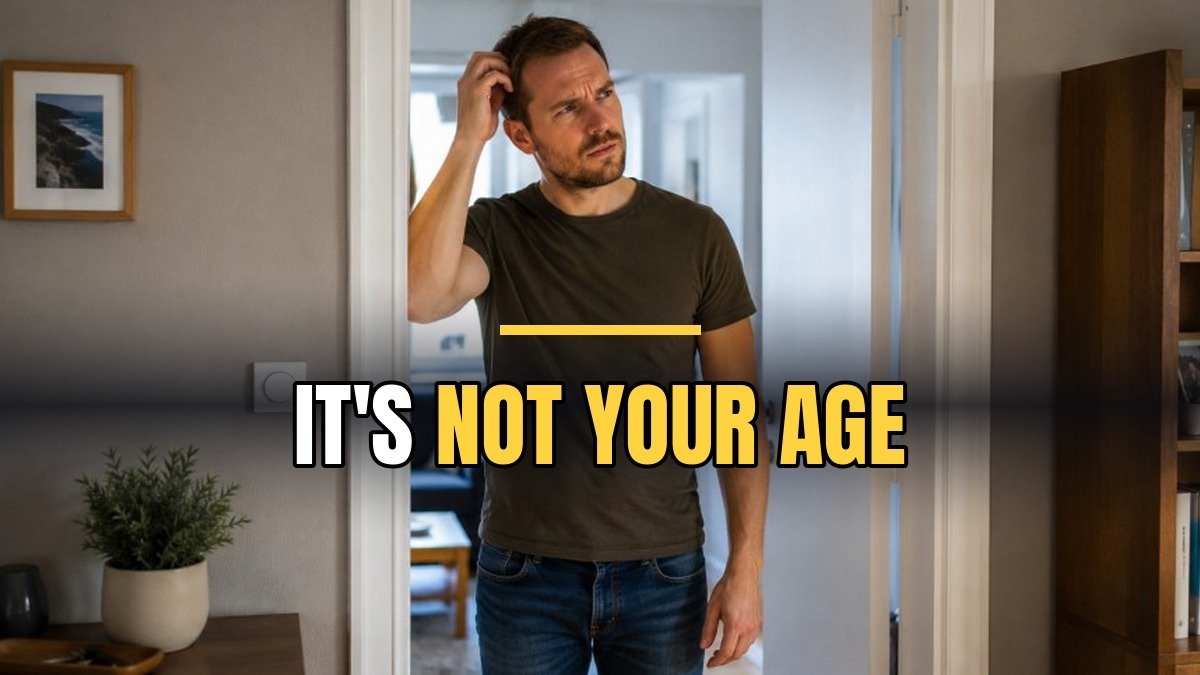
You get up from the couch with a mission. You walk into the kitchen. You stop. You stand there, staring at the refrigerator like it owes you money.
Why did I come in here?
If this happens to you weekly, congratulations: you’re not losing your mind, and it’s not your age. Psychologists have a name for it — the doorway effect — and it happens to 20-year-olds in lab coats just as reliably as it happens to you.
The Science of the Blank Stare
Researchers at the University of Notre Dame, led by psychologist Gabriel Radvansky, studied this exact phenomenon. In their experiments, people carried objects through doorways — real rooms and virtual ones — and were then asked what they were carrying. Passing through a doorway made people significantly more likely to forget, compared to walking the same distance without a doorway.
Why? Because your brain organizes memory by episodes — chunks of experience tied to places. A doorway is a boundary between episodes. When you cross it, your brain files away the previous room’s “event model” and starts a new one. Your intention — get the scissors — was stored in the old episode. New room, new episode, intention left behind at the border.
In other words: the doorway didn’t erase your memory. It filed it under “previous room.”

Why Going Back Works
Here’s the part that proves it: when you walk back to the room you came from, the memory usually returns instantly. That’s not magic — you re-entered the episode where the intention was stored. The context cues it back up.
It’s also why you remember the thing you wanted to say the moment you leave the room where you wanted to say it, and why walking into a store can make your entire shopping list evaporate.

How to Beat It
Researchers and memory experts suggest a few simple tricks:
Say it out loud. “Scissors, scissors, scissors” as you walk. It sounds ridiculous. It works — verbal repetition keeps the intention active across the boundary.
Carry a cue. Holding the empty mug you’re going to refill, or the envelope you’re going to mail, gives your brain a physical anchor.
Visualize the destination. Picture yourself using the item in the next room. You’re pre-loading the new episode with your intention.
So the next time you’re standing in the kitchen having a staring contest with the fridge, don’t blame your age. Blame the doorway. It’s been sabotaging human memory since we invented rooms — and now you know its name.