
On a cold November night in 1974, a white Honda Civic left a dark stretch of Oklahoma highway and crashed into a concrete wall. Inside the wreckage was the body of a 28-year-old mother of three, a woman who had spent the final months of her life uncovering what she believed was a dangerous truth hidden inside one of America’s most powerful nuclear companies.
Her name was Karen Silkwood.
Just days earlier, she had been preparing to meet with a New York Times reporter and a union official. In her possession, according to those close to her, were documents, notes, and evidence connected to allegations of serious safety violations at the Kerr-McGee nuclear facility near Crescent, Oklahoma.
She never made it to that meeting.
The folder disappeared.
The notebook disappeared.
The woman who had spent months documenting what she believed were threats to workers and the public was suddenly gone.
Authorities called it an accident.
Her supporters called it something far more sinister.
For decades, the question surrounding Karen Silkwood’s death has remained one of the most haunting mysteries in American industrial history: Was she simply the victim of a tragic crash, or was she silenced because she knew too much?
Her story became a symbol of the dangers faced by whistleblowers, a landmark legal battle over corporate responsibility, and a reminder that sometimes the most important voices are not those with power—but those brave enough to speak when powerful people want silence.
A Young Mother Steps Into the Nuclear World
Karen Gay Silkwood was not born into a world of politics, science, or corporate battles.
She was an ordinary American woman.
Born in 1946 in Longview, Texas, Karen grew up in a working-class family. She attended high school in Nederland, Texas, and later married William Meadows. Together, they had three children. Like many young mothers of her generation, she was focused on building a stable life and providing for her family.
She was not a scientist.
She was not a government investigator.
She was not a famous activist.
She was simply a worker trying to earn a living.
In 1972, Karen accepted a job at Kerr-McGee’s Cimarron Fuel Fabrication Site near Crescent, Oklahoma. The facility produced plutonium fuel rods used in nuclear reactors, placing it at the center of America’s growing nuclear energy industry.
At the time, nuclear power was often presented as the future — a cleaner, more advanced source of energy that would transform the country.
But behind the walls of facilities like Kerr-McGee, many workers were dealing with dangerous materials that few outside the industry understood.
Karen entered the plant believing she was taking a normal industrial job.
Instead, she found herself surrounded by a world where questions about safety, radiation exposure, and worker protection were becoming increasingly difficult to ignore.
The work was demanding. The environment was highly technical. Yet many employees, according to later testimony, received limited training about the materials they handled.
Plutonium was not just another industrial substance.
It was one of the most dangerous radioactive elements known to humanity.
Even microscopic amounts could pose serious health risks.
And Karen began to wonder whether the people working around it were being adequately protected.
The Worker Who Started Asking Dangerous Questions
At first, Karen was simply another employee on the production floor.
But over time, she became increasingly concerned about what she saw around her.
Workers reported problems with safety equipment.
Respirators were questioned.
Contamination incidents raised alarms.
Employees worried that workplace protections were not keeping pace with the risks involved.
Instead of ignoring those concerns, Karen became involved with the Oil, Chemical and Atomic Workers Union.
She believed that workers deserved a voice.
In August 1974, she achieved something significant: she became the first woman elected to the union’s bargaining committee at the plant.
Her responsibility was not glamorous.
It was not about money or recognition.
Her focus was health and safety.
And that position gave her a closer look at issues many employees feared discussing.
Karen began collecting information.
She began documenting complaints.
She began creating a record.
What she discovered would eventually place her directly against one of the most powerful industries in America.
One of the most serious allegations involved the inspection of nuclear fuel rods.
According to claims later presented during legal proceedings, some weld inspections may have been manipulated. Workers alleged that defective areas were altered or marked in ways that made them appear acceptable.
If true, the implications were enormous.
Nuclear fuel components had to meet extremely strict safety standards. Any failure in manufacturing could potentially affect nuclear facilities and the communities surrounding them.
Karen believed these issues were not just about employees inside the plant.
She believed they affected everyone who depended on nuclear technology.
Taking the Evidence to Washington
Karen Silkwood did not immediately run to the media.
She followed the process that many whistleblowers are told to follow.
She reported concerns internally.
She documented problems.
She went through official channels.
In September 1974, she traveled to Washington, D.C., where she met with representatives of the Atomic Energy Commission, the government agency responsible for overseeing nuclear safety at the time.
She presented her concerns.
She spoke about workplace conditions.
She raised questions about safety practices.
Then she returned to Oklahoma.
But instead of stepping away, she continued collecting information.
For Karen, this was no longer just about her own workplace.
She believed she had uncovered something that required public attention.
However, challenging a major nuclear company came with risks.
Companies in highly regulated industries have enormous resources.
Workers who speak out often face pressure, isolation, or attempts to damage their credibility.
Karen was about to experience one of the most frightening chapters of her life.
The Contamination Incident That Changed Everything
On November 5, 1974, something happened that shocked Karen and everyone around her.
A radiation detector at the Kerr-McGee facility indicated that she had been contaminated.
Tests revealed plutonium contamination.
Not just on her clothing.
Not just around her.
Inside her body.
The discovery immediately raised questions.
How had plutonium entered her system?
Karen insisted she had not intentionally taken radioactive material home.
She had followed workplace procedures.
She had never been assigned to handle plutonium directly in the way some workers did.
Yet testing continued to show traces of radioactive contamination.
Her home was also inspected.
Investigators found contamination inside her house, including on objects such as her refrigerator.
The situation became even more alarming.
Karen was terrified.
Her family was terrified.
The company questioned how the contamination happened.
Karen believed something had gone terribly wrong.
The possibility that someone could have intentionally exposed her became part of the controversy surrounding the case.
But proving exactly what happened would become nearly impossible.
The evidence was incomplete.
The records were disputed.
And then, only days later, Karen Silkwood was dead.
The Final Drive Into the Night
On November 13, 1974, Karen left work carrying materials connected to her investigation.
She was expected to meet journalist David Burnham of The New York Times and Steve Wodka, a union official.
The meeting never happened.
Witnesses later reported seeing Karen carrying documents shortly before she disappeared.
Then, sometime that evening, her car left Highway 74 near Crescent, Oklahoma.
Her Honda Civic struck a concrete barrier.
Karen Silkwood died instantly.
She was 28 years old.
The official explanation was simple: she had fallen asleep while driving.
Authorities classified it as a single-car accident.
The investigation moved quickly.
But many people were not satisfied.
Those who knew Karen pointed to unanswered questions.
Why was she carrying important documents shortly before her death?
Where did those documents go?
Why were some materials never recovered?
Why did some investigators believe there were signs suggesting another vehicle may have been involved?
The union hired independent experts to examine the crash.
They argued that there were indications of another impact, including damage patterns that suggested Karen’s car may have been struck from behind before leaving the road.
The debate over the crash would continue for years.
The official conclusion remained unchanged.
But suspicion never disappeared.

A Legal Battle That Changed America
Karen Silkwood’s family refused to let the story end there.
Her father, Bill Silkwood, filed a lawsuit against Kerr-McGee.
The trial became one of the most important legal battles involving nuclear safety and corporate responsibility in American history.
The courtroom heard testimony about workplace conditions, contamination concerns, safety procedures, and the evidence Karen had collected before her death.
After months of proceedings, the jury found Kerr-McGee negligent.
They awarded Karen’s family $10.5 million in damages.
It was a historic moment.
But the legal fight was far from over.
An appeals court later reduced the award dramatically, cutting it down to only $5,000.
The decision shocked supporters of the Silkwood family.
How could a company be found responsible for negligence, yet the compensation be reduced so drastically?
The family continued fighting.
Eventually, the case reached the United States Supreme Court.
In 1984, the Supreme Court ruled in favor of the Silkwood family.
The decision became a landmark victory.
It established that victims of radiation exposure could pursue legal action against nuclear companies under state law.
Karen Silkwood’s name became permanently connected to a major expansion of legal protections for people harmed by industrial negligence.
Hollywood Tells Her Story
Less than a decade after her death, Karen Silkwood’s story reached millions through Hollywood.
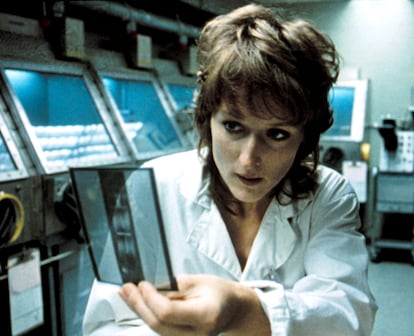
In 1983, the film “Silkwood” was released, starring Meryl Streep as Karen Silkwood.
The movie introduced audiences around the world to the young woman who had challenged a nuclear corporation and died before seeing the outcome of her fight.
The film received five Academy Award nominations.
It transformed Karen from a relatively unknown worker in Oklahoma into an international symbol of courage and resistance.
But behind the movie was a real family still searching for answers.
A real mother whose children grew up without her.
A real woman whose final days were filled with fear, determination, and unanswered questions.
Decades Later, The Questions Remain
The story of Karen Silkwood did not disappear.
More than forty years after her death, questions continued to follow the case.
Investigations, legal challenges, and renewed interest have kept attention on what happened during those final days of her life.
Her supporters argue that Karen was right about the dangers she uncovered.
They point to later environmental problems connected to nuclear facilities and argue that her warnings were ignored.
In 2014, Kerr-McGee’s successor company reached a multibillion-dollar settlement connected to environmental contamination issues across the United States.
For many who remember Karen’s story, it felt like confirmation that the concerns she raised were not imaginary.
But one question remains unanswered:
What happened on that dark Oklahoma highway in November 1974?
Was Karen Silkwood simply the victim of a tragic accident?
Or did someone want her evidence — and her voice — to disappear?
No one has ever been charged in connection with her death.
The documents she carried were never found.
The full truth may never be known.
The Legacy of Karen Silkwood
Karen Silkwood was only 28 years old when she died.
She was not a powerful executive.
She was not a politician.
She was not someone with influence or wealth.
She was a worker.
A mother.
A woman who believed that ordinary people deserved protection from extraordinary dangers.
Her legacy is not just the lawsuit.
It is not just the movie.
It is not just the mystery surrounding her death.
Her greatest legacy is the idea that one person can make a difference.
That a factory worker with a high school education can challenge a corporation with billions of dollars.
That someone without a title can still demand accountability.
Karen Silkwood spent her final months doing something many people are afraid to do: asking questions when the answers were uncomfortable.
She documented what she saw.
She reported what she believed was wrong.
She refused to stay silent.
And even decades later, her name remains a reminder that truth often depends on ordinary people willing to stand up when the stakes are highest.
Somewhere, the missing documents connected to Karen Silkwood’s final investigation may still exist.
Somewhere, there may still be answers.
But even without them, one fact remains undeniable:
Karen Silkwood changed the world by refusing to look away.