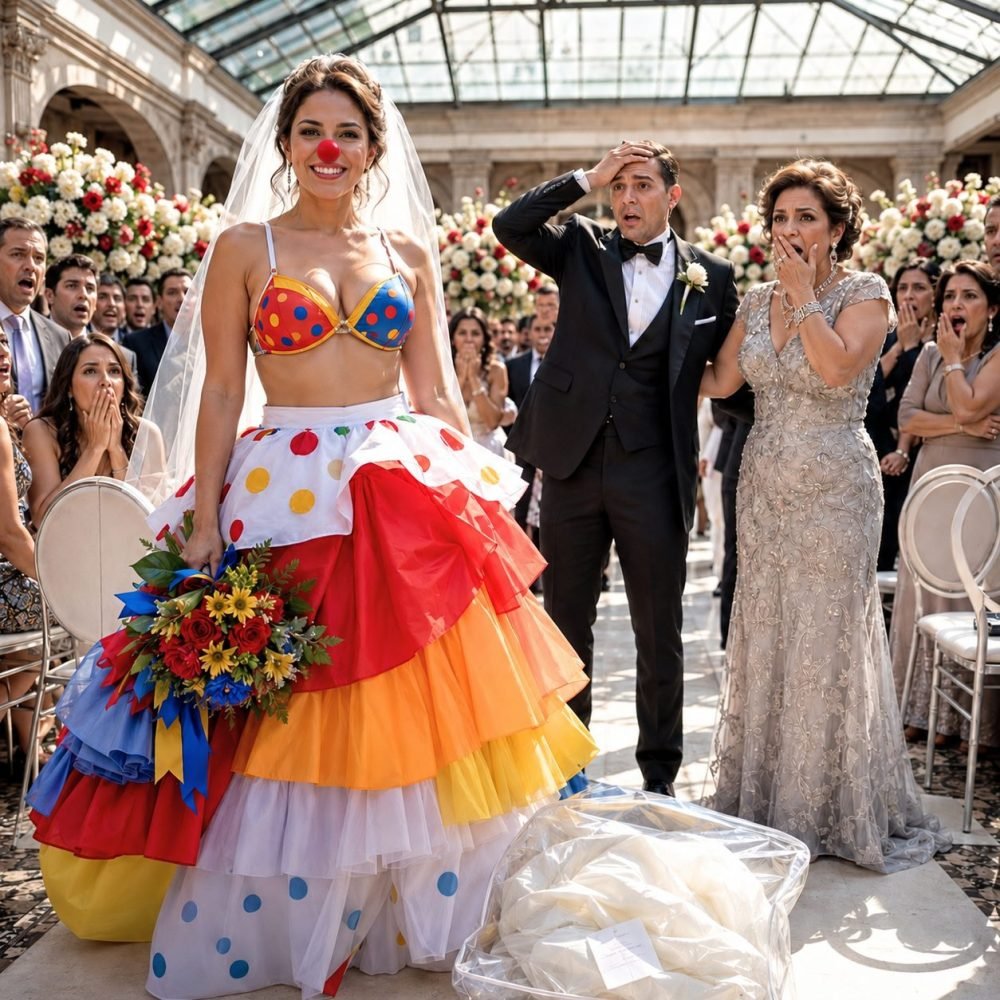
The first thing I saw on my wedding morning was a red foam nose sitting where my veil should have been. Beneath it lay a striped clown costume and a note in my mother-in-law’s sharp handwriting: “Know your place.”
For ten seconds, the bridal suite was silent except for the rain tapping against the windows of Whitmore Hall. My bridesmaids froze behind me, their champagne smiles draining into horror. My father, standing near the door in his charcoal suit, looked at the empty mannequin where my custom ivory dress had hung an hour earlier.
“Clara,” he said softly, “you don’t have to do this.”
Downstairs, two hundred guests waited under crystal chandeliers. My fiancé, Bennett Whitmore, waited too, polished and handsome, raised by a family that treated kindness like poverty and poverty like disease.
His mother, Elise, had never forgiven me for being “ordinary.” Her word. She had whispered it at engagement dinners, charity luncheons, even during cake tastings.
“She’ll learn,” Elise once told Bennett, not knowing I could hear from the hallway. “Girls like her always do.”
Bennett had laughed.
That laugh was why I did not cry.
One bridesmaid whispered, “Call security. Call the police. Call Bennett.”
“No,” I said.
I picked up the costume. Cheap polyester. Bright yellow buttons. Oversized sleeves. The humiliation had been planned with theatrical cruelty. Elise wanted me to hide, to collapse, to give her a story she could retell for years.
Poor Clara. So unstable. So dramatic. Never fit for our family.
My father’s jaw tightened. “Sweetheart, tell me what you want.”
I looked at him in the mirror. Then I looked at the small black folder inside my bridal clutch—the one Elise had dismissed as a “cute little planner.”
Inside were notarized copies, bank records, emails, vendor invoices, and one signed ownership deed.
Elise had hidden the wrong dress from the wrong woman.
“Zip me up,” I said.
My bridesmaids stared.
I stepped into the clown costume.
The fabric scratched my skin. The shoes were too big, so I kept my white heels on. I pinned my hair beneath the ridiculous little hat Elise had left for me. Then I placed the red nose in my palm, closed my fingers around it, and smiled.
My father’s eyes shone, but his voice stayed steady.
“Are you sure?”
“No,” I said. “I’m certain.”
Then I took his arm.
Downstairs, the music began.
Part 2
The doors opened, and two hundred heads turned.
At first, there was only confusion. Then a ripple of laughter moved through the hall like spilled poison. Someone gasped. Someone raised a phone. Elise Whitmore stood in the front row in silver silk, her mouth curving with victory.
Bennett’s face went white, then red.
“What the hell is she doing?” he hissed.
I heard him clearly because the hall had gone quiet again. Beautiful flowers lined the aisle. White roses. Gold ribbons. Imported candles burning at seventy dollars each. Elise had chosen every detail except the bride.
My father held my hand tighter.
“Eyes forward,” he murmured.
So I walked.
Every step felt like fire, but I kept my chin high. I did not stumble. I did not hide my face. I walked past guests who had once smiled at me over champagne while calculating my worth. I walked past Bennett’s cousins, who laughed into their hands. I walked past Elise, who leaned close enough to whisper as I passed.
“Good girl.”
That was her mistake.
At the altar, Bennett grabbed my wrist. “Go upstairs and change.”
“Into what?”
His eyes flicked toward his mother.
“Don’t make a scene.”
I smiled. “Bennett, your mother dressed me like a clown in front of your entire social circle. The scene has already been made.”
A few guests murmured.
The officiant cleared his throat. “Shall we begin?”
“Yes,” Elise said quickly. “Before this becomes more embarrassing.”
I turned toward her. “Oh, Elise. We’re just getting started.”
Her smile faltered.
From the back of the room, the wedding planner stepped forward. She looked nervous, but she nodded at me. On the grand screen behind the floral arch, the romantic slideshow vanished. In its place appeared a single image: Elise’s handwritten note.
“Know your place.”
Gasps erupted.
Bennett’s grip loosened.
“What is this?” he snapped.
“The theme of your family,” I said. “But I thought everyone deserved context.”
The next slide appeared: an invoice from a shell company called Sterling Events Consulting. Then another. And another. Hundreds of thousands of dollars billed to the Whitmore Children’s Foundation for fake services, all routed through accounts controlled by Elise and Bennett.
Elise lunged to her feet. “Turn that off!”
Nobody moved.
I faced the guests. “For the last six months, I have been auditing the Whitmore Foundation.”
Bennett laughed once, too loudly. “You’re a marketing assistant.”
“No,” I said. “That was the story you preferred. I am a licensed forensic accountant. My firm was hired anonymously after three donors reported missing funds.”
Elise’s face went slack.
My father opened the black folder and handed the first stack of documents to a man in the second row. District Attorney Marcus Hale stood calmly, buttoned his jacket, and accepted them.
Bennett stared at him. “Marcus?”
Marcus did not smile. “Bennett.”
The room shifted. Phones rose higher. Elise looked around for allies and found spectators.
I looked at Bennett’s perfect tuxedo, his perfect hair, his perfect family name.
“You targeted the wrong woman,” I said.
Part 3
Bennett stepped toward me, voice low and venomous. “You planned this?”
“No,” I said. “You did. I only documented it.”
Elise pointed a shaking finger at me. “She’s lying. She’s a gold digger. She trapped my son.”
The next slide appeared.
It was a scanned copy of the prenuptial agreement Bennett had pressured me to sign. Beside it was another document—an altered version filed with his family lawyer, adding a clause that made me responsible for debts tied to Whitmore Hall.
“My signature was forged,” I said. “So was my father’s witness signature.”
My father finally spoke, his voice cold enough to freeze the chandeliers. “And I was a state judge for twenty-eight years.”
The silence was instant.
Elise sat down hard.
Bennett whispered, “Mom?”
There it was. The first crack.
I turned to the guests. “Whitmore Hall is not owned by the Whitmores anymore. Three months ago, after their creditors began circling, the holding company defaulted. I bought the debt through a legal trust.”
Bennett looked at me as if I had become a stranger.
“The venue,” I said, “belongs to me.”
A stunned laugh escaped someone near the back.
Elise’s lips moved, but no sound came out.
“So this wedding,” I continued, “was never going to bind me to your family. It was going to expose you in front of every donor, investor, lawyer, and journalist you invited to admire yourselves.”
The doors opened again.
Two investigators entered with quiet professionalism, followed by uniformed officers. No screaming. No movie chaos. Just the sound of consequences walking across marble.
Marcus Hale stood. “Elise Whitmore, Bennett Whitmore, we need to speak with you regarding fraud, forgery, and misappropriation of charitable funds.”
Elise snapped back to life. “You can’t do this here!”
I removed the red clown nose from my palm and placed it on the altar between us.
“You chose the costume,” I said. “I chose the audience.”
Bennett reached for me. My father stepped between us.
“Don’t,” he said.
For the first time since I had known him, Bennett looked small.
“Clara,” he whispered. “We can fix this.”
I looked at the man I had almost married. The man who had watched his mother sharpen me into a joke and called it tradition.
“No,” I said. “I already did.”
Then I turned, took my father’s arm again, and walked back down the aisle. This time, no one laughed.
Three months later, Whitmore Hall reopened as The Clara Voss Center for Children’s Advocacy, funded by recovered assets from the foundation case. Elise’s name disappeared from every board she had once ruled. Bennett pled guilty to fraud and forgery, traded designer suits for court dates, and discovered that family influence gets quieter when bank accounts are frozen.
As for me, I kept the clown costume.
Not because it hurt me.
Because on the day they tried to make me ridiculous, I became undeniable.