My parents walked into federal court that morning believing they were there to save their son—the boy they still called their proudest accomplishment—and to finish burying the daughter they had spent ten years telling everyone had failed out of the Navy.
That Tuesday morning, the federal courthouse in downtown Boston smelled of industrial lemon polish, burned chicory coffee, and the unique, sour sweat of fear that people try to disguise with three-thousand-dollar suits. My brother, Carter, sat at the defense table. His navy-blue suit was perfectly tailored, his back rigidly straight, his jaw locked tight. He wore the same calm, practiced expression he had used to convince lenders, neighbors, and half the eastern seaboard to trust Harbor Shield Recovery.
Behind him sat my parents, William and Evelyn Ashford. They were dressed as if sheer dignity could still save them. My mother clutched her quilted leather purse with both hands, her knuckles white, her pearls resting against her collarbone like an armor of old money. My father stared at the mahogany wood of the judge’s bench like respectability might still miraculously shield what remained of our family name.
They had no idea I was already inside the building.
For a decade, they had lived inside Carter’s version of me. I was the daughter who broke under the pressure of basic training. The one who washed out, disgraced. The one who vanished in shame to God-knows-where, occasionally begging her brilliant older brother to protect the Ashford name from my financial ruin. Carter repeated that story so often, with such pitch-perfect melancholy, that my parents stopped treating it like a lie. They treated it like mercy.
I was nineteen when I first told them I wanted to enlist. My father, swirling a glass of scotch in his study, had warned me not to start something I didn’t have the spine to finish.
The cruel part was that I did finish. I kept finishing. Through the mud, the tearing muscles, the sleepless nights, and the kind of classified intelligence work that teaches you to keep your hands steady when the entire world around you is detonating. Carter needed me broken because my success made his own mediocrity feel suffocating.
So, he forged emails from my old civilian account. He mocked up discharge papers official enough to convince two parents already eager to believe the worst of me. But the true betrayal wasn’t just the lie. It was what they built upon it. To fund Carter’s initial venture, my parents didn’t just give him their savings. They liquidated the one thing I loved in this world: my grandfather’s marshland estate. It was a sprawling, beautiful sanctuary where I had spent my childhood, the only place I ever felt safe. They sold it to a commercial developer to provide the seed money for Harbor Shield Recovery, burning my sanctuary to the ground to finance a company built on my stolen identity.
He became the dependable Ashford child. I became the ghost. The warning story.
Years later, during a routine federal review of storm-recovery contractors, Harbor Shield Recovery appeared in a file routed across my desk at naval intelligence. Veteran-preference status. Fifty-one percent veteran-linked ownership. Verified service record. Honorable separation. A hardship narrative attached to the name E. Ashford.
Every single line was built from my blood. Or rather, from the dead version of me Carter had invented. The lie that had erased me from my family had become a multi-million dollar federal income stream. My copied signature. My service history. My name.
And when federal investigators pulled just one loose thread, they found my parents’ signatures too. Guarantees, pledged assets, retirement funds—all tied to the fraud they believed was just a clever business move protecting their son.
So, when the Department of Justice asked if I would testify, I said yes. Not for revenge. But because lies should not be allowed to outlive the people they bury.
They expected to defend Carter from an unstable, bitter ghost. Then, the heavy oak doors at the rear of the courtroom swung open.
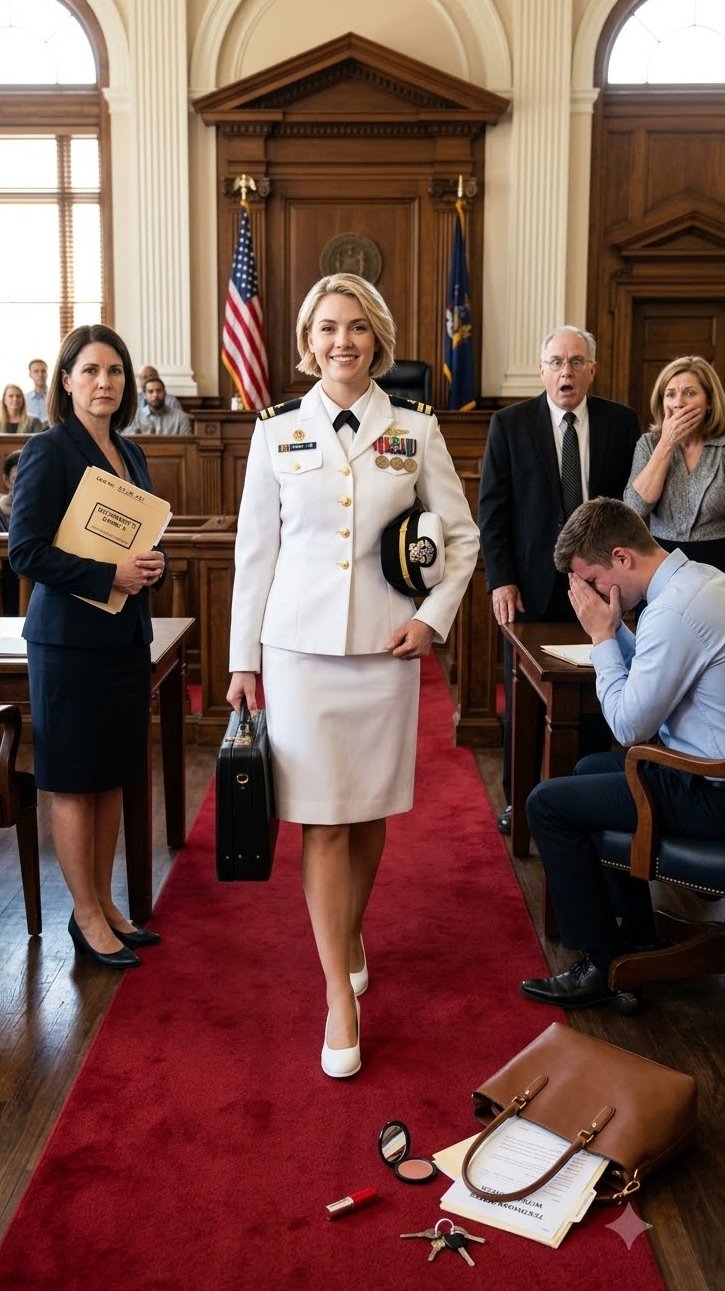
My polished dress shoes struck the marble floor. Clack. Clack.
Before I even reached the wooden gate, my mother’s purse slipped from her lap, hitting the floor hard enough to echo. Half the gallery turned. My father rose halfway from his seat, his face draining of blood, caught in a purgatory between shock and pure panic. Carter turned around. He saw the crisp white ceremonial uniform. He saw the gold rank insignia on my shoulders. He saw the rows of ribbons on my chest. In that fraction of a second, watching his jaw slacken, I saw a man finally understand what a witness stand could do to a lie.
The courtroom went dead silent. The prosecutor, Sarah Jenkins, stepped forward, lifted a manila folder, and pointed to the microphone.
“Please state your name and rank for the record.”
I leaned in. “Lieutenant Commander Eleanor Ashford, United States Navy.”
I saw Carter’s lead defense attorney—a predatory reptile in a gray pinstripe suit named Harrison Vance—scribble something furiously on a legal pad. Vance suddenly shot to his feet, knocking his chair back with a loud screech.
“Objection, Your Honor!” Vance’s voice boomed. “The defense moves for an immediate recess and the disqualification of this witness based on newly acquired, highly sensitive medical evidence regarding her mental competency!”
I felt a cold prickle at the base of my neck. Carter wasn’t just going to sit there and lose. He was going to bury me all over again.
The judge granted a two-hour recess, throwing the courtroom into a frantic buzz. I was ushered into a small, windowless witness holding room that smelled of stale drywall and bleach.
When court resumed, the atmosphere had shifted from shock to a predatory anticipation. Jenkins guided me through my actual service record, establishing the theft of my identity. I kept my voice measured, factual. But the real war began when Harrison Vance stepped up for cross-examination.
“Commander Ashford,” Vance began, prowling the space between the podium and the jury box. “An impressive uniform. Truly. But isn’t it true that the military is currently evaluating you for severe PTSD?”
“I have undergone standard post-deployment evaluations, like any service member,” I replied, my voice steady.
“Standard?” Vance whipped out a piece of paper. “I have here an affidavit from a private psychiatric consultant hired by your brother out of deep concern for your well-being. It details a history of paranoia, delusions of grandeur, and an obsessive jealousy regarding your brother’s financial success.”
“Objection! Hearsay, inflammatory!” Jenkins shouted.
“Sustained. Mr. Vance, tread carefully.”
But the poison was already in the water. Vance spent the next hour twisting every piece of my life. He painted my ten-year absence not as an escape from a toxic lie, but as a deliberate, psychotic estrangement. He made my intelligence work sound like the paranoid delusions of a broken mind.
Then came the knife twist. To corroborate his narrative, Vance called my parents to the stand as character witnesses for the defense.
I sat in the gallery, my nails digging into my palms, as my mother, Evelyn, took the oath. Her hands were shaking, but when she looked at Carter, her expression hardened with a desperate, protective instinct.
“Mrs. Ashford,” Vance asked softly. “When Eleanor left home ten years ago, what was her mental state?”
My mother swallowed hard. She didn’t look at me. “She… she was unwell. She was erratic. She yelled at Carter constantly. She couldn’t handle the pressure of the military, and when she came home, she was making up stories. Carter tried to help her. He always tried to help her.”
The betrayal felt physical, like a cracked rib pressing into my lung. Even now, facing federal prison, they were choosing the lie. They were choosing the son who had robbed them over the daughter who had survived them.
My father’s testimony was worse. William Ashford sat tall, projecting the weary sorrow of a patriarch who had done his best. “Eleanor has always had a vindictive streak,” he lied smoothly to the jury. “She saw Carter building Harbor Shield, doing the very things she failed to do, and it broke her. I believe she’s concocted this entire identity theft story to ruin him.”
By the time court adjourned for the day, the jury looked confused, sympathetic to the tearful older couple. Carter shot me a smug, almost imperceptible smirk as he buttoned his suit jacket.
I walked out into the echoing hallway, feeling the familiar, suffocating weight of being the family outcast. I was heading toward the elevator when a heavy hand caught the door. It was Harrison Vance. He slipped inside the elevator car with me and hit the emergency stop button. The machine lurched to a halt.
“What do you want, Vance?” I snapped, my training taking over to keep my heart rate down.
Vance smiled, a thin, reptilian stretching of his lips. The air in the cab smelled heavily of peppermint and expensive scotch. He pulled a folded document from his breast pocket and tapped it against the steel handrail.
“Your brother is a survivor, Commander,” Vance murmured. “And he’s offering you one last chance to be a good daughter.”
“I don’t negotiate with criminals.”
“You will today.” Vance stepped closer, unfolding the paper. “Because this isn’t just about your parents going to prison. It’s about you.” He held up a banking ledger. “We found a Cayman Islands offshore account in the name of Eleanor Ashford. It seems that for the past five years, you’ve been receiving quiet, untraceable dividends from Harbor Shield Recovery.”
I stared at the paper. It was a flawless forgery, meticulously engineered to make me look like a co-conspirator.
“If you get back on that stand tomorrow and admit you ‘exaggerated’ your testimony due to emotional distress, Carter takes a plea deal for a minor administrative error,” Vance whispered. “But if you push this fraud charge, the DOJ will freeze all of Harbor Shield’s assets. Including the collateral. Your parents co-signed Carter’s federal loans. They will die in a federal penitentiary. And I will introduce this ledger into evidence, proving that you didn’t come here for justice, Commander. You came here to extort your brother for a bigger cut.”
Vance hit the emergency button again, and the elevator began to descend.
“You have until 9:00 AM tomorrow,” Vance whispered as the doors slid open. “Destroy your brother, and you put your mother in a cage and yourself in a military tribunal. Sleep well.”
I walked out into the lobby, the cold marble suddenly feeling like the floor of a tomb.
The hotel room was suffocatingly quiet. I sat on the edge of the bed, the glow of my laptop casting long shadows against the textured wallpaper.
Vance’s ultimatum echoed in my skull. It was a flawless, sociopathic trap. Carter wasn’t just using the family as a human shield; he had fashioned a noose for my own neck. If I spoke the truth, I became the monster who sent her elderly parents to prison, and Vance would drag my naval career through the mud with his forged Cayman accounts. If I lied, I surrendered my name, my honor, and let Carter walk away with millions in stolen federal funds.
I paced the floor. My military training had taught me that when the enemy boxes you into a binary choice, you don’t choose. You blow up the box.
I opened my encrypted drive. I had access to the unredacted discovery files the DOJ had gathered on Harbor Shield Recovery. I started digging. Not into my own forged files—those were airtight, meticulously crafted by Carter to look like I was a silent partner. I needed to look at where the money went after it cleared the federal accounts.
Hours bled away. My eyes burned as I sifted through thousands of pages of bank statements, shell company registrations, and deleted emails the FBI cyber division had recovered. Carter was smart. He had layered the money through offshore accounts and a network of fake subcontractors.
But nobody is perfect. Especially not a narcissist.
At 3:15 AM, I noticed a discrepancy. It was a recurring operational expense logged as “Veteran Outreach Logistics,” paid to a firm called Vanguard Consultancy. I ran the tax ID. It didn’t exist. I ran the routing numbers.
My breath caught in my throat. It wasn’t just my name Carter had stolen.
I found a hidden ledger buried in a mislabeled system file. Harbor Shield wasn’t just faking a veteran-owned status with my identity. Carter had been actively recruiting actual, struggling veterans—men and women returning with traumatic brain injuries, amputations, and severe financial distress. He offered them “employment” in his company, required them to hand over their Social Security numbers and VA benefit routing information for “payroll setup.”
He never hired them. He used their identities to secure massive, tax-free minority-business grants from the state. When the money came in, he funneled it out, leaving the veterans with ruined credit scores, tax liabilities they couldn’t pay, and in two cases, foreclosures on their homes.
Carter wasn’t just a liar. He was a parasite feeding on the most vulnerable people in the country.
I felt a cold, terrifying clarity wash over me. I kept digging, tracing the digital signatures on the Vanguard Consultancy authorizations. I needed to know who was helping Carter move the money stateside. And then, I looked back at the routing numbers. I pulled up a digital photograph I had snapped of the fake Cayman Islands ledger Vance had threatened me with in the elevator.
I overlaid the routing numbers. A slow, predatory smile touched my lips. Vance was so busy trying to frame me that he had used one of Carter’s own dummy shell routing paths to generate the fake document.
I opened an archived audio file attached to an email thread dated five years ago, found deep within the Vanguard server backups. The subject line was simply: Tax season headache.
I clicked play. The audio was scratchy, recorded on a phone in an echoing room.
“You’re moving it too fast, Carter.”
The voice froze the blood in my veins.
“The IRS flags deposits over ten thousand. You have to break the Vanguard payments down. Under seven grand. Stagger them. If you keep pulling from the veterans’ dummy accounts like this, the feds will audit the whole structure.”
“I need the liquidity, Dad,” Carter’s voice whined in response.
“I don’t care what you need,” William Ashford snapped back. “I didn’t sell your grandfather’s estate and pledge my retirement fund to watch you get sloppy. Eleanor is out of the picture. Her ghost profile is clean. Keep using it, but structure the damn cash before you get us both indicted.”
I slammed the laptop shut. The silence in the room was deafening.
My parents hadn’t been tricked. My father wasn’t a victim of his son’s manipulation. William had known. For five years, he had known my identity was stolen, that Carter was bleeding real veterans dry, and he had actively coached him on how to launder the money to protect his own investments.
The sun began to bleed through the hotel curtains, casting a sickly gray light across the floor. My phone buzzed on the nightstand. A text from Jenkins: Court resumes at 9. See you in prep.
I slipped my uniform jacket on. The gold buttons felt heavy, like anchors. I possessed the one thing that could obliterate Carter’s defense, and the key to turning Vance’s blackmail against him. But pulling this trigger wouldn’t just send my brother to prison. It would incinerate the very foundation of my family.
The atmosphere in the courtroom was thick with tension when the bailiff called us to order. The jury filed in, their faces tight. They were expecting the tragic climax of a family drama. They were expecting me to crack.
Vance sat at the defense table, leaning back with a smug confidence. He caught my eye and tapped his watch. A silent reminder of the trap. Save your parents. Ruin yourself.
My father sat in the gallery, his face a mask of solemn grief. My mother was weeping softly into a tissue. It was an incredible performance.
The prosecutor stood up. “The prosecution recalls Commander Ashford for redirect.”
I walked to the stand. Every step felt like I was walking to a firing squad. I placed my hand on the Bible, swore the oath again, and sat down.
“Commander,” Jenkins began, her tone gentle but firm. “Yesterday, the defense presented a narrative that you are mentally unstable. That this entire trial is born of a vindictive grudge against your family. Do you wish to change your testimony?”
I looked at Carter. He was practically vibrating with anticipation. I looked at my father, who offered me a sad, patronizing nod. Give up, little girl. We won.
“No,” I said, my voice cutting through the quiet room like a scalpel. “My testimony stands. But I do have a correction to make regarding the evidence Mr. Vance planned to introduce to frame me as a co-conspirator.”
Vance was on his feet instantly, his face turning an ugly shade of puce. “Objection! This is redirect, Your Honor! The witness is hallucinating!”
“Your Honor,” Jenkins intervened, looking slightly confused herself, as I hadn’t told her what I was about to do. “The defense opened the door to the witness’s state of mind and her motivations. She has the right to clarify.”
“I’ll allow it,” the judge rumbled. “But keep it tight, Commander.”
I turned directly to the jury. “Last night, the defense attorney threatened me with a forged ledger, attempting to prove I held an offshore account in the Cayman Islands funded by Harbor Shield. But as an active-duty intelligence officer, I am trained to look at the metadata.”
I pulled a printed packet from my jacket pocket and handed it to the bailiff to pass to the judge.
“The routing numbers on Mr. Vance’s forged document,” I stated, my voice echoing off the mahogany walls, “match a shell company called Vanguard Consultancy. A company my brother used not just to launder money, but to steal the identities of forty-two disabled combat veterans.”
Chaos erupted. Carter slammed his hands on the table, his carefully constructed mask shattering into pure, animalistic panic. “She’s lying! She’s crazy!” he screamed.
“I have the banking routes,” I raised my voice over the din. “I have the forged signatures that saddled wounded men with tax liabilities and drove them into foreclosure. I am turning the Vanguard decryption keys over to the Department of Justice.”
Vance was backing away from the defense table, his eyes wide as he realized his attempt at extortion had just handed me the missing link to the federal money laundering chain. He had accidentally provided the smoking gun.
“And,” I paused, letting my eyes lock onto my father in the gallery. “I have an audio recording from five years ago. Proof that William Ashford not only knew about the fraud, but actively instructed his son on how to launder the stolen money to evade IRS detection.”
My mother screamed. It wasn’t a theatrical cry; it was a guttural wail of absolute terror. She turned to my father, hitting his chest with her fists. “What did you do? William, what did you do?!”
My father couldn’t speak. His mouth opened and closed like a suffocating fish. He looked at Carter, and in that moment, the unbreakable Ashford family alliance devoured itself.
“It was his idea!” Carter suddenly shrieked, pointing wildly at our father, his voice cracking hysterically. “He made me do it! He said the company was bleeding money! But I didn’t fake her military discharge!” Carter spun toward my mother, his eyes wild with betrayal. “Tell them! Tell them you were the one who traced her handwriting! You forged the letters to the Navy, Mom! You did it so Dad would keep funding me!”
“You ungrateful little bastard!” William roared. The aristocratic veneer vanished entirely. My father lunged forward over the gallery railing, his face twisted in a feral rage. He tackled Carter to the floor before two federal marshals could intervene.
The sound of flesh hitting bone echoed through the courtroom as my father punched his golden boy in the jaw.
The judge was hammering his gavel so hard the wood splintered. “Order! Order in this court! Bailiff, secure the defendants! I want this courtroom cleared immediately!”
I sat perfectly still on the witness stand, my hands folded in my lap, watching the fire I had set burn everything to the ground. The marshals dragged my father off Carter, slamming him against the wooden banister and slapping handcuffs on his wrists. Carter was sobbing on the carpet, blood leaking from his nose, begging Vance to make a deal. But Vance had already grabbed his briefcase and was sprinting toward the side exit, knowing his own disbarment—and likely indictment—was imminent.
As the courtroom emptied, Jenkins, the prosecutor, walked up to the stand. She looked at the packet in my hand, then up at my face.
“You knew,” she whispered, her eyes wide with a mixture of awe and horror. “You knew they were going to come after you in the dark, so you rigged the entire room to blow.”
“I brought the truth,” I said quietly.
“The DOJ is going to indict your parents, your brother, and likely half his legal team by the end of the day, Eleanor. There’s no walking this back.”
I stood up, smoothing the front of my white uniform. “I know.”
But the real ending wasn’t going to happen in front of a judge. It was going to happen outside, in the cold light of day.
Three hours later, the courthouse had transformed into a fortress of flashing police lights and aggressive news vans. The story had leaked. It was no longer just a white-collar fraud case; it was a massive betrayal of American veterans by a prominent local family, featuring a courtroom brawl that would lead the evening news.
I walked out the side entrance, flanked by two military police officers who had been dispatched from the local base once the severity of my testimony was confirmed. The Boston air was biting, smelling of incoming rain and exhaust fumes.
I was halfway down the stone steps when I heard her voice.
“Eleanor! Please!”
I stopped. The MP beside me shifted his stance, but I held up a hand.
Standing by a black town car, shivering in the wind without her coat, was my mother. Her flawless makeup was ruined, streaked in black lines down her cheeks. The haughty, untouchable aura of Evelyn Ashford had completely evaporated, leaving behind a terrified, hollowed-out old woman.
Behind her, looking out through the tinted window of the car, was my father. He had posted bail, but his face was gray, a dark bruise blossoming along his jawline from where the marshals had restrained him. He looked like a corpse waiting to be buried.
I walked slowly down the remaining steps until I stood a few feet from her.
“Eleanor,” she choked out, her hands trembling. She reached into her pocket and pulled something out. It was a vintage, silver pocket watch. My grandfather’s watch. The one piece of the estate she hadn’t sold, the heirloom she had promised me when I was a little girl before I became the family disappointment.
She held it out to me like a talisman, her eyes desperate. “I kept it for you. See? I always kept it for you. Please, sweetheart. You have to tell them… you have to tell the prosecutors your father was confused. That Carter was just… misguided. They took our passports. They froze the bank accounts. We have nothing.”
I looked at the silver watch glinting in the dull afternoon light. Ten years ago, the sight of it might have broken me. It might have made me believe she loved me.
“You have what you built, Mother,” I said, my voice devoid of anger, devoid of anything at all. It was just a cold statement of fact.
“We are your family!” she shrieked, a flash of her old manipulative anger rising to the surface before drowning in desperation again. “You can’t do this to your own blood! We protected you!”
“Protected me?” The absurdity of the word didn’t even warrant a laugh. “You erased me. For ten years, you let the world believe I was a failure so you wouldn’t have to admit your golden boy was a thief. You traced my signature to rob me of my dignity, and you sold my grandfather’s home to fund a parasite.”
“We were trying to save Carter!” she sobbed, taking a step forward.
“And I was trying to save the men and women Carter was destroying,” I replied, stepping back. I looked down at her outstretched hand and slapped it away.
The silver pocket watch hit the concrete with a sharp crack, the glass face shattering into a dozen pieces.
My mother gasped, dropping to her knees to gather the broken pieces of silver.
“You made a choice ten years ago, Evelyn,” I said, looking down at her. “You looked at a forged piece of paper and decided it was worth more than your daughter. Then you made another choice to steal from people who actually bled for this country.”
I looked past her, making direct eye contact with my father through the glass of the car window. He slowly lowered his head, staring at his lap. He knew it was over. There were no more lies left to spin.
“We’re sorry,” she whispered, kneeling on the cold concrete, clutching the broken watch to her chest. “Please, Eleanor. You’re our daughter.”
I looked down at the woman who had birthed me, feeling absolutely nothing. The fault line in my chest that had ached for a decade had finally fused shut.
“The daughter you’re looking for died ten years ago,” I said softly, the words final and absolute. “You didn’t lose me today. You buried me yourselves to make room for a thief. I am Lieutenant Commander Ashford. And we have nothing left to say to each other.”
I turned my back on her weeping frame and walked toward the waiting military jeep.
Carter Ashford was sentenced to twenty-five years in federal prison for identity theft, wire fraud, and the exploitation of veterans. He broke down during sentencing, crying for a mother who couldn’t comfort him. Harrison Vance was disbarred and indicted for evidence tampering and extortion, his predatory career ended by the very metadata he had tried to weaponize against me.
Evelyn and William Ashford didn’t fare much better. The federal government seized everything to pay restitution to the forty-two veterans Carter had defrauded. My parents pled guilty to conspiracy to avoid prison time, accepting five years of house arrest and complete financial ruin. They moved into a cramped, two-bedroom apartment on the outskirts of the city, utterly ostracized by the high society they had worshipped.
I never saw them again.
Six months after the trial, I stood on the deck of an aircraft carrier, the salt spray stinging my face, the roar of jet engines vibrating through the steel beneath my boots. The sun was setting, painting the horizon in violent streaks of orange and bruised purple.
I looked down at the gold rank on my collar. It wasn’t just a piece of metal. It was proof of existence. Proof of survival.
They had tried to bury me in a shallow grave of lies, hoping the dirt would silence me. They forgot that some people are seeds.
I breathed in the cold ocean air, surrounded by the men and women who had actually earned the right to call me family. The ones who didn’t care about the Ashford name, but cared about the woman wearing it. I was finally, truly, alive.
If you want more stories like this, or if you’d like to share your thoughts about what you would have done in my situation, I’d love to hear from you. Your perspective helps these stories reach more people, so don’t be shy about commenting or sharing.