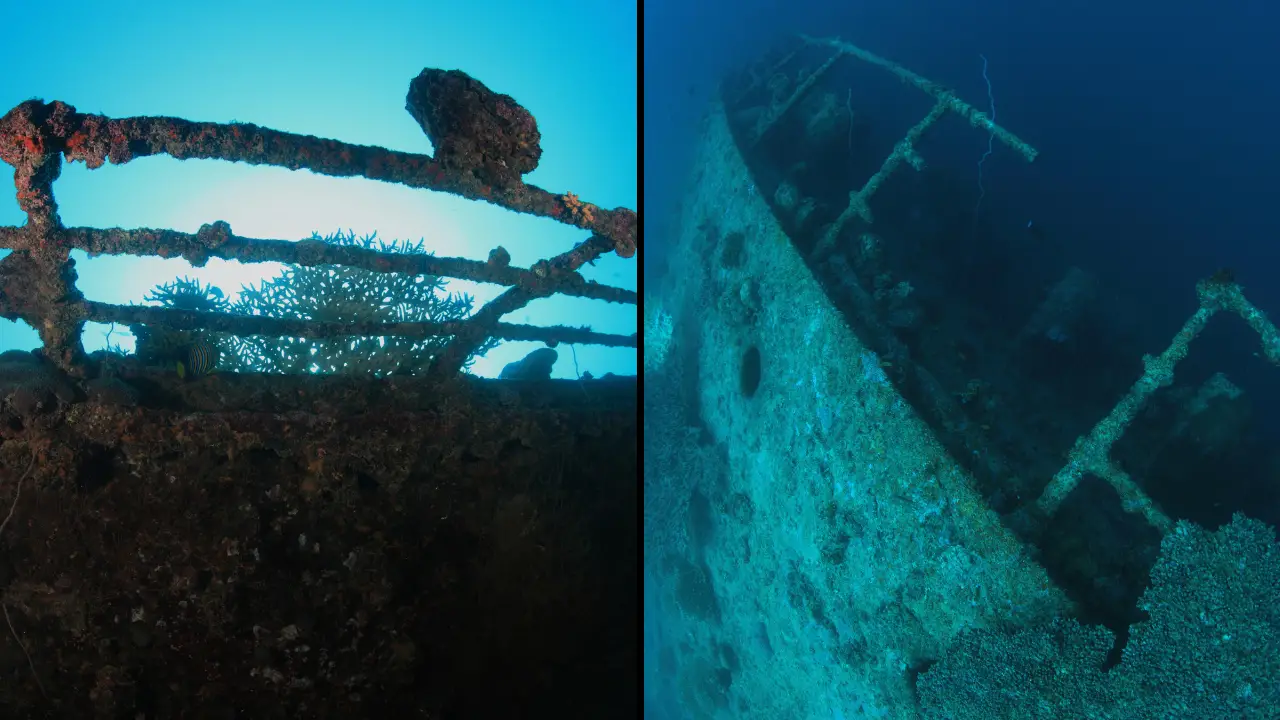

Credit: Adobe Stock
Expert Shares The Reason Nobody Has Ever Found Human Remains Inside The Titanic
Experts have shared the reason that nobody has ever found human remains inside the Titanic.
The tragic sinking of the RMS Titanic remains one of the most captivating and heavily documented disasters in human history.
When the ‘unsinkable’ luxury liner struck an iceberg on its maiden voyage on April 14, 1912, it plunged to the bottom of the North Atlantic Ocean, taking more than 1,500 lives with it.
For decades, the ship lay undisturbed in pitch-black isolation until its discovery in 1985.
Since then, numerous expeditions, advanced robotic rovers, and manned submersibles have meticulously cataloged the wreckage.
Yet, despite the staggering loss of life, explorer after explorer has returned with the same unsettling report: not a single skeleton or trace of human bone has ever been confirmed inside the ship.
This baffling mystery recently resurfaced on social media, sparking intense curiosity and debate on platforms like Reddit.
An inquisitive user prompted a fascinating discussion by asking: “Have any actual human remains ever been seen/recovered from the wreck since her discovery?”
The answers provided by historians, deep-sea explorers, and oceanographers offer a chilling look at the destructive forces of the deep sea.
A ghostly landscape of shoes and clothing
When deep-sea explorers navigate the decaying corridors and debris fields of the Titanic, they are frequently confronted by eerie reminders of the passengers who once walked its decks.
Rather than skeletons, the ocean floor is dotted with perfectly preserved personal items, most notably pairs of shoes and leather garments.
These items lie in positions that heavily imply they were once worn by individuals who met their end as the ship went down.
Legendary Hollywood director James Cameron, who directed the 1997 blockbuster Titanic, has famously explored the wreckage 33 times.
Over the course of his extensive deep-sea career, Cameron has spent more hours aboard the vessel than its actual captain ever did.
Speaking to The New York Times in 2012, Cameron confirmed the total absence of skeletal remains, stating: “I’ve seen zero human remains.”
He expanded on the ghostly phenomenon of the personal artifacts left behind, noting: “We’ve seen clothing. We’ve seen pairs of shoes, which would strongly suggest there was a body there at one point. But we’ve never seen any human remains.”
On Reddit, enthusiasts and amateur historians echoed this sentiment, referencing the experiences of Dr. Robert Ballard, the oceanographer who first discovered the wreck.
One commenter pointed out: “Closest thing Ballard had seen at the wreck were pairs of shoes that landed close together as if the body they belonged to decayed, and that’s all that’s left.”
However, the user also provided an alternative, less macabre explanation for some of these shoe pairings, adding: “Although I have also heard that the shoe cleaners would tie them together and leave them outside the stateroom for the passengers overnight, and it could have just been a pair of those kind.”
Even when expeditions encounter highly suggestive configurations of clothing, they choose to respect the integrity of the site as a maritime grave.
Another Reddit user recounted a particularly gripping story from an expedition: “During one expedition there was a leather raincoat found on the ocean floor with two boots poking out of it, and a conspicuous bulge in the middle of the coat.”
Out of respect and decorum, the crew desisted from investigating further. “In the interests of good taste, they didn’t pick it up to see what was underneath, but I can imagine a similar scenario leading to a plausible situation where human remains may have survived in some capacity,” the user shared.
The chemistry of the deep ocean
While the haunting placement of clothing fuels the imagination, science provides a definitive answer as to why the bones themselves are completely missing.
The primary reason is a chemical threshold unique to the extreme depths of the world‘s oceans.
The Titanic sits roughly 12,500 feet (3,800 meters) below the ocean surface, an environment characterized by immense pressure, freezing temperatures, and a distinct lack of essential minerals.

Dr. Robert Ballard explained this phenomenon clearly during an interview with NPR, shedding light on the harsh chemical reality of the deep sea.
“The issue you have to deal with is, at depth below about 3,000 feet [914 meters], you pass below what’s called the calcium carbonate compensation depth,” Ballard stated.
This boundary lines the point where the water chemistry drastically shifts. “And the water in the deep sea is undersaturated in calcium carbonate, which is mostly, you know, what bones are made of,” Ballard continued.
Because the water at this depth is starved of calcium carbonate, it acts like an acid toward alkaline structures, dissolving them over time.
Ballard noted that this environmental reality applies to other famous deep-sea shipwrecks as well: “For example, on the Titanic and on the Bismarck, those ships are below the calcium carbonate compensation depth, so once the critters eat their flesh and expose the bones, the bones dissolve.”
A Redditor summarized this scientific reality in more direct terms, writing: “She was discovered in 1985. Any human remains (if any) would be long gone. Flesh doesn’t last long 2.5 miles underwater.”
Once scavenging marine life consumed the soft tissues of the victims, the exposed skeletons were completely vulnerable to the surrounding water, dissolving into nothingness decades before human eyes ever looked upon the wreck again.
Scavengers and the timeline of decay
To fully understand the disappearance of the bodies, one must look at the rapid timeline of biological decomposition in the deep ocean.
The deep sea is not a sterile environment; it is home to specialized ecosystems of organisms that rely on organic material falling from the surface to survive.
When a large volume of organic matter, such as the victims of a shipwreck, reaches the ocean floor, it triggers a feeding frenzy among deep-sea scavengers.
Creatures like amphipods, hagfish, and specialized bone-eating worms (such as Osedax) are highly efficient at consuming soft tissue.
Within a matter of weeks or months, these organisms would have completely stripped the flesh from any bodies inside or around the Titanic.
Once the flesh was gone, the chemical dissolution of the bones began. Because the Titanic was not discovered until 73 years after it sank, there was more than enough time for nature to entirely erase the biological evidence of the tragedy.
Interestingly, leather items like boots, shoes, and coats survived because of the heavy chemical tanning processes used in the early 20th century.
The tannins used to cure the leather made the material highly unpalatable to marine scavengers, allowing the footwear to remain intact as a grim monument to the lives lost, while the bodies themselves vanished.
The midnight storm
While deep-sea chemistry explains why bones inside the ship vanished, another crucial factor explains why bodies aren’t found in the immediate debris field outside the vessel.
According to historical data compiled by maritime researchers and experts at Titanic Universe, the meteorological conditions on the night of April 14 and the early morning of April 15, 1912, played a massive role in distributing the casualties.
When the Titanic went down, hundreds of passengers plunged into the freezing water wearing cork-filled life jackets.
While these life preservers kept the victims afloat initially, a powerful, chaotic storm swept through the disaster area shortly after the ship sank.
The fierce winds and strong ocean currents acted quickly, dragging the floating bodies away from the direct site of the sinking.
As a result, the casualties were scattered across a vast, multi-mile radius of the North Atlantic Ocean. When the life jackets eventually degraded or waterlogged weeks later, the bodies sank individually across a massive area of the seafloor rather than clustering around the main hull.
This immense dispersion means that any skeletal remains that did survive the chemical dissolution would be miles away from the wreckage, hidden in the vast, uncharted expanses of the ocean floor, making them virtually impossible for researchers to ever locate.
Related Article: Why Champagne Bottles Didn’t Implode On The Titanic
Related Article: Mom Horrified To ‘Discover Son’s Dead Body’ On Display At Museum
Want more stuff like this?
Get the best viral stories straight into your inbox!