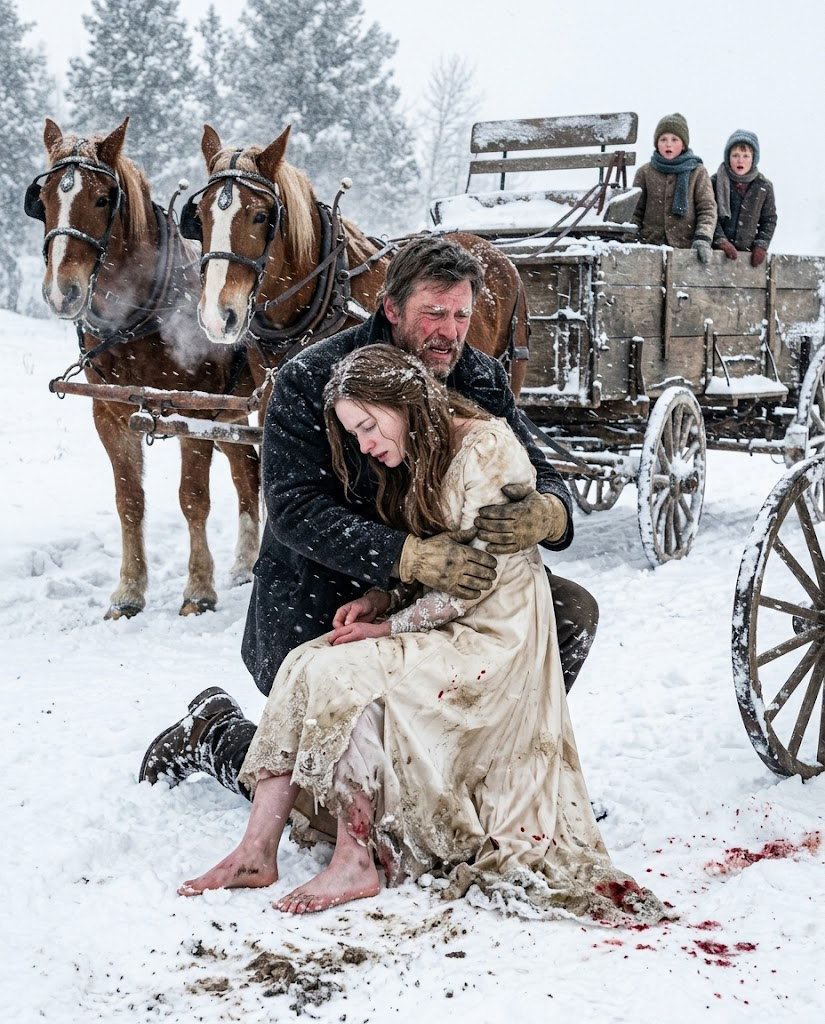
“Papa… it’s her,” the rancher whispered, his voice breaking as he watched the barefoot bride collapse into the snow at the edge of his land.
In that instant, everything he thought he had buried came rushing back, and the entire ranch went silent.
The storm had been building since late afternoon, though Silas Brennan had tried not to look at it too closely.
A man with two boys, a winter road, and a wagon full of necessities did not have the luxury of fear.
He had flour wrapped in a sack behind the seat, coffee tucked beneath it, lamp oil packed tight so it would not roll, and two sons who were trying hard not to complain.
Eli was seven and old enough to believe he should be brave.
Sam was five and still small enough to disappear beneath a blanket when the world turned too large.
The wool blanket lay over both of them, tucked up to their chins, but the wind kept finding ways to lift its edges.
Snow needled through every gap in the wagon board.
It clung to Silas’s hat brim and froze in the roughness of his beard.
The horses knew the road home, but the road was turning into a rumor under them.
“Papa, I’m cold,” Sam said.
His voice came muffled from under the blanket, thin and scared.
Silas kept one hand tight on the reins and the other braced near his knee.
“I know, son. Keep yourself covered. We’re almost there.”
Eli looked up at him.
Silas did not scold him.
The boy was tired, and tired children told the truth in a way grown men often avoided.
“I said it because I meant it,” Silas answered. “Now keep hold of your brother.”
The wagon wheels groaned in the frozen ruts.
Each turn sounded like old wood begging not to break.
A little before dark, the sky had gone from iron gray to white violence, rolling across the Montana plain with a force that made distance disappear.
Silas had seen storms come hard before.
This one came mean.
It came with teeth.
He had wanted to leave town earlier.
He had wanted to skip the last purchase at the mercantile and ride straight for home.
But winter was not moved by wanting, and neither were children’s bellies.
So he had bought what the house needed, loaded the wagon, tied the canvas tight, and told himself the team could outrun the worst of it.
Now the team was no longer outrunning anything.
The horses bent their heads into the blast, nostrils steaming, manes stiff with ice.
The leather reins had turned hard in his grip.
The smell of horse sweat and wet wool mixed with the bitter cold until every breath felt like work.
“Don’t let the blanket loose,” Silas said.
Eli pulled the edge tighter around Sam.
For a while, there was only the sound of the storm and the strained creak of the wagon.
Then Eli straightened.
His hand came out from the blanket and caught Silas by the sleeve.
“Papa.”
Silas heard it before he understood it.
Not a complaint.
Not a question.
A warning.
“What?”
“There’s something ahead.”
Silas leaned forward.
Snow battered his face.
The road was nearly gone, swallowed by white drifts and wind-driven powder.
The world had lost its fences, its ditches, its familiar turns.
“There’s nothing,” he said, though he kept looking.
“Yes there is.”
Eli’s voice dropped.
“It’s standing in the road.”
Silas drew the reins back.
The horses stopped too quickly, grateful for the command, heads tossing under the harness.
The wagon lurched, then settled with a heavy wooden sigh.
Silas stared through the storm.
At first the shape seemed to be a fence post or a broken limb, something dark and vertical caught in the whiteness.
Then it shifted.
Not much.
Just enough.
A person.
A woman.
She stood in the road as if the snow had grown up around her.
Her arms hung loose at her sides.
Her head was bowed.
Dark hair was plastered to her cheeks and throat, heavy with sleet.
For one strange second Silas could not understand what he was seeing.
Women did not stand alone in a blizzard on that road.
They did not stand without a shawl or coat.
They did not stand in silk.
Then the wind struck the gown against her legs, and the truth showed itself.
A wedding dress.
Cream-colored, fine-made, ruined by the storm.
The lace at the collar had gone gray with wet.
The beadwork along the bodice caught what little light remained, glittering coldly beneath the snow.
The hem was frozen stiff and ragged from dragging.
One shoulder had torn.
The sight of it was so wrong that Silas felt his mind refuse it.
“Papa?” Eli whispered.
Silas put the reins into his son’s hands.
“Hold these.”
Eli shook his head once, small and frightened.
“I can’t.”
“You can.”
“But—”
“Hold them, Eli. Do not let go.”
The boy closed both hands around the leather.
Silas climbed down from the wagon.
The snow took him to the shin with the first step.
Cold rushed up his legs and through the seams of his boots, but he moved toward the woman without stopping.
“Ma’am,” he called.
The storm flung the word back at him.
She did not lift her head.
Silas took another step.
Then another.
He saw her feet.
Bare.
Not poorly shod.
Not in thin slippers.
Bare against the snow, the skin pale and damaged from the cold.
Small red stains marked the white beneath her, each one a hard accusation against whatever had driven her there.
Silas felt anger before he even knew who she was.
It rose clean and sudden in him, hotter than fear.
No decent soul let a bride walk barefoot into a storm.
No decent soul let a woman get close enough to death that she stood still because falling was too much effort.
“Can you hear me?” he said.
Her hand trembled.
Only once.
The motion was so slight he might have missed it if he had not been close.
Then her knees gave out.
Silas lunged.
He caught her before she struck the road, one arm around her back, the other under her shoulder.
She came down against him with the terrible weight of someone who had no strength left to help herself.
Silk, ice, wet hair, cold skin.
That was all he could feel at first.
He dropped to one knee, turning his body between her and the wind.
Behind him, Sam screamed.
“She fell!”
“Stay in the wagon,” Silas shouted.
But his voice did not sound like his own.
He pulled one glove off with his teeth and pressed two fingers to the side of the woman’s throat.
Her skin was colder than any living skin ought to be.
The storm raged around them.
The horses stamped.
The wagon boards creaked.
Eli called his name, but Silas barely heard him.
For one long second, there was nothing beneath his fingers.
Then he felt it.
A pulse.
Weak.
Thin.
Fighting.
Silas breathed once, hard.
“Alive,” he said, though he did not know whether the boys could hear him.
The woman’s face was hidden by wet strands of hair.
He brushed them back enough to see her mouth, blue at the edges, and the hollow of her cheek.
Something inside him faltered.
Not recognition.
Not yet.
Something worse.
A memory trying to wake.
The curve of that cheek.
The line of that brow.
The shape of a mouth he had once trained himself not to remember.
No, he thought.
The word came fast and useless.
No.
He gathered her closer, trying to cover her with his coat, but the gesture brought her face nearer.
Snow melted on her lashes.
Her lips moved without sound.
Three years opened beneath him.
He saw a gate at dusk.
He saw a young woman turn back once before leaving.
He saw himself standing too proud, too hurt, too certain that silence meant betrayal.
He had not spoken her name after that.
Not to the boys.
Not in town.
Not even alone, when memory came with the sound of winter working at the walls.
He had buried her without a coffin, without a grave, without a prayer, because she had not died.
She had simply vanished.
That had been harder in its own way.
Death left a marker.
Vanishing left a man arguing with ghosts.
She was supposed to have gone on with another life.
She was supposed to have married another man.
She was supposed to have become a story Silas could tell himself did not matter anymore.
Yet here she was in his arms, in a wedding gown, barefoot in a killing storm.
“Papa,” Eli called. “Do we bring her home?”
That broke something loose in him.
Home.
The word struck hard because it was simple.
A child had asked the only question that mattered.
Not who she was.
Not what she had done.
Not why she had come.
Only whether she would be left in the road.
“No one stays out here,” Silas said.
He shifted his hold and tried to stand.
The snow fought him.
The woman’s dress had iced at the hem, catching under his boot.
He freed it with one hard pull, careful not to tear it worse.
Sam was crying openly now.
Eli was still on the wagon seat, hands locked around the reins, his face white beneath his cap.
Silas looked at his older boy and saw fear trying to become obedience.
“Keep the team steady,” he said. “You’re doing fine.”
“I don’t want to drop them.”
“You won’t.”
The boy nodded, though tears stood in his eyes.
Silas lifted the woman higher and carried her toward the wagon.
She made a small sound then.
Not a word.
A breath broken by pain and cold.
It went through him like a knife.
He had heard that sound once before, in a different season, when she had laughed too hard and then tried to hide the tears that came after.
He had known her moods by then.
Or thought he had.
He had known when she wanted to speak and when she needed silence.
He had known the way she held warmth in both hands on cold mornings.
He had known the way she watched bad weather from a doorway, not afraid of it exactly, but respectful.
And still he had not known enough to keep her from disappearing.
At the wagon, Eli looked down at the bride and then at his father.
“Do you know her?”
Silas could not answer.
The honest answer was too large.
The false one would have shamed him.
He set one boot on the wagon step and handed the woman up as carefully as he could, settling her against the sideboard near the boys.
“Blanket,” he ordered.
Eli let the reins rest across the brake lever long enough to shove the wool blanket toward him, then grabbed the leather again.
Sam crawled backward, trembling.
“Is she dead?”
“No,” Silas said. “Not if I can help it.”
He wrapped the blanket over the woman’s shoulders and around her feet.
The ruined wedding gown looked almost gray under the snowmelt.
The lace had gone limp.
The beadwork shivered under his hand as if it, too, had been frightened.
Silas climbed back to the seat and took the reins.
His hands were shaking now.
He hated that the boys could see it.
He had held a team through flash storms.
He had worked through fever.
He had swallowed grief until it behaved like duty.
But this woman’s face had undone what weather and loneliness had not.
The horses leaned into the harness when he clicked his tongue.
The wagon started moving again.
Home was closer than it felt.
The ranch lay beyond the last rise, where the road crossed the edge of his land and dipped toward the buildings.
On a clear day, he could have seen the dark shape of the barn and the smoke from the house.
That night there was only snow, but Silas knew every rut and hollow by memory.
He drove fast enough to matter and slow enough not to lose the wagon.
Behind him, under the blanket, the bride’s breathing rattled.
Each sound was a small bargain with God.
Sam had stopped crying, but only because he was watching her too closely.
Children knew when the room of the world had changed.
Even on a wagon.
Even in a blizzard.
Eli finally spoke again.
“Papa.”
Silas kept his eyes ahead.
“What?”
“She’s bleeding on the blanket.”
Silas’s jaw tightened.
“I know.”
“Her feet?”
“Yes.”
“Why didn’t she have shoes?”
Silas had no answer that would not put fear into a child.
So he gave the only answer he could.
“She came through more than she should have had to.”
Eli went quiet.
The horses climbed the rise, hooves slipping once before finding purchase.
Silas held them steady.
The wagon reached the boundary of his land, and the wind opened across the yard with a roar.
For a breath, everything seemed to pause.
The storm.
The wagon.
The boys.
The woman under the blanket.
Silas turned because he felt her move.
Her hand had come out from beneath the wool.
It searched blindly, fingers stiff and pale, until it found his coat sleeve.
She held on with the last strength in her body.
Silas looked down.
The wind shifted her hair away from her face.
There was no mercy left in not knowing.
He saw her fully then.
The woman who had vanished.
The woman he had sworn he would forget.
The woman who was supposed to be wearing that gown for another man, not dying in Silas Brennan’s wagon at the edge of his ranch.
His voice broke before he could stop it.
“Papa?” Eli whispered.
Silas stared at her, and every buried year rose in him at once.
Then the words left him, low and shaken.
“It’s her.”
The whole world seemed to hear it.
Sam stopped breathing for a second.
Eli’s fingers went white around the blanket.
The horses stood with their heads lowered, steam rolling from their nostrils into the snow.
No one spoke.
No one moved.
The bride’s eyelids fluttered.
Silas leaned closer, afraid to hope and more afraid not to.
Her lips parted.
The first sound was only air.
The second almost became his name.
He bent toward her, his hand still locked around the reins, his heart pounding like a fist against a closed door.
The bride tried again.
This time, one word trembled at the edge of her mouth.