1. Deep in the Congo’s Silent Forest
In the heart of the Congo Basin, where the air feels heavy with humidity and every sound seems to echo from another world, life moves in a rhythm older than memory itself. This is the land of mist-covered trees, broken sunlight, and constant survival. It is also a place where humans rarely stay long enough to be remembered.
Among those who did was a man named David.
He worked with a wildlife rescue unit operating deep in regions threatened by illegal hunting networks. Their mission was simple in words but brutal in reality: track down poachers, dismantle traps, and save whatever animals could still be saved.
Most days blurred into each other—long hikes through thick forest, sudden encounters with danger, and the quiet grief of arriving too late.
But one mission changed everything.
2. The Rescue That Changed Everything
During a raid on a hidden poaching camp, David’s team discovered something that stopped them cold.
Several primates had been captured and kept in inhumane conditions. Many were injured, dehydrated, and unable to even stand properly. The air inside the makeshift enclosure was heavy with fear.
Among them was a baby gorilla.
Small. Fragile. Barely clinging to life.
When the team entered, the baby gorilla didn’t run away like the others. Instead, it locked eyes with David.
And then it ran.
Not in fear—but in recognition, or something that looked very close to it.
It clung tightly to his leg, refusing to let go, as if it had already decided that this human was the only safe thing in a world that had already failed it.
David carefully lifted the animal into his arms. He didn’t think about protocols or distance or rules. He simply held it the way you hold something that might disappear if you loosen your grip.
A bottle of milk was prepared. The baby drank slowly. For the first time in who knows how long, its breathing steadied.
3. A Bond Formed in Silence
After the rescue, the young gorilla was transferred to a sanctuary designed for rehabilitation and long-term care.
David visited whenever his missions allowed.
He never made a spectacle of it. There were no photos, no announcements. Just quiet visits where he would sit nearby, sometimes speaking softly, sometimes saying nothing at all.
Over time, the gorilla grew stronger. It adapted to sanctuary life, learning the rhythms of safety instead of survival.
But the world outside the sanctuary was not kind.
David’s work continued across other regions. The fight against poaching never truly ended—it simply moved. Years passed. Then more years. And eventually, decades.
Life did what life always does: it carried him away.
4. Thirty-Five Years of Distance

By the time David returned to the sanctuary, he was older. Slower in movement, quieter in presence. The jungle had etched itself into his memory, but so had time.
He didn’t know what to expect.
Thirty-five years is not just a gap—it is a transformation. Animals grow. Behaviors change. Memory fades. Or so people believe.
As he stepped through the sanctuary path, surrounded by fencing and trees that felt both natural and controlled, he wondered if the gorilla he once held would even recognize him at all.
The staff led him toward the enclosure.
And then everything stopped.
5. The Moment of Recognition
Inside the habitat, the adult gorilla stood still.
For a brief second, there was silence—absolute, heavy silence, the kind that feels like the entire world is holding its breath.
Then it moved.
It turned its head slowly toward David.
And it ran.
Not cautiously. Not hesitantly. But with full force, breaking into a powerful charge that made the nearby staff instinctively step back in alarm.
But David didn’t move.
He knew that movement.
He had seen it once before—in a smaller body, in a desperate forest, in a moment where trust was born out of survival.
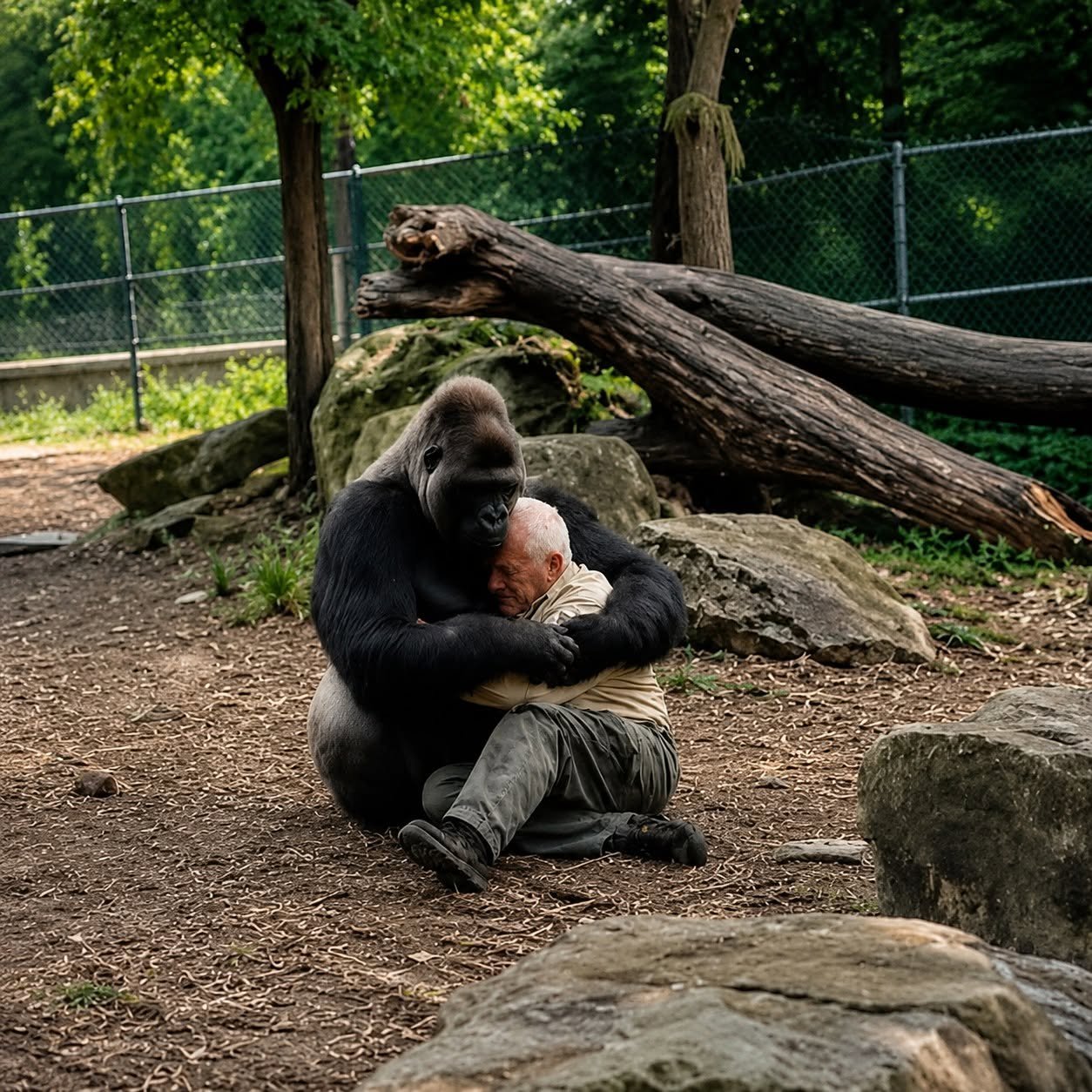
The gorilla reached him and wrapped its massive arms around him.
Not in aggression.
In recognition.
In something deeper than language.
It pulled him close, holding him with a gentleness that contrasted its immense strength, as if trying to confirm that what it was seeing was real.
David closed his eyes and simply stood there.
Because some memories don’t live in words. They live in touch.
6. What Memory Really Means
People often assume that time erases connection. That years dilute emotion, and distance dissolves recognition.
But nature is more complicated than that.
In the quiet intelligence of animals like the gorilla, memory is not just a sequence of events—it is association, emotion, and survival tied together in ways science is still trying to fully understand.
What happened between David and the gorilla wasn’t just recognition.
It was continuity.
A thread that time couldn’t fully cut.