A TRAIN ARRIVING IN SWEDEN WITH ONE CHILD AND AN ENTIRE WAR BEHIND HER
In November 1938, a sixteen-year-old Jewish girl named Hilde Back stepped off a train in Sweden alone. She had crossed borders not as a traveler, but as a refugee, sent away from Germany under a fragile arrangement that allowed children to escape persecution while their parents remained behind.
Her parents, Salomon and Margot Back, did not accompany her. The decision that saved Hilde’s life was also the decision that separated her permanently from the people who gave her life. In Boizenburg, northern Germany, her family remained in a country rapidly transforming under laws that stripped Jewish citizens of their rights, their safety, and eventually their future.
Hilde would never see her parents again. They would later be murdered in Auschwitz, part of the vast machinery of genocide that defined one of the darkest chapters in human history.
She survived because strangers made a choice to intervene.
Sweden accepted refugee children in limited numbers during this period, offering sanctuary to those who could not remain where they were. For Hilde, this decision became the dividing line between extinction and survival. She arrived in a country she did not know, carrying only what a sixteen-year-old child could carry when the world behind her had already collapsed.
A QUIET LIFE BUILT AFTER SURVIVAL, NOT DESPITE IT
After the war, Hilde Back did not become a public figure or a symbol. She did not write memoirs or speak frequently about her past. Instead, she built a life that, on the surface, appeared ordinary.
She trained as a kindergarten teacher and later worked as a school inspector in Västerås, a modest Swedish city west of Stockholm. Her life unfolded in classrooms, administrative offices, and small apartments. She never married. She never had children of her own. She lived alone, with a quiet discipline shaped by experience rather than ambition.
Nothing in her daily life suggested that she had once been part of a historical rupture that defined an entire century. To those around her, she was simply a dedicated educator, someone who believed in learning as a foundation for stability and dignity.
But beneath that quiet existence remained a memory that could not be erased: a childhood interrupted, a family lost, and a survival made possible by strangers she would never repay directly.
That absence of repayment would later take a different form entirely.

FIFTEEN DOLLARS THAT BECAME A LIFE-LINE ACROSS CONTINENTS
In the early 1970s, Hilde Back enrolled in a child sponsorship program. The idea was simple: for a small contribution each term—approximately fifteen dollars—a sponsor could help support the education of a child somewhere in the developing world.
For Hilde, the amount was not large. She was a schoolteacher living modestly. But the act itself carried meaning beyond its size. It was a continuation of something she had experienced earlier in life: the idea that a stranger’s decision could determine whether a child survived or disappeared into statistical history.
She began sending fifteen dollars each term consistently, without expecting recognition or contact. To her, it was a structured act of support, not a relationship.
What she did not know was that on the other side of the world, that small amount of money was becoming the difference between education and abandonment for a child she had never met.
That child was a boy named Chris Mburu, living in rural Kenya.
A BOY IN KENYA AND THE DIFFERENCE BETWEEN SCHOOL AND SURVIVAL
Chris Mburu grew up in a region where education beyond primary school was rare. His family lived in a simple mud house, and like many children in his area, his future was expected to follow a predictable path shaped by economic limitation rather than personal ambition.
He was academically gifted. For years, he ranked among the top students in his district. But academic excellence alone was not enough. Secondary school required fees his family could not afford.
Without intervention, his path would have ended early—into labor, subsistence work, or low-wage agricultural employment.
What changed that trajectory was the steady arrival of a small financial contribution from a woman in Sweden he had never met. That contribution did not arrive with ceremony. It arrived with consistency.
Fifteen dollars per term.
In a system where small amounts determined whether a student remained in school or dropped out, that money became structural rather than symbolic. It did not simply support education. It made it possible.
Chris stayed in school.
And over time, he began to understand that his education was being quietly sustained by someone unknown to him.
A RELATIONSHIP BUILT THROUGH LETTERS AND SILENCE
Eventually, correspondence began between Chris and his sponsor. The letters were not formal or distant. They were simple exchanges about school, life, and aspirations. Hilde asked about his studies. Chris described his progress and his goals.
What developed was not a typical sponsor-recipient relationship, but something closer to a quiet mentorship formed across geography and circumstance. Chris began to understand that behind the monthly contribution was a teacher who believed in education as a force capable of transforming entire futures.
For Hilde, the letters did not feel extraordinary. They felt like an extension of her life’s work in education. For Chris, however, they represented something larger: proof that his life mattered to someone beyond his immediate environment.
Years passed in this way, with steady correspondence and gradual progress. Chris completed his schooling, then moved forward into higher education.
He attended the University of Nairobi, where he studied law. Later, he pursued a Master of Laws at Harvard University. Eventually, he joined the United Nations Office of the High Commissioner for Human Rights, working on issues related to genocide prevention and international justice.
In a profound structural irony, the boy whose education had been preserved by a small act of financial support went on to work within the global legal framework designed to respond to mass atrocity—the very system that had failed to protect his sponsor’s own family decades earlier.
THE SEARCH FOR A WOMAN HE COULD NOT LOCATE
Despite his achievements, Chris carried a lingering awareness that he had never properly thanked the woman who had made his education possible. He knew her name. He knew she lived in Sweden. But he did not know where or how to find her.
For years, the connection remained incomplete—a gratitude without destination.
In 2001, Chris and colleagues in Kenya established a scholarship initiative aimed at supporting academically gifted students from impoverished backgrounds. The purpose was direct and personal: to create the same opportunity for others that had once been created for him.
He wanted to name the program after Hilde Back.
But before he could do that meaningfully, he needed to find her.
With assistance from the Swedish embassy, he eventually located her in Västerås. She was alive, retired, and living quietly. To Chris, she was not a myth or an abstraction. She was a real person whose small, consistent act had shaped his entire life.
When he visited her, accompanied by Swedish representatives, she responded with humility and confusion. She insisted it was only a small contribution. Only fifteen dollars.
To her, it had never been extraordinary.
To him, it had been everything.
A RETURN TO KENYA AND THE MOMENT THE STORY CLOSED THE CIRCLE
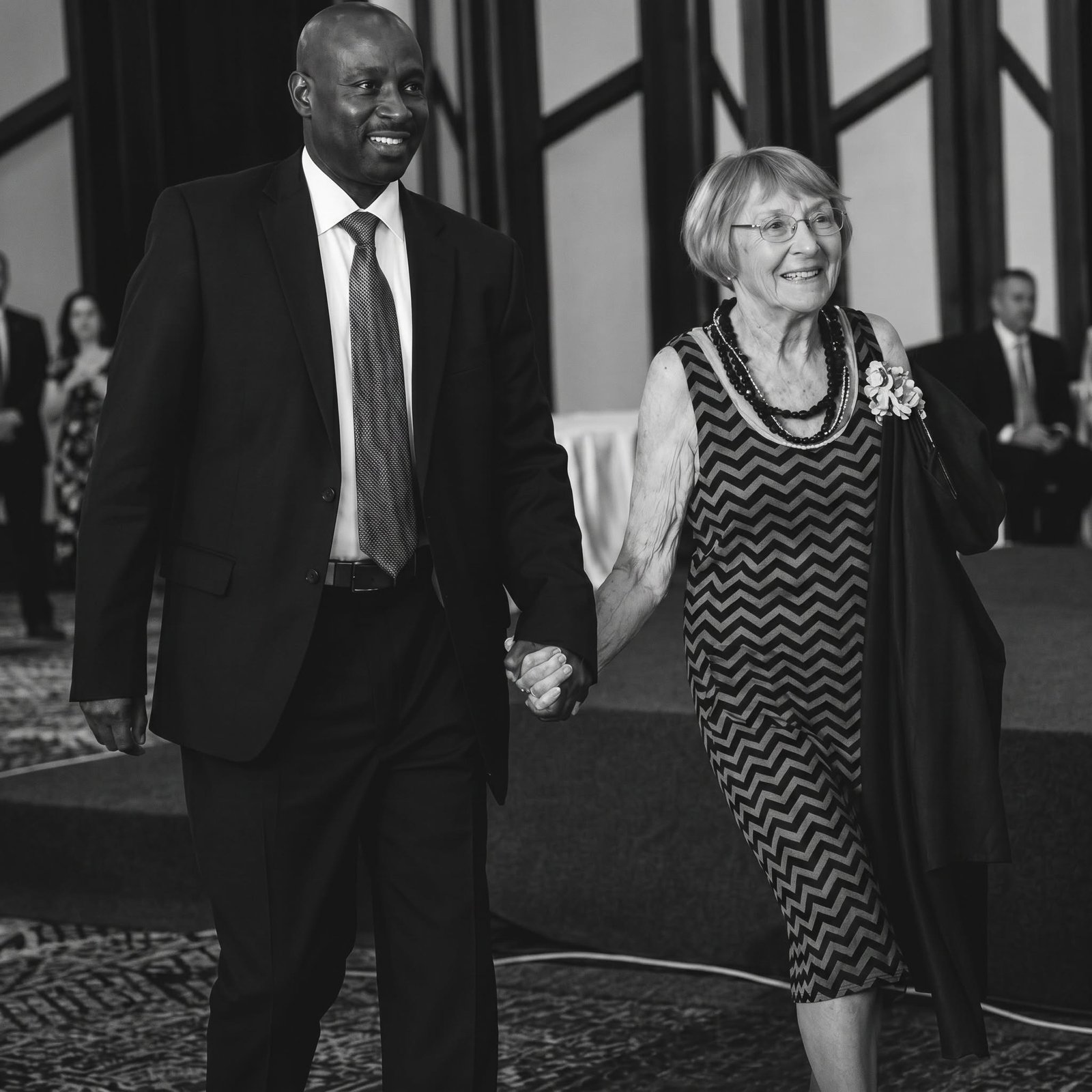
In 2003, Hilde Back traveled to Kenya for the inauguration of the education fund named in her honor. The visit transformed what had once been an invisible connection into a visible human relationship.
Villagers welcomed her with ceremony, music, and gratitude. Students whose education had been supported by the fund stood before her. She was named an honorary elder, not because of wealth or status, but because of what her action had enabled.
The visit marked the first time she saw, in physical form, the outcome of what had once been an abstract act of giving.
What had begun as a small financial contribution in Sweden had become a structured pathway for education in Kenya. The scale of that transformation was something she had never anticipated.
THE DOCUMENTARY THAT REVEALED THE FULL DEPTH OF TWO LIVES
Years later, filmmaker Jennifer Arnold documented their story in A Small Act, revealing dimensions of Hilde’s past that even Chris had not fully known. The film uncovered the deeper historical arc of her life: her arrival in Sweden as a refugee, the loss of her parents in Auschwitz, and the long silence that followed.
The realization added another layer to the story.
A child who had survived genocide because strangers intervened had, decades later, enabled the education of a boy who would dedicate his life to justice and human rights.
The connection was not symbolic. It was structural. One act of survival became, indirectly, another act of survival across continents and generations.
A FINAL RETURN AND A LEGACY STILL EXPANDING
Hilde Back returned to Kenya again in 2012 to celebrate her ninetieth birthday, surrounded by students supported by the program she had unknowingly initiated. She remained modest, insisting she was simply a teacher who had helped many children.
She died in 2021 at the age of ninety-eight in Västerås.
By that time, the Hilde Back Education Fund had supported nearly a thousand students through secondary education, many of whom have since gone on to support others through a continuation program named A Small Act Jamii—“jamii” meaning community in Swahili.
Chris Mburu’s work at the United Nations continued, focusing on accountability for genocide and international crimes. The trajectory of his life, shaped by education, had entered the institutional frameworks designed to confront the darkest aspects of human history.
A STORY THAT MOVES QUIETLY THROUGH GENERATIONS
The story of Hilde Back and Chris Mburu is not defined by dramatic moments or public recognition. It is defined by continuity.
A child survives because strangers intervene.
A boy receives education because a stranger sends fifteen dollars.
A man builds a program because he remembers that intervention.
A community continues because the structure expands beyond its original form.
Across decades and continents, the logic remains the same: small actions accumulate into outcomes far larger than their origin.
And in that accumulation, a quiet truth emerges.
History is not only shaped by those who act visibly. It is also shaped by those who act quietly, consistently, and without expectation of recognition.
A single small act, repeated over time, can move through generations without ever losing its original meaning.