PROLOGUE — WHEN THE FOREST STOPPED BEHAVING LIKE A FOREST
There are moments in the wild that do not fit into the language of science, nor the cold precision of research logs, nor even the structured detachment of wildlife observation. They arrive instead as interruptions—events so unexpected that they force those who witness them to reconsider what they thought they understood about intelligence, emotion, and life itself. Deep inside the Congo Basin rainforest, where the canopy filters sunlight into fractured gold and the ground is a constant negotiation between survival and silence, a trail camera captured something that would later leave researchers unable to speak for several minutes after watching it. It began with an injured elephant. It ended with a gorilla sitting beside death, refusing to leave.
THE ELEPHANT THAT DID NOT FALL QUIETLY
The footage shows a young elephant moving through dense forest, its body already compromised, its movements uneven and strained. Deep lacerations mark its flank—long, irregular wounds that researchers later attributed to a leopard attack, a rare but not impossible encounter in the fragmented edges of predator territory. The elephant is not running. It is not fleeing. It is simply trying to continue. Each step forward appears negotiated with pain, as though the act of movement itself requires permission from the body.
In the wild, weakness is not sustainable. It is not accommodated. It is not delayed. And yet the elephant continues forward longer than expected, as if some internal mechanism still believes the forest might eventually become safe again if it just keeps going.
But survival has limits. And eventually, those limits arrive.
The elephant collapses.
Not dramatically. Not instantly. But in the slow surrender of weight that no longer has the strength to be carried.
The forest does not react. It simply continues.
THE HOURS BEFORE THE SECOND PRESENCE
What makes the footage unsettling is not the collapse itself, but what follows: nothing. No immediate scavengers. No herd returning. No dramatic cycle of predation completing itself. Only stillness.
The elephant lies among roots and fallen leaves, breathing irregularly, its body no longer attempting movement but not yet fully absent from itself. The forest around it continues its indifferent rhythm—wind through leaves, distant insect patterns, the invisible architecture of life continuing elsewhere.
Researchers later noted this gap in time as significant. In nature, gaps are never empty. They are transitional. Something is always moving toward something else, even if the camera cannot see it yet.
And then, after what appears to be several hours, something enters the frame.
THE ARRIVAL OF THE GORILLA
A lone gorilla steps into view.
There is no rush in its movement. No visible alarm. No immediate aggression or retreat. It stops at a distance first, observing the elephant in a way that researchers would later struggle to classify. Not curiosity in the human sense. Not caution in the predator sense. Something slower. Something heavier.
It does not approach immediately.
Instead, it watches.
The elephant remains still.
The forest holds both of them without commentary.
And then the gorilla moves closer.

THE BEHAVIOR THAT BROKE EXPECTATION
What happens next is what transformed the footage from observation into global discussion among researchers.
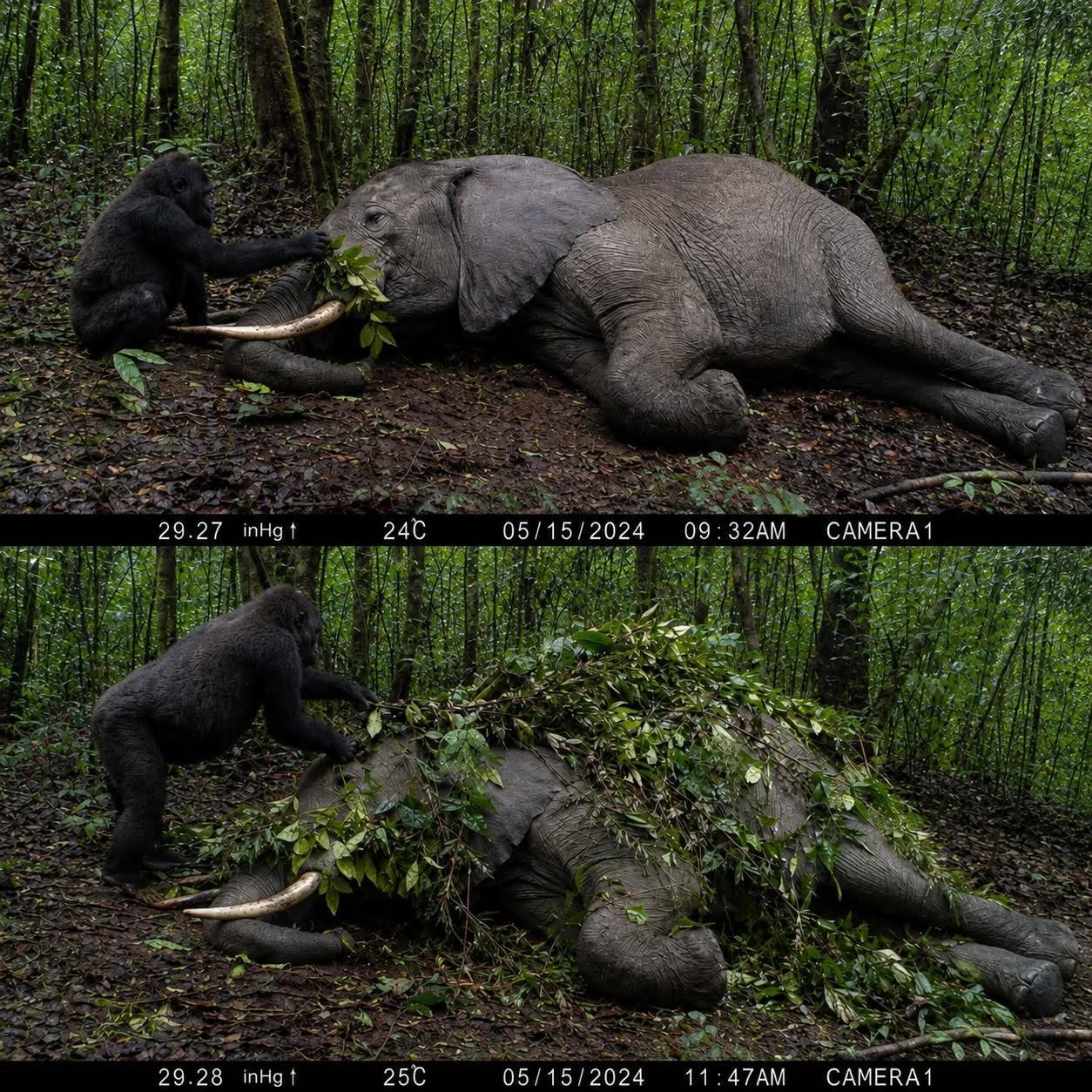
The gorilla begins gathering leaves.
Not in frantic motion. Not as displacement behavior. But in a deliberate sequence of actions: bending, pulling, collecting, carrying. It then pushes the leaves toward the elephant’s mouth.
At first, it appears almost mechanical, as if repetition might solve the problem of suffering. The elephant does not respond. Its condition does not allow participation.
The gorilla pauses.
Then tries again.
Again.
And again.
It is not feeding in the conventional sense. It is attempting something that resembles assistance without having a framework for what assistance should achieve.
The elephant does not eat.
The forest does not intervene.
And the gorilla begins to understand, in whatever way its cognition allows understanding to form, that effort alone will not reverse what is happening.
THE MOMENT OF CONTACT
What comes next is quieter than everything before it.
The gorilla sits beside the elephant.
Not at a distance. Not circling. Not observing.
Beside.
It places one hand gently on the elephant’s head.
There is no aggression in the gesture. No dominance. No performance.
Only contact.
The elephant does not move away.
It does not respond.
It simply remains.
Researchers later described this moment as the most difficult to interpret. Not because of what it showed, but because of what it suggested without stating: recognition without language.
The gorilla remains like that.
For a long time.
While the elephant takes its final breaths.
.jpg)
WHEN THE FOREST BECOMES A WITNESS
After the elephant dies, there is no immediate change in behavior. No sudden departure. No instinctive retreat. Instead, something even more unexpected occurs.
The gorilla begins gathering leaves again.
But this time, not to feed.
To cover.
One by one, it places vegetation over the elephant’s body, as though attempting to alter what death looks like in physical space. As though concealment might soften finality. As though the forest itself could be asked to participate in mourning.
Researchers watching the footage described a shift in their own perception at this stage. Some stopped speaking. Others leaned back from their screens. A few reportedly left the room entirely.
Because what they were witnessing no longer fit into behavioral categorization.
It resembled ritual.
But ritual implies culture.
And culture, in scientific terms, requires frameworks that this moment did not cleanly provide.
THE LIMIT OF EXPLANATION
After analysis, discussions among primatologists remained divided.
Some interpreted the behavior as cognitive problem-solving under stress—attempted caregiving behavior misapplied to a situation beyond understanding. Others suggested social emotional capacity extending further than previously documented. A few refused to interpret it at all, arguing that interpretation risked flattening something that should remain observationally intact.
But all agreed on one point:
This was not random behavior.
The gorilla responded.
Repeatedly.
Deliberately.
And for a sustained period of time that exceeded reflex or instinct alone.
The footage did not answer why.
It only confirmed that something occurred.
THE SILENCE AFTER THE SCREEN GOES DARK
Perhaps the most consistent reaction among researchers was not analytical, but emotional exhaustion.
One described the experience as “watching intention form where we assumed only reaction existed.”
Another said nothing at all during the debriefing session.
What disturbed many was not the death of the elephant—it was the companionship that followed it. Not because it changed the outcome, but because it did not.
In science, outcomes are often the center of meaning.
In this case, the meaning appeared to exist in spite of the outcome.
WHAT THE FOOTAGE NEVER SAYS OUT LOUD
Nobody knows exactly what the gorilla understood in that moment.
Not in the language of certainty.
Not in measurable cognition.
Not in definable emotional taxonomy.
But the footage shows one thing clearly enough that it requires no interpretation to feel its weight:
A living being stayed with another living being when it no longer benefited survival.
It did not fix it.
It did not prevent it.
It did not reverse it.
It stayed.
And in a world governed by survival, efficiency, and instinct, that single act is what continues to unsettle everyone who watches it.
Because it suggests something researchers are still not fully prepared to name:
That awareness, in its most basic form, may not belong exclusively to humans.
And that presence—simple, unproductive, irreversible presence—might be one of the oldest languages the forest has ever known.