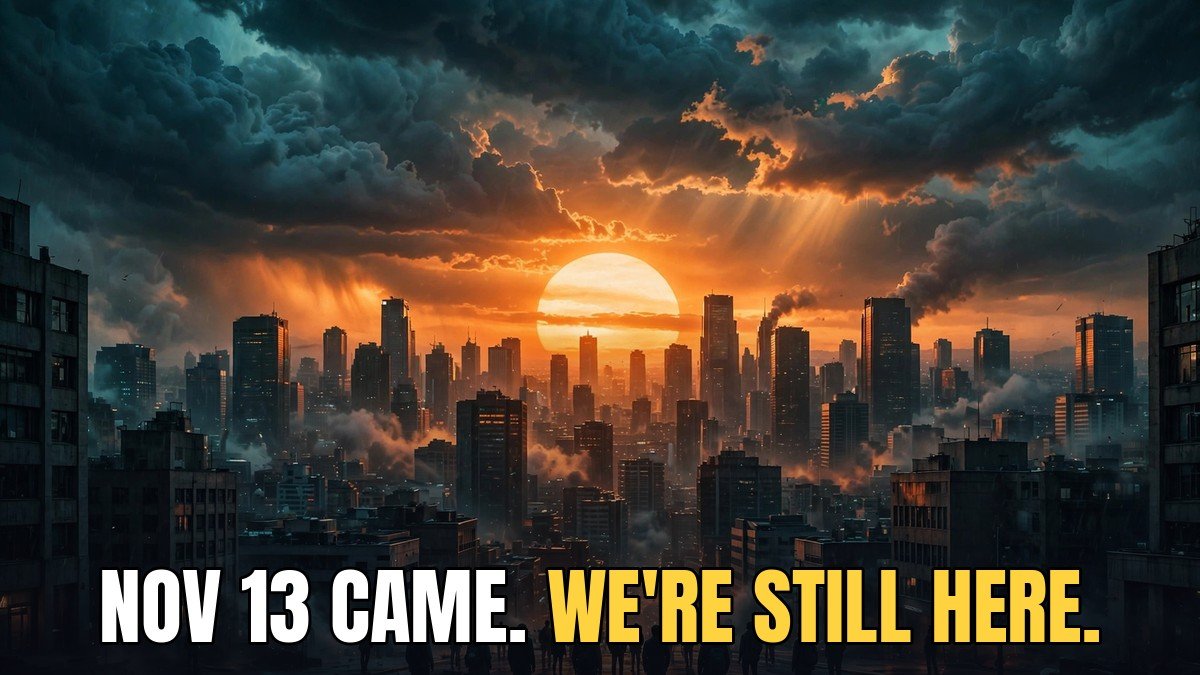
On Friday, November 13, 2026, the world was supposed to end. At least, that is what a lot of posts on Facebook said. The claim sounded scientific: a study in the journal Science had named the date. It had a real author, a real journal, and a real date.
And it was, in the way it was shared, completely wrong about what the study actually said.
The 1960 Paper
In November 1960, physicist Heinz von Foerster and two colleagues at the University of Illinois published a paper in Science titled “Doomsday: Friday, 13 November, A.D. 2026.” They had studied population estimates going back to around 400 BC and fitted a curve that rose faster and faster. Extended forward, their maths said the world’s population would pass 25 billion by 2020 and approach infinity around 2026.
But “doomsday” in their paper was a maths term, not a prophecy. It was the point where their equation stopped producing a meaningful number. There was no asteroid, no war, no disaster in the paper at all. Von Foerster even picked November 13 partly because it was his own birthday.
Why It Didn’t Happen
The curve tracked reality well for about thirty years — and then reality walked away from it. Around 1993, actual population growth began falling behind the forecast. The global birth rate today is slightly less than half what it was in 1960. The United Nations puts the world population at about 8.2 billion, not infinity — the formula had implied roughly 131 billion people for 2025. The UN now projects a peak of about 10.3 billion in the mid-2080s.
The paper was really a warning: growth at the 1960 rate could not continue forever. And in a sense, the warning worked — birth rates fell by about the amount the authors had called for.
So What Actually Happened on Nov 13?
Nothing. Friday the 13th came and went, the world kept turning, and the posts moved on to the next prediction. The date is now a reminder of something worth remembering: a real study, quoted accurately on the date and the journal, can still be shared in a way that means the opposite of what it said.
The world did not end on November 13. It just kept getting slower, quieter, and — by the numbers — a little more careful about the future.