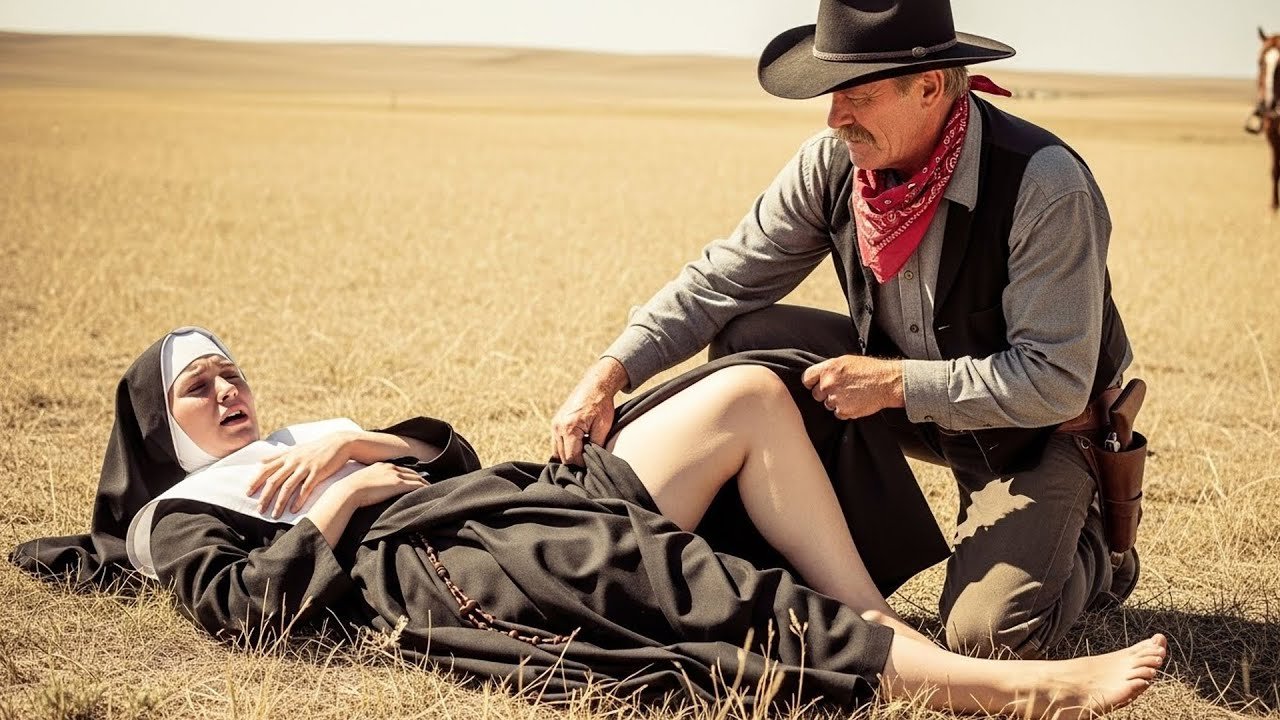
The Kansas sun had no mercy that morning. It pressed down on the prairie like a hot iron, turning the grass to wire and the sky to tin. Thomas McGra rode slow, checking fence posts that didn’t need checking, just to feel useful. Then he saw the shape—black cloth against brown earth, a crumpled shadow that didn’t move when the wind did.
He swung down, boots sinking in parched soil, and knelt. A young woman lay twisted, her nun’s habit torn, rosary beads dug into her palm like small stones. Her lip was split, her leg scraped raw, her eyes shut against the light. When his shadow fell across her she flinched so hard the dust jumped.
Thomas spoke soft, the way he talked to foals caught in wire. “Easy, miss. I’m just a man, not a storm.”
Her eyes snapped open, wide and wild. “If you shave me, God will kill you.”
The words cracked out of her, half threat, half prayer. Thomas didn’t know what to do with that, so he kept his hands where she could see them. “No razors here. Only water and a bad cook.”
She studied his face, searching for the lie. Finding none, she let her head drop back. “I ran,” she whispered. “He said it was cleansing. I heard blade.”
Thomas understood enough. He lifted her, lighter than a calf, and set her across his saddle. She clung to his shirt like someone falling off the world. Behind them the prairie kept its secrets; ahead lay his small ranch—one house, three horses, and quiet that sometimes hurt.
At the pump he cleaned her cuts, apologizing every time she winced. She told him her name—Sister Evelyn—and the story poured out: Father Silas, the public penance, the razor waiting to “shear the pride” from her. Thomas listened, jaw tight, while the sun climbed and the wind rattled the cottonwoods.
Days slid by. Evelyn slept in the spare room, door latched from inside. Thomas slept on the porch, rifle leaned against the wall. He cooked, she washed; she mended, he fixed. Words came slow, then steady, then easy. She learned the creak of his boots meant safety; he learned the tap of her spoon on the pot meant supper was ready.
The third week brought riders—two black shapes against sunrise. Father Silas sat his horse like a throne, Cole Barrett beside him, pistol polished, smile thin. Silas spoke first, voice smooth as oiled wood. “I’ve come for my lost sheep. Thank you, Mr. McGra, for keeping her warm.”
Evelyn stepped onto the porch, hair short now, eyes level. “I’m not lost. I’m found.”
Silas’s smile twitched. “Humility, child. You ran from correction.”
Thomas moved between them, boots planted. “Correction ends at the first drop of blood.”
Cole’s hand drifted to his gun. Thomas didn’t flinch. “Draw it and you’ll wear it in your ear.”
The priest raised a hand, all mercy. “The Church asks—”
“The Church can ask in town,” Thomas cut in. “Under daylight, before the sheriff.”
They rode to Dodge that afternoon, dust rising like judgment. The street filled—shopkeepers, ranch wives, cowhands, children. Evelyn stood on the jailhouse steps and spoke clear: the razor, the rope, the humiliation dressed as holiness. Her voice shook only once—when she said, “No one stood between me and the blade.”
A murmur rippled through the crowd. Widow Harris stepped forward, voice brittle. “He threatened to cut off our flour if we missed tithes.” Another voice rose, then another. The sheriff listened, arms folded, eyes hard. When Silas tried to speak, the crowd turned away like he was spoiled meat.
The lawman’s verdict was plain: Silas would ride to Abilene and explain to the bishop why fear wore a collar. Cole’s gun was taken, his fine reduced to dust. The priest mounted up between two deputies, righteous mask finally cracked.
Back at the ranch, evening settled soft. Evelyn stood before the small mirror, scissors in hand. She cut her hair chin-short, locks falling like dark feathers. Thomas watched from the hall, throat thick. When she turned, the smile that met him was new—light and fierce.
“I still believe,” she said. “But I believe in mercy, not chains.”
He cleared his throat. “I’m no preacher, but I figure God’s bigger than one man’s razor.”
Seasons turned. She learned to brand calves, to ride beside him, to laugh when the mule bit his sleeve. He learned the sound of her singing, the way she hummed while patching fence, the comfort of her hand on his shoulder when nightmares came.
They married in a little church under a different priest, one who spoke of love more than obedience. The town filled the pews—not for spectacle, but because they had watched two people stand in the dust and choose each other over fear.
Years later, when travelers ask how a quiet rancher and a runaway nun built a life together, Thomas just points to the porch rail where two pairs of boots stand side by side—one scuffed, one small—and says, “Courage looks like stepping between harm and the harmed. Everything after that is just morning coffee and evening prayers.”
Evelyn adds softer, eyes bright, “And sometimes courage is simply refusing to let cruelty speak for heaven.”