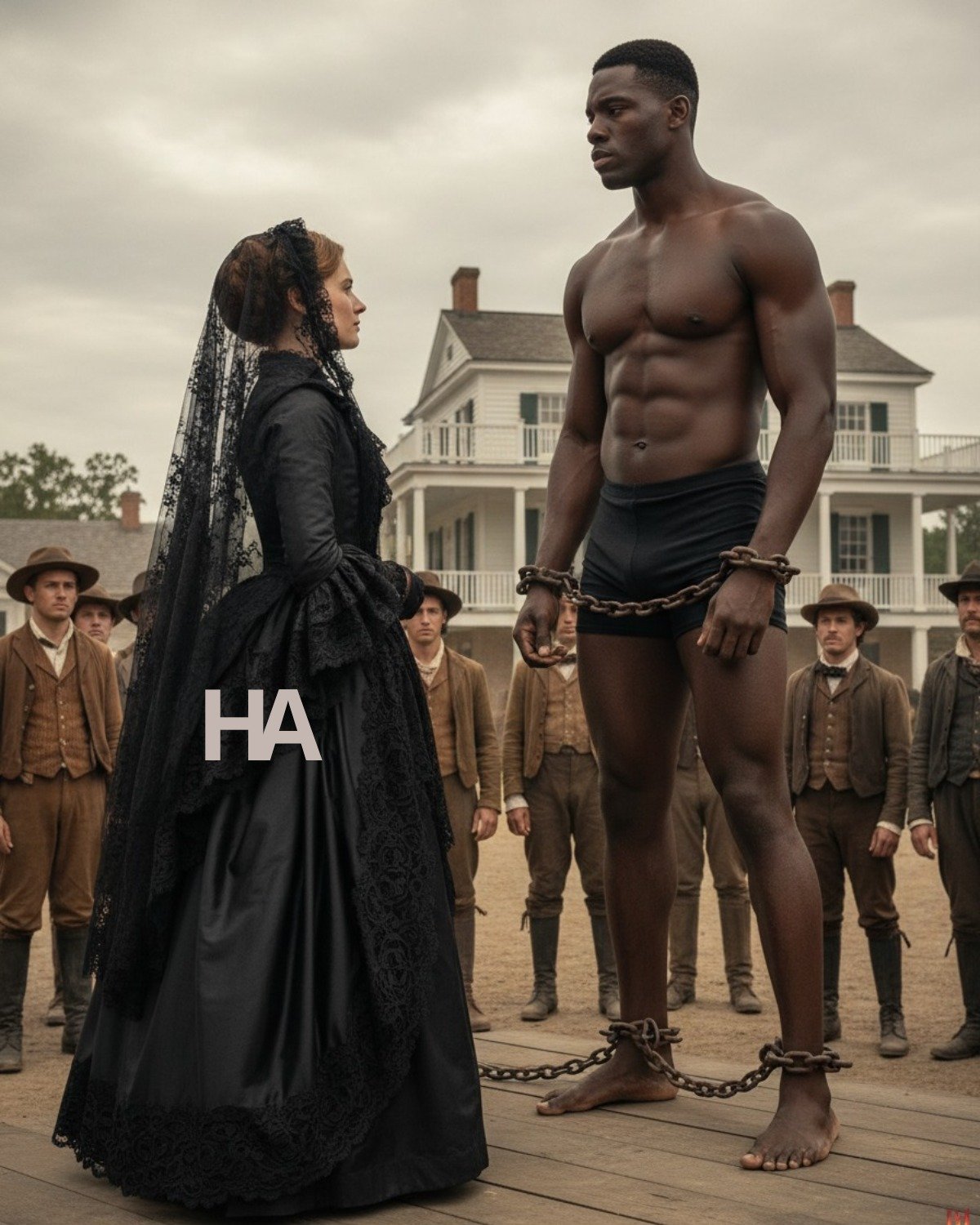
The heat in Veracruz doesn’t sit on your skin, it presses, like a lid on a boiling pot, daring you to breathe. In July of 1842, the market square looks sun-bleached and merciless, a bright stage where people pretend not to hear the human sounds behind commerce. You pull your black mantilla tighter, not because it cools you, but because it keeps your face composed. Widowhood is supposed to make you soft and quiet, but debt makes you sharp and awake. The scent in the air is sweat, horses, overripe fruit, and something worse, something that shouldn’t exist in daylight. Chains clink in a rhythm that tries to become normal if you let it. You don’t let it, not today, not while your name is hanging by a thread. Your hacienda needs hands for the coffee harvest, and every day you wait, your land slips further into the mouth of other men.
They told you to buy three, because three is what a woman is supposed to do when men stop doing it for her. Your administrators spoke in numbers, pretending numbers are clean, pretending the ink isn’t mixed with hunger and blood. They said one worker won’t save you, and they were right, but they didn’t know what you know about your husband’s secrets. Don Aurelio’s debts were not honest debts, not the kind paid back with patience and prayer. They were traps hidden in contracts, signatures that looked like his but weren’t, promises made to people who smile while they sharpen knives. Eight months ago you buried him, and the town watched, and the town measured how long it would take you to collapse. Now they watch you again, expecting you to bargain, to flinch, to accept your place. You tell yourself you’re here for the hacienda, not for the spectacle, but the spectacle is here for you. The square is loud with bargaining, yet the corner by the auction platform has an uncomfortable hush, like even cruelty has a limit for politeness.
The line of chained men stands under the sun as if the sun itself is part of the punishment. Their feet are bare in the dust, their shoulders shiny with sweat, their eyes trained on nothing and everything. You try not to look too long, because looking too long turns the scene into something you can’t excuse. Your mind tells you the same lie the town tells itself: this is how things are, this is how the harvest happens, this is how order survives. But your stomach rejects the lie, tightens, reminds you that being used to something doesn’t make it right. You walk slowly, your shoes tapping the stone, your veil shading your gaze so no one can read what you feel. You pass one man and then another, each one inspected like a mule, priced like a tool. Some buyers laugh, some bargain, some stand with a bored expression that scares you most. Then you reach the last man in the line, and your steps stop without permission.
He is tall, skin browned by sun rather than weakness, and he holds himself like the chains are an inconvenience rather than a verdict. It isn’t beauty in the polite sense that hits you, not a salon portrait kind of beauty, but a presence that refuses to shrink. His face is carved harder than the others, jaw set, eyes dark and alive, the kind of eyes that ask questions even when silence is safer. You’ve seen proud men before at dinners and in church, men with soft hands and loud opinions. This pride is different, quieter, more dangerous, because it doesn’t need witnesses. When he lifts his gaze and meets yours, the world narrows, and you feel an odd, sharp knot under your ribs. He doesn’t look away, not even when your status should make him. That single refusal unsettles you more than any pleading would, because it reminds you of something you’ve tried not to name: that he is a man, not a thing. In that moment you become aware of your own breath, your own heartbeat, your own complicity. You look down first, and it annoys you that you do.
People whisper the way they whisper around storms they can’t control. One buyer approaches him, studies his arms, his teeth, the strength in his shoulders, then steps back as if he felt heat. Another buyer leans in, hears a few words from the broker, and immediately shakes his head, lips tightening. It repeats, again and again, like a ritual of refusal, and the air around the man grows strangely empty. You hear fragments, soft as dust but sharp as thorns: “bad luck,” “trouble,” “three owners,” “fires,” “ruin.” The broker laughs too loudly, a practiced sound meant to erase fear from a transaction. The man at the end of the line waits, still, watching everything with a patience that looks like a plan. You tell yourself superstition is for the weak-minded, for the bored, for those who want an excuse. Yet your skin prickles anyway, because the town rarely agrees on anything, and here they all agree on him. It makes you wonder what they’re protecting themselves from.
When his turn comes, even the auctioneer clears his throat like he’s about to say a prayer he doesn’t believe in. “Nahuel Itzcóatl,” he announces, and the name lands heavy, unlike the casual names tossed for the others. “Twenty-eight, strong, healthy, from Oaxaca, knows field work… and other things.” The auctioneer’s tone is careful, the way men speak when they want to warn without being blamed for warning. The starting price is insultingly low, so low it makes your face go hot with shame on behalf of everyone listening. A few men snort, as if they’ve been handed a joke. Your hand rises before you decide, and the movement feels both reckless and inevitable. Silence follows, wide and clean, as no one counters you. The hammer falls with a sharp crack that makes your shoulders tense, and you realize you have just made yourself the only one willing to claim what others refuse.
At the table where papers are signed, the broker avoids your eyes like eye contact could infect him. You dip your pen, sign your name, and each stroke feels like a debt paid with something other than money. “Why so cheap?” you ask, because you need a reason that isn’t fear. The broker’s mouth twitches, and he glances toward Nahuel as if the man can hear through walls. “They say he brings ruin,” he mutters, almost spitting the words. “Three owners in two years, and wherever he goes, something breaks.” You want to laugh, because men like to blame fate for their own choices, but your laugh doesn’t come. You look at Nahuel again, and he looks back, not with gratitude, not with submission, but with an unreadable steadiness. It dawns on you that “something breaks” might not mean accidents at all. It might mean lies, systems, comfortable arrangements that depend on silence.
The ride to La Quebrada del Sol is long enough for doubt to grow teeth. The road shimmers with heat, and the hills breathe green in the distance, but your carriage feels like a small, sealed box of tension. Nahuel walks tethered behind, feet striking the dust, chains biting his wrists, and he never once drops his head. Your driver keeps glancing back, nervous, as if the man might turn into a demon the moment you stop looking. Halfway, you order the carriage halted near a stand of shade, and your own attendants look at you as if you’ve lost sense. You take a water skin and approach Nahuel, feeling a dozen stares pinning your back. You offer the water, and he accepts it without scrambling, without the animal desperation people expect. He drinks with measured dignity, then meets your eyes again. “Thank you, señora,” he says, and the word señora hits differently than amo ever could, because it acknowledges your station without surrendering his humanity.
When you arrive, the hacienda spreads out like a painted promise: coffee plants in disciplined rows, green hills rolling like waves, the main house whitewashed and proud. Yet beneath the beauty, you feel the strain, like a beam that looks fine until you stand under it and hear it creak. Baltasar Múgica, your capataz, waits with his arms crossed and a face made for disapproval. He has always been loyal to the men who owned the land, and his loyalty feels like a chain of its own. “One won’t be enough,” he says before you even dismount, as if your widow’s decisions must be corrected. “One is what I can afford,” you answer, keeping your voice calm because calm is power in a place that tests it. Baltasar circles Nahuel like he’s evaluating a bull, eyes narrowing at the man’s posture. “He has the face of trouble,” Baltasar mutters, and you hear something too eager in his dislike. You turn your gaze to Nahuel, giving him a space no one expects. “And you?” you ask him, as if his opinion matters, as if he’s part of the conversation.
The courtyard goes quiet, the way rooms do when an unexpected rule is introduced. Nahuel looks at you without flinching, and you see intelligence there, sharp as a blade and just as controlled. “Hard work doesn’t frighten me,” he says, voice steady, neither humble nor aggressive. “But unjust cruelty… I won’t accept it in silence.” Baltasar’s hand drops toward his whip instinctively, like a reflex that has been trained by years of getting away with it. “No one speaks without permission here,” he snaps, and his eyes flick to you, waiting for your approval. Something in you stiffens, a memory of Aurelio’s cold rules and your own learned quiet. “Enough,” you say, and the word is small but final. “In my hacienda, no one is punished for telling the truth.” Baltasar’s jaw tightens, and for the first time you feel, clearly, that your enemy might not be the debts alone.
That night, sleep circles you but never lands. Widowhood has turned your bed into a wide space where silence feels heavier than another body. You think of your marriage, how it was arranged like a business deal between surnames, how affection was treated like an unnecessary expense. You think of Aurelio’s smile at church, the way he charmed people into trusting him, the way his papers always seemed in order. Now those papers are choking you, and every creditor in Veracruz can smell weakness the way dogs smell blood. You also think of Nahuel’s eyes, and it unsettles you that you remember them so clearly. Not because you are drawn to him in a foolish, romantic way, but because he looked at you like you were not untouchable. He looked at you like you were accountable. That kind of gaze is rare in your world, especially directed at a young widow expected to obey. By dawn, you’ve decided you didn’t buy a worker. You bought a question you can’t put back.
In the days that follow, Nahuel moves through the coffee fields like someone who understands more than labor. He learns routes, watches routines, listens to the way men speak when they think no one important is near. He works hard, yes, but it’s the way he thinks that makes people uneasy. He notices where irrigation is wasted, where the soil is being abused, where schedules are arranged to benefit some and break others. You catch him sketching simple diagrams in the dirt, showing two workers how to rotate tasks so fewer backs collapse. Baltasar hates that, you can tell, because it makes Nahuel influential without permission. The other workers glance at Nahuel with a cautious kind of hope, as if he might be proof that a spine can remain unbroken. You tell yourself you should stop it, because change invites retaliation, but you don’t. Part of you wants to see what happens when a quiet order is challenged by a quiet intelligence. Another part of you worries you’ve brought a spark into a barn full of dry straw.
The accidents begin like rumors: small, whispered, easily dismissed until they line up. An old storage shed catches fire in the night, flames licking up the wood as if the building had been waiting to burn. A peón is injured when a beam falls, and Baltasar claims it was carelessness, though you notice the beam’s rope looks cut. A well collapses after Baltasar ignored a warning about its unstable wall, and the panic that follows tastes like dust and guilt. The workers start crossing themselves when Nahuel walks by, the way people do when they need a simple villain for complicated fear. “He carries a shadow,” they whisper, and you hate how quickly human minds reach for superstition when truth is dangerous. Baltasar uses the murmurs like fuel, stepping closer to you with each incident, voice low and urgent. “This is why they refused him,” he insists, eyes gleaming with something that feels like satisfaction. You refuse to be bullied by whispers, yet a chill crawls up your neck anyway, because the pattern is too neat.
Baltasar confronts you openly after the second incident, as if he’s been waiting for permission to seize control. He says the workers respect Nahuel more than they respect you, and the insult is aimed to sting. He says the hacienda is becoming unstable, and the word unstable makes you think of creditors, courts, men with ink-stained fingers who can take land legally without drawing a knife. You remind Baltasar whose name is on the property, and he smiles too politely, the way a man smiles at someone he plans to outlast. He claims he’s protecting you, that he’s been protecting the Montoya name for years, that Aurelio trusted him. The mention of Aurelio makes your stomach tighten, because that trust is what buried you in debt. You ask for records, for ledgers, for explanations of expenses that never made sense, and Baltasar promises to bring them. He doesn’t, and every delay feels like a door closing. Your instinct, sharpened by grief, tells you Baltasar is hiding something large enough to crush you. Still, suspicion alone is not proof, and proof is what courts respect.
One afternoon, seeking anything that might help, you open a chest of your father’s old documents in the back room of the main house. Don Gaspar de Alvarín was a man who kept records like weapons, neat stacks of paper that could ruin a rival without raising his voice. You flip through brittle pages, letters, land surveys, and the kind of quiet confessions men write only when they believe no one will read them. Dust rises, light slants through the shutters, and the house feels like it’s holding its breath. Then you see a name that makes your fingers go cold. Not just “Nahuel Itzcóatl,” but “Nahuel Itzcóatl Alvarín.” The surname is a blade sliding between your ribs. Your father’s surname. Your surname by birth. The world tilts, and for a moment you hear nothing but your own heartbeat. The realization is sickening and clarifying at once: you didn’t bring a stranger into your hacienda. You brought blood.
You confront Nahuel at dawn, because dawn feels like the only honest hour, a time when shadows are still visible. He’s by the water trough, washing his hands, and the simple act looks strangely intimate because it’s so human. You hold the paper in your fist like it might burn you. “Did you know who my father was?” you ask, and your voice surprises you with how steady it is. Nahuel doesn’t pretend confusion, and that honesty makes your anger sharper. “Yes,” he says, and the word is a weight dropping into still water. You demand to know why he came here, why he allowed himself to be sold into your land. He looks away for a fraction of a second, as if deciding what truth you can bear. “At first,” he admits, “I wanted to break everything that carried his name.” The confession hits you like a slap because you understand it, which makes it worse.
You ask the question you don’t want answered, because fear demands clarity. “So you came for vengeance,” you say, and your mouth tastes like iron. Nahuel’s expression tightens, but he doesn’t deny it. “I came for truth,” he corrects you, and the difference matters more than you want it to. He tells you he recognized the region, recognized the name, recognized the pattern of power that built your hacienda. He tells you what you’ve never been told directly: your father used people, took what he wanted, and then sealed his sins in paperwork. “You weren’t there,” Nahuel says, and his voice isn’t kind, but it isn’t cruel either. “But you live inside the house his choices built.” You want to defend your father, to defend your own history, but the documents in your hand whisper against your pride. Then Nahuel says something that fractures your certainty in a different way. “You treated me like a man,” he says, “and it changed what I planned to do.” The admission doesn’t absolve you, but it complicates you, and complication is the beginning of awakening.
The next events move like dominos once the first is pushed. Government inspectors arrive at La Quebrada del Sol under the pretense of routine oversight, yet their eyes are too sharp for routine. They bring questions about contracts, labor records, and debts that were never disclosed to you. You feel the walls tightening, not around Nahuel, but around Baltasar, around the men who have been feeding off your husband’s estate. Anonymous denunciations are mentioned, paperwork that matches details only someone inside would know. You watch Baltasar’s face as the inspectors speak, and you see sweat form at his temples despite the morning breeze. He tries to charm them, tries to redirect attention toward Nahuel, tries to sell superstition as evidence. The lead inspector doesn’t even glance at Nahuel, which tells you something important: they’re not here for a scapegoat. They’re here for a network. When they ask for Aurelio’s signatures on certain documents, you recognize the slant of the ink and feel nausea rise. Some signatures look wrong, like they were forged by someone who knew his hand well.
Baltasar is arrested before noon, and the courtyard fills with stunned silence, the kind that comes when a powerful man is finally named what he is. He shouts about loyalty, about betrayal, about how you’ll regret letting officials into your home. He tries to meet your eyes, searching for fear, and you refuse to give it to him. Men like Baltasar survive by convincing women like you that you can’t manage without their brutality. As he is dragged away, you notice something else: the workers are watching you, not with superstition now, but with cautious evaluation. They want to know if you’ll fold, if you’ll replace one tyrant with another, if your kindness was temporary. You open your mouth to speak, but the words stick because what do you say after you’ve been part of the system that broke them. Then you realize you can’t fix everything with one speech. You can only choose what you do next, and let your actions argue for you. You turn to find Nahuel, and he’s gone.
He disappears with the efficiency of someone who planned escape routes long before he needed them. One hour he’s in the field, the next he’s a rumor, a shadow between coffee rows. You send men to search, then stop yourself, because you don’t want him hunted like an animal again. You ask questions quietly, and the workers avoid your eyes, which tells you they know more than they will say. In the nights that follow, the hacienda feels both safer and emptier, as if the air itself is waiting. Creditors still circle, because villains being arrested doesn’t magically erase paper debt. The town begins buzzing with the story, twisting it into something it can digest: the widow’s hacienda invaded by scandal, a cursed man who brought ruin, a capataz betrayed. You hear versions where you are foolish, versions where you are wicked, versions where you were seduced by a “dangerous” man, and you want to scream at how quickly people turn complexity into gossip. But you also feel a strange steadiness, because for the first time you’re not pretending everything is fine. You start reviewing every ledger, every contract, every line Aurelio ever signed, and you understand the real curse was never Nahuel. It was the silence that let men like Aurelio and Baltasar thrive.
Weeks pass, and the inspectors’ investigation spreads beyond your property. Neighboring estates are questioned, contracts seized, accounts frozen, and the powerful begin to look frightened. You learn that what Aurelio owed wasn’t only money, it was favors, it was cover, it was participation in an ugly trade that people deny exists while profiting from it. The thought makes your skin crawl, because you realize your mourning was for a man who may have helped build cages. You want to hate him completely, but memory is stubborn, full of moments where he held your hand in public, smiled at you in church, told you you were safe. That’s what makes betrayal lethal: it comes wrapped in familiar warmth. You walk through your hacienda and see new details, things you ignored when you trusted the wrong people. The locked storage room behind the stables, the missing pages in certain ledgers, the way certain workers were moved like chess pieces. You begin speaking directly to the laborers, not as objects but as people, and your voice shakes the first time you do it. Some of them flinch, expecting punishment for honesty, and that flinch is its own indictment. You start to realize that paying a debt with money is easy compared to paying it with accountability.
Months later, a letter arrives with a capital seal, and your hands tremble as you break it open. It announces changes in law and enforcement, strong language about liberty, trafficking, and penalties. The words feel both late and miraculous, like rain arriving after the field has already cracked. You read the lines again and again, and you understand the nation is trying, unevenly, to drag itself toward justice. Alongside the official notice is a second letter, thinner paper, no seal, but it carries a weight you can’t ignore. The handwriting is clean, disciplined, familiar in its steadiness, and your breath catches before you even finish the first line. It doesn’t address you as “señora” or “doña,” but by your name, like an equal. The letter says slavery has been formally abolished, that enforcement has teeth now, that networks are being exposed. It says, simply, “I helped make this happen.” And then it says something that makes your throat tighten: “You didn’t owe me justice, but you gave it anyway.”
You read the signature at the bottom and feel the strange ache of blood and history colliding. “Nahuel Alvarín.” Not Itzcóatl, not the name the auctioneer used like an insult, but the surname your father carried like a crown. The letter doesn’t demand anything from you, which is what makes it powerful. It doesn’t ask for forgiveness, because it isn’t his to ask for. It doesn’t promise friendship, because friendship is earned, not granted by revelation. It only states a truth you can no longer avoid: “Now we are equal before the law, and before blood.” You close your eyes, and the heat of Veracruz feels different, not softer, but more honest. You realize the warning “don’t touch him” was never about bad luck. It was about consequence. Men feared him because he made them face what they’d buried, and buried things rot.
After the letter, you change the way you run La Quebrada del Sol, not with grand speeches, but with new rules that cost you comfort. You dissolve contracts that depended on coercion, even when creditors sneer and call you naive. You hire paid workers openly, and you post the wages where everyone can see them, because secrecy is how exploitation hides. You bring in an auditor from the city, a man who doesn’t know your family and can’t be bullied by your surname. You listen to workers’ complaints in the courtyard once a week, and when your hands shake, you let them shake, because humility is part of repair. Some neighbors stop inviting you to their dinners, and you accept the exile as a small fee compared to what others have paid. You sell jewelry Aurelio gave you to cover wages during a lean month, and you realize you feel lighter without the weight of his gifts. Little by little, the hacienda stops running on fear and starts running on agreement, which is slower but steadier. The land does not love you more for it, but the people do, and people are the only wealth that matters when you’re trying to become human again. At night, when you remember Nahuel’s eyes at the market, you no longer mistake their steadiness for a curse. You recognize it as the beginning of a reckoning.
You never see Nahuel again, not in person, not in the coffee rows, not at the gate, not in the market square. Sometimes you imagine him in the capital, speaking to officials who try to look brave while sweating through their collars. Sometimes you imagine him walking the roads without chains, breathing air that doesn’t belong to anyone else’s paperwork. You don’t romanticize him, because romanticizing would be another form of ownership, another way of turning a man into a story you can control. Instead, you let him be what he was: a truth you bought without understanding the price. On the anniversary of Aurelio’s death, you stand by his grave and feel nothing like forgiveness, only a quiet clarity. You did not choose the world you were born into, but you choose what you do with it now, and that is the only choice that counts. The heat still falls like lead in Veracruz, and the market square still remembers its sins, but you stop looking away. You become the kind of woman who doesn’t need a mantilla to hide her face. And when people whisper, “Don’t touch him,” you finally understand what they meant. They weren’t warning you about him. They were warning you about what happens when truth walks into a place built on lies.
THE END