Amos Thorne had lived alone so long the walls had begun to answer him back. Three winters without Abigail had turned his voice rusty, his hands impatient, and his nights into long, silent calibrations of wind against pine. He was fifty-eight, bent like a nail left in weather, and he expected nothing except the next sunrise over the Sangre de Cristos.
Then the horse came—lathered, wild-eyed, carrying a giant of a woman whose legs hung like felled trees. She collapsed at the gate, blood blooming through buckskin, and muttered one clear sentence: “They’re coming for me.”
Amos did what any man who has buried love does: he carried her inside, laid her on the table, and set water to boil. The wound in her thigh was jagged; the wound beneath her ribs was older—years of leather pulled so tight it had grown into her skin. A corset of laces and scars. She called it her “correction,” said the Dalton brothers laced it on her at thirteen because a girl her size was “too wild to trust.”
Amos cut the dress away, revealing knots crusted with blood and pride. “This has to come off,” he said. She caught his wrist. “I’ll only undress tonight—just to let the wounds breathe.” Her voice was smoke over iron—soft, but it would cut if pressed.
He stitched the thigh first, no whiskey to dull it, her teeth clamped on a strip of leather. When the last knot of the corset snapped, she drew a breath so deep it sounded like the room itself exhaled. Tears slid into the corners of her smile. “I had forgotten what full lungs feel like.”
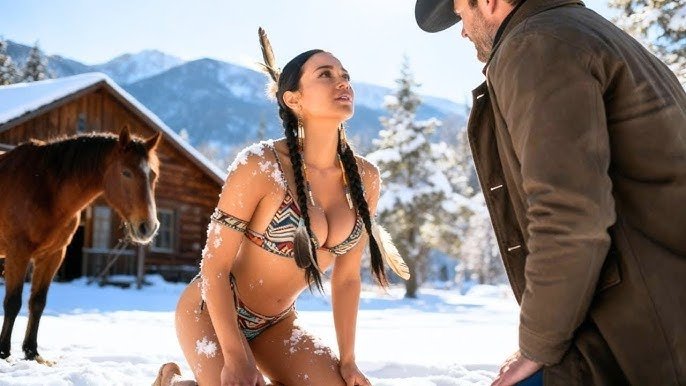
Outside, dust rose—three riders tracking the horse she had stolen. Amos and Nita became actors in their own salvation: she swapped buckskin for his dead wife’s blue dress, he forged wedding lines on an old certificate using her blood for ink. When the Daltons pounded the porch, they found a six-foot-six Apache “wife” limping beside a rancher who lied without blinking.
The brothers left, promising to return with proof and fury. At dawn Amos and Nita drove the buckboard to town, walked into the courthouse, and signed the ledger before the lie could cool. By sunrise they were legally bound—two strangers who had shared one honest night of rescue.
On the steps Nita kissed his cheek, tasting salt and surprise. “I’ll be a good wife, Amos Thorne. Maybe not the one you imagined, but faithful.”
He answered the only vow he had left: “I’ll never try to make you feel small.”
They rode home past mesas that blushed under new light. The corset lay buried under firewood, the corset that had tried to shrink a woman into someone else’s fear. Back at the ranch they planted corn in straight rows and squash in wandering circles, the way she said her people always did—one crop for order, one for wildness.
When the Daltons finally came again, they found not a fugitive but a marriage armed with rifles and witness papers signed in blood that had dried legitimate. The brothers turned away, beaten less by bullets than by the sight of a woman standing taller without her cage than she ever had inside it.
Some nights Amos still wakes to find Nita barefoot in the yard, arms raised to the sky, breathing the dark in great, grateful draughts. He listens to the air fill her—listens until her exhale mingles with the wind and he knows the sound of freedom.
And whenever the wind sharpens, they remember the night two strangers decided to save each other instead of themselves, the night they learned that the strongest bond is forged not in romance but in refusal to let cruelty keep its lace tight one moment longer.