Elias Ward had been walking for two days without a drop to drink, without a horse, and without any idea of what tomorrow might look like. At first sunrise the land had still looked kind, a thin blue seam of sky promising water or shade or maybe just a place to rest. By noon that same line had turned into a cruel joke, wiggling and vanishing every time he blinked, as if the world itself was laughing at him. His tongue felt like old leather left in the sun, his thoughts cracked like dry mud, and every step felt like borrowing pain from the next hour.
The horse had died yesterday evening. One bad step on a stone the color of bread had snapped something inside its leg. The animal had turned its big soft eye on him, sorry and ashamed, as if it had failed a test. Elias ended the misery with one shot, buried the guilt deep, and kept walking. Now it was only him and the pale desert, two stubborn things waiting to see which one would give up first. He talked to himself without noticing, strings of prayer and curse stitched together, until he finally admitted no god or man was out there to hear him.
He found the dead mesquite tree at the moment he stopped believing he could stay upright. It was nothing but charcoal bones reaching for a sky that would never answer, yet it had once lived, which meant water had once lived here too. He leaned against the trunk, felt the heat bite through his shirt, and slid to the ground. “End of the trail,” he whispered, and let the darkness take him, hoping it might be kinder than the light.
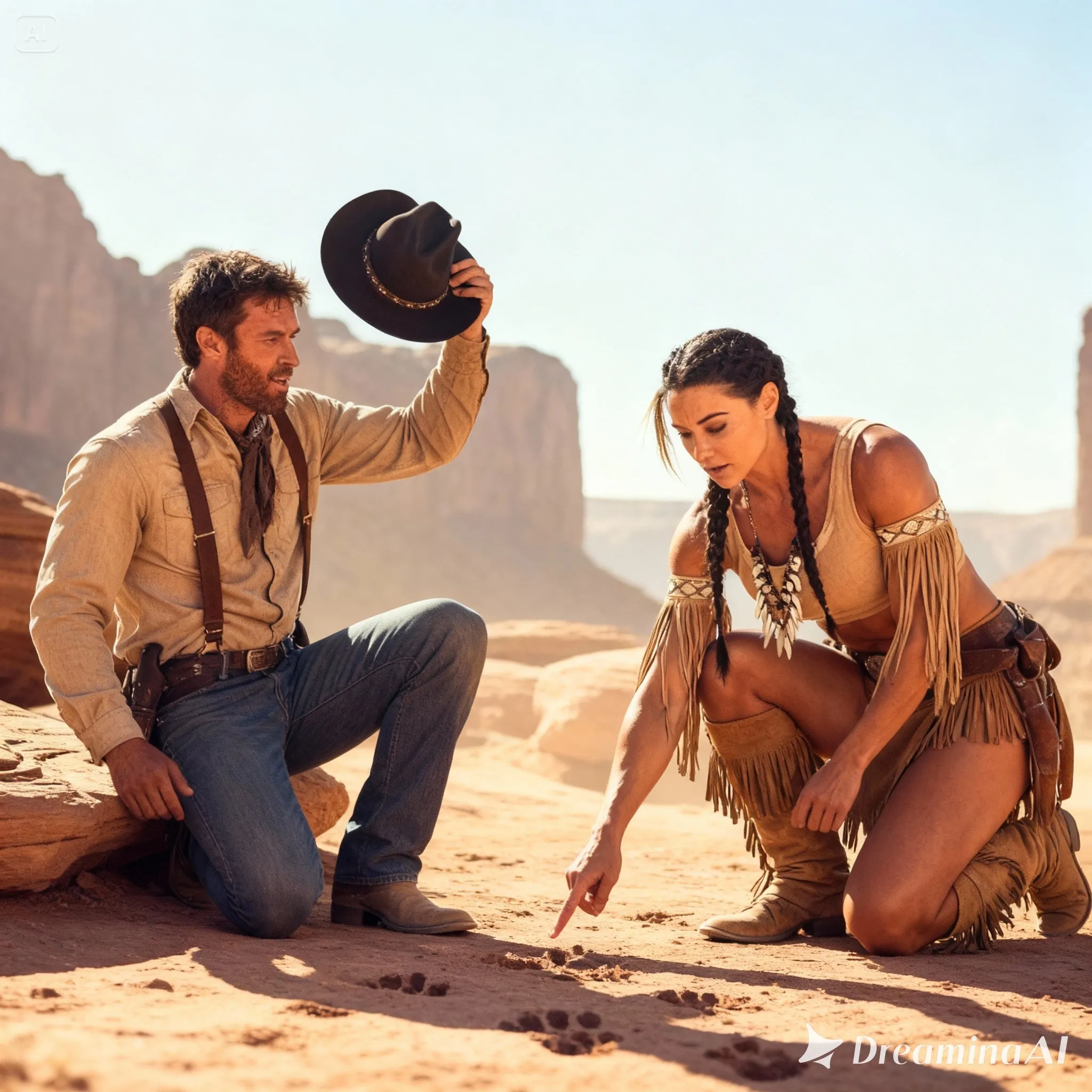
He woke to a shadow that was not made by clouds. A woman stood over him, tall as a cliff and twice as steady. Her braids carried bone beads that clicked when she moved, and her eyes looked awake in a way that made the desert feel suddenly small. “You should be dead,” she said in an accent that rolled the words like river stones. Elias tried to answer, but only dust came out. She lifted him as easily as a sleeping child and started walking, the horizon staying politely behind her.
When he next opened his eyes he smelled smoke, meat, and sage. Willow lodges sat in a hidden bowl of rock, their doors painted with symbols that looked older than pain. Children paused mid-game to stare; a few women nodded, but quiet stayed on their faces. The woman who had carried him—Naali, he would learn—laid him on soft blankets and fed him water one drop at a time until his heart remembered its own rhythm. Days slipped by in a haze of broth, cool paste on burned skin, and low voices speaking a tongue that felt like wind through grass. He slept, woke, and slept again, each time waking a little more inside his own skin.
On the seventh evening he climbed a short ridge with Naali. The camp looked tiny below, a single bright stitch on a vast brown cloak. She told him how her people had once covered the land like stars, and how soldiers, cattlemen, and broken promises had reduced them to this small bright knot. She spoke of daughters who would carry no children if nothing changed, of stories that would die when her own mouth stopped telling them. Then she placed her broad hand on his chest and offered him a place—not as guest, not as prisoner, but as root. “Stand beside me,” she said. “Let the desert’s answer be children who will still laugh here when we are only smoke.”
Elias felt the weight of it settle inside the hollow the sun had burned dry. He saw versions of himself he had never met: a man teaching a boy to notch an arrow, a man singing some half-remembered lullaby while stars wheeled above, a man whose name mattered because it was stitched into other names. Fear tapped his ribs, but beside it rose a softer, fiercer feeling he had almost forgotten.
He took Naali’s hand, rough and warm, and felt the ground steady under his boots for the first time in all his wandering years. The desert had stripped him down to bone so something new could grow. He agreed to stay, to learn, to become more than a man who simply kept breathing. Below them the cook-fires crackled, children chased the blue smoke, and the first stars stepped out as if they had been waiting for this exact moment to shine on a future that suddenly seemed possible.